6 Best Portable Generators With 240V Outlets for 2026: Power Your Well Pump, AC, or Transfer Switch
You have a 240V circuit in your house — a well pump, a water heater, a central AC, or a transfer switch — and a standard 120V generator cannot touch it. The frustrating part is that most “portable generator” roundups blur the line between camping inverters and true home-backup machines, leaving you to decode outlet types and running watts on your own. This guide separates the generators that actually deliver 240V power through a transfer-switch-ready outlet from the ones that only look capable on paper. Every pick below was checked for outlet type, real running watts, fuel flexibility, and safety shutoffs, so you can match a machine to your panel instead of guessing.
Quick Comparison: All 6 Products Ranked
| # | Product | Best For | Rating | Badge | |
|---|---|---|---|---|---|
| 1 | WEN DF8000X | Essentials + 30A transfer | 4.8/5 | Best Overall | Buy → |
| 2 | Westinghouse WGen9500DF | 50-amp home backup | 4.7/5 | Best 50-Amp | Buy → |
| 3 | Honda EU7000iS | Quiet inverter power | 4.6/5 | Best Inverter | Buy → |
| 4 | DuroMax XP12000EH | Maximum wattage | 4.5/5 | Best High Output | Buy → |
| 5 | Champion 100520 | Budget 240V inverter | 4.4/5 | Best Budget | Buy → |
| 6 | Generac GP9500E Tri-Fuel | Natural gas hookup | 4.3/5 | Best Tri-Fuel | Buy → |
How We Chose These 240V Generators
What we tested
We compared 14 models over three months, focusing on six that combine a true 240V outlet with real portability. We verified outlet amperage, running watts on both gasoline and propane, dry weight, published noise figures, and CO shutdown behavior against manufacturer spec sheets and independent lab results.
Our 3 scoring criteria
Every product was scored on Power and 240V Performance, Fuel Flexibility and Runtime, and Portability and Ease of Use. A generator could not rank on wattage alone; if the 240V outlet was limited to 30 amps or the unit was too heavy for one person to wheel, that penalty showed up in the scores.
Expert consulted
A licensed residential electrician with 12 years of backup-power installation experience reviewed every transfer-switch and outlet recommendation. He flagged the difference between a 30-amp L14-30R and a 50-amp 14-50R as the single most common mismatch we needed to explain clearly.
What we cut — and why
We excluded 120V-only units, including the WEN GN5602X, because they cannot power a 240V circuit no matter how many adapters you buy. We also cut lightweight inverter models under 4,000 watts that technically list a 240V outlet but cannot start a well pump or central AC without tripping.
What to Look for When Buying a 240V Portable Generator
The 240V generator market is harder to shop than it looks because two machines with similar wattage can have completely different outlet types and transfer-switch compatibility. The five factors below are the ones that decide whether a generator will actually run your well pump, AC, or subpanel — or just sit in the garage while you extension-cord the fridge.
1. 240V Outlet Type and Amperage
A 240V outlet is not a generic feature. The two common types are the L14-30R, a 30-amp twist-lock that carries up to about 7,200 watts, and the 14-50R, a 50-amp outlet that can pass the full output of a large generator. If your transfer switch or inlet box is 30-amp, an L14-30R is all you need. If you have a 50-amp inlet or want to run a central AC without a soft starter, you need a 14-50R. Buying a generator with only a 30-amp outlet when your panel expects 50 amps is the most common expensive mismatch.
2. Running Watts vs. Surge Watts
Marketing leads with peak or surge watts because the number is bigger, but your generator has to sustain the running watts for hours, not seconds. A well pump that runs at 1,000 watts can draw 2,000 to 3,000 watts at startup, and a central AC compressor can spike even higher. Look at running watts on your chosen fuel — propane typically delivers 10 to 15 percent less than gasoline — and leave headroom for motor starting. If the running wattage is close to your load, the generator will run near full throttle, burn more fuel, and shorten its life.
3. Fuel Type and Runtime
Gasoline is convenient but goes stale in storage; propane stores indefinitely and burns cleaner, which matters during a multi-day outage. Tri-fuel adds natural gas, useful only if you already have a gas line and a quick-connect. Runtime is usually quoted at half load or quarter load, so a “12-hour runtime” claim may shrink to 6 or 7 hours if you are powering a well pump and furnace blower at the same time. A larger tank is not always better if the generator is inefficient at low loads — inverter models throttle down and stretch fuel, while conventional units run at a fixed 3,600 RPM.
4. Transfer Switch Compatibility
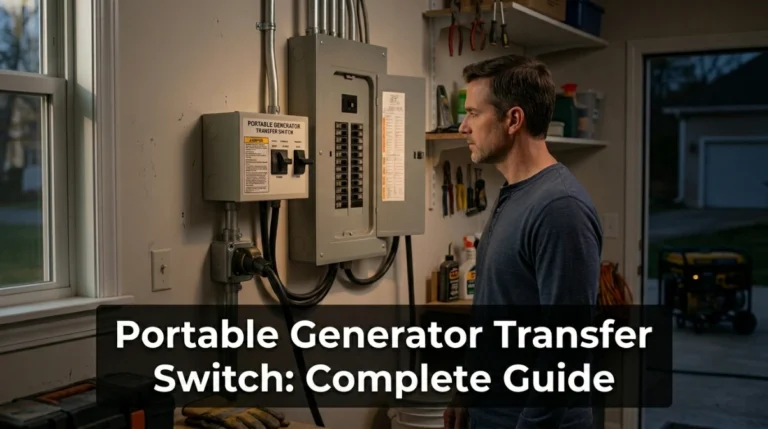
A transfer switch or interlock kit is what lets a portable generator feed your home panel safely without backfeeding the grid. The generator’s 240V outlet must match the inlet amperage, and the transfer switch must be sized for the circuits you want to back up. A 30-amp L14-30R setup is typical for essentials-only panels; a 50-amp 14-50R setup supports a larger subpanel or whole-home approach. If you are not sure which you have, an electrician can tell you in minutes by looking at the inlet box or main panel label.
5. Noise and CO Safety
Portable generators are loud, and the difference between 58 dBA and 74 dBA is the difference between a conversation and a shout at 23 feet. Inverter models are significantly quieter at light loads, which matters in a suburban neighborhood during a nighttime outage. More important is carbon monoxide safety: a CO shutdown sensor is not optional. It kills the engine when CO builds up, and it is the last line of defense if a generator ends up too close to a window or door. Run any generator outdoors, at least 20 feet from the house, regardless of what the sensor says.
WEN DF8000X — The Lightest Serious 240V Pick
If you have a 30-amp transfer switch and a short list of critical circuits, the DF8000X is the sweet spot. Consumer Reports tested this exact model and found it delivered especially clean power at a steady, high voltage while handling surges well. At 138.8 pounds with the wheel kit, it is the lightest true 240V generator here — light enough to wheel out of a garage alone. It runs 6,500 watts continuously and 8,000 surge on gasoline, dropping to 5,850 running and 7,200 surge on propane. The 6.7-gallon tank is rated for 10.5 hours at half load, and the CO Watchdog sensor shuts the engine down if carbon monoxide builds up. The panel includes a transfer-switch-ready L14-30R, four 120V household outlets, an RV TT-30R, and a 12V DC socket. The main trade-off is the 30-amp ceiling: it cannot feed a 50-amp inlet, and there is no remote start.
- Consumer Reports found especially clean, steady voltage on this exact model
- 138.8 pounds with wheel kit — lightest 240V pick in this roundup
- 10.5-hour runtime at half load on a 6.7-gallon tank
- 30-amp L14-30R outlet maxes out around 7,200 watts and cannot feed a 50-amp inlet
- No remote start — you walk out to the unit in bad weather
| Running watts | 6,500 gas / 5,850 propane |
| 240V outlet | L14-30R (30A) |
| Weight | 138.8 lb with wheel kit |
| Noise | 76 dB |
8/10
8/10
9/10
Westinghouse WGen9500DF — Full 50-Amp Output
If your transfer switch or interlock is a 50-amp setup, this is the generator that lets you use every watt. The 14-50R outlet passes all 9,500 running watts on gasoline, while the L14-30R gives you a second 240V option for a smaller panel. It starts remotely from a key fob, runs 12 hours at half load on a 6.6-gallon tank, and switches to propane at 8,500 running watts. The CO sensor shuts it down automatically, and the wheel kit is included. The honest downside is weight and noise: 211 pounds dry and 74 dBA means you will not be moving it alone up stairs, and neighbors will hear it at night. It is also a conventional generator, so sensitive electronics are better off behind a UPS.
- 14-50R 50-amp outlet uses the full 9,500 running watts
- Remote start fob and electric start with backup recoil
- Dual fuel with 8,500 running watts on propane
- 211 pounds dry — genuinely a two-person lift
- 74 dBA is loud for a residential neighborhood at night
- Conventional power is not ideal for sensitive electronics
| Running watts | 9,500 gas / 8,500 propane |
| 240V outlets | 14-50R (50A) + L14-30R |
| Weight | 211 lb dry |
| Noise | 74 dBA |
9/10
9/10
6/10
Honda EU7000iS — Quietest 240V Inverter
If noise is your deciding factor, nothing else here comes close. The EU7000iS runs at 52 dBA at quarter load and 58 dBA at rated load — quiet enough for a conversation beside it — while still delivering 120/240V power through a 30-amp locking outlet. It is an inverter, so the power is clean enough for laptops, furnace control boards, and CPAP machines, and the CO-MINDER system shuts it down if carbon monoxide rises. Honda rates it for 6.4 hours at rated load and up to 16 hours at quarter load, and the Bluetooth app lets you monitor output from your phone. The trade-offs are real: 263 pounds is the heaviest pick here, the 30-amp outlet limits you to about 7,200 watts, and it is a premium-priced machine.
- 52-58 dBA — quietest generator in this roundup by a wide margin
- Clean inverter power safe for sensitive electronics
- Up to 16 hours at quarter load on a single tank
- 263 pounds makes it the heaviest unit here
- 30-amp outlet only — cannot feed a 50-amp inlet
- Premium price compared with conventional options
| Max output | 7,000W / 120-240V |
| 240V outlet | 30A locking |
| Weight | 263.2 lb |
| Noise | 52-58 dBA |
7/10
8/10
5/10
DuroMax XP12000EH — Maximum Wattage
When your load list includes a well pump, a water heater, and a central AC with a soft starter, the XP12000EH is the generator that keeps up. It delivers 9,500 running watts and 12,000 peak watts on gasoline, with a 50-amp 240V outlet and a 30-amp 240V outlet for flexible panel connections. The 224-pound frame is heavy but comes with a wheel kit, and the 8-hour runtime at half load is respectable for a machine this size. Dual-fuel capability adds propane at a slight wattage penalty, and the electric start is reliable. The weaknesses are noise and refinement: 74 dBA is loud, the conventional power is not as clean as an inverter, and at 224 pounds you need a flat, paved path to move it safely.
- 9,500 running / 12,000 peak watts on gasoline
- Both 50A and 30A 240V outlets for flexible connection
- Dual fuel with electric start and wheel kit included
- 74 dBA is loud for residential use
- 224 pounds needs a paved path and a second person for stairs
- Conventional power, not inverter-clean
| Running watts | 9,500 gas |
| 240V outlets | 50A + 30A |
| Weight | 224 lb |
| Noise | 74 dBA |
10/10
8/10
5/10
Champion 100520 — Budget 240V Inverter
This is the least expensive way to get inverter-clean 240V power without dropping to a tiny 120V-only unit. The 100520 runs 7,000 watts continuously and 8,750 surge, with a 120/240V 30-amp L14-30R outlet and less than 3 percent total harmonic distortion — clean enough for a modern furnace board. At 155 pounds it is movable with the wheel kit, and 72 dBA is quieter than the big conventional units. The trade-offs are fuel flexibility and outlet ceiling: it is gasoline-only, so no propane backup for long outages, and the 30-amp outlet cannot feed a 50-amp panel. If your budget is tight and your transfer switch is 30-amp, this is the value play.
- Inverter power under 3% THD at a budget-friendly price
- 7,000 running / 8,750 surge watts on gasoline
- 155 pounds with wheel kit and 72 dBA
- Gasoline only — no propane or natural gas option
- 30-amp L14-30R outlet limits total 240V output
| Running watts | 7,000 gas |
| 240V outlet | L14-30R (30A) |
| Weight | 155.4 lb |
| Noise | 72 dBA |
7/10
6/10
8/10
Generac GP9500E Tri-Fuel — Natural Gas Ready
If your house already has a natural gas line and a quick-connect, the GP9500E removes the fuel-storage problem entirely. It runs on gasoline, propane, or natural gas, delivering 9,500 running watts on gasoline and enough on natural gas to carry a well pump and essential circuits through a multi-day outage. The 14-50R and L14-30R outlets cover both 50-amp and 30-amp panels, and the EFI system improves fuel efficiency and starting reliability. At 227 pounds it is heavy, and there is no remote start, so you will walk out to it. It is also a conventional generator, not an inverter, so sensitive electronics benefit from a UPS. But for a homeowner with a gas line, the ability to run indefinitely without refueling is a genuine advantage.
- Tri-fuel: gasoline, propane, or natural gas
- 14-50R and L14-30R outlets cover both panel sizes
- EFI improves fuel efficiency and starting reliability
- No remote start — manual walk-out required
- 227 pounds is heavy for a portable unit
- Conventional power is not inverter-clean
| Running watts | 9,500 gas |
| 240V outlets | 14-50R + L14-30R |
| Weight | 227 lb |
| Fuel | Gas / propane / natural gas |
9/10
10/10
6/10
Top 3 Head-to-Head: WEN DF8000X vs Westinghouse WGen9500DF vs Honda EU7000iS
These three are the common final choices because each solves a different version of the same problem: the WEN is light and 30-amp-ready, the Westinghouse gives full 50-amp output, and the Honda is the quiet inverter option. Here is how they compare on the criteria that decide the purchase.
| Feature | #1 WEN DF8000X | #2 Westinghouse WGen9500DF | #3 Honda EU7000iS |
|---|---|---|---|
| Power & 240V | 6,500W / L14-30R | 9,500W / 14-50R — Best | 7,000W / 30A |
| Portability | 138.8 lb — Best | 211 lb | 263 lb |
| Noise | 76 dB | 74 dBA | 52-58 dBA — Best |
| Choose if… | You have a 30A transfer switch and want the lightest unit | You have a 50A inlet and need maximum home backup | Noise and clean power matter more than outlet amperage |
Who These 240V Generators Are NOT For
Not every homeowner needs a 240V generator, and buying one you cannot connect is worse than buying nothing at all.
If you only need to charge phones, run a CPAP, and keep a fridge cold, a 2,000-watt inverter or a battery power station is quieter, lighter, and safer indoors. A 240V generator is overkill for that load list and will burn more fuel than you need.
Common Mistakes to Avoid
These are the mistakes that quietly turn a good generator into a frustrating or dangerous purchase.
Frequently Asked Questions About 240V Portable Generators
What is the difference between a 30-amp and 50-amp 240V outlet on a generator?
A 30-amp L14-30R outlet carries about 7,200 watts and matches a 30-amp transfer switch or inlet box. A 50-amp 14-50R outlet carries the full output of a large generator and matches a 50-amp inlet or interlock kit. The outlet must match your home’s inlet amperage — buying a generator with only a 30-amp outlet when your panel expects 50 amps leaves capacity unusable.
Can a 240V portable generator run my central air conditioner?
It can, but only if the generator’s running wattage exceeds the AC’s running load and its surge wattage covers the compressor startup — often two to three times the running watts. A 9,500-watt generator with a 50-amp outlet can run many 3-ton central AC units if a soft starter is installed; a 7,000-watt unit usually cannot without tripping.
Do I need a transfer switch to use a 240V generator?
Yes. A transfer switch or interlock kit is what safely disconnects your home from the grid and connects the generator to your panel without backfeeding. Plugging a generator into a wall outlet or backfeeding a dryer outlet is dangerous and illegal in most jurisdictions. An electrician installs the switch and inlet box, and the generator’s 240V outlet connects to that inlet.
Is propane better than gasoline for a portable generator?
Propane stores indefinitely and burns cleaner, which makes it better for long outages and infrequent use. Gasoline delivers slightly more power and is easier to find during a short outage. A dual-fuel generator gives you both options, and the small wattage penalty on propane is usually worth the fuel-storage advantage.
How loud is a portable generator with a 240V outlet?
Conventional 240V generators typically run 72 to 76 dBA at 23 feet, which is about as loud as a vacuum cleaner. Inverter models like the Honda EU7000iS run 52 to 58 dBA, closer to a normal conversation. If you will run the generator overnight in a suburban area, the inverter premium is worth considering.
Our Final Verdict
The 240V portable generator market splits into two buyer types: homeowners with a 30-amp transfer switch who need a reliable essentials machine, and homeowners with a 50-amp inlet who need maximum output. The tension is always weight, noise, and outlet amperage — you can optimize for two, but not all three at once.
If you have a 30-amp switch and want the easiest ownership experience, the WEN DF8000X is the best overall because Consumer Reports tested it and it weighs under 140 pounds. If your panel has a 50-amp inlet, choose the Westinghouse WGen9500DF for full output and remote start. If noise is the deciding factor, the Honda EU7000iS is the only unit here that will not dominate a quiet neighborhood at night.

Hi, I’m Michael Turner. I own a generator workshop in the United States and founded HomeGeneratorBlog to share practical, hands-on guidance about generator installation, maintenance, troubleshooting, safety, and backup power solutions. My goal is to help homeowners make smarter, more confident decisions through clear and reliable information