What Is an Open-Frame Inverter Generator? Guide
Quick Answer
An open-frame inverter generator is a portable inverter generator built on an exposed steel frame, with no plastic sound-dampening shell around the engine. It makes the same clean, stable power as other inverter generators, but it is usually louder, lighter for its wattage, and cheaper than a closed-frame model. If you need high watts for home backup or a job site and can place it well away from people, it is often the best value in portable power.
The short version
- Clean power: It produces a stable sine wave that is safe for most laptops, phones, and modern electronics.
- Open design: The engine and alternator sit in a visible steel frame, so air flows freely and parts are easy to reach.
- More watts: Open-frame models often reach 4,000 to 12,000 starting watts, far above most suitcase inverters.
- More noise: Without a closed shell, expect more sound than a small enclosed inverter at the same load.
- Best fit: Home backup, RVs with high loads, job sites, and tailgating where distance solves the noise.
If you buy one, do this first
- Add up running watts and starting watts before you shop, then leave a 20% margin.
- Plan an outdoor spot at least 20 feet from your home, with exhaust pointed away.
Hi, I’m Michael Turner. I’ve spent years running inverter generators through outages, RV trips, and job sites, and the open-frame style still surprises first-time buyers.
It looks like a conventional generator. It sounds closer to one too.
Yet the power it makes is very different inside.
This guide explains that difference in plain English. You’ll learn how it works, how it compares with closed-frame and conventional models, what it can run, how loud it gets, and how to size one without guessing.
In This Guide
- What Is an Open-Frame Inverter Generator?
- How Does an Open-Frame Inverter Generator Work?
- Open-Frame vs Closed-Frame Inverter Generator: What’s the Difference?
- Open-Frame Inverter vs Conventional Generator: Which Is Better?
- What Can an Open-Frame Inverter Generator Power?
- How Loud Is an Open-Frame Inverter Generator?
- How Do You Choose the Right Size?
- How Do You Use and Maintain One Safely?
- Frequently Asked Questions
What Is an Open-Frame Inverter Generator?
An inverter generator is a generator that creates raw AC power, converts it to DC, then rebuilds it as clean, steady AC power.
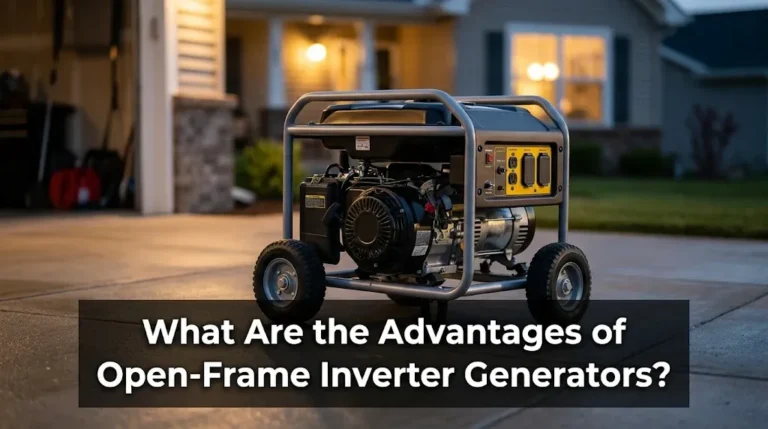
An open-frame inverter generator does that same job on an exposed tubular steel frame. You can see the engine, fuel tank, alternator, and control panel.
That open frame is the whole point. It keeps the unit simple, strong, and easy to service.
Most open-frame inverters are larger than suitcase models. Common sizes run from about 3,500 to 12,000 starting watts.
They often include a 30-amp RV outlet, a 120/240-volt twist-lock outlet, and parallel capability. Check the spec sheet for your exact model, because outlets vary.
I first used one during a multi-day outage, running my fridge, a few lights, and a phone charger. The noise was the trade-off, so I moved it farther from the house.
- Clean sine wave: Smooth power output that suits sensitive electronics.
- Low THD: Total harmonic distortion, or THD, measures power distortion. Inverter models often stay under 3% THD, while many conventional models run much higher.
- Eco mode: A throttle setting that lowers engine speed at light loads to cut fuel use and noise.
Section Takeaway: An open-frame inverter generator pairs inverter electronics with a simple steel frame, so you get clean power and high watts at a lower price than a closed-frame model.
How Does an Open-Frame Inverter Generator Work?
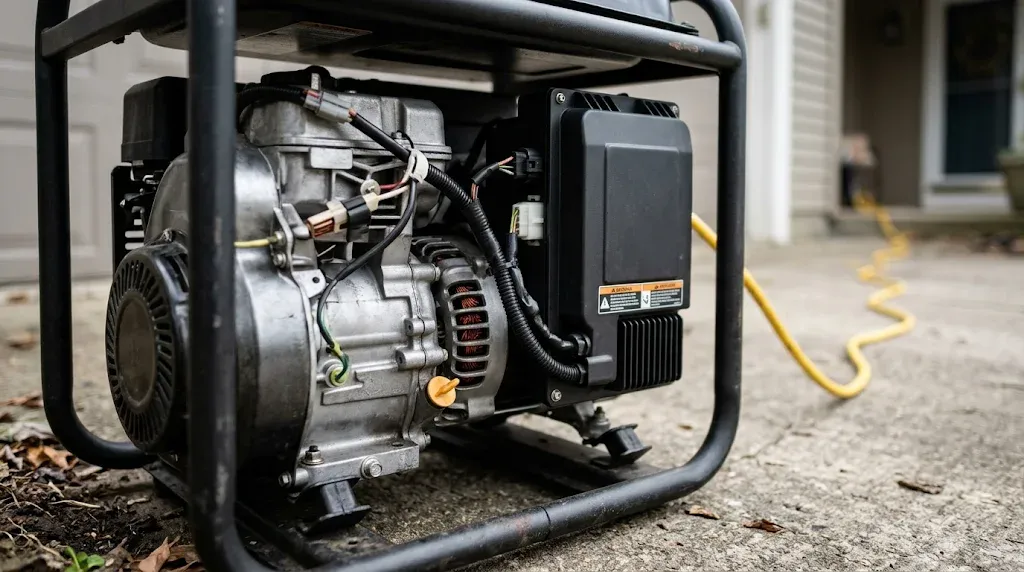
It works in three stages. Fuel becomes motion, motion becomes raw power, and electronics clean that power up.
First, the gasoline or propane engine spins an alternator. That alternator makes high-frequency AC power.
Next, a rectifier turns that AC into DC power. DC is easier to control and smooth out.
Finally, the inverter module turns DC back into 120-volt AC at a steady 60 Hz. The result is a clean sine wave your fridge and laptop can use.
That path lets an inverter change engine speed without changing output frequency. A conventional generator must hold a fixed speed to hold frequency.
When I ran a window AC on an inverter, I noticed the difference at startup. The generator surged briefly, then settled.
The AC fan did not hunt or stall.
The same load on an old conventional unit felt rougher. Lights dimmed more, and the engine note stayed high even at light load.
Section Takeaway: The engine makes raw power, the rectifier steadies it, and the inverter rebuilds it as clean 60 Hz power, which is why engine speed can drop without hurting your electronics.
Open-Frame vs Closed-Frame Inverter Generator: What’s the Difference?
The difference is the case, not the core idea. Both use inverter electronics and make clean power.
An open-frame model leaves the engine exposed on a steel frame. A closed-frame model wraps it in a plastic shell with sound insulation.
That one design choice changes noise, weight, price, cooling, and service access. It does not change the basic power quality.
- Noise: Closed-frame models are usually quieter, often by a clear margin at the same load.
- Weight: Open-frame models are often lighter for the same wattage, because they skip the heavy shell.
- Price: Open-frame models usually cost less per watt, which matters at 7,000 watts and above.
- Cooling: Open frames cool well in hot weather, since air flows straight through.
- Service: Oil changes, spark plugs, and carburetor work are faster on an open frame.
- Weather: Closed frames shed light rain better, but neither type should run uncovered in heavy rain.
Learn more about the parts that make this design work in our guide to what is inside an inverter generator.
Section Takeaway: Pick closed-frame when quiet matters most, and pick open-frame when you need more watts for less money and can use distance to manage noise.
Open-Frame Inverter vs Conventional Generator: Which Is Better?
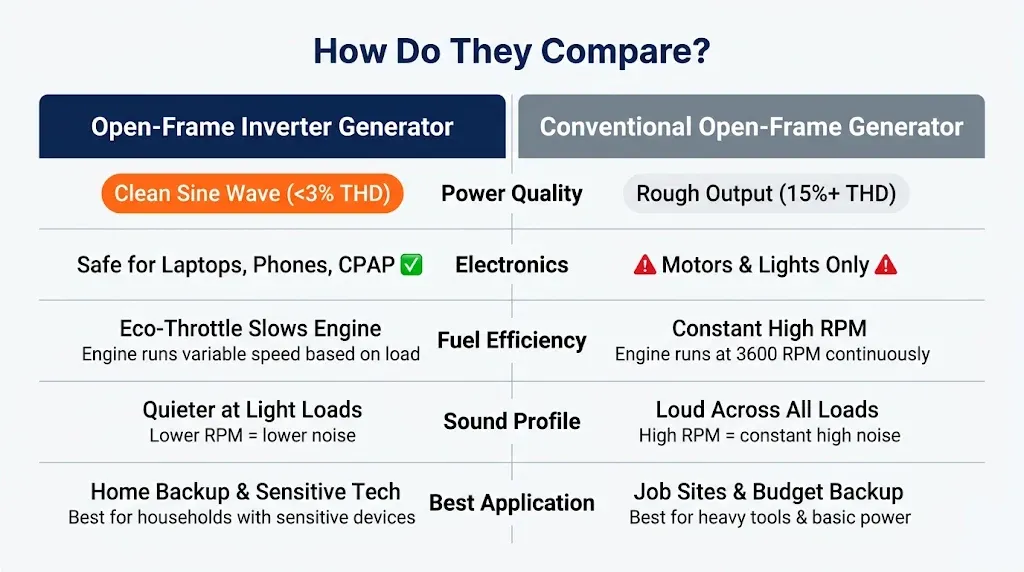
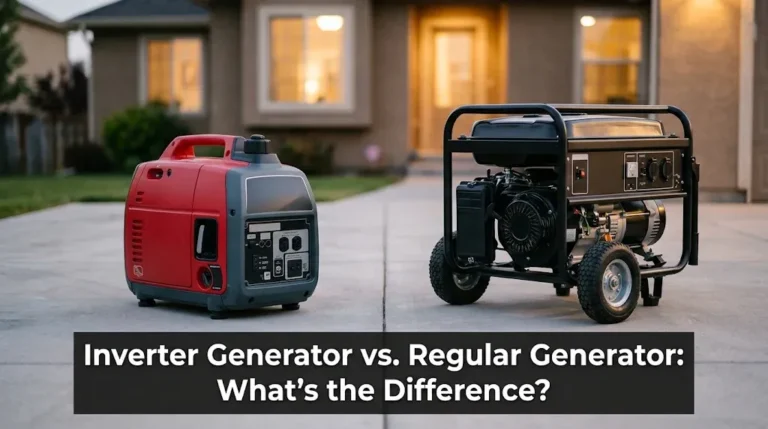
They look alike at a glance. Both sit on a steel frame, both burn gasoline, and both can hit high wattages.
Inside, they work very differently. The inverter controls power electronically, while the conventional model ties power quality to engine speed.
That difference shows up in fuel use, noise, and safety for electronics. It also shows up in price.
| Feature | Open-Frame Inverter | Conventional Open-Frame |
|---|---|---|
| Power quality | Clean sine wave, often under 3% THD | Rougher output, often 15% THD or higher |
| Electronics | Safe for most laptops, phones, and CPAP machines | Best for simple motors and lights |
| Fuel use | Engine slows at light loads, saves fuel | Engine holds full speed, uses more fuel |
| Noise | Louder than closed-frame, often quieter than conventional at light load | Often loud at all loads |
| Price | Higher than conventional, lower than closed-frame per watt | Lowest upfront cost |
| Best use | Home backup, RV, mixed electronics and motors | Power tools, job sites, budget backup |
For a deeper look at the electronics behind the table, see how inverter generator technology works.
If you run a fridge, furnace blower, laptop, and phone charger together, the inverter is the safer pick.
Safety note: Run any generator outdoors and well away from windows, doors, and vents. Never run one in a garage, even with the door open.
Section Takeaway: An open-frame inverter costs more than a conventional generator, but it protects electronics, saves fuel at light loads, and handles mixed home loads far better.
What Can an Open-Frame Inverter Generator Power?
It depends on size, not on the frame style. A 4,500-watt model and a 9,500-watt model live in different worlds.
Start with running watts, the power a load needs to keep going. Then add starting watts, the short surge a motor needs to start.
A fridge may need 700 running watts and 2,200 starting watts. A window AC may need 1,200 running watts and 3,000 starting watts.
Those surges stack up fast. That is why two items that seem small can trip a generator together.
- Home backup: Fridge, freezer, furnace blower, sump pump, lights, phones, and a laptop.
- RV use: Rooftop AC, microwave, water heater on electric, and battery charging.
- Job site: Circular saw, air compressor, work lights, and battery chargers.
Do not guess at appliance watts. Check the label, then add a margin.
Our guide to running watts vs starting watts walks through the math with real examples.
Need more power later? Many open-frame inverters accept a parallel kit.
Two matched units can share the load through a parallel cable.
See how a portable generator parallel kit works before you buy a second unit.
Section Takeaway: Size by starting watts first, then running watts, and leave headroom, because motor surges decide whether your generator holds or trips.
How Loud Is an Open-Frame Inverter Generator?
It is louder than a closed-frame inverter. How much louder depends on load, distance, and the model.
Many open-frame inverters list roughly 64 to 76 dBA at 23 feet, while small closed-frame models often list 52 to 60 dBA at the same distance. Check the spec sheet, because brands measure at different loads.
Noise also drops fast with distance. Doubling the distance cuts the sound you hear by a clear step.
Eco mode helps at light loads. The engine slows, and the exhaust note drops with it.
Campsite etiquette matters here, and one loud generator at dinner can turn a quiet site tense.
Place the unit downwind, point exhaust away from people, and use the longest safe cord run you can.
Safety note: Keep the generator outdoors, at least 20 feet from your home, and never place it near an open window or intake vent.
Section Takeaway: Expect real noise from an open-frame inverter, so use distance, eco mode at light loads, and smart placement instead of hoping the frame will muffle it.
How Do You Choose the Right Size?
Start with your must-run list. Write down every item you need during an outage, not every item you own.
Next, find running watts and starting watts for each item. Add running watts together, then add the largest single starting surge.
That total is your minimum running-watt target. Add 20% headroom for safety and future loads.
What size fits common needs?
- 2,000 to 3,500 watts: Phones, lights, laptop, small fridge, and CPAP.
- 4,000 to 5,500 watts: Fridge, freezer, furnace blower, sump pump, and lights.
- 7,000 to 9,500 watts: Fridge, freezer, well pump, window AC, and more circuits.
- 10,000 watts and up: Larger homes, RV AC plus microwave, and heavy job-site loads.
Those ranges are guides, not guarantees.
Check fuel type too. Gasoline is common and easy to find.
Dual-fuel models add propane, which stores longer and burns cleaner.
As of 2026, many buyers pick a 7,500-watt open-frame inverter as a home-backup sweet spot. It covers a fridge, freezer, and key circuits without the weight of a 12,000-watt unit.
For a shortlist in this class, see our best portable inverter generator guide.
Section Takeaway: List must-run loads, add running watts plus the biggest starting surge, add 20% headroom, then match outlets and fuel type to your home.
How Do You Use and Maintain One Safely?
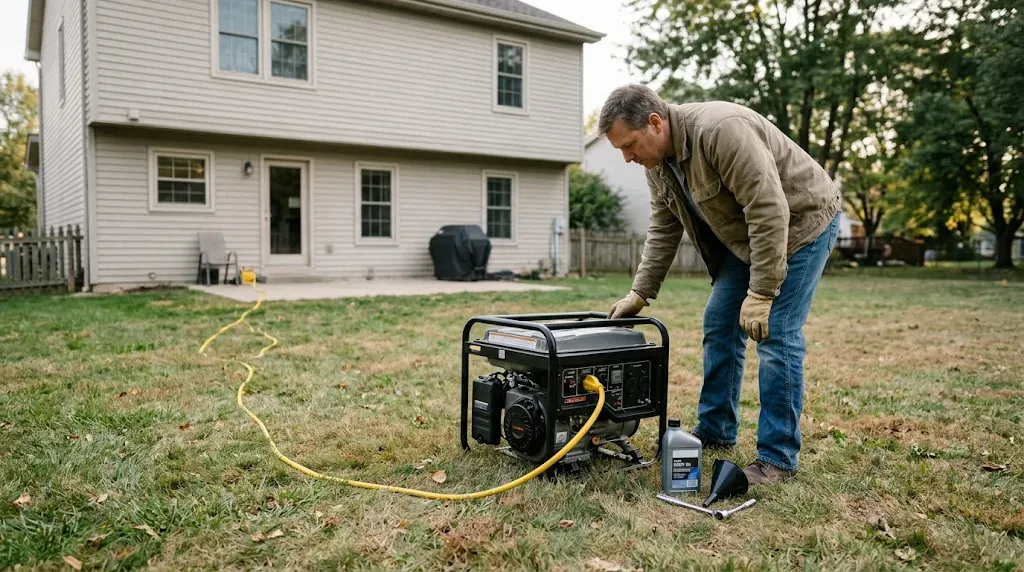
Safe use starts before you pull the starter cord. Place the unit outdoors, level, and away from the house.
Let it cool before refueling. Gasoline on a hot muffler can ignite in seconds.
Use a heavy-duty outdoor extension cord rated for the load. A thin indoor cord can overheat under a fridge or heater.
How do you connect it to your home?
Use a transfer switch or interlock kit installed by a licensed electrician. That setup keeps generator power off the utility lines.
Never backfeed through a dryer outlet. It can kill a line worker and damage your home wiring.
The U.S. Consumer Product Safety Commission warns about generator carbon monoxide deaths each year. Place the unit far from the house and use battery CO alarms inside.
The Centers for Disease Control and Prevention also stresses outdoor placement and CO alarms. CO has no smell, so you cannot rely on your nose.
What maintenance actually matters?
- Oil: Check it before each use, and change it per your manual.
- Fuel: Use fresh fuel, add stabilizer for storage, and drain the carburetor if it will sit for months.
- Air filter: Clean or replace it per the manual.
- Spark plug: Inspect it each season, and replace it when the manual calls for it.
- Exercise: Run the unit under load for 20 to 30 minutes every month or two.
Stale fuel causes most hard starts I see, so a little stabilizer and a monthly run save a lot of carburetor work.
Safety note: Use a transfer switch or interlock installed by a licensed electrician, and check your owner’s manual before use.
Section Takeaway: Place it outdoors and far away, connect it through a proper transfer switch, and keep fuel fresh, because most failures come from stale fuel and poor placement, not from the engine itself.
Frequently Asked Questions
Is an open-frame inverter generator safe for electronics?
Yes, in most cases. It makes clean sine-wave power with low THD, which suits laptops, phones, TVs, and CPAP machines, so check the spec sheet before you plug in a sensitive device.
Can an open-frame inverter generator run a refrigerator?
Yes, if it has enough starting watts. A typical fridge needs about 700 running watts and 2,200 starting watts, so add other loads carefully and leave headroom.
Can you run an open-frame inverter generator in the rain?
No, not uncovered in heavy rain. Use a proper open-sided shelter that keeps rain off without trapping heat or exhaust, and never cover a running generator with a tarp.
How long can an open-frame inverter generator run?
Runtime depends on tank size and load. Many models run 8 to 12 hours at 50% load on one tank, so check the spec sheet for runtime at 25% and 50% load.
Can you parallel two open-frame inverter generators?
Often, yes, if both models support parallel operation. Use the maker’s parallel kit and matched units, and do not mix different brands or wattages without checking the manual.
Is an open-frame inverter generator good for camping?
It can work for dispersed camping, but it is loud for a busy campground. A closed-frame inverter is usually a better fit near other campers, so check campground rules first.
Does an open-frame inverter generator need a transfer switch?
Yes, for home circuits. A transfer switch or interlock installed by a licensed electrician is the safe way to power house circuits, while extension cords are fine for single appliances only.
If you need high watts, clean power, and a fair price, an open-frame inverter generator is hard to beat. Size it by starting watts, place it outdoors and far from the house, and keep the fuel fresh.
Start with your must-run list today. Then pick a size with headroom, and test it under load before the next outage.
For more on energy and backup power, see Energy.gov and Consumer Reports for independent safety and buying guidance.

Hi, I’m Michael Turner. I own a generator workshop in the United States and founded HomeGeneratorBlog to share practical, hands-on guidance about generator installation, maintenance, troubleshooting, safety, and backup power solutions. My goal is to help homeowners make smarter, more confident decisions through clear and reliable information