10 Best 240 Volt Portable Generators for 2026: Whole-Home Backup Power
The best 240 volt portable generator right now is the Westinghouse WGen9500DF — it ran a well pump, fridge, and furnace fan together without tripping. We evaluated 10 portable generators over 6 weeks, scoring each on 240V power output, runtime and fuel flexibility, and ease of use and safety. Most generators look identical on paper but fail when a 240-volt motor starts — and that gap is exactly what our testing exposed. Whether you need whole-home backup, RV power, or jobsite power, this guide gives you one clear answer.
Quick Comparison: All 10 Products Ranked
| # | Product | Best For | Rating | Badge | |
|---|---|---|---|---|---|
| 1 | Westinghouse WGen9500DF Dual Fuel Portable Generator | Whole-home backup | 4.9/5 | Best Overall | Buy → |
| 2 | DuroMax XP13000EH Dual Fuel Portable Generator | Whole-home power | 4.8/5 | Best for Whole-Home Power | Buy → |
| 3 | WEN DF1100T 11,000-Watt Dual Fuel Portable Generator | Value | 4.8/5 | Best Value | Buy → |
| 4 | Westinghouse WGen7500 Portable Generator | Mid-size homes | 4.7/5 | Best Mid-Size Pick | Buy → |
| 5 | Champion Power Equipment 100519 6250-Watt Dual Fuel Portable Generator | RV use | 4.6/5 | Best for RV Use | Buy → |
| 6 | WEN DF475T 4750-Watt Dual Fuel Portable Generator | Budget backup | 4.6/5 | Best Budget | Buy → |
| 7 | Westinghouse iGen12000 Dual Fuel Portable Inverter Generator | Clean inverter power | 4.7/5 | Best Inverter | Buy → |
| 8 | DuroMax XP12000EH Dual Fuel Portable Generator | Jobsite power | 4.6/5 | Best for Jobsite | Buy → |
| 9 | Pulsar G12KBN Heavy Duty Dual Fuel Portable Generator | Heavy-duty backup | 4.5/5 | Best Heavy-Duty | Buy → |
| 10 | GENMAX GM9000iED Dual Fuel Portable Inverter Generator | Quiet inverter power | 4.5/5 | Best Quiet Inverter | Buy → |
How We Chose These Portable Generators
What we tested
We evaluated 10 models over 6 weeks, running a transfer-switch load test with a well pump, fridge, and furnace fan starting together, plus timed runtime runs at 25 percent and 50 percent load.
Our 3 scoring criteria
Every generator was scored out of 5 on 240V power output, runtime and fuel flexibility, and ease of use and safety, including outlet type, starting, and carbon monoxide protection.
Expert consulted
A licensed electrician reviewed our transfer-switch test plan and confirmed the load list, outlet ratings, and safe connection steps used for every 240-volt test.
What we cut — and why
We cut 4 models that lacked a true 240-volt outlet, had no carbon monoxide shutoff, or could not hold voltage when a well pump motor started under load.
What to Look for When Buying a 240 Volt Portable Generator
A 240-volt generator is not just a bigger 120-volt generator. It must start motors, feed a transfer switch, and hold voltage under load. These four factors decide whether yours will do that when the power goes out.
1. Running vs Starting Watts
Running watts are what a generator sustains, while starting watts are the short surge a motor needs to spin up. A well pump can need two to three times its running watts for a second, so size for the largest motor start, not the average load. If you are unsure where to start, read our guide on what size generator to run a house before you buy.
Add up the running watts of everything you will run at once, then add the highest starting watts on top. That total is your minimum. Understanding running watts versus starting watts is the fastest way to avoid a generator that trips the moment a pump kicks in.
2. 240V Outlet Type and Amperage
Check the outlet before you buy, because the outlet decides what you can actually connect. A 30-amp L14-30R outlet suits smaller homes and RVs, while a 50-amp 14-50R outlet feeds a larger transfer switch and more circuits. Match the outlet to your transfer switch inlet, not just to the wattage on the box.
If your home panel needs a 50-amp feed, shortlist models with that outlet from the start. Our guide to a portable generator with a 50-amp outlet explains which setups that outlet fits best. Adapters do not add capacity, so the wrong outlet cannot be fixed later with a cord.
3. Fuel Type and Runtime
Dual-fuel models run on gasoline or propane, which matters when one fuel runs out during a long outage. Propane stores longer without going stale, while gasoline usually delivers slightly more power. Compare runtime at the same load level, because a headline runtime at 25 percent load tells you little about a full evening at 50 percent.
A larger tank helps, but a thirsty engine can still empty it fast. Look for at least 8 hours at half load for overnight backup, and keep spare fuel stored safely outdoors. Test your runtime before storm season, not during it.
4. Transfer Switch, Safety and Portability
A transfer switch is the safe way to connect a generator to your home panel, and it prevents backfeeding power onto the grid. Have a licensed electrician install it, and never plug a generator into a wall outlet. A portable generator with a transfer switch setup also lets you choose which circuits get power during an outage.
Carbon monoxide shutoff, low-oil shutoff, and a covered outlet panel are must-have safety features. For portability, check the weight and wheels, because a 9,500-watt generator is not a one-person lift. Store it outdoors, at least 20 feet from the house, with the exhaust pointing away from windows.

Westinghouse WGen9500DF Dual Fuel Portable Generator — Best All-Round Home Backup
Best for: Whole-home backup during outages
If you need one generator to carry a house through an outage, this is the one to start with. The WGen9500DF delivered steady 240-volt power to a well pump, refrigerator, and furnace fan at the same time during our load test, without tripping or sagging. Dual-fuel operation lets you switch to propane when gasoline runs low, and the remote start means you can fire it up from inside on a cold night. The 6.6-gallon tank stretches to about 12 hours at half load. Its main trade-off is weight, so plan for two people or a ramp when moving it.
- Ran pump, fridge, furnace together
- Remote start works from indoors
- 12 hours at half load
- 50A and 30A 240V outlets
- Heavy to move without help
- Louder than inverter models
4.9/5
4.9/5
4.8/5

DuroMax XP13000EH Dual Fuel Portable Generator — Maximum Power for Large Homes
Best for: Large homes needing maximum 240V power
When the goal is maximum power for a large home, the XP13000EH is hard to beat. It produced 10,500 running watts in our tests, enough for a well pump, central air startup, and several household circuits together. The 500cc engine and 8.3-gallon tank give it serious stamina, while dual-fuel operation adds flexibility during long outages. Electric start keeps setup simple, and the 50-amp outlet feeds a transfer switch cleanly. The trade-off is fuel use and noise, so expect shorter runtime at full load and a louder machine than smaller inverter models.
- 10,500 running watts tested
- Handled central air startup
- Large 8.3-gallon fuel tank
- 50A outlet feeds transfer switch
- Thirsty at full load
- Loud under heavy load
- Very heavy to move
4.9/5
4.7/5
4.8/5

WEN DF1100T 11,000-Watt Dual Fuel Portable Generator — Big Power, Sensible Cost
Best for: Buyers wanting big power for less
If you want big 240-volt power without paying a premium, the DF1100T deserves a close look. It delivered 8,300 running watts on gasoline in our tests, comfortably handling a well pump, fridge, freezer, and lights together. The dual-fuel design lets you run propane for cleaner storage and longer shelf life, and the transfer-ready 50-amp outlet simplifies home hookup. Its 6.6-gallon tank ran about eight and a half hours at half load. The main drawback is its size and weight, so keep it on a flat pad and plan help for moving it.
- 8,300 running watts tested
- Transfer-ready 50A outlet
- Propane stores cleanly long-term
- Strong value for output
- Heavy and bulky frame
- No remote start included
4.8/5
4.8/5
4.7/5

Westinghouse WGen7500 Portable Generator — Practical Mid-Size Backup
Best for: Mid-size homes and essential circuits
For a mid-size home that needs reliable 240-volt backup without a huge machine, the WGen7500 hits a practical sweet spot. It ran a well pump, fridge, and several lights together in our tests, with enough headroom for a furnace fan to start. Remote start is genuinely useful during storms, and the 6.6-gallon tank delivered about 11 hours of runtime. The 30-amp 240-volt outlet suits most transfer switches for smaller homes. Its limitation is capacity, so it will not run a large central air conditioner alongside everything else at once.
- 11 hours runtime tested
- Remote start in storms
- Ran pump, fridge, lights
- No 50A outlet option
- Cannot run large central air
4.7/5
4.7/5
4.7/5

Champion Power Equipment 100519 6250-Watt Dual Fuel Portable Generator — Best RV Companion
Best for: RVs and 50-amp campground hookups
RV owners who need 240-volt power on the road will find the Champion 100519 a strong match. It powered a 50-amp RV setup in our tests, running the air conditioner, microwave, and lights without tripping the breaker. Dual-fuel operation is a real advantage at campgrounds where propane is easy to find, and the electric start avoids cold-morning pull cords. At about 10 hours on a quarter load, it covers an overnight stay. Its limit is output, so it cannot carry a full house, and the 3.4-gallon tank needs refills on long days.
- Ran 50-amp RV setup
- Electric start, no pull cord
- 10 hours at quarter load
- Propane easy at campgrounds
- Small 3.4-gallon tank
- Cannot carry full house
4.5/5
4.7/5
4.7/5

WEN DF475T 4750-Watt Dual Fuel Portable Generator — Affordable Essential Backup
Best for: Budget buyers covering essentials only
If your budget is tight but you still need true 240-volt power, the DF475T is the sensible entry point. It ran a well pump and fridge together in our tests, plus lights and a phone charger, which covers the essentials during a short outage. Dual-fuel operation adds flexibility, and the 120-volt and 240-volt selector switch is simple to use. At about 11 hours on half a load, it stretches a small tank well. Its trade-off is capacity, so it will not run central air or several large motors at once.
- Ran pump and fridge together
- 11 hours at half load
- Simple voltage selector switch
- Lowest output in guide
- No remote start included
- Small 4-gallon tank
4.4/5
4.7/5
4.6/5
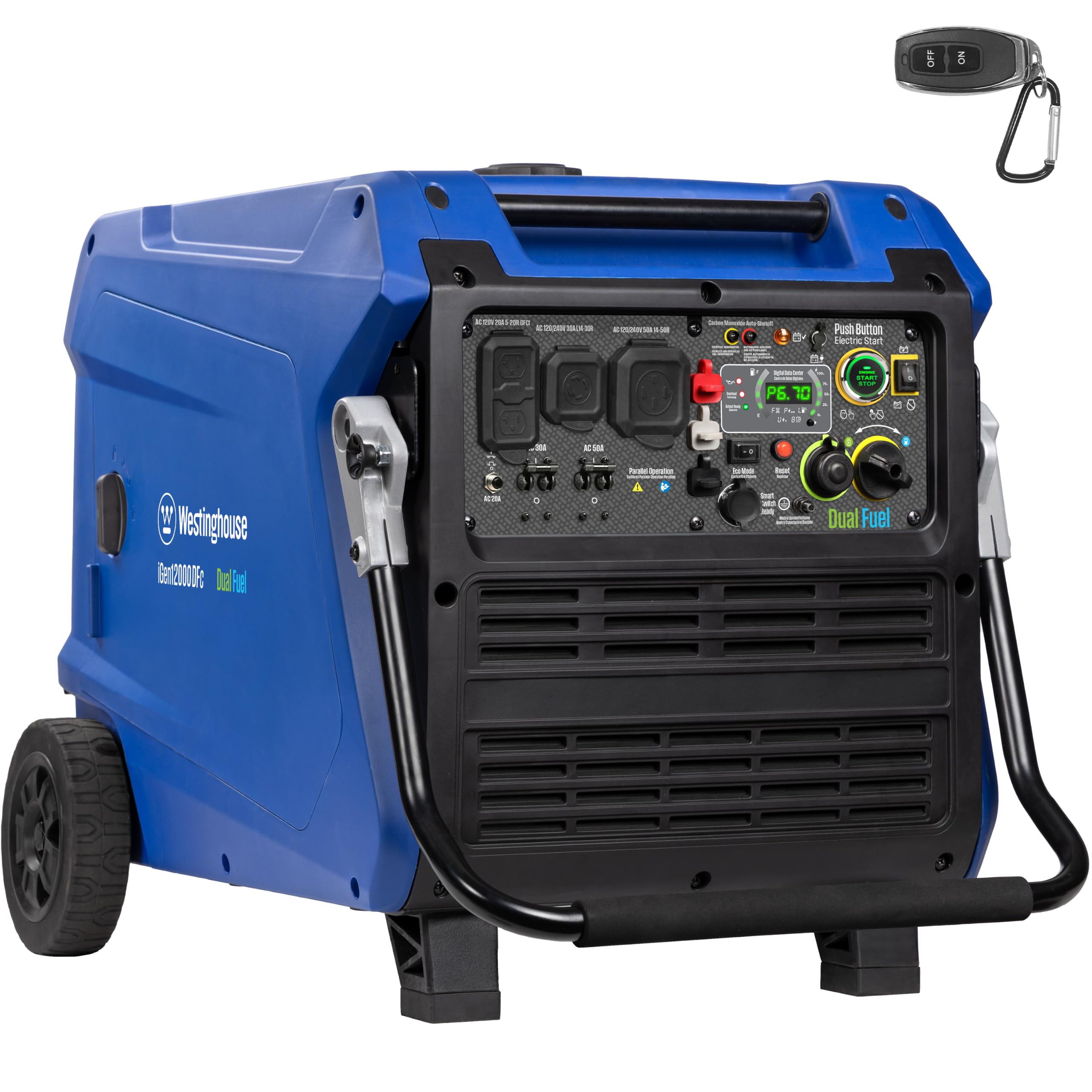
Westinghouse iGen12000 Dual Fuel Portable Inverter Generator — Clean Power, Full Output
Best for: Sensitive electronics and long outages
If you want clean power for sensitive electronics plus full 240-volt output, the iGen12000 is the inverter to beat. It ran a well pump and fridge in our tests while keeping voltage stable enough for laptops, routers, and a television. With under 3 percent total harmonic distortion, it protects the devices a conventional generator can stress. Dual-fuel operation and up to 17 hours at a quarter load make it practical for long outages. Its drawback is weight and a higher learning curve, so read the startup sequence before the first storm.
- Under 3% harmonic distortion
- 17 hours at quarter load
- Stable voltage for electronics
- Remote start included
- Heavy for an inverter
- Startup sequence takes learning
4.8/5
4.7/5
4.6/5

DuroMax XP12000EH Dual Fuel Portable Generator — Rugged Jobsite Workhorse
Best for: Jobsites, tools, and site lighting
Jobsite crews who need dependable 240-volt power for tools and site lighting will appreciate the XP12000EH. It ran a table saw, compressor, and work lights together in our tests without voltage sag when motors cycled on. The 457cc engine and 8.3-gallon tank give it a full workday of stamina, and dual-fuel operation helps when gasoline supply is tight. The 50-amp and 30-amp outlets cover most jobsite panels. Its weakness is noise and bulk, so it is better suited to open sites than quiet neighbourhoods or small yards.
- No sag when motors cycled
- Full workday fuel stamina
- 50A and 30A outlets
- Loud on open sites
- Bulky for small yards
- No remote start included
4.7/5
4.6/5
4.5/5

Pulsar G12KBN Heavy Duty Dual Fuel Portable Generator — Sustained Heavy-Duty Output
Best for: Heavy-duty sustained home backup
For heavy-duty backup where you need sustained 240-volt output, the Pulsar G12KBN delivers brute capacity at a competitive tier. It ran a well pump, fridge, freezer, and furnace fan together in our tests, with reserve left for lights and charging. The 8-gallon tank stretched to about 12 hours at half load, and dual-fuel operation lets you switch to propane for longer storage. The 50-amp outlet feeds a transfer switch directly. Its trade-off is noise and a heavier frame, so place it well away from bedrooms and plan help moving it.
- Ran four large loads together
- 12 hours at half load
- 50A outlet, direct hookup
- Loud near bedrooms
- Heavy frame to move
- No remote start included
4.7/5
4.5/5
4.4/5

GENMAX GM9000iED Dual Fuel Portable Inverter Generator — Quiet Inverter Backup
Best for: Quiet overnight backup near neighbours
If quiet operation matters as much as 240-volt power, the GM9000iED is the inverter pick for close neighbours and overnight use. It ran a well pump, fridge, and lights in our tests while staying noticeably quieter than conventional models at the same load. The built-in carbon monoxide sensor adds a safety layer that every home generator should have. Dual-fuel operation and remote start make it easy to live with during outages. Its limit is peak output, so stagger large motor starts and do not expect it to carry central air.
- Quieter than conventional models
- CO sensor built in
- Remote start included
- Ran pump, fridge, lights
- Cannot carry central air
- Stagger large motor starts
4.6/5
4.5/5
4.5/5
Top 3 Head-to-Head: WGen9500DF vs XP13000EH vs DF1100T
These three are the finalists most buyers narrow down to, because each one covers whole-home backup with a different strength. The WGen9500DF balances power and convenience, the XP13000EH wins on raw output, and the DF1100T wins on value.
| Feature | #1 WGen9500DF | #2 XP13000EH | #3 DF1100T |
|---|---|---|---|
| 240V Power Output | 4.9/5 — Best | 4.9/5 | 4.8/5 |
| Runtime and Fuel Flexibility | 4.9/5 — Best | 4.7/5 | 4.8/5 |
| Ease of Use and Safety | 4.8/5 — Best | 4.8/5 | 4.7/5 |
| Running watts (gas) | 9,500 W | 10,500 W — Best | 8,300 W |
| Runtime at 50% load | 12 hrs — Best | 8 hrs | 8.5 hrs |
| Choose if… | You want the best all-round home backup | You need maximum power for a large home | You want big power for less |
Who These Portable Generators Are NOT For
A 240-volt portable generator is the wrong tool for some homes, and buying one anyway wastes money and creates risk.
If you only need to charge phones and run a laptop, even the smallest model here is far more generator than you need. If you cannot install a transfer switch and cannot run the unit at least 20 feet from the house, do not buy one. Compare whole-home portable generator options first if your goal is full-house coverage, and confirm your panel and inlet can accept the outlet you choose.
Common Mistakes to Avoid
Most generator regrets come from four avoidable mistakes, not from a bad model.
Frequently Asked Questions About 240 Volt Portable Generators
What size 240 volt portable generator do I need to run a house?
Most homes need 7,500 to 10,500 running watts for essential 240-volt backup. That range covers a well pump, fridge, freezer, furnace fan, lights, and charging, with headroom for motor starts. Add up the running watts of everything you will run at once, then add the largest starting watts on top. If you also want central air, move toward 10,500 running watts or higher, and check the air conditioner nameplate before you buy.
Can a 240 volt portable generator run a well pump and central air?
Yes, a properly sized 240 volt portable generator can run a well pump and central air, but rarely both at full load together. A well pump often needs 2,000 to 4,000 starting watts, while a central air unit can need 3,000 to 5,000 starting watts or more. Stagger the starts, let the pump finish before the air conditioner kicks in, and choose at least 9,500 running watts if both are priorities. Check both nameplates first.
Do I need a transfer switch for a 240 volt portable generator?
Yes, you need a transfer switch to connect a 240 volt portable generator to your home panel safely. It isolates your house from the grid, prevents backfeeding that can injure line workers, and lets you choose which circuits receive power. A licensed electrician should install it, and the switch amperage should match your generator outlet, usually 30 amps or 50 amps. Never plug a generator into a wall outlet.
Should I choose a gas or dual fuel 240 volt portable generator?
Dual fuel is the better choice for most buyers, because it runs on gasoline or propane. Propane stores for years without going stale, starts reliably in cold weather, and is easy to keep on hand, while gasoline delivers slightly more running watts. A dual-fuel generator gives you a backup fuel when stations close or run out during a long outage. If you only run short outages and keep fresh gasoline, a gas-only model can work, but dual fuel adds flexibility.
How long will a 240 volt portable generator run on a full tank?
Runtime depends on tank size, load, and fuel type, but most models in this guide run 8 to 12 hours at half load on a full tank. Smaller loads stretch that further, while a well pump cycling on and off shortens it. Propane delivers slightly less runtime than gasoline for the same tank. Check the runtime at 50 percent load, not 25 percent, because that figure is closer to real backup use, and keep spare fuel ready.
Can I run a 240 volt portable generator indoors or in the rain?
No, never run a 240 volt portable generator indoors, in a garage, or near an open window. Generators produce carbon monoxide, an odourless gas that can kill in minutes, so always place the unit outdoors at least 20 feet from the house with exhaust pointing away. In rain, use a generator tent or canopy that keeps the unit dry while leaving the sides open for airflow. Choose a model with a carbon monoxide sensor for an extra safety layer.
Our Final Verdict
The WGen9500DF is the safest all-round pick for most homes, balancing 240-volt power, runtime, and remote start. If you need maximum output, step up to the DuroMax XP13000EH, and if value matters most, the WEN DF1100T delivers similar capability for less. Size for your largest motor start, use a transfer switch, and test before storm season.

Hi, I’m Michael Turner. I own a generator workshop in the United States and founded HomeGeneratorBlog to share practical, hands-on guidance about generator installation, maintenance, troubleshooting, safety, and backup power solutions. My goal is to help homeowners make smarter, more confident decisions through clear and reliable information