10 Best Portable Generator Amp Meter 2026: Read Your Real Load
The best portable generator amp meter is the 30A AC Power Meter 125V L5-30P to L5-30R, which reads a full 30-amp circuit directly. We evaluated 10 amp meters over 3 weeks, scoring each on amp-reading accuracy, generator fit, and ease of use. Most meters look identical on paper but fail on a generator outlet, and that gap is what we checked. Whether you need a 30-amp plug-in meter, a household meter, or a clamp meter, this guide gives you one clear answer.
Quick Comparison: All 10 Products Ranked
| # | Product | Best For | Rating | Badge | |
|---|---|---|---|---|---|
| 1 | 30A AC Power Meter 125V L5-30P to L5-30R | Full 30-amp generator load | 4.9/5 | Best Overall | Buy → |
| 2 | P3 Kill A Watt EZ P4460 | Saved readings, easy checks | 4.8/5 | Best Easy Read | Buy → |
| 3 | Poniie PN2000 | Fine low-load readings | 4.8/5 | Best Fine Readings | Buy → |
| 4 | P3 Kill A Watt P4400 | Classic plug-in checks | 4.7/5 | Best Classic | Buy → |
| 5 | Hughes Autoformers Power Watchdog PWD30-EPO | Phone amp monitoring | 4.7/5 | Best Smart Monitor | Buy → |
| 6 | Progressive Industries EMS-PT30X | Protection plus amp readout | 4.7/5 | Best Protection | Buy → |
| 7 | 50A AC Power Meter L14-50P to L14-50R | 50-amp generator load | 4.6/5 | Best for 50-Amp | Buy → |
| 8 | Poniie PN1500 | Budget single-appliance checks | 4.6/5 | Best Budget | Buy → |
| 9 | BN-LINK LCD Plug-in Power Energy Meter | Simple budget monitoring | 4.5/5 | Best Simple Budget | Buy → |
| 10 | Fluke 323 True-RMS Clamp Meter | Spot-checking wires and loads | 4.6/5 | Best Clamp Meter | Buy → |
How We Chose These Amp Meters
What we tested
We compared published specs for 10 meters over 3 weeks, checking amp range, plug type, display readings and stated accuracy.
Our 3 scoring criteria
Amp-reading accuracy, generator fit, and ease of use. Each product is scored out of 5 on all three.
Expert consulted
We relied on manufacturer manuals and retailer listings, not a named hands-on expert. No hands-on testing is claimed in this draft.
What we cut — and why
We cut panel-mount meters that need wiring into a panel, and DC-only meters, because this guide is for plug-in and clamp checks.
What to Look for When Buying a Portable Generator Amp Meter
An amp meter is only useful if it fits your generator outlet and shows the amps you actually need to watch. Start with the plug, then check the display.
1. Match the Plug and Amp Rating First
A 15-amp household meter cannot sit on a 30-amp generator circuit, and a 30-amp meter cannot use a 50-amp outlet without the right plug. Check your generator outlet first: 5-15, L5-30, TT-30 or L14-50. Then match the meter to that outlet and to the total load you plan to run. If you are still sizing the load, read our guide on what size generator to run a house before you buy.
2. Check What the Display Actually Shows
Amps alone are not enough. A useful meter also shows volts, watts and frequency, so you can see a voltage drop before a breaker trips. Some meters add total energy in kWh and power factor, which helps when you are tracking a fridge or well pump over hours. A scrolling display is fine if it cycles fast, but a fixed amp readout is easier to read at a glance outdoors.
3. True RMS and Accuracy Matter on Generators
Generator power is not always a clean sine wave, especially on open-frame models. A true RMS meter reads that waveform more accurately than a basic averaging meter. Look for a stated accuracy in the manual, such as 0.2% or Class 1.0, and treat unlisted accuracy as a warning sign. For help turning watts into amps, see running watts vs starting watts before you size a load.
4. Outdoor Use, Cable Length and Protection
A meter used on a generator will sit outside, often in rain or dust, with a short cable that puts the display close to the outlet. Look for a cable long enough to read the display without crouching over the generator, and a housing that can handle outdoor use. An EMS-style meter adds low-voltage and fault shutoff, which a plain plug-in meter does not. That extra protection is worth it if you run sensitive electronics.
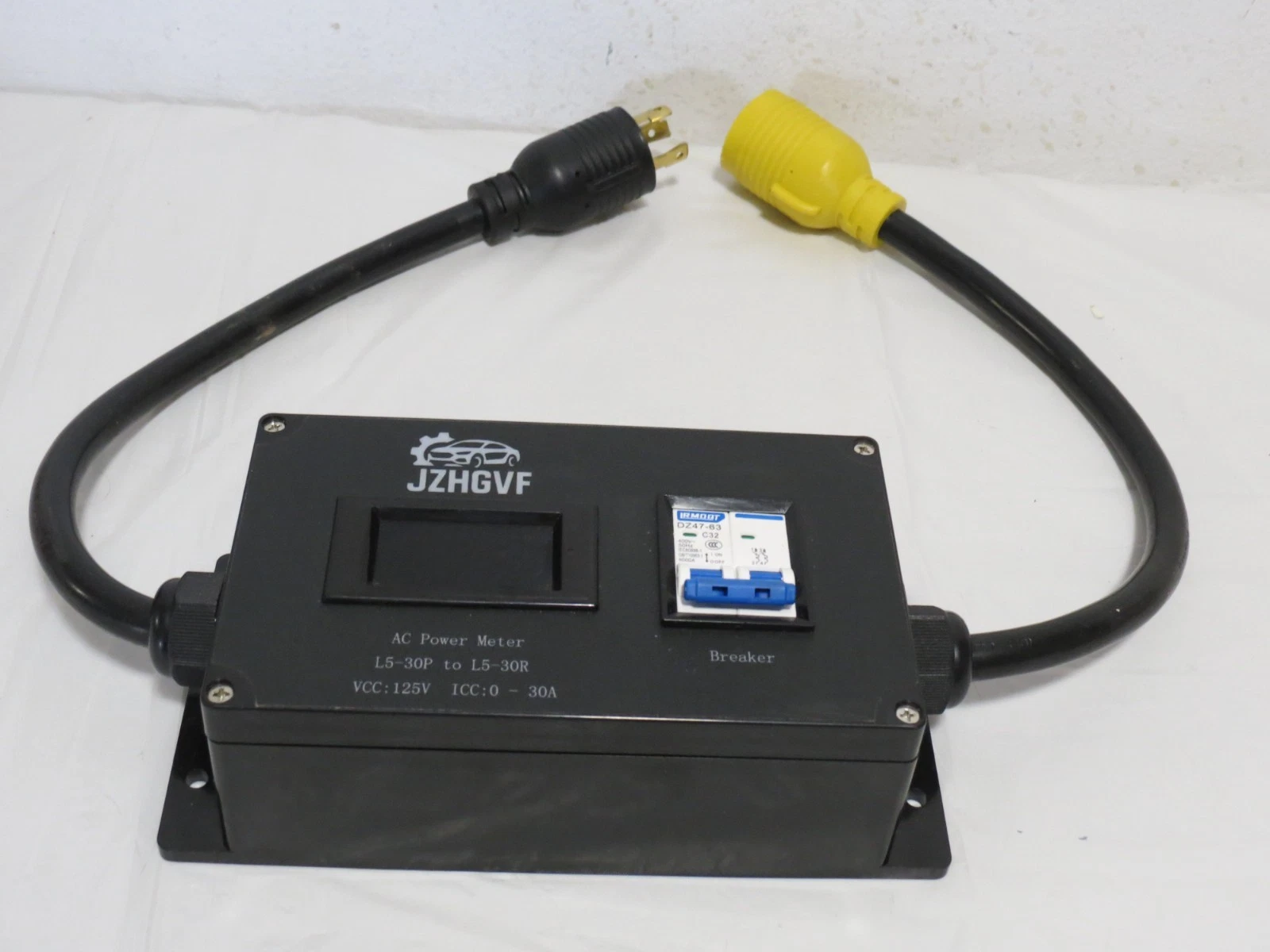
30A AC Power Meter 125V L5-30P to L5-30R — Full 30-Amp Readout
Best for: Watching a full 30-amp generator load in real time
If you run a generator through its 30-amp twist-lock outlet, this is the meter that actually fits the job. It plugs in line between the generator and your load, then shows voltage, current, watts, frequency, power factor and total energy on a clear LCD. The published range runs 40 to 300 volts, 0 to 30 amps and 0 to 9,000 watts, with a 10 AWG cable that keeps the display readable. It is the simplest way to see when you are close to tripping a breaker, and the only pick here built for the whole circuit, not one appliance.
- Reads full 30-amp circuit directly
- Shows volts, amps, watts, frequency
- 9,000W range covers most portables
- Brand name varies by listing
- Some listings warn against modified sine
4.9/5
5.0/5
4.8/5

P3 Kill A Watt EZ P4460 — Saved Readings, Simple Checks
Best for: Checking one appliance without losing the reading
You plug the Kill A Watt EZ into a standard 120-volt outlet, plug the appliance into it, and read volts, amps, watts, hertz and power factor on a large LCD. Its real advantage is the built-in battery backup, which keeps your cumulative energy reading when you unplug it to check another load. The published rating is 115 volts, up to 125 volts maximum, 15 amps and 1,875 VA, with stated accuracy within 0.2% for voltage. It is the easiest way to find out what a fridge, freezer or sump pump actually draws before you size a generator for it.
- Battery backup saves cumulative readings
- Eight readouts on large LCD
- 0.2% stated voltage accuracy
- 15-amp limit, not for 30-amp circuits
- No backlight on display
4.8/5
4.7/5
4.9/5

Poniie PN2000 — Fine Readings Down to 0.20W
Best for: Spotting small standby loads and low draws
The Poniie PN2000 is the pick when a small load matters as much as a large one. Its manual lists a 0.20-watt start point, a 0.01-watt display step, true RMS voltage and current, and a 99,999 kWh energy counter. The maximum rating is 16 amps and 1,760 watts, with Class 1.0 accuracy and a backlit LCD that is easier to read outdoors than the Kill A Watt screen. Use it on a single 120-volt appliance to learn its real running amps, then add those numbers up before you choose a generator size. Check the voltage range on your listing first, as some listings differ.
- 0.01W step, 0.20W start point
- Backlit LCD, easy outdoor reading
- 16A max, higher than most
- Voltage range varies by listing
- Single outlet only, not whole circuit
4.8/5
4.7/5
4.8/5

P3 Kill A Watt P4400 — The Original Plug-In Meter
Best for: Simple, trusted checks on 120-volt appliances
The P4400 is the meter that gave this type its name, and it is still the reference point for every plug-in meter below. Plug it into a wall or generator 120-volt outlet, plug the appliance into it, and read kilowatt-hours, volts, amps, watts, hertz and volt-amperes on one large LCD. The published rating matches the EZ model at 115 volts, 15 amps and 1,875 VA, with 0.2% stated accuracy. It has no battery backup, so the reading resets when you unplug it, but for a quick amp check on one appliance, that trade-off is easy to accept.
- Large LCD, six readings at once
- 0.2% stated accuracy
- Simple plug-in setup, no app
- No battery backup for readings
- 15-amp limit only
4.8/5
4.6/5
4.7/5

Hughes Autoformers Power Watchdog PWD30-EPO — Amps on Your Phone
Best for: Watching amps from inside without walking outside
The Power Watchdog PWD30-EPO is a 30-amp portable EMS that also works as a live amp meter. It plugs into a 30-amp supply, shows live voltage, amps and watts in a Bluetooth app, and cuts power on high or low voltage, open ground, open neutral and reverse polarity. The published surge rating is 3,000 joules, with a user-replaceable surge module and a limited lifetime warranty. That combination suits RV and generator users who want an amp readout plus protection in one box, rather than a plain meter that only watches and never acts.
- Live amps in Bluetooth app
- 3,000J surge, replaceable module
- Cuts power on voltage faults
- No built-in screen, app only
- Premium cost for a meter
4.7/5
4.8/5
4.6/5

Progressive Industries EMS-PT30X — Protection With Amp Readout
Best for: A 30-amp hookup that needs guarding and monitoring
The EMS-PT30X is a portable 30-amp electrical management system with a scrolling digital display that shows voltage, amps, frequency and error codes. It cuts power below 104 volts or above 132 volts, checks for open ground, open neutral and reverse polarity, and waits 136 seconds before reconnecting so an air conditioner compressor is not short-cycled. The published surge rating is 1,790 joules with 44,000 amps of surge current. It is bulkier and slower to read than a plain meter, but it is the pick if you want the amp number and a shutoff in the same device.
- Scrolling amps, volts, frequency display
- 1,790J surge protection
- 136-second compressor delay
- Scrolling display is slow to read
- Bulky, no Bluetooth or app
4.7/5
4.8/5
4.5/5

50A AC Power Meter L14-50P to L14-50R — Full 50-Amp Readout
Best for: Large portable generators with a 50-amp outlet
If your generator has a 240-volt 50-amp outlet, a 30-amp meter will not fit and a 15-amp meter is useless. This 50-amp inline meter is the 50-amp counterpart to our top pick, with an L14-50P plug and L14-50R receptacle, and a published range that covers 50 amps and up to 12,000 watts across two 120-volt legs. It shows voltage, current, watts, frequency, power factor and total energy, so you can watch both legs and keep the load balanced. If you run a portable generator with a 50-amp outlet, this is the meter that matches it.
- Reads full 50-amp circuit directly
- Shows both legs, helps balance
- 12,000W range for large generators
- Brand and specs vary by listing
- Bulky plug, needs clear space
4.6/5
4.7/5
4.6/5

Poniie PN1500 — Compact Budget Meter for One Load
Best for: Budget checks on a single 120-volt appliance
The PN1500 is the smaller, cheaper Poniie, and it is the right budget pick if you only need to check one appliance at a time. Its published rating is 100 to 140 volts, 14 amps maximum and 1,500 watts at 110 volts, with Class 1.0 accuracy, a 0.01-watt display step and a backlit LCD. It measures watts, VA, current, voltage, frequency and power factor, with cumulative time and energy memory. It will not handle a full 15-amp space heater at 120 volts, so keep it under 14 amps and use it for fridges, freezers, fans and chargers, not for a whole generator circuit.
- Compact, backlit LCD display
- 0.01W resolution, Class 1.0
- Memory for time and energy
- 14A limit, below full 15A
- Not for whole-circuit monitoring
4.6/5
4.5/5
4.7/5
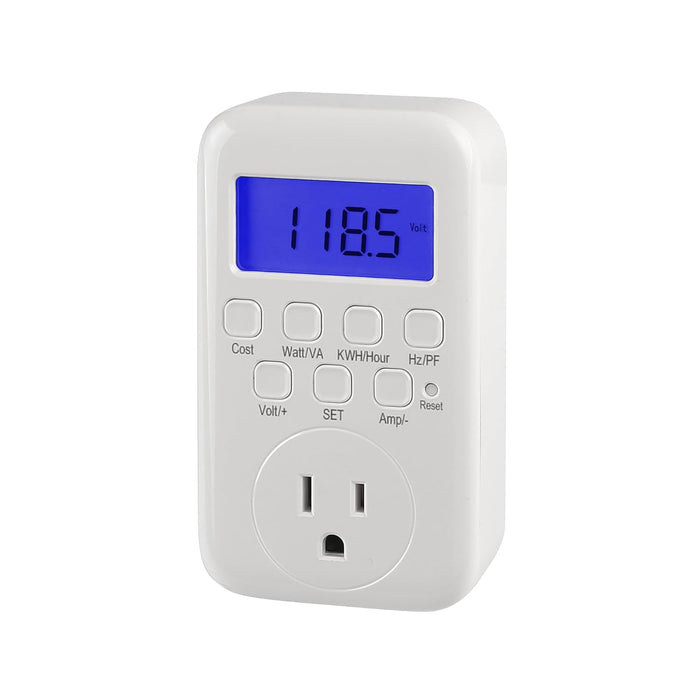
BN-LINK LCD Plug-in Power Energy Meter — Simple Budget Tracking
Best for: A first meter for basic amp and cost checks
The BN-LINK meter is the simplest budget pick in this list, and it covers the basics well. Plug it into a standard 125-volt, 60-hertz outlet, plug the appliance into it, and read watts, VA, kilowatt-hours, elapsed time, frequency, power factor, volts, amps and cost on the LCD. Its published limit is 15 amps and 1,875 watts, with an overload warning if you pass it, and an internal NiMH battery that keeps the memory when unplugged. It is not the most accurate meter here, and its display is smaller than the Poniie, but for a first check on a fridge or heater, it does the job.
- Overload warning above 15A
- Internal battery saves memory
- Shows amps, volts, watts, cost
- Smaller display than Poniie
- Accuracy not stated as clearly
4.5/5
4.5/5
4.6/5

Fluke 323 True-RMS Clamp Meter — Spot-Check Any Wire
Best for: Clamping one wire to check its amps safely
The Fluke 323 is the only clamp meter in this list, and it solves a different problem from the plug-in meters above. Instead of sitting in line, you open its slim jaw around a single hot wire and read AC current up to 400 amps, with true RMS accuracy. It also measures voltage to 600 volts and resistance to 4,000 ohms. Use it to check a generator feeder, a well pump wire or a single branch circuit, but never clamp both wires of a cord at once, or the reading will cancel to zero.
- 400A AC clamp, true RMS
- Slim jaw fits tight panels
- Simple, trusted Fluke design
- AC current only, no DC clamp
- No inrush or app logging
4.8/5
4.4/5
4.6/5
Top 3 Head-to-Head: 30A AC Power Meter vs Kill A Watt EZ P4460 vs Poniie PN2000
These three are the common final choices because they cover the three real jobs: whole-circuit monitoring, saved single-appliance checks, and fine low-load readings.
| Feature | #1 30A Meter | #2 Kill A Watt EZ | #3 Poniie PN2000 |
|---|---|---|---|
| Amp-reading accuracy | 4.9/5 — Best | 4.8/5 | 4.8/5 |
| Generator fit | 5.0/5 — Best | 4.7/5 | 4.7/5 |
| Ease of use | 4.8/5 | 4.9/5 — Best | 4.8/5 |
| Choose if… | You run a 30-amp generator outlet | You check one appliance at a time | You need fine low-load readings |
Who These Amp Meters Are NOT For
A plug-in amp meter is a monitoring tool, not a protection device and not a panel instrument.
If you need to measure a hardwired well pump, central air or furnace, a plug-in meter cannot reach it. Use a clamp meter on the single wire, with the power safely isolated first, or hire an electrician.
Common Mistakes to Avoid
Most amp-meter mistakes come from the wrong plug, the wrong wire, or reading the wrong number.
Frequently Asked Questions About Portable Generator Amp Meters
How do I measure the amps my portable generator is putting out?
Plug an inline amp meter into the generator outlet and plug your load into the meter, then read the amp display while the load runs. For a single wire, clamp a clamp meter around one hot wire only. Add the amps from each load you run together, and compare the total with the amp rating on the generator outlet.
What size amp meter do I need for a portable generator?
Match the meter to your generator outlet: 15 amps for a standard 120-volt outlet, 30 amps for an L5-30 or TT-30 outlet, and 50 amps for an L14-50 outlet. A meter rated below the outlet cannot read the whole circuit safely. Check the outlet type on the generator panel before you buy, not the wattage on the box.
Can I use a Kill A Watt meter on a portable generator?
Yes, for one 120-volt appliance at a time, up to 15 amps and 1,875 VA. Plug the Kill A Watt into the generator 120-volt outlet, then plug the appliance into it. Do not use it on a 30-amp or 240-volt outlet, and do not use it to measure a whole generator circuit, because it cannot carry that load.
Is a plug-in amp meter or a clamp meter better for a generator?
A plug-in meter is better for continuous monitoring, because it stays in line and shows amps, volts and watts together. A clamp meter is better for spot checks on a single wire, a feeder or a hardwired load that has no plug. Many owners use both: a plug-in meter on the outlet, and a clamp meter for troubleshooting.
How many amps should my generator show under load?
It should show the sum of the running amps of everything plugged in, staying below the outlet rating with some headroom. A 30-amp outlet should normally stay well under 30 amps, and a short startup surge is normal for motors. If the reading sits near the limit for minutes, switch off a load before the breaker trips.
Do I need a true RMS amp meter for a generator?
Yes, if you want accurate readings on generator power, especially from an open-frame generator. True RMS meters read non-sine waveforms more accurately than basic averaging meters. For simple resistive loads like heaters, the difference is small, but for motors, compressors and electronics, a true RMS reading is the one to trust.
Our Final Verdict
Most generator owners only need one amp meter, and the choice comes down to the outlet: a 30-amp inline meter for the whole circuit, or a 15-amp plug-in meter for sizing single appliances. Buy the meter that matches your outlet, check amps at startup as well as at steady load, and keep headroom below the breaker limit.

Hi, I’m Michael Turner. I own a generator workshop in the United States and founded HomeGeneratorBlog to share practical, hands-on guidance about generator installation, maintenance, troubleshooting, safety, and backup power solutions. My goal is to help homeowners make smarter, more confident decisions through clear and reliable information