How Much Power Does a 7000-Watt Inverter Generator Provide? What It Can Run, What It Cannot, and How to Use It Right
Quick Answer
A 7000-watt inverter generator provides about 7,000 running watts and 8,000 to 8,750 starting watts, depending on the model. That is enough for a fridge, lights, fans, phones, a TV, a furnace blower, and a small window AC or RV air conditioner together, if you stagger the big starts. Check the spec sheet for your model, because the right generator size depends on running watts, not the headline number.
What 7,000 watts means in real life
- Running power: Plan around 7,000 watts for steady loads, and keep a 10 to 20 percent buffer.
- Starting power: Use the short surge rating for motors that kick on, like a fridge compressor or AC.
- Clean power: Most inverter models make clean sine wave power with low THD for laptops, phones, and a CPAP machine.
- Big limit: It will not run a whole house, central AC, and an electric water heater at once.
- Best fit: It suits serious home backup, a large RV, and a busy job site.
Use it right
- Add up running watts first, then add the largest starting watt draw once.
- Start the biggest motor first, then add smaller loads one at a time.
- Run it outdoors, at least 20 feet from the house, with exhaust pointed away.
I’ve run a 7000-watt inverter generator through a three-day outage, and it changed how I think about backup power. It kept the fridge cold, the phones charged, and the house livable without the roar of an open-frame unit.
This guide goes past the headline number. You’ll learn what 7,000 watts can run, what it cannot run, how long it lasts, and how to size it without tripping an overload.
In This Guide
- What Does 7,000 Watts Really Mean?
- How Much Power Does a 7000-Watt Inverter Generator Provide in Running and Starting Watts?
- What Can a 7000-Watt Inverter Generator Run?
- What Can a 7000-Watt Inverter Generator Not Run?
- How Long Will a 7000-Watt Inverter Generator Run?
- Is 7,000 Watts Enough for Home Backup, RV, and Job Sites?
- How to Use a 7000-Watt Inverter Generator Safely and Without Overloads
- 7000-Watt vs 5000-Watt vs 10000-Watt: Which Size Fits You?
- Frequently Asked Questions
- The Bottom Line on 7,000 Watts
What Does 7,000 Watts Really Mean?
An inverter generator is a portable generator that makes clean, stable power by converting raw engine power to DC, then back to smooth AC power. That clean sine wave matters for sensitive electronics.
The “7000-watt” label usually means 7,000 running watts. Running watts are the steady power it can supply for hours.
Some brands use 7,000 watts as the starting watts instead. That is a different machine, and it may offer only 5,500 to 6,000 running watts.
Always read the spec sheet before you buy. Look for two numbers: rated watts and maximum watts.
Rated watts tell you what you can run all day. Maximum watts tell you what it can handle for a few seconds at startup.
How many amps is 7,000 watts?
At 120 volts, 7,000 watts is about 58 amps in theory. Most 7000-watt inverter generators do not give you all of that through one outlet.
They split power across 120-volt outlets and a 120/240-volt outlet. A common setup includes a 30-amp RV outlet and a 30-amp or 50-amp twist-lock outlet.
That split matters for home backup. You need the right outlet, cord, and inlet to use the full output safely.
Check your panel setup with a licensed electrician. A transfer switch or interlock kit keeps generator power from backfeeding the grid.
Safety note: Never plug a generator into a wall outlet. Use a transfer switch or interlock installed by a licensed electrician, and check your owner’s manual before use.
Section Takeaway: Treat 7,000 watts as running power only when the spec sheet says so, and plan your loads around rated watts, not the biggest number on the box.
How Much Power Does a 7000-Watt Inverter Generator Provide in Running and Starting Watts?
A typical 7000-watt inverter generator provides 7,000 running watts and 8,000 to 8,750 starting watts. Some dual fuel models provide less on propane, often by 10 percent or more.
Starting watts, also called surge watts, cover the brief spike when a motor starts. A fridge may need 1,200 starting watts but only 150 to 200 running watts.
An RV air conditioner is the classic test. A 13,500 BTU unit may need 2,800 to 3,000 starting watts and 1,200 to 1,500 running watts.
A 15,000 BTU unit needs more at startup. It can still work on a 7000-watt unit if you start it first and keep other big loads off.
Why the gap between running and starting watts matters
You cannot add every starting watt together. You add running watts for all loads, then add the single largest starting spike once.
That math keeps you from oversizing or undersizing. It also stops nuisance overload shutdowns at the worst moment.
I learned this during an outage when the fridge and window AC tried to start together. The generator shut down, the house went dark, and I had to restart with a plan.
Start the AC first, wait for it to settle, then plug in the fridge. That order works because only one motor surges at a time.
- Running watts: Steady power for lights, fans, TVs, chargers, and a fridge once it is running.
- Starting watts: Short surge power for motors, compressors, and pumps at startup.
- THD: Total harmonic distortion, a measure of power cleanliness; inverter models often stay under 3 percent.
- Eco-mode: Economy mode slows the engine at light loads to save fuel and cut noise.
If you want a step-by-step method, use this wattage calculation guide to add your own appliances before you buy.
Section Takeaway: A 7000-watt inverter generator gives you about 7,000 watts to use and a short surge above that, so size by running watts and stagger every motor start.
What Can a 7000-Watt Inverter Generator Run?
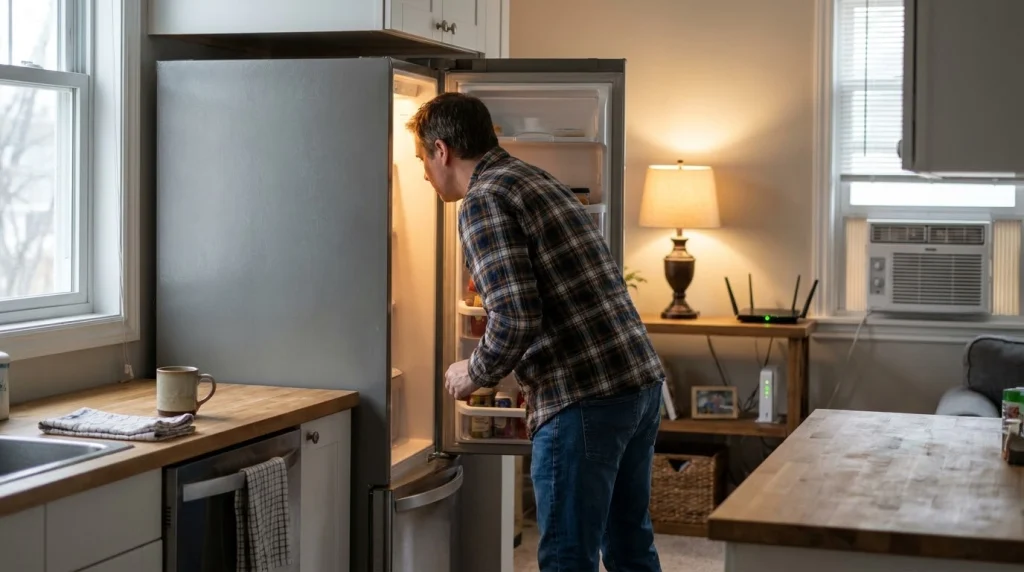
A 7000-watt inverter generator can run a strong home-backup kit at once. Think fridge, freezer, lights, fans, Wi-Fi, phones, laptops, TV, and a furnace blower.
It can also run a small window AC or a 13,500 BTU RV air conditioner with that kit, if you manage the starts. It can run a microwave for short bursts, a coffee maker, and a sump pump in rotation.
On a job site, it can run saws, drills, chargers, lights, and a small compressor. It will not run every large tool at full load at the same time.
The key is the total, not any single appliance. Add the running watts, leave headroom, and you stay in the safe zone.
Typical appliance watts for a 7000-watt setup
Use these numbers as planning estimates, not exact specs. Check the label on your own appliance, because age and model change the draw.
| Appliance | Running Watts | Starting Watts | Notes |
|---|---|---|---|
| Refrigerator | 150-200 | 1,200 | Cycles on and off |
| Chest freezer | 100-150 | 800-1,000 | Stagger with fridge |
| Window AC, 10,000 BTU | 900-1,200 | 2,200-2,800 | Start it first |
| RV AC, 13,500 BTU | 1,200-1,500 | 2,800-3,000 | Common RV fit |
| Furnace blower | 600-900 | 1,500-2,000 | Gas heat only |
| Sump pump, 1/3 HP | 800-1,000 | 1,800-2,200 | Runs in bursts |
| Microwave, 1,000W | 1,000-1,300 | 1,000-1,300 | Short use only |
| CPAP machine | 30-90 | 30-90 | Low draw, clean power helps |
| LED lights, TV, Wi-Fi | 150-300 | 150-300 | Combined total |
| Circular saw | 1,200-1,500 | 2,200-2,800 | One tool at a time |
A real home-backup example
Here is a load I have run without trouble: fridge at 180 watts, freezer at 120 watts, lights and Wi-Fi at 200 watts, TV at 150 watts, and a window AC at 1,100 watts. That totals about 1,750 running watts.
Add the AC starting spike once, and the peak stays near 4,500 watts. That leaves plenty of headroom on a 7000-watt unit.
You can then add a microwave for two minutes or a coffee maker in the morning. Just turn the AC fan to low first, or pause one load while the other runs.
For cooling, compare your AC size before you buy, because a generator for an air conditioner needs enough surge for the compressor, not just the fan.
Section Takeaway: A 7000-watt inverter generator handles a full essentials kit plus one cooling load with room to spare, as long as you count running watts and stagger motor starts.
What Can a 7000-Watt Inverter Generator Not Run?
It cannot run a whole house like a standby generator. Central AC, electric heat, an electric water heater, and an electric range together will overload it fast.
A central AC alone can need 3,000 to 5,000 running watts and a much larger startup surge. That leaves little room for anything else, even if it starts.
An electric water heater draws about 4,500 watts on its own. An electric dryer draws about 5,000 watts, and a well pump can surge past 3,000 watts.
You can run some of these one at a time, with everything else off. That is not a practical plan for a multi-day outage, though.
Loads to avoid or rotate
- Central AC: Too much running and starting power for most 7000-watt units.
- Electric water heater: High, steady draw with no easy way to trim it.
- Electric range and oven: One burner can use 1,500 watts, and the oven uses more.
- Electric dryer: Heavy draw and long run time, a poor fit for portable power.
- Large well pump: Deep wells need a big surge, so check the pump label first.
- Two big motors at once: Two AC units or two pumps starting together will trip the overload.
Use a smaller workaround instead. Heat water in a kettle, cook on a portable stove, and dry clothes on a line during an outage.
That trade keeps the fridge, lights, and heat running. Comfort comes from choices, not from forcing the generator to do everything.
Section Takeaway: Skip central AC, electric heat, and electric water heating on a 7000-watt unit, and rotate any single heavy load with everything else off.
How Long Will a 7000-Watt Inverter Generator Run?
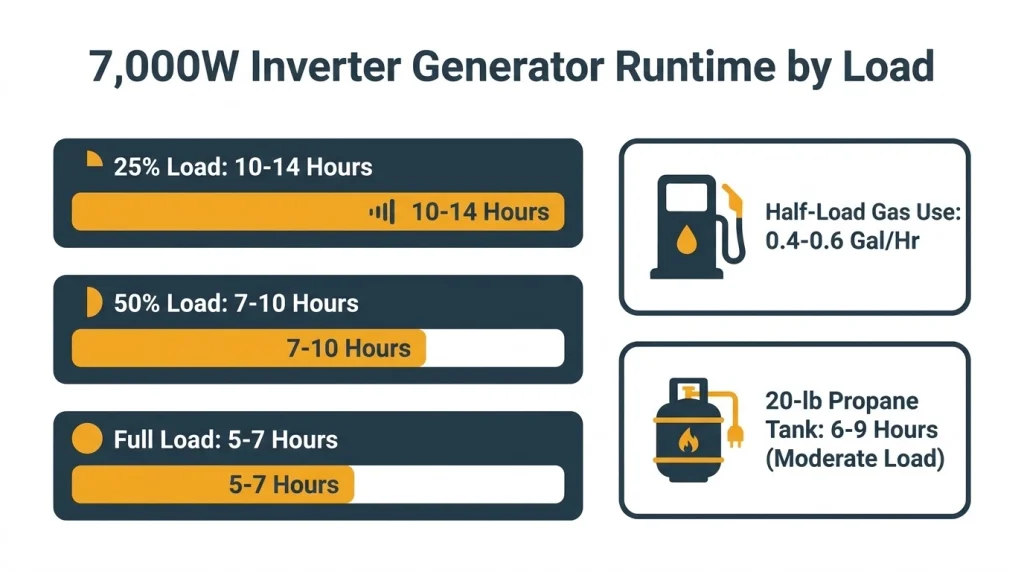
Runtime depends on load, tank size, fuel type, and eco-mode. Most 7000-watt inverter generators run 10 to 14 hours at 25 percent load on a full tank of gasoline.
At 50 percent load, that often drops to 7 to 10 hours. At full load, it can drop to 5 to 7 hours, so check the spec sheet for your model.
Eco-mode helps a lot at light loads. It slows the engine when demand is low, which saves fuel and cuts noise.
Turn eco-mode off for AC and other motor loads. The engine needs full speed to handle the surge without a dip.
Fuel use in plain terms
A 7000-watt unit with a 4- to 5-gallon tank may use about 0.4 to 0.6 gallons per hour at half load. That is a planning range, not a promise for every model.
For a 24-hour outage at moderate load, plan on 10 to 14 gallons of gasoline. Store fuel safely, use stabilizer, and rotate it so it stays fresh.
Propane runs cleaner and stores longer, but it gives less power on most dual fuel models. A 20-pound propane tank may last 6 to 9 hours at moderate load.
Keep spare fuel outside, away from the generator and the house. Never refuel a hot generator, and let it cool before you open the cap.
Safety note: Run generators outdoors and well away from windows, doors, and vents. Store fuel in approved containers, outside living spaces, and follow your owner’s manual.
Section Takeaway: Expect a full day of backup from one to two tank fills at moderate load, and carry more fuel than you think you need for a multi-day outage.
Is 7,000 Watts Enough for Home Backup, RV, and Job Sites?
Yes, for most homes, large RVs, and light job sites, 7,000 watts is a strong middle ground. It is bigger than a camping unit and smaller than a whole-home standby system.
For home backup, it covers the essentials plus cooling. It keeps food safe, lights on, phones charged, and a furnace blower running in winter.
For RV use, it can run a 13,500 BTU AC, fridge, lights, and chargers together. A 15,000 BTU AC may need a soft-start kit or careful load control.
For job sites, it can run saws, sanders, drills, and lights. It suits a crew that works one big tool at a time, not a shop full of machines.
Home backup in 2026
As of 2026, more buyers want quiet backup that can run sensitive electronics. Inverter power fits that need, because it protects laptops, routers, and medical devices like a CPAP machine.
Weight is the trade-off. A 7000-watt inverter generator often weighs 120 to 160 pounds, so it is not a one-person lift for most people.
Look for wheels, a telescoping handle, and electric start. Those features matter more after a storm, when you are tired and moving gear in the dark.
Noise is another real factor. Many inverter models run at 58 to 65 dB at 25 percent load from 23 feet, but check the spec sheet for the exact rating.
RV and camping fit
A 7000-watt unit is large for a small camper, but it fits a large travel trailer or fifth wheel. It can power the AC, microwave, and water heater on electric, in rotation.
Check campground rules before you run it. Many sites limit generator hours and noise, and some ban open-frame units outright.
Place it downwind, away from your door and your neighbor’s windows. A quiet inverter model still needs space and respect for quiet hours.
Section Takeaway: 7,000 watts is enough for serious home backup, a large RV, and a light job site, but it is heavy and best used where quiet, clean power matters.
How to Use a 7000-Watt Inverter Generator Safely and Without Overloads
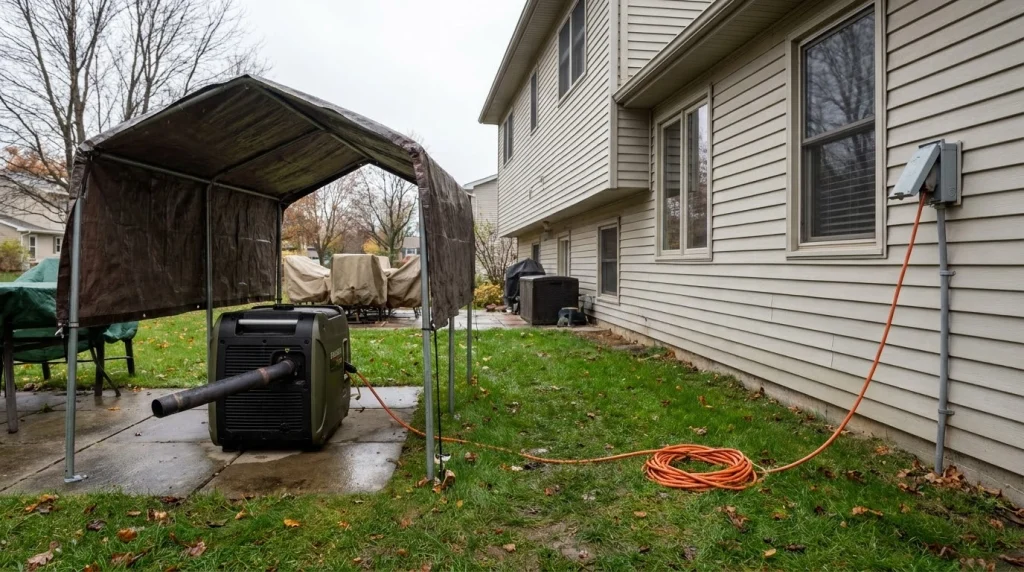
Start with a load list before the power goes out. Write down each appliance, its running watts, and its starting watts.
Plug in the biggest motor first. Let it settle for 30 seconds, then add the next load.
Use heavy-duty outdoor cords rated for the load. A thin extension cord can overheat, drop voltage, and damage a motor.
Watch the overload light and the watt meter, if your model has one. If the light blinks, shed a load fast.
Safe setup checklist
- Place it outside: Keep it at least 20 feet from the house, with exhaust pointed away.
- Use a CO alarm: Put battery-powered CO alarms inside, near sleeping areas.
- Keep it dry: Use a generator tent or canopy that leaves airflow open, never a closed box.
- Ground it right: Follow the manual on grounding and GFCI outlets.
- Cool before fueling: Shut it down, wait for it to cool, then refuel outdoors.
- Break it in: Follow the manual for the first oil change, often after 20 to 30 hours.
Carbon monoxide is colorless and odorless, and it can build up fast in a garage or near a window. The CDC and CPSC both stress outdoor use only, with CO alarms inside the home.
For home hookups, the EPA and Energy.gov guidance points to proper transfer equipment and licensed electricians. Consumer Reports also notes the value of CO shutoff features on newer models.
Safety note: Run generators outdoors and well away from windows, doors, and vents. Use a transfer switch or interlock installed by a licensed electrician, and check your owner’s manual before use.
Section Takeaway: Place it outside, start big loads first, use proper cords and transfer gear, and keep CO alarms working inside the house.
7000-Watt vs 5000-Watt vs 10000-Watt: Which Size Fits You?
A 5000-watt inverter generator fits a smaller home kit, a mid-size RV, and light backup. It can run a fridge, lights, and a small AC, but it has less headroom.
A 7000-watt unit adds room for a second fridge, a larger AC, or a job-site saw. It is the sweet spot when you want cooling plus essentials without going huge.
A 10000-watt unit fits a larger home, two AC units, or a heavier job site. It costs more, weighs more, and uses more fuel.
Do not buy size for peace of mind alone. Buy the size that matches your load list, with a buffer.
If you are comparing costs by size, this inverter generator cost guide shows how price, fuel, and upkeep change as watts rise.
A smaller unit may also be easier to move and store. A larger unit may need a bigger inlet, a bigger cord, and more fuel storage.
For a direct size comparison, a 5000-watt inverter generator is a useful benchmark if your load list is close to 4,000 running watts.
Section Takeaway: Choose 5,000 watts for light backup, 7,000 watts for cooling plus essentials, and 10,000 watts only when your load list truly needs it.
Frequently Asked Questions
Can a 7000-watt inverter generator run a whole house?
No, it cannot run a whole house at once. It can run essential circuits through a transfer switch, including a fridge, lights, furnace blower, and one cooling load, but not central AC, electric heat, and an electric water heater together.
Can a 7000-watt inverter generator run a 15000 BTU RV air conditioner?
Yes, in many cases, if you start the AC first and keep other big loads off. A 15,000 BTU unit needs a large startup surge, so a soft-start kit helps, and you should check the AC label and the generator spec sheet first.
How many amps does a 7000-watt inverter generator provide?
At 120 volts, 7,000 watts is about 58 amps in theory. In practice, power is split across outlets, so check the 30-amp and 50-amp outlet ratings on your model and use the right cord and inlet.
Will a 7000-watt inverter generator run a refrigerator and freezer together?
Yes, a fridge and freezer together use only about 250 to 350 running watts once they are running. Stagger their starts, because each compressor needs 800 to 1,200 starting watts when it kicks on.
Is a 7000-watt inverter generator quiet?
It is quieter than an open-frame generator, but it is not silent. Many models run at 58 to 65 dB at 25 percent load from 23 feet, and the sound rises with load, so check the spec sheet and use eco-mode at light loads.
How much fuel does a 7000-watt inverter generator use?
It often uses about 0.4 to 0.6 gallons of gasoline per hour at half load, depending on the model and eco-mode. Plan on 10 to 14 gallons for 24 hours at moderate load, and store extra fuel safely.
Can I parallel two 7000-watt inverter generators?
Some models support parallel operation with a kit, which can double output for larger loads. Check your manual first, because not every 7000-watt model is parallel-capable, and you must use the correct kit and cords.
The Bottom Line on 7,000 Watts
A 7000-watt inverter generator provides about 7,000 running watts and 8,000 to 8,750 starting watts. That is enough for a strong backup kit, a large RV, and a light job site.
Count your running watts, stagger your motor starts, and leave headroom. That simple habit turns a big number into power you can trust.
If your load list is near 5,000 to 6,000 running watts, this size fits well. If it is far below that, a smaller unit will save fuel, weight, and money.

Hi, I’m Michael Turner. I own a generator workshop in the United States and founded HomeGeneratorBlog to share practical, hands-on guidance about generator installation, maintenance, troubleshooting, safety, and backup power solutions. My goal is to help homeowners make smarter, more confident decisions through clear and reliable information