How to Winterize a Portable Generator: Step-by-Step Guide
Quick Answer
To winterize a portable generator, protect the fuel system, change or check the oil, maintain the starting battery, inspect the spark plug and air filter, clean the unit, and store it somewhere dry. Gasoline generators need the most attention because stale fuel can clog the portable generator fuel system.
Quick Winterizing Steps
- Choose a fuel method: Add stabilizer to fresh gasoline or drain the fuel system according to your manual.
- Run treated fuel: If using stabilizer, run the generator outdoors so treated gasoline reaches the carburetor.
- Check the oil: Change dirty or due engine oil before extended storage.
- Protect the battery: Disconnect or maintain an electric-start battery as your manual recommends.
- Inspect wear parts: Check the spark plug, air filter, hoses, wiring, and fasteners.
- Store it dry: Keep the generator clean, protected from moisture, and away from ignition sources.
One Rule That Matters Most
- Follow your generator’s owner’s manual when its storage procedure differs from general advice.
Winterizing a generator doesn’t take much time, but skipping it can leave you fighting a hard-starting engine during the next outage. I prefer doing the work before temperatures drop, when I’m not rushing during a storm.
This guide covers the complete process for gasoline, propane, dual-fuel, and electric-start portable generators. It also explains which maintenance tasks matter and which ones you can skip.
What Does It Mean to Winterize a Portable Generator?
Winterizing a portable generator means preparing its engine, fuel system, battery, electrical parts, and frame for cold-weather storage or winter emergency use. The goal is simple: prevent fuel deterioration, corrosion, battery discharge, moisture damage, and starting problems.
For the 2026 winter season, I would focus on these five areas first:
- Fuel: Prevent gasoline from deteriorating inside the tank and carburetor.
- Oil: Make sure the engine contains clean oil at the correct level.
- Battery: Keep electric-start batteries from slowly discharging.
- Moisture: Keep snow, condensation, and damp storage conditions away from electrical components.
- Readiness: Make sure everything needed for the next safe startup is already available.
I also keep the owner’s manual beside me during the process. Generator designs vary enough that the manufacturer’s storage procedure should always win.
Should You Drain Generator Gas or Add Fuel Stabilizer?
You can usually winterize a gasoline generator by either storing it with properly stabilized fresh fuel or draining the fuel system. The correct choice depends on your generator’s manual and how long you expect it to sit.
Never assume fuel stabilizer can restore gasoline that’s already stale. Honda specifically notes that stabilizer should be mixed with fresh gasoline, while Generac recommends treating fuel that will sit unused. You can review Honda’s engine storage guidance for the underlying storage principles.
| Storage Method | Best For | Main Benefit | Important Detail |
|---|---|---|---|
| Fresh fuel + stabilizer | Seasonal storage | Keeps the fuel system ready | Run the engine after treatment so stabilized fuel reaches the carburetor |
| Drained tank and carburetor | Long or uncertain storage | Removes gasoline that could deteriorate | Follow the manual’s drain procedure |
| Propane disconnected | Propane or dual-fuel units | No gasoline remains to gum the carburetor when operated only on propane | Inspect the hose, regulator, and cylinder condition |
Option 1: Store It With Stabilized Gasoline
Start with fresh gasoline and add the stabilizer at the ratio printed on its bottle. Then run the generator outdoors for several minutes, or for the exact period specified by the manufacturer.
Briggs & Stratton recommends treated fuel as one storage option and stresses circulating it through the fuel system. Its generator winter maintenance guidance also recommends checking oil and replaceable maintenance parts.
Option 2: Drain the Fuel System
Draining is often a good choice when the generator may sit for a long or unknown period. That normally means removing gasoline from both the tank and carburetor according to the owner’s manual.
Don’t dump gasoline onto the ground or into a drain. Transfer usable fuel into an approved container and follow local disposal rules for contaminated or unusable gasoline.
What About Propane and Dual-Fuel Generators?
Propane avoids many of the carburetor problems caused by stored gasoline. After shutdown, close the cylinder valve, let the engine cool, and disconnect the cylinder according to the manual.
If you’re considering a fuel setup that’s easier to keep ready between outages, my guide to a propane portable generator explains the main advantages and tradeoffs.
How Do You Winterize a Portable Generator Step by Step?
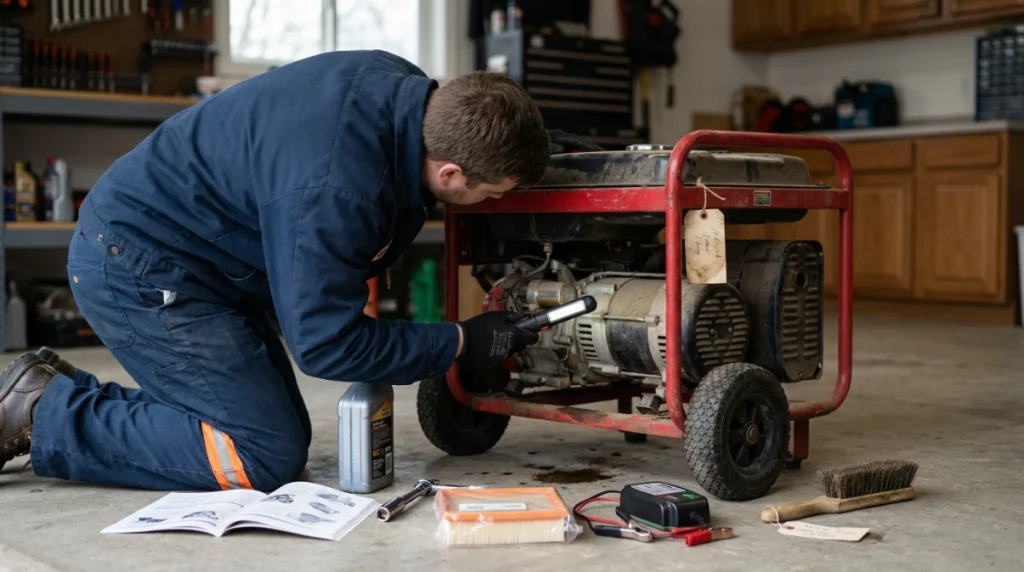
The easiest method is to work from fuel to engine maintenance, then finish with cleaning and storage. I use the same basic order each year because it keeps me from forgetting the small items.
- Read the owner’s manual first. Find the manufacturer’s storage interval, oil specification, fuel recommendation, spark-plug specification, and battery instructions.
- Run the generator outdoors before servicing it. A short run warms the oil and also gives you a chance to notice surging, leaks, unusual noise, or starting trouble.
- Choose your fuel-storage method. Use fresh stabilized gasoline or drain the tank and carburetor if your manual directs you to do so.
- Change or check the engine oil. Drain used oil while it’s warm if a change is due, then refill with the exact viscosity and amount required by your generator.
- Inspect the spark plug and air filter. Replace dirty, worn, damaged, or overdue parts rather than hoping they’ll survive another outage.
- Service the starting battery. Clean the terminals and maintain the battery according to its chemistry and the generator manufacturer’s instructions.
- Clean the generator. Brush away dust, leaves, insects, and oily residue while avoiding direct water spray on electrical components.
- Inspect the frame and wiring. Look for cracked fuel hoses, damaged insulation, loose fasteners, corrosion, and deteriorated rubber parts.
- Store it in a dry location. Keep it protected from rain and snow while maintaining the storage clearances required by its manual.
- Label what you did. Write the oil-change date, fuel treatment date, and storage method on a tag so there’s no guessing next season.
That last step has saved me more time than you’d expect. A small piece of painter’s tape marked with the date tells me exactly what needs attention before the next startup.
Should You Change Generator Oil Before Winter Storage?
Change the oil before winter storage when the maintenance schedule says it’s due or when the existing oil has seen significant runtime. Used oil contains contaminants you don’t need sitting inside the engine for months.
Don’t assume one viscosity works for every portable generator. Oil requirements depend on the engine design, operating temperature, and manufacturer.
- Check the manual: Use the specified viscosity and API service category.
- Warm the engine first: Warm oil usually drains more completely.
- Use the dipstick correctly: Follow the manual’s instructions on whether to thread it in when checking.
- Never overfill: Too much oil can create its own engine problems.
- Keep spare oil: Winter outages can involve long runtimes and repeated level checks.
If you only ran the generator briefly since its last oil change, you may not need another change. The engine-hour schedule in your manual is the better guide.
How Do You Protect an Electric-Start Generator Battery in Winter?
An electric-start generator battery should remain charged without being chronically overcharged. Cold weather exposes weak batteries quickly because available starting performance drops as temperatures fall.
If your generator uses a starting battery, review how the electric-start system works before disconnecting or maintaining it.
- Inspect the case: Replace a cracked, swollen, or leaking battery.
- Clean the terminals: Remove visible corrosion before storage.
- Check connections: Make sure terminal hardware is secure.
- Use the correct maintainer: Match the charger to the battery voltage and chemistry.
- Follow disconnect instructions: Some generators have specific battery-storage procedures.
A maintainer is different from blindly leaving a basic charger connected all winter. A suitable smart maintainer controls charging instead of continuously forcing maximum current into the battery.
Should You Replace the Spark Plug and Air Filter Before Storage?
You don’t have to replace these parts every winter unless they’re worn or the maintenance interval requires it. You should inspect them, though.
A dirty air filter restricts airflow, while a worn or fouled spark plug can make cold starting harder. Both are inexpensive problems to catch before an emergency.
- Air filter: Check for heavy dirt, oil saturation, tears, or deterioration.
- Spark plug: Inspect the electrode for wear, heavy deposits, or damage.
- Fuel filter: Replace it if required by your generator’s service schedule.
- Fuel hoses: Look for cracking, stiffness, leaks, and loose clamps.
I prefer buying model-specific service parts before winter weather arrives. Searching for a spark plug during a multi-day outage isn’t much fun.
Where Should You Store a Portable Generator During Winter?
Store a portable generator somewhere dry, protected, and away from sources of flame or ignition. The location should also comply with the manufacturer’s fuel-storage instructions and local fire rules.
Generac’s portable-generator storage guidance specifically emphasizes treating fuel that will sit unused. Whatever brand you own, use its manual as the final authority.
- Keep it dry: Prevent rain, melting snow, and condensation from reaching outlets and electrical parts.
- Let it cool: Never cover or store a generator immediately after operation.
- Avoid ignition sources: Keep fuel and fuel vapors away from furnaces, heaters, flames, and sparks.
- Prevent pests: Inspect the air intake and surrounding areas for nesting material before spring startup.
- Avoid plastic wrapping: Trapping moisture tightly against the generator can encourage corrosion.
A fitted storage cover can keep dust off the unit, but remove it completely before operating the generator. A normal storage cover is not a safe running enclosure.
How Do You Prepare a Winterized Generator for an Outage?
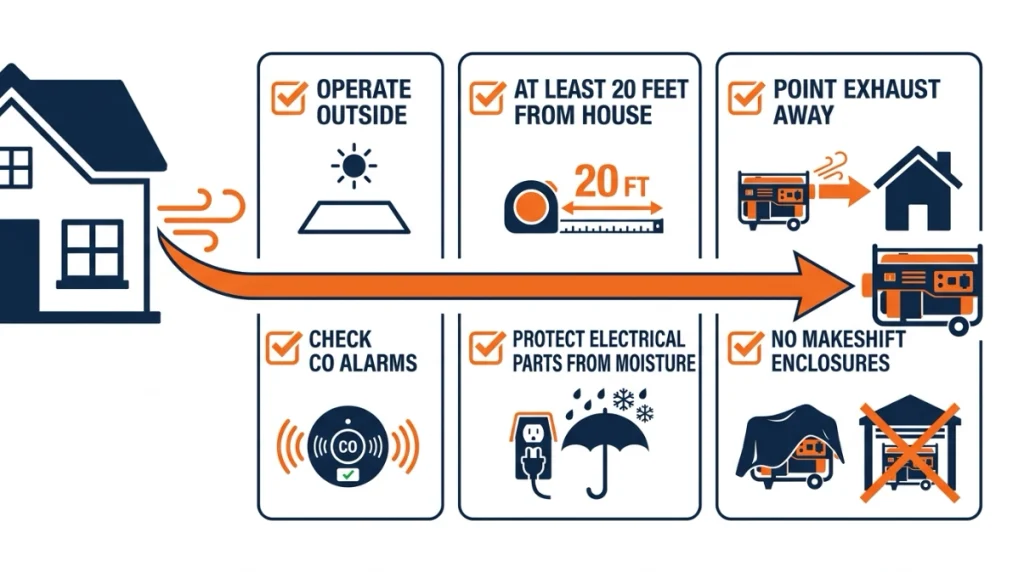
Winterizing isn’t only about putting the generator away. You also want it ready to operate safely when freezing rain, snow, or wind causes an outage.
Portable generators produce carbon monoxide whenever their engines run. Review my complete portable generator carbon monoxide safety guide before deciding where you’ll operate yours.
- Operate outside: Never run a portable generator inside a home, garage, basement, shed, or enclosed porch.
- Use proper distance: CPSC recommends operating portable generators at least 20 feet from the house with exhaust pointed away.
- Check CO alarms: Make sure working carbon-monoxide alarms protect the home.
- Protect against moisture: Never expose outlets and electrical components to unsafe wet conditions.
- Avoid makeshift enclosures: Don’t throw a tarp directly over a running generator.
The U.S. Consumer Product Safety Commission recommends at least 20 feet of separation and directing exhaust away from the home. Ready.gov gives the same 20-foot guidance in its power-outage preparedness information.
If snow is falling during an outage, use only a weather-protection system designed for operating generators with proper airflow. Never confuse a fitted running canopy with an ordinary storage cover.
Portable Generator Winterization Mistakes to Avoid
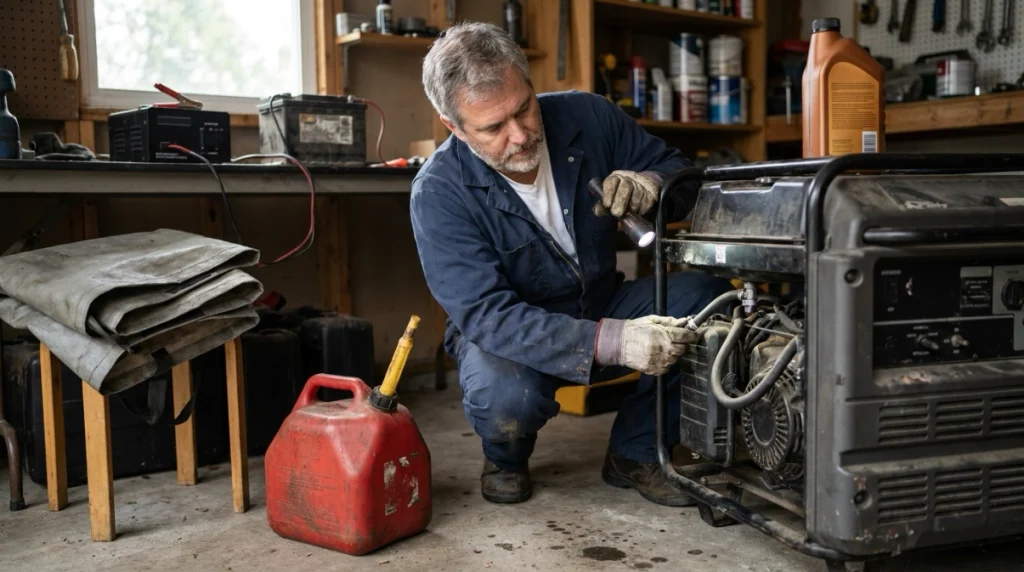
The most expensive winter-storage mistakes are usually simple ones. Most take only a few minutes to prevent.
- Leaving old gasoline untreated: Stabilizer works best with fresh fuel, not gasoline that’s already degraded.
- Ignoring the carburetor: Draining only the tank may still leave gasoline in the carburetor bowl.
- Using random engine oil: Cold-weather viscosity requirements vary between engines.
- Forgetting the battery: A perfect engine won’t electric-start with a discharged battery.
- Covering a hot generator: Allow the engine and muffler to cool completely.
- Running it inside for a test: Storage location and operating location are two different things.
- Using a loose tarp while running: It can interfere with airflow, exhaust, and hot components.
- Skipping a final inspection: Small fuel leaks, cracked wiring, and damaged hoses are easier to handle before winter.
The best winterizing job is boring. You put the generator away correctly, then it starts without drama when you need it again.
Generator Winterizing Products I Recommend
If you’re putting together a simple winter-maintenance kit, these are the types of products I’d keep near the generator. Always confirm compatibility with your specific generator and battery before use.
🏆 Best for Fuel Storage
STA-BIL Storage Fuel Stabilizer 32 oz (22214)
★★★★★ 4.8/5
Made for gasoline-powered seasonal equipment and designed to protect stored fuel. I like having a dedicated storage stabilizer on the shelf because it removes the temptation to leave untreated gas sitting in the generator.
🔋 Best for Electric Start
NOCO GENIUS1 1A Smart Battery Charger
★★★★☆ 4.7/5
This compact 1-amp unit works as a charger and maintainer for compatible 6V and 12V batteries. It’s the type of tool I prefer for a generator that spends months waiting between outages.
❄️ Best for Winter Operation
GenTent Universal Open Frame Generator Running Cover
★★★★☆ 4.6/5
GenTent builds covers specifically for operating compatible generators during rain and snow while preserving needed airflow. I’d choose a purpose-built running cover over trying to improvise with a loose tarp during a winter outage.
Frequently Asked Questions
How long does it take to winterize a portable generator?
Basic winterization usually takes less than an afternoon when you already have the correct oil, fuel treatment, filters, and tools. A generator needing a full oil change, carburetor draining, battery service, and replacement parts will take longer than a simple seasonal inspection.
Can I leave gas in my generator all winter?
You can store gasoline in some generators when the manufacturer permits it and you use fresh fuel treated with the correct stabilizer. Another approved method may be draining the tank and carburetor. Never leave untreated aging gasoline in the fuel system for months.
Should I run my generator dry before winter?
Running or draining the fuel system dry can be an appropriate long-term storage method for some gasoline generators. However, manufacturers differ in their procedures, so follow your owner’s manual instead of assuming every carbureted generator should be stored the same way.
Do I need to remove the generator battery for winter?
Not always. Some electric-start generators can remain connected to an appropriate maintainer, while other manufacturers recommend disconnecting or removing the battery. Check the manual, clean the terminals, and make sure the charger matches the battery’s voltage and chemistry.
Can a portable generator stay outside all winter?
Long-term outdoor storage exposes a generator to moisture, condensation, snow, corrosion, and temperature swings. A dry, protected storage location is usually better. If you must store it outdoors, use a compatible storage solution and follow the manufacturer’s environmental and fuel-storage requirements.
Final Takeaway
The most important part of learning how to winterize a portable generator is getting the fuel system right. Fresh stabilized fuel or a properly drained system prevents many of the starting problems that appear after months of storage.
Then check the oil, battery, filters, spark plug, wiring, and storage environment. Do those jobs before the first winter storm, and your generator has a much better chance of being ready when the lights go out.
I also recommend keeping oil, the correct spark plug, a flashlight, approved fuel containers, heavy-duty extension cords, and your owner’s manual together. Emergency preparation works much better when you aren’t searching for supplies in the dark.

Hi, I’m Michael Turner. I own a generator workshop in the United States and founded HomeGeneratorBlog to share practical, hands-on guidance about generator installation, maintenance, troubleshooting, safety, and backup power solutions. My goal is to help homeowners make smarter, more confident decisions through clear and reliable information