What Appliances Can a 3000-Watt Inverter Generator Run? Full Wattage Chart, Safe Combos & Limits
Quick Answer
A 3000-watt inverter generator can run a fridge, lights, TV, laptop, phone chargers, Wi-Fi router, microwave, coffee maker, and a small window AC or RV AC — but not all at once. Most 3000-watt models deliver 2,600 to 2,800 running watts, so the safe limit is the running total, not the 3000-watt label. Learn the exact power a 3000-watt inverter generator provides before you plug in a second big appliance.
What it runs well together
- Home essentials: Fridge, freezer, lights, TV, laptop, and router fit easily in one combo.
- Kitchen help: Microwave or coffee maker works if you pause the AC first.
- Comfort loads: Small window AC, fan, CPAP, and furnace blower can run with care.
- RV and camping: RV AC, lights, water pump, and charging gear are possible with a soft start.
- Work gear: Light power tools, battery chargers, and a small welder setup are borderline.
The one rule to remember
- Add running watts first, then add the highest starting watts once.
- Keep the total under 2,600 running watts for a safe margin.
- Start motor loads one at a time, never together.
I have run a 3000-watt inverter generator through a three-day outage, a hot RV weekend, and a long campsite stay. It kept food cold, lights on, and phones charged.
It also taught me its limits fast. The microwave plus the AC tripped it once, and that lesson stuck.
This guide gives you real wattage numbers, safe combos, and clear no-go loads. You will know exactly what to run, what to stagger, and when to step up in size.
In This Guide
- What Is a 3000-Watt Inverter Generator?
- How Many Watts Do You Actually Get From 3000 Watts?
- What Appliances Can a 3000-Watt Inverter Generator Run at Home?
- Can a 3000-Watt Inverter Generator Run RV and Camping Gear?
- What Can a 3000-Watt Inverter Generator NOT Run?
- How to Run More Appliances Without Overloading It
- How Long Will a 3000-Watt Inverter Generator Run?
- Is 3000 Watts Enough for You, or Do You Need More?
- Frequently Asked Questions
What Is a 3000-Watt Inverter Generator?
An inverter generator is a portable generator that makes clean, stable power safe for phones, laptops, and TVs. It converts raw engine power to DC, then inverts it back to smooth AC power.
That clean sine wave matters. Sensitive electronics do not like the rough power from a basic open-frame generator.
A 3000-watt inverter generator sits in the sweet spot for many homes. It is bigger than a 2000-watt camping unit, yet still light enough to move by one person.
Why 3000 watts is a popular size
It can cover a fridge plus the basics. It can also run a small AC in many RVs.
That range makes it useful for outages, RV trips, tailgating, and light job-site work. It is not a whole-home unit, though.
- Typical weight: 50 to 80 pounds, depending on fuel and frame.
- Typical noise: 52 to 60 dB at a quarter load, measured at 23 feet.
- Typical outlets: Two 120V household outlets, one 30A RV outlet, and USB ports.
- Typical fuel: Gasoline, with some dual-fuel models that also use propane.
Check the spec sheet before you buy. The label tells you the peak, not the steady power you can use all day.
Section Takeaway: A 3000-watt inverter generator is a mid-size portable unit that makes clean power for home essentials, RV gear, and light tools, but it is not a whole-home generator.
How Many Watts Do You Actually Get From 3000 Watts?
You get about 2,600 to 2,800 running watts from most 3000-watt models. The 3000-watt number is usually the starting watts, or surge watts.
Running watts are the steady power you can use for hours. Starting watts are the short burst a motor needs to start.
What is the difference between running watts and starting watts?
Running watts power an appliance while it runs. Starting watts cover the extra surge when a motor starts.
A fridge may run at 150 watts but need 600 watts to start. A window AC may run at 1,000 watts but need 2,200 watts to start.
Learn the difference between running watts and starting watts before you add up your loads. That one step prevents most overload trips.
How do you do the wattage math?
Add the running watts of everything you want on at once. Then add the highest starting watts from one motor load.
Keep that total under the running watts, with a 10 to 20 percent margin. I aim for 2,400 watts or less on a 3000-watt unit.
- Example combo: Fridge 150W + lights 100W + TV 150W + laptop 65W + router 10W = 475W running.
- Add a microwave: Add 1,000W running, for 1,475W total, still safe.
- Add a small AC: Add 1,000W running, for 2,475W total, now near the limit.
- Add AC start: Add 1,200W extra surge once, and you can trip the breaker.
That is why I stagger starts. I start the AC first, let it settle, then add the microwave.
Section Takeaway: Plan around 2,600 to 2,800 running watts, not 3000, and add running watts plus the largest single starting surge to stay safe.
What Appliances Can a 3000-Watt Inverter Generator Run at Home?

A 3000-watt inverter generator can run most home essentials during an outage. It cannot run them all at once, but the right combo covers a lot.
Start with food, light, heat or cooling, and comms. Those four groups keep a home livable for days.
Can it run a refrigerator and freezer?
Yes, a fridge and a chest freezer are a classic 3000-watt combo. A modern fridge runs at 100 to 200 watts and needs 600 to 800 watts to start.
A chest freezer runs at 100 to 150 watts and needs about 500 watts to start. Together they use under 400 running watts once both are cold.
I ran both through a summer outage with lights and a fan. The fridge cycled on and off, and the generator stayed in eco mode most of the time.
What kitchen appliances will it run?
A microwave, coffee maker, toaster, and electric kettle are all possible, one at a time. Each one draws 800 to 1,500 watts while it runs.
Do not run two heating appliances together. A microwave plus a coffee maker can push you past 2,600 watts fast.
- Microwave: 800 to 1,200 running watts, no extra start surge.
- Coffee maker: 800 to 1,200 running watts, heats in short bursts.
- Toaster: 800 to 1,400 running watts, use it alone.
- Electric kettle: 1,200 to 1,500 running watts, short but heavy.
- Slow cooker: 200 to 300 running watts, easy to run all day.
Appliance wattage chart for a 3000-watt inverter generator
Use these typical ranges as a guide. Check the label on your own appliance, because size and age change the numbers.
| Appliance | Running watts | Starting watts | Verdict on 3000W |
|---|---|---|---|
| Refrigerator | 100-200 | 600-800 | Yes, easy |
| Chest freezer | 100-150 | 400-600 | Yes, easy |
| LED lights (whole room) | 40-100 | 40-100 | Yes |
| TV, 55-inch LED | 100-200 | 100-200 | Yes |
| Laptop + router + phones | 65-120 | 65-120 | Yes |
| Microwave, 1000W | 1000-1200 | 1000-1200 | Yes, one at a time |
| Coffee maker | 800-1200 | 800-1200 | Yes, one at a time |
| Window AC, 8000 BTU | 800-1200 | 1800-2400 | Yes, with care |
| Furnace blower | 400-800 | 1000-1500 | Yes, via inlet |
| Sump pump, 1/3 HP | 800-1000 | 1300-2000 | Yes, alone |
| CPAP machine | 30-90 | 30-90 | Yes, all night |
| Washing machine | 500-800 | 1200-2000 | Yes, cold wash |
| Electric water heater | 3000-4500 | 3000-4500 | No |
| Central AC, 3-ton | 3000-5000 | 5000-7000 | No |
Can it run heating, cooling, and medical gear?
Yes, with the right setup. A furnace blower, a small window AC, a fan, and a CPAP all fit in the 3000-watt range.
A furnace needs a transfer switch, inlet, or interlock installed by a licensed electrician. Never backfeed through a dryer outlet.
Safety note: Run generators outdoors and well away from windows, doors, and vents. Use a transfer switch or interlock installed by a licensed electrician, and check your owner’s manual before use.
Learn how to calculate the generator wattage you need for your own fridge, AC, and furnace combo. Your labels will beat any generic chart.
Section Takeaway: At home, a 3000-watt inverter generator handles a fridge, freezer, lights, TV, laptop, one heating appliance, and a small AC or furnace blower, but not two heavy loads at once.
Can a 3000-Watt Inverter Generator Run RV and Camping Gear?
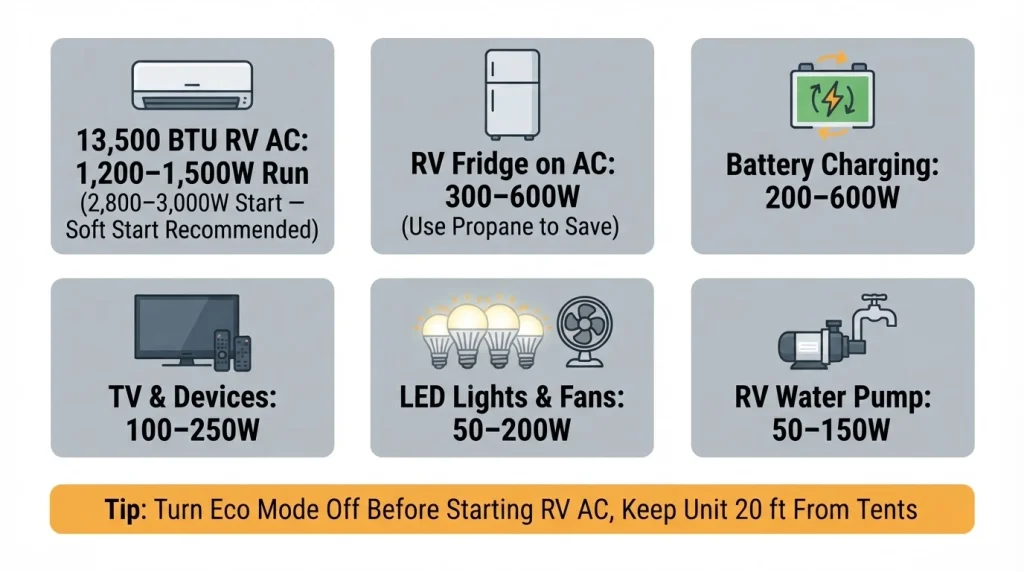
Yes, for many RVs this is the size that finally works. A 3000-watt unit can run a 13,500 BTU RV AC in many cases, especially with a soft start.
A 15,000 BTU AC is harder. It may start, but it leaves little room for anything else.
Will it run an RV air conditioner?
A 13,500 BTU RV AC typically runs at 1,200 to 1,500 watts. It can need 2,800 to 3,000 watts to start without a soft start.
A soft start cuts that surge by a lot. I have seen the same AC start cleanly after a soft start, with the generator barely raising its voice.
Turn off eco mode before you start the AC. Let it settle for a minute, then turn eco mode back on if the load is stable.
What RV and camping loads fit easily?
- RV fridge on AC: 300 to 600 watts, or use propane to save power.
- RV water pump: 50 to 150 watts, runs in short bursts.
- RV lights and fans: 50 to 200 watts total on LED.
- Battery charging: 200 to 600 watts through the converter.
- TV and devices: 100 to 250 watts, safe for clean inverter power.
- Portable heater, low: 750 watts on low, 1,500 watts on high.
Camping is easier than home backup. Lights, a small fridge, a fan, and phone charging use under 800 watts most of the time.
Noise matters at a campsite. Keep the generator 20 feet from tents, point the exhaust away, and respect quiet hours.
Section Takeaway: A 3000-watt inverter generator can run a 13,500 BTU RV AC, RV fridge, lights, pump, and charging gear, but a soft start makes the AC start far more reliable.
What Can a 3000-Watt Inverter Generator NOT Run?
It cannot run central AC, an electric water heater, an electric dryer, or an electric range. Those loads need 3,000 to 10,000 watts each.
It also cannot run a large well pump, a 15,000 BTU RV AC plus a microwave, or two big motor loads at once. The math simply does not fit.
Which heavy loads should you avoid?
- Central AC: Needs 3,000 to 5,000 running watts and a huge start surge.
- Electric water heater: Needs 3,000 to 4,500 watts, alone.
- Electric dryer: Needs 4,000 to 6,000 watts, far past the limit.
- Electric range or oven: Needs 2,000 to 5,000 watts per element or oven.
- Large well pump: Needs 2,000 watts running and 4,000 watts to start.
- Big air compressor: Needs 1,500 watts running and 3,000 watts to start.
A space heater is a trap. It looks small, but it draws 1,500 watts nonstop.
Use a heater on low, or use a fan and blankets instead. Save the watts for the fridge and the furnace blower.
Section Takeaway: Skip central AC, electric heat, electric water heating, dryers, ranges, and large well pumps on a 3000-watt unit — they need far more power than it can give.
How to Run More Appliances Without Overloading It
You do not need a bigger generator to run more. You need a better order, and a few smart swaps.
I use a simple routine in outages. It has kept the same 3000-watt unit from tripping for years.
What is the best start-up order?
- Start the generator with no load, and let it warm up for two minutes.
- Turn off eco mode, then start the biggest motor first, usually the AC or fridge.
- Wait 60 seconds for that load to settle.
- Add the next motor load, then the lights and electronics.
- Add heating appliances last, one at a time.
- Turn eco mode back on only when the load is steady.
Which swaps save the most watts?
- Use propane for the RV fridge: It frees 300 to 600 watts for other loads.
- Use LED lights: They use a tenth of the power of old bulbs.
- Use a fan, not AC: A fan uses 50 to 100 watts, an AC uses 1,000 watts.
- Cook in batches: Heat food, then turn the microwave off before you brew coffee.
- Charge in the day: Charge phones and batteries while the sun is up and the fridge is cold.
A parallel kit is another option. Two 3000-watt units in parallel can double your power, but they cost more and use more fuel.
Check the CPSC generator safety guidance and the CDC carbon monoxide guidance before you set up any parallel or home hookup. Safe placement matters more than extra watts.
Safety note: Run generators outdoors and well away from windows, doors, and vents. Never run one in a garage, even with the door open.
Section Takeaway: Start the biggest motor first, stagger every other load, and swap to propane, LED, and fans where you can to stretch 3000 watts further.
How Long Will a 3000-Watt Inverter Generator Run?
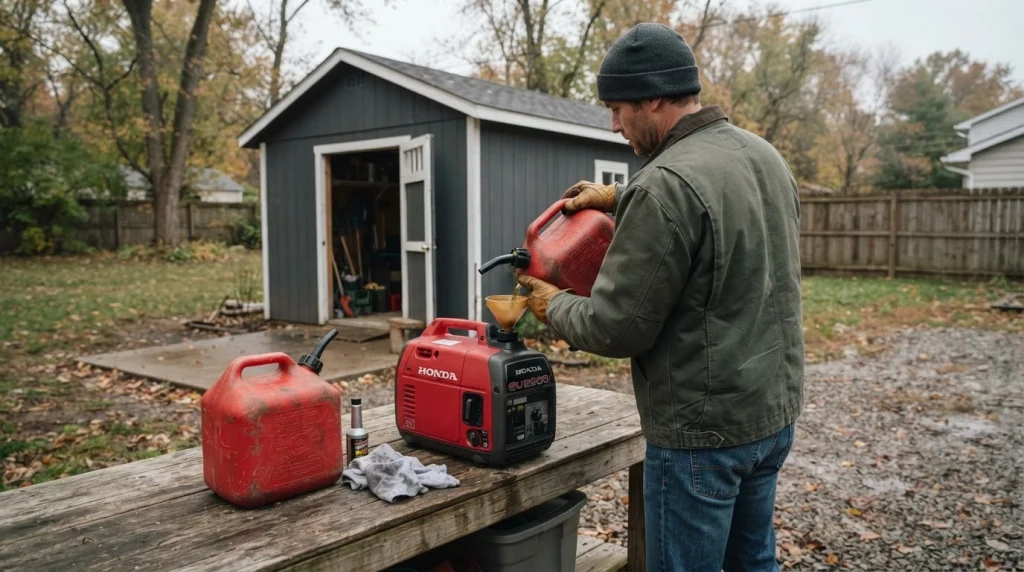
Runtime depends on load, tank size, and eco mode. A typical 3000-watt unit runs 7 to 9 hours at a 50 percent load on a full tank.
At a 25 percent load, that can stretch to 12 to 18 hours. At full load, it can drop to 5 to 7 hours.
How does eco mode change runtime?
Eco mode, also called eco-throttle, slows the engine when the load is light. It saves fuel and cuts noise.
It can hurt motor starts, though. The engine needs a second to ramp up, and a fridge or AC may stall.
I turn eco off for starts, then back on for steady loads. That balance gives me the best fuel use without trips.
How much fuel should you store?
Plan for at least 24 hours of fuel for an outage. That is often 5 to 10 gallons, depending on load.
Store fuel in approved cans, away from the house, and use stabilizer. Stale fuel is the top cause of hard starts.
See Energy.gov for home energy and backup-power basics, and check your manual for oil-change intervals. Most makers call for the first oil change after 20 to 30 hours, then every 100 hours or so.
Section Takeaway: Expect 7 to 9 hours at half load and far longer at light load, and use eco mode for steady loads but not for motor starts.
Is 3000 Watts Enough for You, or Do You Need More?
3000 watts is enough for most outage basics, most RV trips, and most camping. It is not enough for a whole home, a large RV with two ACs, or a job site with big tools.
Use your own list to decide. If your must-run total is under 2,400 watts, 3000 watts will work.
When should you stay at 3000 watts?
- Short outages: Fridge, lights, phones, and a fan are enough.
- Single-AC RV: One 13,500 BTU AC plus basics fits.
- Camping: Lights, fridge, and charging are light loads.
- Budget: 3000-watt models cost less than 4500-watt models.
When should you go bigger?
- Two ACs: You need 4500 watts or more, or a parallel setup.
- Well pump plus fridge: The start surge alone can trip a 3000-watt unit.
- Electric heat: A heater plus a fridge leaves no margin.
- Heavy tools: A table saw or large compressor needs more surge headroom.
Compare the power a 2000-watt inverter generator provides if you want a lighter camping unit. The 2000-watt size is quieter and cheaper, but it cannot run an RV AC.
Check what size inverter generator you need for your full list before you buy. A 10-minute wattage check beats a costly return.
Also check how much a 3000-watt inverter generator costs in 2026, and read Consumer Reports for independent testing notes. Price, noise, and runtime vary a lot by brand.
Section Takeaway: Stay at 3000 watts if your must-run total is under 2,400 watts, and step up to 4500 watts or parallel power if you need two ACs, a well pump, or heavy heat.
Frequently Asked Questions
Can a 3000-watt inverter generator run a refrigerator and microwave at the same time?
Yes, in most cases. A fridge at 150 watts plus a microwave at 1,000 watts totals about 1,150 watts, well under the limit.
Can a 3000-watt inverter generator run a window AC?
Yes, an 8,000 BTU window AC usually works. It runs at 800 to 1,200 watts and needs 1,800 to 2,400 watts to start, so start it first.
Can a 3000-watt inverter generator run a TV and laptop?
Yes, easily. A TV, laptop, router, and phone chargers together use 200 to 300 watts, and clean inverter power is safe for them.
Can a 3000-watt inverter generator run a washing machine?
Yes, for a cold wash. A washer runs at 500 to 800 watts and needs up to 2,000 watts to start, so run it alone.
Can a 3000-watt inverter generator run a sump pump?
Yes, a 1/3 HP sump pump usually works. It runs at 800 to 1,000 watts and needs up to 2,000 watts to start, so keep other big loads off.
Can a 3000-watt inverter generator run a coffee maker and toaster together?
No, not safely with other loads. Together they can draw 2,000 to 2,600 watts, so use one at a time.
Can a 3000-watt inverter generator run a house?
No, not a whole house. It can run essentials through an inlet and transfer switch, but not central AC, electric heat, or a dryer.
A 3000-watt inverter generator is at its best when you pick a short must-run list and stick to it. Start with the fridge, add lights and comms, then add one comfort load at a time.
Write down your own wattage total today, before the next outage. Test it once on a calm weekend, and you will know exactly what your generator can do for you in 2026.

Hi, I’m Michael Turner. I own a generator workshop in the United States and founded HomeGeneratorBlog to share practical, hands-on guidance about generator installation, maintenance, troubleshooting, safety, and backup power solutions. My goal is to help homeowners make smarter, more confident decisions through clear and reliable information