Do All Inverter Generators Support Parallel Operation? No — How to Tell, What You Need & Models That Can’t
Quick Answer
No. Do all inverter generators support parallel operation? Only models built with parallel ports and sync electronics can be linked safely, which is why checking matters before you plan to run multiple appliances at once on combined power.
How to tell in 30 seconds
- Parallel ports present: Look for two small covered ports on the front panel labelled Parallel Operation Outlets.
- Manual says parallel capable: The spec sheet must list parallel capability, not just inverter technology.
- Kit exists for it: The maker sells a specific parallel kit or cord for that exact model family.
- No ports, no link: A unit without ports cannot be paralleled with an adapter, a splitter, or a homemade cord.
What this means for you
- Buy parallel capable now if you may need more watts later, even if one unit is enough today.
I learned this the hard way at a campground. I brought a second small inverter, assumed the ports were standard, and found a blank panel.
This guide shows you how to check any model in minutes. You will also learn why some inverters cannot sync, what a kit actually does, and when a single bigger unit is the smarter buy.
In This Guide
- Do all inverter generators support parallel operation?
- How can you tell if an inverter generator is parallel capable?
- Why can’t some inverter generators be paralleled?
- Parallel capable vs not parallel capable: what changes?
- What do you need to run parallel operation safely?
- Which types of models usually support it, and which don’t?
- When should you skip parallel and buy one bigger generator?
- Frequently Asked Questions
Do all inverter generators support parallel operation?
No, not all of them do. Parallel operation is an optional feature, not a standard part of inverter technology.
An inverter generator is a generator that makes raw AC power, converts it to DC, then inverts it back to clean AC. That clean output helps electronics, but it does not automatically allow linking.
Linking takes extra hardware inside the unit. It also takes matching software that can lock two waveforms together.
I have tested budget suitcase models with no ports at all. I have also tested mid-range models where parallel use was the main selling point.
Price alone does not tell you. Some cheaper models include it, and some larger open-frame inverters do not.
- Parallel capable: Has ports, sync electronics, and a listed kit.
- Not capable: Has no ports and no kit listed in the manual.
- Parallel ready: Marketing term that still means you must buy the kit separately.
Section Takeaway: Inverter and parallel capable are two different labels. Check for both before you buy or plan a two-unit setup.
How can you tell if an inverter generator is parallel capable?

Check the front panel first. Parallel ports are the fastest visual proof.
Look at the panel, the manual, and the kit list
- Front panel: Two round or rectangular ports, often under a rubber cover.
- Label wording: Text that says Parallel Operation, Parallel Outlets, or Parallel Ready.
- Owner’s manual: A full section on connecting two units, with start order and warnings.
- Spec sheet: A line listing the parallel kit part number or combined watt rating.
- Retail listing: A combined watts claim, such as two 2,200-watt units making about 4,400 starting watts together.
If none of those appear, assume it cannot be paralleled. Do not rely on a forum post or a generic cord listing.
When I shop, I compare the panel photo with the manual PDF. If they disagree, I trust the manual for the exact model number.
That habit also helps when you browse the best inverter generators and need to filter for future expandability. A quick check now saves a return later.
Safety note: Never open the control panel or try to add ports yourself. That voids the warranty and can create a shock and fire risk.
Why can’t some inverter generators be paralleled?
They lack the sync circuit that keeps two outputs in phase. Without that lock, two live waveforms fight each other.
Two generators must match voltage, frequency, and timing exactly. Even a tiny drift can trip breakers or damage the inverter board.
That is why the technology matters. Understanding how inverter generator technology works makes the limit clear.
- Cost cutting: Entry models skip ports and boards to hit a lower price.
- Single-use design: Large home-backup inverters are sized to run alone, so makers skip linking.
- Different electronics: Older or simpler inverter boards cannot communicate with a second unit.
- No kit ecosystem: If no tested kit exists, the maker has not validated safe load sharing.
You cannot fix this with a cable alone. The communication happens inside the units, through the parallel ports.
Think of it like cruise control sync on two cars. The cable is only the link, not the brain.
Section Takeaway: No sync electronics means no safe parallel use. No adapter changes that fact.
Parallel capable vs not parallel capable: what changes?
A parallel capable pair gives you modular power. A non-capable unit gives you only its single rating, no matter what you plug in.
| Feature | Parallel Capable | Not Parallel Capable |
|---|---|---|
| Front panel ports | Yes, labelled parallel outlets | No ports |
| Combined watts | Near double, minus kit and load limits in manual | Single unit rating only |
| Kit available | Yes, model-specific kit or cord | None listed |
| Use one or two | Run one for light loads, two for heavy loads | Must size the single unit for peak load |
| 240V from a pair | Only if the kit and models explicitly support it | No |
| Best for | RV, camping, growing loads | Fixed, known loads |
The table also explains a common myth. Parallel does not magically create new outlet types.
Most small pairs still output 120V only. Check the kit outlet, often a TT-30 RV outlet or a twist-lock outlet, before you plan.
What do you need to run parallel operation safely?
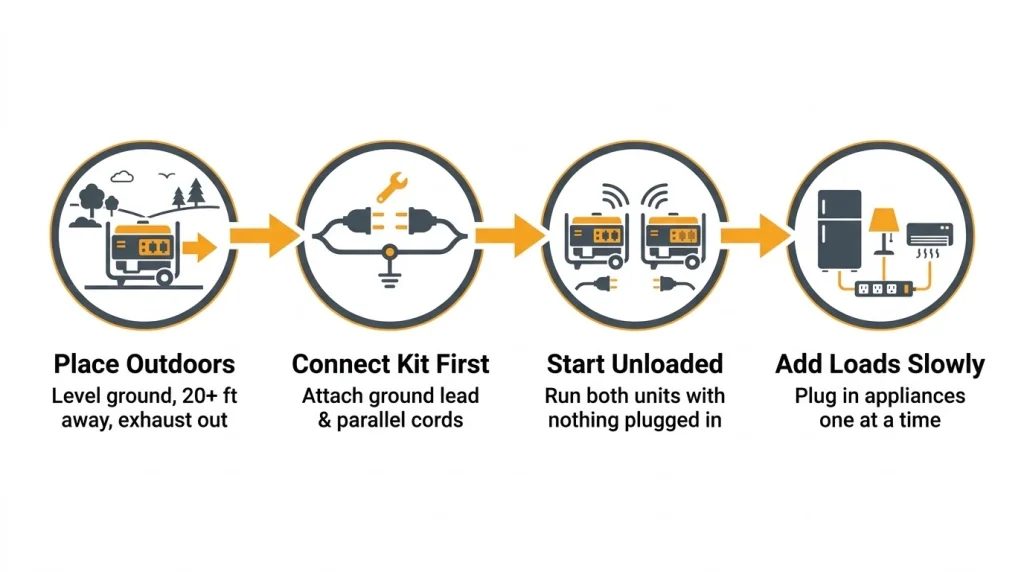
You need two compatible units and the correct kit. Compatibility and start order matter as much as the cord.
The sync works because the inverter stage can be controlled precisely. That control is explained in the guide on why inverters convert AC to DC back to AC.
- Two capable units: Same brand and family is safest, check the manual for mixed wattage rules.
- Correct parallel kit: Use the kit rated for your models and desired outlet.
- Grounding lead: Some kits include a ground wire that must be connected first.
- Level, outdoor placement: Both units outside, far from windows, with exhaust pointing away.
- Load math: Add running watts, then check starting watts for motors and AC compressors.
Start both units with no load plugged in. Connect the kit first, following the manual order for your brand.
Then add loads one at a time. That prevents a surge from tripping both units at once.
Safety note: Run generators outdoors only, at least 20 feet from the home, and follow carbon monoxide guidance from the U.S. Consumer Product Safety Commission. Never backfeed a house panel without a transfer switch installed by a qualified electrician.
Section Takeaway: The right kit plus the right start order makes parallel safe. Guessing either one risks the boards and the load.
Which types of models usually support it, and which don’t?
Small suitcase inverters are the most likely to support it. Large single-purpose inverters are the least likely.
That pattern makes sense for RV and camping use. Two light units are easier to lift than one heavy unit.
- Usually capable: 2,000 to 3,500-watt suitcase models from major brands, sold with an optional kit.
- Sometimes capable: Mid-size dual-fuel inverters, where only certain revisions have ports.
- Often not capable: Ultra-budget no-name models, very large open-frame inverters, and older inverter models.
- Check revision: Same model name can change by year, so verify by exact model number.
For RV use, this check decides your AC plan. See the sizing guide for what size inverter generator can run an RV air conditioner before you assume a pair will start it.
Independent testing notes from Consumer Reports can also help you compare noise and runtime. Those factors matter when you run two units instead of one.
When should you skip parallel and buy one bigger generator?
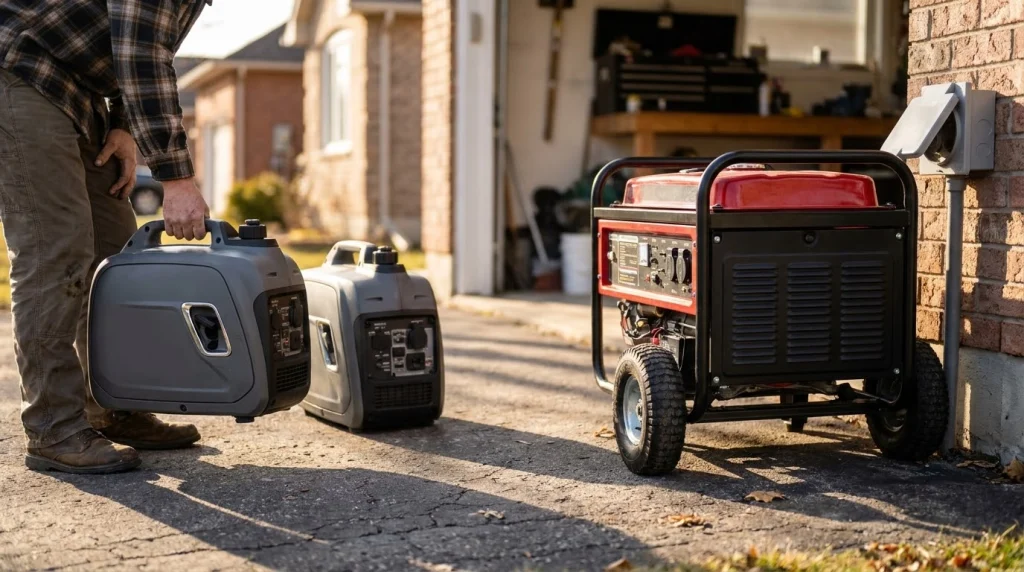
Skip parallel when you always need the full power. One bigger unit is simpler to fuel, maintain, and connect.
Parallel shines when your loads vary a lot. Run one quiet unit at night, then add the second for AC at midday.
- Choose parallel: You value light weight, flexibility, and backup if one unit fails.
- Choose one bigger unit: You need 240V, a 50-amp outlet, or simple one-pull starting every time.
- Choose parallel: You already own one capable unit and your load grew slightly.
- Choose one bigger unit: Your first unit is not capable, so you would need to buy two new units anyway.
For camping, I often recommend starting with one capable unit. That approach matches many picks among the best portable generators for RV camping, where weight matters daily.
For home backup, do the opposite math first. A single larger inverter with a transfer switch is often cleaner, and the U.S. Department of Energy has general home energy guidance that helps frame that choice.
Section Takeaway: Parallel is flexibility, not a requirement. Buy it when modular power fits your real load pattern.
Frequently Asked Questions
Can you add parallel capability to a generator that doesn’t have it?
No, you cannot add it safely with an adapter or aftermarket cord. The unit needs built-in ports and sync electronics from the factory. If yours lacks them, your options are a larger single generator or replacing it with a parallel capable model.
Does parallel capable mean the kit is included?
Usually no. Most brands sell the parallel kit separately, and the kit outlet type varies. Check whether the kit gives you a TT-30 RV outlet, a twist-lock outlet, or standard outlets, and confirm it matches your cord before you buy.
Can you parallel a conventional generator with an inverter generator?
No. Conventional generators do not have the inverter sync system that parallel kits rely on. Attempting to link them can damage both units and create an unsafe output. Only link units the manufacturer lists as compatible for parallel use.
Do you need two identical models to parallel?
Not always, but identical is simplest and safest. Some brands allow different wattages within the same family, with output limited by the kit rating. Check the manual for your exact pair, because cross-brand linking is rarely approved by manufacturers as of 2026.
Will paralleling two generators double the runtime?
No, runtime does not double in a simple way. Each unit burns fuel from its own tank, and load sharing affects consumption. You gain more watts and flexibility, but you will refuel two tanks and maintain two engines.
Is parallel operation louder than one big generator?
It can be similar, but it depends on load and model. Two small units at light load in eco mode can be quieter than one large unit working hard. At full load, two engines running will be noticeable, so test noise at your typical campsite distance.
The bottom line on parallel support
Do all inverter generators support parallel operation? No, and now you can spot the difference in under a minute.
Check the ports, check the manual, and check the kit list. If all three line up, you have a flexible system you can grow.
If they do not line up, do not force it. Size one right unit for your peak load, and enjoy the simpler setup.

Hi, I’m Michael Turner. I own a generator workshop in the United States and founded HomeGeneratorBlog to share practical, hands-on guidance about generator installation, maintenance, troubleshooting, safety, and backup power solutions. My goal is to help homeowners make smarter, more confident decisions through clear and reliable information