How big is a generator for a 2000 sq ft house?
Quick Answer
A typical 2,000 sq ft house needs about 7,500 to 10,000 running watts for practical emergency backup. If you want central air conditioning and most household circuits available at once, a 14 to 22 kW standby generator is often a better starting range, but you should calculate your actual generator power capacity before buying.
Useful Generator Sizes
- 5,000–7,500 watts: Good for a refrigerator, lights, electronics, furnace controls, and selected essentials.
- 7,500–10,000 watts: A practical portable-generator range for pumps, a furnace blower, refrigeration, lights, and selected kitchen loads.
- 10,000–14,000 watts: Gives you more room for larger loads and carefully managed air conditioning.
- 14–22 kW: A more realistic range for broad whole-home standby coverage with central air.
- 22 kW or more: May be needed when heating, water heating, cooking, drying, or other major systems are electric.
Before You Choose
- Check the actual running and starting requirements of the appliances you want to use during an outage.
A 2,000-square-foot house sounds like it should have one simple generator size. It doesn’t, because the electrical loads inside two equally sized homes can be completely different.
When I size backup power, I start with the outage you want to survive rather than the floor plan. That keeps you from buying too little capacity or paying for power you’ll rarely use.
What Size Generator Do You Need for a 2000 Sq Ft House?
For most homes this size, I would start around 7,500 to 10,000 running watts if you’re shopping for a portable generator. That range gives you enough flexibility to run common emergency loads while managing what operates at the same time.
If you expect the generator to behave more like normal utility power, the calculation changes. Central air, well pumps, electric water heaters, ranges, and other 240-volt loads can quickly push you into standby-generator territory.
| Backup Goal | Generator Range | Typical Loads |
|---|---|---|
| Basic essentials | 5,000–7,500 W | Fridge, freezer, lights, internet, electronics |
| Comfortable portable backup | 7,500–10,000 W | Essentials plus furnace blower, pumps, microwave, selected cooling |
| Heavy managed backup | 10,000–14,000 W | More simultaneous circuits and selected 240V equipment |
| Whole-home standby | 14–22 kW+ | Central AC plus broad household coverage |
Generator size means the electrical output a generator can supply, usually expressed in watts or kilowatts. One kilowatt equals 1,000 watts.
These ranges are planning numbers, not a replacement for a proper electrical load calculation. Your actual appliances decide the final number.
Why Doesn’t Square Footage Tell You the Exact Generator Size?
Square footage tells me surprisingly little about a home’s electrical demand. A 2,000 sq ft house with gas heat and gas cooking can need far less generator capacity than an all-electric house of the same size.
The biggest differences usually come from a handful of high-demand systems:
- Central air conditioning: The compressor creates a large startup surge.
- Well pumps: Pump motors often need much more power for a moment when starting.
- Electric water heaters: Heating elements can add several thousand watts.
- Electric ranges: Oven elements and burners create large steady loads.
- Electric dryers: The heating element can consume a major share of portable-generator capacity.
- Electric heating: Resistance heat can make whole-home backup far more demanding.
A gas furnace still uses electricity for its blower and controls, but its generator demand is much smaller than electric resistance heat. That’s why fuel type matters almost as much as house size.
For a broader comparison of different home configurations, see my guide to choosing a generator size for your home.
How Many Watts Do Common Household Appliances Need?
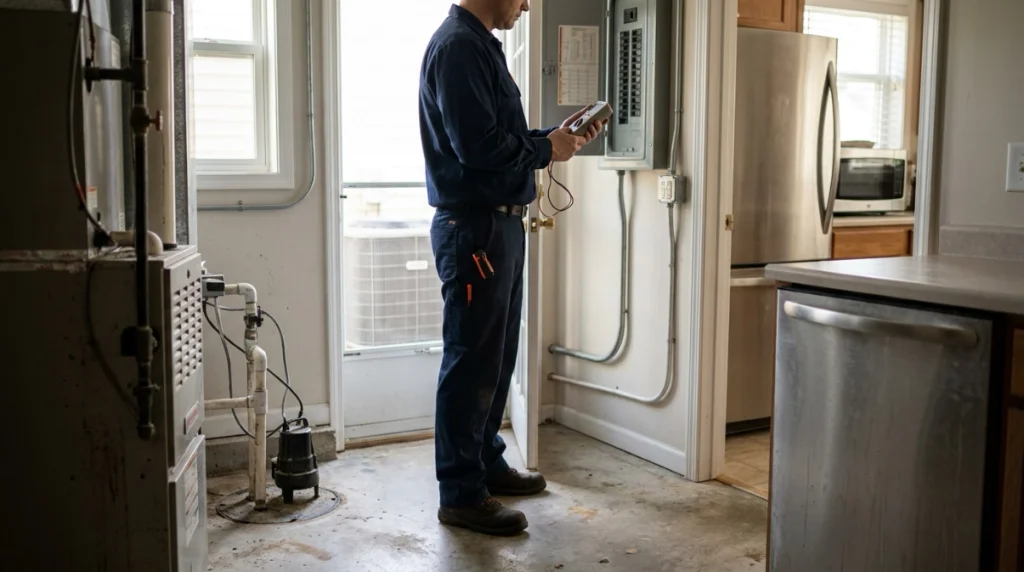
The safest numbers are always on the equipment nameplate or in the owner’s manual. Still, reasonable planning ranges help you build your first worksheet.
| Appliance | Typical Running Watts | Possible Starting Demand |
|---|---|---|
| Refrigerator/freezer | 150–400 W | 800–1,200 W |
| Furnace blower | 300–800 W | 1,000–2,350 W |
| Sump pump | 800–1,050 W | 1,300–2,150 W |
| Well pump | 1,000–1,500 W | 2,000–3,500 W |
| Microwave | 600–1,500 W | Usually little additional surge |
| Window AC | 700–1,200 W | 1,800–2,200 W |
| Central AC | Varies widely by unit | Can be several times running demand |
Don’t treat these numbers as substitutes for your appliance labels. Motor sizes, compressor designs, efficiency, and age all change electrical demand.
How Do You Calculate the Generator Size You Actually Need?
The basic calculation is straightforward: add the running watts of everything you expect to operate together, then account for the largest startup surge. Champion describes the same load-planning principle in its generator sizing guidance.
- List your essential appliances. Ignore equipment you can comfortably leave off during an outage.
- Write down running watts. Add the continuous wattage of everything that may operate together.
- Identify motor loads. Look for refrigerators, pumps, furnace blowers, and air conditioners.
- Find the largest startup surge. Your generator must handle that temporary demand without stalling or tripping.
- Leave operating headroom. Avoid choosing a unit that must run continuously at its maximum rating.
If starting and running ratings are confusing, my running watts vs. starting watts guide explains the difference in detail.
A Worked Example for a 2000 Sq Ft House
Here’s how I would size a simple outage plan without central air. The goal is refrigeration, heating controls, water protection, basic cooking, lighting, and internet.
- Refrigerator: 300 running watts
- Freezer: 250 running watts
- Furnace blower: 600 running watts
- Sump pump: 900 running watts
- Microwave: 1,200 running watts
- Lights: 300 running watts
- Internet and electronics: 250 running watts
That example totals about 3,800 running watts. If the sump pump has the largest motor surge, your short-term peak requirement could rise substantially when it starts.
I wouldn’t buy a 4,000-watt generator for that worksheet. A 7,500-watt-class unit gives much more practical breathing room for startup loads and changing household use.
Is a 7500-Watt Generator Enough for a 2000 Sq Ft House?
Yes, a 7,500-watt generator can be enough for a 2,000 sq ft house when you’re powering selected essentials. It works best when you deliberately manage high-demand appliances.
A 7,500-watt unit can commonly support a combination such as:
- Refrigerator and freezer
- Furnace blower
- Sump pump or selected well-pump loads
- LED lighting
- Router, television, laptops, and chargers
- Microwave used selectively
- A modest window air conditioner
The problem starts when several large loads turn on together. Central air, electric water heating, an electric range, and a dryer can overwhelm this class quickly.
Will a 10000-Watt Generator Run a 2000 Sq Ft House?
A 10,000-running-watt generator is a strong option for managed backup in many 2,000 sq ft homes. It gives you more freedom to operate pumps, refrigeration, heating equipment, and household circuits together.
For example, Champion’s model 201438 is rated for 10,000 running watts on gasoline, 9,000 on propane, and 8,000 on natural gas. That fuel-related difference is exactly why I check the rating for the fuel a homeowner actually plans to use.
Even 10,000 watts doesn’t automatically mean “whole house.” A large central AC compressor or several electric heating appliances can still exceed the available capacity.
What Size Generator Do You Need for Central Air?
Central air is often the load that changes a generator recommendation from portable to standby. Compressor startup demand can be much higher than normal operating demand.
Don’t size the generator from your AC’s running watts alone. Check the unit’s electrical label, including voltage, amperage, and compressor information.
- Small cooling loads: Window AC units are usually much easier to support with portable generators.
- Mini-splits: Efficient inverter-driven models may have gentler startup behavior than traditional compressors.
- Central AC: Larger compressors can require a substantial temporary surge.
- Multiple systems: Two HVAC systems can push whole-home sizing considerably higher.
My detailed guide on generator sizing for air conditioners walks through the cooling calculation separately.
If central AC is non-negotiable during an outage, have an electrician or HVAC technician check the real starting demand. That’s more reliable than estimating from house size or cooling tonnage alone.
Portable or Standby Generator for a 2000 Sq Ft House?
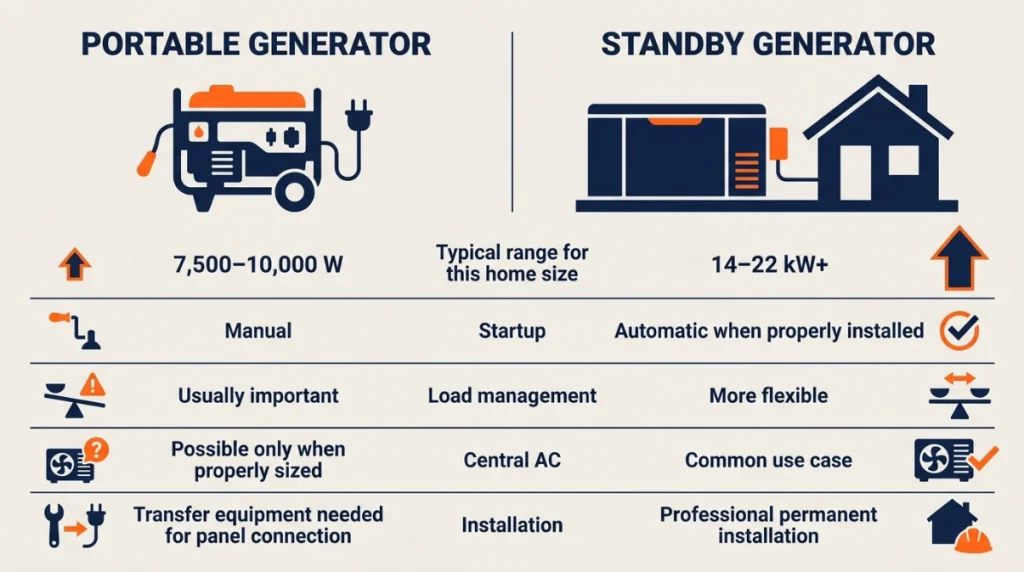
A portable generator makes sense when you’re comfortable choosing which circuits run during an outage. A standby generator makes more sense when you want automatic operation and broader household coverage.
| Feature | Portable Generator | Standby Generator |
|---|---|---|
| Typical range for this home size | 7,500–10,000 W | 14–22 kW+ |
| Startup | Manual | Automatic when properly installed |
| Load management | Usually important | More flexible |
| Central AC | Possible only when properly sized | Common use case |
| Installation | Transfer equipment needed for panel connection | Professional permanent installation |
A 14 kW standby generator is a useful starting class for a moderate-load home, while 18–22 kW gives more flexibility. You can review residential standby options directly through Generac before discussing the final load calculation with an installer.
Does Fuel Type Change Generator Output?
Yes. Multi-fuel portable generators can produce different rated wattage depending on whether you use gasoline, propane, or natural gas.
Always check the specification table for your chosen fuel rather than relying on the largest number printed on the generator. The advertised number may also represent peak watts rather than continuous running watts.
- Gasoline: Often provides the highest listed portable-generator output.
- Propane: Stores well and offers fuel flexibility, but output may be lower on some models.
- Natural gas: Convenient for compatible units, although rated output can be lower than gasoline.
This matters when you’re already close to the generator’s limit. A unit that fits your worksheet on gasoline may have less headroom on another fuel.
How Do You Connect a Generator to a House Safely?
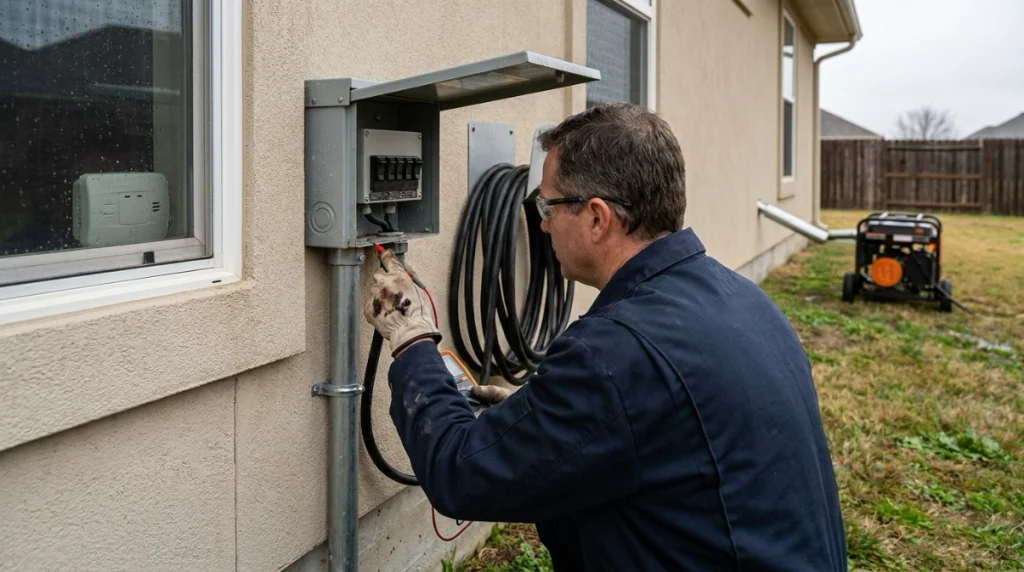
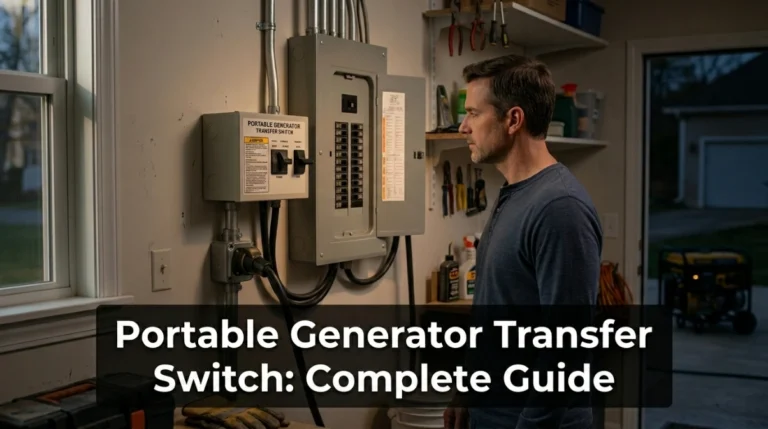
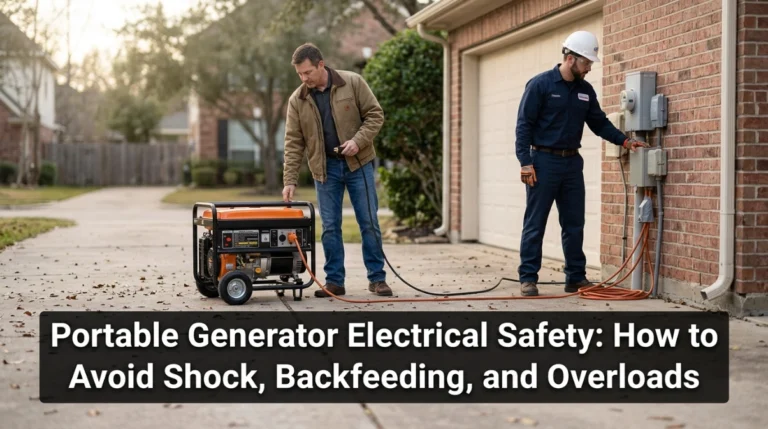
Never improvise a connection from a portable generator into household wiring. A properly installed transfer switch or other approved transfer equipment isolates generator power from utility power and helps prevent dangerous backfeeding.
The Electrical Safety Foundation International recommends using a qualified electrician for home-generator connections. It also warns against connecting a generator directly to household wiring without appropriate transfer equipment.
Carbon monoxide is another critical risk. The U.S. Consumer Product Safety Commission says portable generators should be operated outdoors at least 20 feet from the home, with exhaust directed away.
- Keep portable generators outdoors.
- Keep exhaust away from doors, windows, and vents.
- Install working carbon monoxide alarms.
- Keep the generator dry.
- Use properly rated cords and electrical equipment.
- Never backfeed power through a household outlet.
- Use a licensed or qualified electrician for transfer equipment.
Generator sizing matters, but safe installation matters more. Never trade safety for convenience during an outage.
Generators I Would Consider for a 2000 Sq Ft House
If you’re ready to pick a generator, these are three useful starting points for different backup strategies. Match the unit to your calculated loads before ordering.
🏆 Best Flexible Portable Pick
Champion 201438 10,000W Tri-Fuel Generator
★★★★☆
It delivers 10,000 running watts on gasoline, 9,000 on propane, and 8,000 on natural gas, with 120/240V output. I like this class when fuel flexibility matters and the homeowner is willing to manage loads during an outage.
⚡ Best High-Output Portable Pick
Westinghouse WGen9500DFc
★★★★☆
This dual-fuel model is rated at 9,500 running watts and 12,500 peak watts on gasoline, with 8,500 running watts on propane. I would consider it for a homeowner who wants strong portable backup without jumping immediately to a permanently installed standby system.
🏠 Best Standby Starting Point
Generac Guardian 14kW Home Standby Generator
★★★★★
The 14 kW Guardian class provides substantially more continuous capacity than a typical portable unit and is built for permanent home backup. I see 14 kW as a useful place to begin the conversation for a 2,000 sq ft home with moderate loads, but central AC and electric-heavy homes may need more.
Frequently Asked Questions
Will a 10,000-watt generator run a 2000 sq ft house?
Yes, a 10,000-running-watt generator can provide strong emergency backup for many 2,000 sq ft houses. It may run refrigeration, pumps, furnace equipment, lighting, electronics, and selected kitchen loads, but large central AC or electric heating can require more capacity.
Will a 5000-watt generator run a 2000 sq ft house?
A 5,000-watt generator can power selected essentials, but it usually won’t provide broad whole-house coverage. It works better for a refrigerator, freezer, lights, electronics, heating controls, and carefully managed small loads.
What size generator runs a whole house with central AC?
A 2,000 sq ft house with central air may need roughly 14–22 kW of standby capacity, depending on the AC startup load and other appliances. Homes with electric water heating, cooking, clothes drying, or electric heat may need a larger system.
Should I buy a generator bigger than my calculated load?
Some extra operating headroom is sensible because motor loads surge and household demand changes throughout an outage. Avoid buying a unit sized so tightly that normal operation keeps it close to maximum output.
Is a portable generator enough for a 2000 sq ft home?
Yes, if your goal is emergency essentials rather than running every circuit normally. A 7,500–10,000-running-watt portable generator is a practical range for many homes when loads are managed carefully.
Final Takeaway
If someone asks me how big of a generator they need for a 2,000 sq ft house, my practical starting answer is 7,500–10,000 running watts for portable backup. That range handles the needs most homeowners actually prioritize during an outage.
For automatic whole-home backup with central air, I would start the conversation around 14–22 kW and calculate the actual electrical loads before choosing a model. Size the appliances you need, not the square footage printed on your property listing.

Hi, I’m Michael Turner. I own a generator workshop in the United States and founded HomeGeneratorBlog to share practical, hands-on guidance about generator installation, maintenance, troubleshooting, safety, and backup power solutions. My goal is to help homeowners make smarter, more confident decisions through clear and reliable information