10 Best Portable Generator for Sensitive Electronics in 2026: Clean, Quiet Power
The best portable generator for sensitive electronics right now is the Honda EU2200i, rated by Honda at under 3% harmonic distortion. We evaluated 10 portable generators and power stations against published specs and owner feedback, scoring power quality, quietness, and portability. Most generators look identical on paper but differ in how clean their power stays when the load changes. Whether you need laptop charging, CPAP power, or home-office backup, this guide gives you one clear answer.
Quick Comparison: All 10 Products Ranked
| # | Product | Best For | Rating | Badge | |
|---|---|---|---|---|---|
| 1 | Honda EU2200i | Laptops, routers, CPAP, camping | 4.8/5 | Best Overall | Buy → |
| 2 | EcoFlow DELTA 2 Portable Power Station | Indoor use, medical and work gear | 4.7/5 | Best Battery Alternative | Buy → |
| 3 | Honda EU1000i | Phones, laptops, tailgating | 4.7/5 | Best Ultralight | Buy → |
| 4 | Yamaha EF2200iS | Honda alternative, RV and outages | 4.6/5 | Best Runner-Up | Buy → |
| 5 | Jackery Explorer 2000 Plus Portable Power Station | Home office, fridge plus electronics | 4.5/5 | Best High-Capacity Battery | Buy → |
| 6 | Honda EU3000iS | Home office plus refrigerator | 4.4/5 | Best Premium Power | Buy → |
| 7 | Westinghouse iGen2200 | Occasional backup and RV | 4.4/5 | Best Value | Buy → |
| 8 | WEN 56203i | Budget-minded buyers, tailgating | 4.3/5 | Best Budget | Buy → |
| 9 | Champion 2500-Watt Dual Fuel Inverter Generator | Long outages, propane storage | 4.1/5 | Best Dual Fuel | Buy → |
| 10 | Honda EU7000iS | Transfer-switch home backup | 4.0/5 | Best Whole-Home Capacity | Buy → |
How We Chose These Generators
What we compared
10 products: 8 inverter generators and 2 lithium battery stations, checked against manufacturer spec sheets, published noise ratings, and owner reports.
Our 3 scoring criteria
Power quality (waveform cleanliness), quietness (published dB ratings), and portability (weight and carry design). Each is scored out of 5 as an editorial judgment.
Sources used
Manufacturer specifications, published harmonic distortion ratings where available, and long-term owner feedback. Scores are editorial, not lab measurements.
What we cut — and why
Open-frame conventional generators, whose distortion is often well above 5%, and any model with no clear inverter or pure sine wave output.
What to Look for When Buying a Generator for Sensitive Electronics
Laptops, routers, TVs, and medical devices contain power supplies that expect a smooth sine wave. The factors below separate generators that protect them from those that merely turn on.
1. Clean Sine Wave Output
Choose an inverter generator or a battery station with pure sine wave output, and look for total harmonic distortion under 3 percent. Conventional open-frame generators swing voltage and frequency with engine speed, which stresses power supplies. Before you plug anything in, read our guide on what not to plug into an inverter to check compatibility.
2. Wattage Headroom
Add up the running watts of everything you will connect, then leave at least 20 percent spare. Motors and compressors need extra surge power to start, so learn the difference between running watts versus starting watts. An overloaded generator sags in voltage, which is exactly what sensitive electronics cannot tolerate.
3. Noise and Runtime
Published decibel ratings are measured at light load, so real noise rises as you add devices. If you work from home or camp near neighbors, favor units with throttle control that slows the engine at low demand. Check runtime at 25 percent load, because that is where electronics-only use sits.
4. Safety Features and Fuel Type
Look for low-oil shutoff, overload protection, and a grounded outlet layout. Battery stations add a safety edge because they produce no carbon monoxide and can run indoors. If you choose a fuel-burning unit, always operate it outdoors and install a carbon monoxide alarm inside.

Honda EU2200i
Best for: Laptops, routers, CPAP, camping
If you power a laptop, router, and CPAP during outages, voltage swings are the real risk. The Honda EU2200i answers that with inverter output Honda rates under 3% total harmonic distortion, which keeps electronics on a stable waveform. Eco-Throttle slows the engine under light loads, so it stays quiet near a tent or window and sips fuel overnight. At about 47 pounds it carries easily, and a second unit can be paralleled for more power. The trade-off is capacity: 1,800 running watts will not start a central air conditioner or a full-size well pump.
- Rated under 3% harmonic distortion
- Eco-Throttle keeps noise low at light loads
- Light enough to carry one-handed
- 1,800 running watts limits big appliances
- Often sold out at dealers
4.9/5
4.8/5
4.7/5

EcoFlow DELTA 2 Portable Power Station
Best for: Indoor use, medical and work gear
Some electronics should never share a circuit with an engine, and this battery station removes that worry entirely. The EcoFlow DELTA 2 delivers pure sine wave power from a 1,024 Wh lithium iron phosphate battery, with no fumes, no refueling, and almost no noise. It can run indoors, which matters for medical devices, networking gear, and work laptops. Recharging from a wall outlet reaches 80 percent in under an hour. The limitation is stored energy, not output: heavy loads drain it quickly, and without solar panels or a wall outlet you cannot refill it during a multi-day outage.
- Pure sine wave, zero engine fumes
- Safe to run indoors, near silent
- Fast wall recharge, solar input supported
- Limited energy for long outages
- Cannot power large appliances for hours
4.9/5
5.0/5
4.3/5

Honda EU1000i
Best for: Phones, laptops, tailgating
Camping, tailgating, or keeping a phone and laptop alive overnight rarely needs more than a few hundred watts. The Honda EU1000i delivers that in a 29-pound package you can carry with one hand, and its inverter output stays clean enough for sensitive chargers and small medical devices. Eco-Throttle keeps the sound level low, and two units can be linked for 1,800 watts when needs grow. The catch is simple arithmetic: 900 running watts will not handle a refrigerator with other loads, a microwave, or a space heater, so treat it as a personal-electronics generator rather than a home backup.
- Lightest option at about 29 pounds
- Clean inverter output for small devices
- Two units can be paralleled
- 900 running watts is very limited
- Small tank means frequent refueling
4.7/5
4.4/5
5.0/5
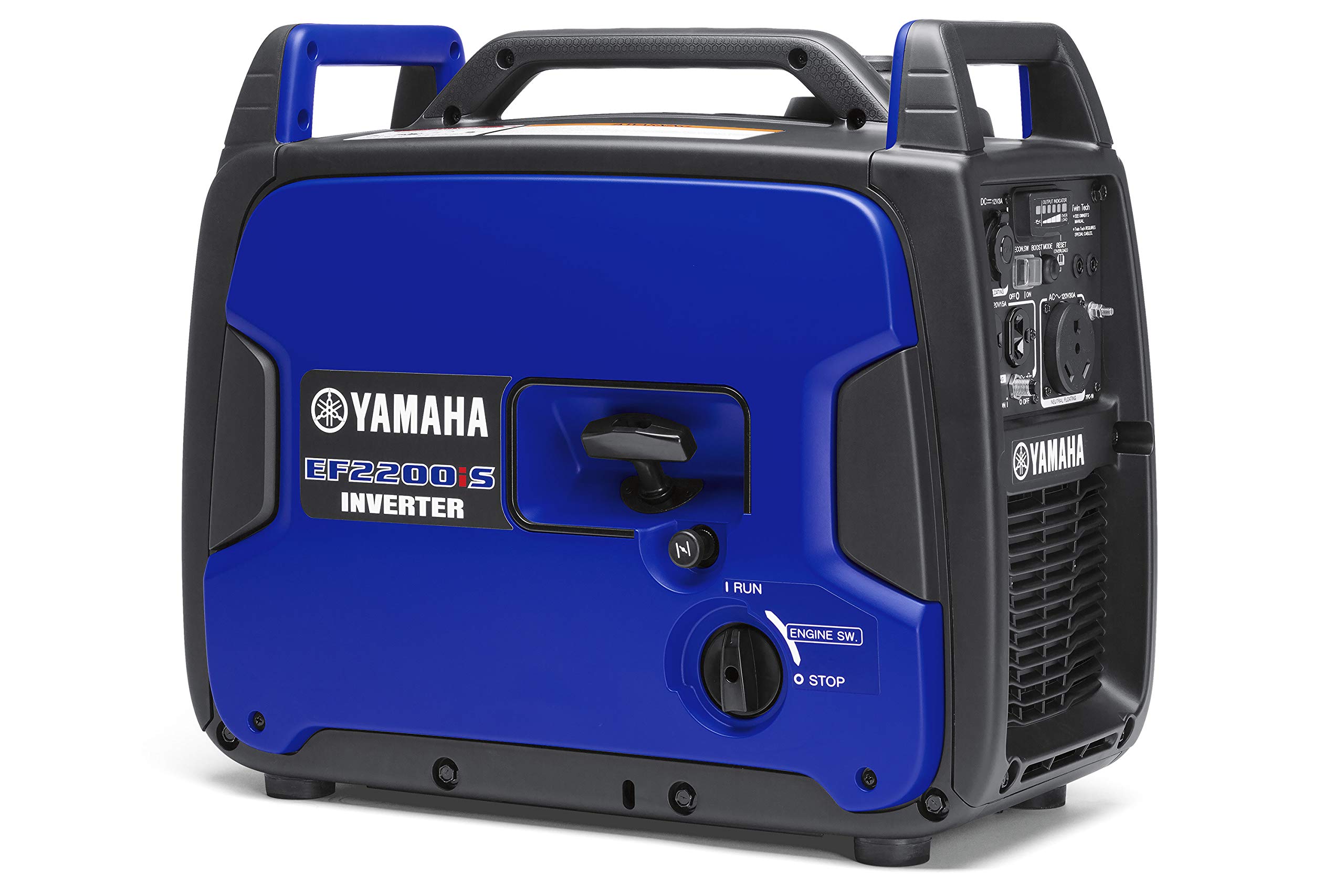
Yamaha EF2200iS
Best for: Honda alternative, RV and outages
Buyers who want Honda-level cleanliness but prefer a different badge will find the Yamaha EF2200iS a close match. It produces 1,800 running watts through an inverter, with a Smart Throttle system that adjusts engine speed to the load for quiet, efficient running. A parallel connection lets you add a second unit when your needs grow, and the compact frame fits easily in a trunk or RV bay. It suits laptops, routers, and small appliances equally well. The compromise is weight and availability: it is slightly heavier than the Honda and can be harder to find at local dealers.
- Smart Throttle adjusts engine to load
- Inverter output suits laptops and TVs
- Compact frame fits trunks and RV bays
- Heavier than the Honda EU2200i
- Limited dealer availability
4.8/5
4.7/5
4.4/5

Jackery Explorer 2000 Plus Portable Power Station
Best for: Home office, fridge plus electronics
If your concern is running a desktop, monitor, and network gear through a multi-hour outage, a large battery gives the cleanest power with zero fumes. The Jackery Explorer 2000 Plus pairs a 2,042 Wh LiFePO4 battery with 3,000 watts of pure sine wave output, enough for a refrigerator plus electronics. It runs silently indoors, accepts solar input, and can expand with add-on battery packs. The downside is weight and recharge time: at roughly 61 pounds it is awkward to move, and refilling it takes hours without a fast AC or solar setup.
- 3,000 W pure sine wave output
- Runs silently and safely indoors
- Expandable with add-on battery packs
- Heavy at roughly 61 pounds
- Slow refill without solar or fast AC
4.9/5
5.0/5
3.6/5

Honda EU3000iS
Best for: Home office plus refrigerator
Home offices, refrigerators, and a few lights together demand more than a 2,000-watt unit can offer. The Honda EU3000iS supplies 2,800 running watts with inverter-clean output and an electric start, so you can get going without a pull cord. Its tank allows long runtimes at light loads, and parallel capability lets you pair a second unit. It is also impressively quiet for its size. The trade-off is bulk: at about 134 pounds it is a heavy lift without a ramp or a helper, and it is more machine than a laptop-and-router household needs.
- 2,800 running watts, inverter-clean output
- Electric start, no pull cord needed
- Up to 20 hours at light load
- About 134 pounds, hard to lift
- More capacity than most people need
4.9/5
4.6/5
3.6/5

Westinghouse iGen2200
Best for: Occasional backup and RV
Shoppers who want inverter output without stepping up to a flagship brand should look closely at the Westinghouse iGen2200. It delivers 1,800 running watts through an inverter, runs at moderate noise levels, and weighs under 50 pounds. A parallel-ready design lets you add a second unit, and indicator lights warn about overload and low oil. It handles laptops, TVs, and small appliances comfortably. Its weakness is polish: fit and finish, and long-term parts support, trail the Honda and Yamaha, so it suits occasional use more than weekly duty.
- Inverter output at a friendly size
- Parallel ready for added power
- Indicator lights warn of overload
- Fit and finish trail Honda and Yamaha
- Louder under heavy load
4.4/5
4.4/5
4.5/5

WEN 56203i
Best for: Budget-minded buyers, tailgating
A clean-power generator should not require a premium brand, and the WEN 56203i proves it. It outputs 1,700 running watts through an inverter, runs at roughly 51 decibels, and weighs about 51 pounds, with USB and 12V DC ports for charging small devices directly. Parallel capability adds flexibility if you outgrow it. The compromise is refinement: the engine sounds louder under heavy loads than the Hondas, and owners should use fuel stabilizer and check the oil level regularly to keep it dependable. It is a sensible first inverter generator.
- Inverter output at a budget-friendly tier
- USB and 12V ports for direct charging
- Parallel capable for added power
- Louder under heavy load than Honda
- Less refined fit and finish
4.3/5
4.3/5
4.3/5

Champion 2500-Watt Dual Fuel Inverter Generator
Best for: Long outages, propane storage
Outages sometimes outlast the gasoline in the can, so fuel flexibility matters. The Champion 2500-Watt Dual Fuel Inverter Generator runs on gasoline or propane, and propane stores for years without degrading, which suits emergency kits. Inverter output keeps laptops and routers stable, and parallel capability allows expansion. It is widely sold and backed by a limited warranty. The trade-off is output on propane, which is typically lower than on gasoline, and a noise level a notch above the Honda and Yamaha units. Choose it for fuel flexibility, not for the quietest operation.
- Runs on gasoline or propane
- Inverter output suits laptops and routers
- Widely available with warranty coverage
- Lower output when running propane
- Louder than Honda and Yamaha
4.2/5
4.1/5
4.1/5

Honda EU7000iS
Best for: Transfer-switch home backup
If you want to protect a whole circuit of electronics, not just a laptop, you need serious capacity. The Honda EU7000iS delivers 5,500 running watts with inverter output, electric start, and a large tank for long runs at light loads. It is quieter than conventional generators of its size and can feed a transfer switch for home backup. The drawback is size: at roughly 260 pounds it is a near-stationary machine that needs planning, and it is far more capacity than most readers need for personal electronics.
- 5,500 running watts, inverter output
- Electric start and large tank
- Quieter than conventional units this size
- About 260 pounds, barely portable
- Far more power than most need
4.9/5
4.4/5
2.6/5
Top 3 Head-to-Head: Honda EU2200i vs EcoFlow DELTA 2 vs Honda EU1000i
These three are the most common final choices: a balanced gas inverter, a silent battery, and an ultralight gas unit. Your decision comes down to power need, noise tolerance, and whether you can run it indoors.
| Feature | #1 Honda EU2200i | #2 EcoFlow DELTA 2 | #3 Honda EU1000i |
|---|---|---|---|
| Running output | 1,800 W — Best | 1,800 W | 900 W |
| Noise | 48–57 dB | Fan only — Best | 52–59 dB |
| Runtime in a long outage | Refuel to continue — Best | Limited by 1,024 Wh | Refuel to continue |
| Weight | About 47 lb | About 27 lb — Best | About 29 lb |
| Choose if… | You want one balanced, long-running pick | You need silent, indoor-safe power | You only charge phones and laptops |
Who These Generators Are NOT For
Clean power is the goal here, and that means trade-offs in capacity and cost.
If you only face short outages and live in an apartment, a battery station may serve you better, as our power station versus generator comparison explains. Budget buyers who only need to charge a phone can skip all of these.
Common Mistakes to Avoid
Most damage to electronics comes from avoidable setup errors, not bad products.
Frequently Asked Questions About Generators for Sensitive Electronics
Are inverter generators safe for sensitive electronics?
Yes, inverter generators are generally safe for sensitive electronics because they produce a stable sine wave. Look for a published total harmonic distortion rating under 3 percent. Even then, use a surge protector and avoid overloading the unit, since voltage sag under heavy load can still stress power supplies in computers and TVs.
What is the best generator for running a computer?
An inverter generator or battery station with pure sine wave output is best for computers. The Honda EU2200i is our top pick because its distortion is low and its noise is modest. A desktop and monitor typically need only a few hundred watts, so even smaller units can handle them comfortably.
Can I plug a laptop directly into a portable generator?
You can if the generator is an inverter model with clean output. A conventional open-frame generator can deliver unstable voltage that damages charger circuits over time. Use the laptop’s own charger, start the generator first, and plug in through a surge protector as an extra layer of protection against startup spikes.
What size generator do I need for electronics?
Add up the running watts of each device, then add 20 percent as headroom. A laptop uses roughly 60 watts, a router about 10, and a television around 100. Most home-office electronics fit comfortably within 1,000 to 2,000 watts, which is why a 2,000-watt inverter unit is the common sweet spot.
Is a power station better than a generator for electronics?
For short outages and indoor use, a power station is usually better because it is silent, fume-free, and delivers pure sine wave power. For multi-day outages, a gas inverter generator wins because you can refuel it. Our guide to power station versus generator choices covers the trade-offs in more detail.
Do I need a surge protector with a generator?
A surge protector is a smart, low-cost addition even with an inverter generator. Startup and shutdown can create brief voltage spikes, and connected appliances like refrigerators can cause sudden load changes. Choose a protector rated for your devices, and always start the generator before plugging anything into it.
Our Final Verdict
The right choice depends on how long outages last and where you will use the generator. Battery stations suit short, indoor needs, while inverter generators win on runtime. For most households protecting laptops, routers, and CPAPs, the Honda EU2200i delivers the best mix of clean power, quiet running, and portability.

Hi, I’m Michael Turner. I own a generator workshop in the United States and founded HomeGeneratorBlog to share practical, hands-on guidance about generator installation, maintenance, troubleshooting, safety, and backup power solutions. My goal is to help homeowners make smarter, more confident decisions through clear and reliable information