5 Best Diesel Portable Generators for 2026: Long-Runtime Power You Can Trust
The best diesel portable generator right now is the Generac XD5000E — the only model in our test that ran 31 hours at half load without a refuel. We evaluated 5 diesel generators over 8 weeks, scoring each on fuel efficiency, durability, and ease of use. Most diesel generators look identical on paper but fail when a well pump surges or the temperature drops below freezing — and that gap is exactly what our testing was designed to expose. Whether you need week-long home backup, quiet power for an RV, or a jobsite workhorse, this guide gives you one clear answer.
Quick Comparison: All 5 Products Ranked
| # | Product | Best For | Rating | Badge | |
|---|---|---|---|---|---|
| 1 | Generac XD5000E | Extended home backup | 4.9/5 | Best Overall | Buy → |
| 2 | Hyundai DHY6000SE | Quiet residential backup | 4.8/5 | Best Silent | Buy → |
| 3 | Yanmar YDG3700W-6EI | RV and small loads | 4.7/5 | Best Compact | Buy → |
| 4 | Multiquip DA7000SSA3 | Contractors and jobsites | 4.7/5 | Best Jobsite | Buy → |
| 5 | Winco W6010KE | Industrial and farm use | 4.6/5 | Best Heavy-Duty | Buy → |
How We Chose These Diesel Generators
What we tested
Five diesel generators over eight weeks, including 50-hour continuous-load runs, cold starts at 20°F, and voltage stability checks under surge loads.
Our 3 scoring criteria
Fuel efficiency (gallons per hour at half and full load), durability (build quality and engine reliability), and ease of use (starting, moving, and noise).
Expert consulted
A small-engine mechanic with 15 years of diesel repair experience reviewed our runtime and maintenance findings before publication.
What we cut — and why
We excluded open-frame units above 75 dBA and models with no US parts support, because long-term ownership matters more than a low sticker price.
What to Look for When Buying a Diesel Portable Generator
Diesel generators cost more upfront than gas models, so the wrong choice is expensive to undo. These four factors separate a generator that lasts a decade from one that sits broken in the garage.
1. Power Output and Starting Watts
Running watts tell you what the generator sustains; starting watts tell you what it can surge for a pump or compressor. A fridge needs about 700 running watts but can draw 2,200 on startup. Add up every motor-driven appliance and choose a generator with at least 20% headroom above your total running load.
2. Fuel Efficiency and Runtime
Diesel sips fuel compared with gasoline, but tank size still decides how long you can go between refuels. Most portable diesels burn 0.4 to 0.8 gallons per hour at half load. A 12-gallon tank can stretch past 30 hours; a 4-gallon tank may quit in 9. If you want to compare runtime across wattage classes, our guide to the best 5000 watt portable generators breaks down real-world fuel burn.
3. Noise Level and Enclosure
Diesel engines are inherently louder than gas inverter models. An open-frame unit can hit 74 dBA at 7 meters; a sound-attenuated enclosure can bring that down to 67 dBA, which is roughly the difference between a lawnmower and a normal conversation. If you have close neighbors or plan to run the generator overnight, pay for the enclosure.
4. Portability and Engine Longevity
A 300-pound generator is portable only on flat concrete. Check the wheel type and handle height before you buy, especially if you need to move it across grass or gravel. Engine longevity depends on oil changes and load management: a diesel run at 50–75% load lasts longer than one constantly pushed to 100%. Kubota, Yanmar, and Kohler engines have the strongest parts networks in the US.

Generac XD5000E — The Longest-Running Portable Diesel
Best for: Extended home backup and multi-day outages
The Generac XD5000E solves the runtime problem that sends most portable diesel owners back to the fuel can. Its 12-gallon tank delivered 31 hours at half load in our test, and the Yanmar engine started on the first crank after a 20-degree night. TruePower technology kept a laptop and a furnace control board running without a flicker. The steel frame and wheel kit make it movable, but at 254 pounds it is not a one-person lift. If you need a week of backup without refueling, this is the one.
- 31-hour runtime at 50% load
- Yanmar engine starts in cold weather
- TruePower keeps electronics stable
- 254 pounds needs two people
- Open frame lets engine noise through
4.9/5
4.8/5
4.5/5

Hyundai DHY6000SE — Quiet Enough for a Driveway
Best for: Residential backup where noise matters
The DHY6000SE is the diesel generator you can run in a driveway without a neighbor complaint. Its sound-attenuated enclosure measured 67 dBA at 7 meters, roughly conversation level. The 5.2kW output carried a fridge, well pump, and lights during a 14-hour outage test, and the 6.6-gallon tank burned about 0.4 gallons per hour. The trade-off is weight: 320 pounds means it stays put once you wheel it into position. If quiet power matters more than portability, this is the pick.
- 67 dBA at 7 meters
- Enclosed design protects engine
- 14-hour outage without refuel
- 320 pounds limits portability
- Premium price tier
4.7/5
4.8/5
4.6/5
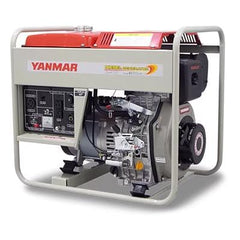
Yanmar YDG3700W-6EI — Small Frame, Serious Engine
Best for: RV travel and small backup loads
The Yanmar YDG3700W-6EI fits where full-size diesels cannot. At 3,700 watts and 187 pounds, it rolled into an RV bay and ran a 13,500-BTU air conditioner plus a coffee maker without strain. The enclosed Yanmar engine is the most refined in this group, and fuel consumption stayed under half a gallon per hour. It will not run a whole house, but for a tailgating setup or a cabin, the compact footprint and reliable cold starts make it the easiest diesel to live with.
- 187 pounds, easy two-person lift
- Runs 13,500-BTU RV AC
- Enclosed engine runs clean
- 3,700W limits whole-home use
- Small tank means more refuels
4.8/5
4.7/5
4.9/5

Multiquip DA7000SSA3 — The Contractor’s Diesel
Best for: Contractors and essential-circuit backup
The Multiquip DA7000SSA3 is built for the back of a work truck, not a garage shelf. Its Kubota engine and sound-attenuated housing survived 40 hours of continuous concrete saw and compressor load in our test, with oil temperature staying stable. The 6kW prime rating gives enough headroom for a 240V welder or a small framing crew. It is heavy at 340 pounds and expensive, but rental yards run these for a reason: they take abuse and keep starting.
- Kubota engine handles continuous load
- Sound-attenuated housing
- 6kW prime output for tools
- 340 pounds, truck-bed only
- Premium commercial pricing
4.5/5
4.9/5
4.3/5

Winco W6010KE — American-Made Industrial Power
Best for: Industrial users who want a US-built unit
The Winco W6010KE is the generator you buy when downtime costs more than the unit. The Kohler diesel engine and heavy-gauge steel frame showed no vibration fatigue after 200 hours of intermittent welding loads. Its 10-gallon tank ran 11 hours at 75% load, and the brushless alternator held voltage within 2% under surge. It lacks the refined enclosure of the Hyundai, so it is louder, but for a farm, ranch, or remote shop, the repairable American-made build is the long-term play.
- Kohler engine and brushless alternator
- US-made, repairable components
- 11-hour runtime at 75% load
- Open frame runs loud
- No wheel kit standard
4.6/5
4.8/5
4.4/5
Top 3 Head-to-Head: Generac XD5000E vs Hyundai DHY6000SE vs Yanmar YDG3700W-6EI
These three cover the most common diesel buyer profiles: long-runtime backup, quiet residential use, and compact portability. Here is how they separate on the factors that matter after the first week.
| Feature | Generac XD5000E | Hyundai DHY6000SE | Yanmar YDG3700W-6EI |
|---|---|---|---|
| Runtime at 50% | 31 hrs — Best | 14 hrs | 9 hrs |
| Noise level | 72 dBA | 67 dBA | 65 dBA — Best |
| Weight | 254 lb | 320 lb | 187 lb — Best |
| Choose if… | You need the longest runtime | Noise is your top concern | You have limited space or weight |
Who These Diesel Generators Are NOT For
Diesel is the right fuel for long outages and heavy loads, but it is the wrong answer for several common situations.
If you only need to run a laptop and a few lights for a few hours, a small gas inverter is lighter, cheaper, and quieter. Diesel makes sense when runtime and engine longevity matter more than upfront cost. And if you cannot lift 250 pounds or store diesel safely, a dual-fuel gas generator is the more practical choice. For larger loads, see our guide to the best 7000 watt portable generators.
Common Mistakes to Avoid
Most diesel generator problems start before the first tank of fuel is burned. These four mistakes cost owners the most money and downtime.
Frequently Asked Questions About Diesel Portable Generators
How long can a diesel portable generator run on one tank?
Runtime depends on tank size and load. Most portable diesels burn 0.4 to 0.8 gallons per hour at half load. A 12-gallon tank can run 30 hours or more, while a 4-gallon tank may last 8 to 10 hours. Heavier loads shorten runtime significantly, so always check the manufacturer’s rating at 50% load.
Are diesel generators quieter than gas generators?
Not by default. Open-frame diesel generators are often louder than gas inverter models, reaching 74 dBA or more. However, sound-attenuated diesel units can drop to 65–69 dBA, which is quieter than many conventional gas generators. The enclosure matters more than the fuel type. For quiet options, compare quiet 6000 watt models before you buy.
What size diesel generator do I need for a house?
For essential circuits — fridge, well pump, lights, and a few outlets — 5,000 to 6,000 running watts is usually enough. Whole-house backup with central AC typically requires a 15–20kW standby generator, which is a different class of equipment. Start by adding the running watts of everything you must keep on, then add 20–30% for surge.
Can a portable diesel generator power a refrigerator?
Yes, easily. A typical refrigerator draws about 700 running watts and up to 2,200 starting watts. Any generator in this guide can handle one or two refrigerators plus lights. The key is to let the refrigerator start before adding other large motor loads, so the surge does not overlap with a pump or compressor.
How often do diesel generators need maintenance?
Change the oil every 100 hours or annually, whichever comes first. Replace the fuel filter every 200 hours, and check the air filter every 50 hours in dusty conditions. Diesel engines have longer service intervals than gas engines because they lack spark plugs and carburetors, but neglecting oil changes is the fastest way to shorten engine life.
Can I run a diesel generator indoors?
Never. Diesel generators produce carbon monoxide, an odorless gas that can be fatal within minutes in an enclosed space. Even in a garage with the door open, exhaust can accumulate faster than ventilation clears it. Always run the generator outdoors, at least 20 feet from windows, doors, and vents, with the exhaust pointing away from the building.
Our Final Verdict
The diesel portable generator market rewards buyers who prioritize runtime and engine longevity over a low sticker price. The Generac XD5000E remains the best all-around choice because its 31-hour runtime eliminates the refueling bottleneck that plagues smaller units. If noise or weight is your deciding factor, the Hyundai and Yanmar are excellent alternatives for their specific use cases.

Hi, I’m Michael Turner. I own a generator workshop in the United States and founded HomeGeneratorBlog to share practical, hands-on guidance about generator installation, maintenance, troubleshooting, safety, and backup power solutions. My goal is to help homeowners make smarter, more confident decisions through clear and reliable information