10 Best Commercial Portable Generators for 2025: Jobsite Power That Keeps Crews Working
When your generator dies mid-morning on a jobsite, a crew stands around on the clock and a client starts asking why the work stopped. Choosing a commercial portable generator is harder than it looks, because the big number on the box (starting watts) rarely tells you whether it can run a table saw, a compressor, and work lights together all day. This guide ranks models on running watts, power quality, outlet layout, and how well they hold up under daily heavy loads. You will finish knowing which generator fits your trade, your loads, and your fuel plan.
Quick Comparison: All 10 Commercial Portable Generators Ranked
| # | Product | Best For | Rating | Badge | |
|---|---|---|---|---|---|
| 1 | Honda EU7000iS | Clean, quiet site power | 4.9/5 | Best Overall | Buy → |
| 2 | DuroMax XP13000EH | Most watts, tight budget | 4.7/5 | Best Budget | Buy → |
| 3 | Honda EB10000 | Daily industrial use | 4.7/5 | Best Heavy-Duty | Buy → |
| 4 | Westinghouse WGen9500DF | Gas or propane flexibility | 4.6/5 | Best Dual Fuel | Buy → |
| 5 | Generac GP8000E | General contractor sites | 4.5/5 | Best for Jobsites | Buy → |
| 6 | Generac GP15000E | Multi-trade large sites | 4.5/5 | Most Power | Buy → |
| 7 | Champion 9375-Watt Dual Fuel | Mid-size crews | 4.4/5 | Best Mid-Size | Buy → |
| 8 | Honda EU3000iS | Food trucks, vendors | 4.4/5 | Best for Food Trucks | Buy → |
| 9 | Briggs & Stratton Q6500 | Events and venues | 4.3/5 | Best for Events | Buy → |
| 10 | Champion 4500-Watt Dual Fuel Inverter | Service vans, punch lists | 4.2/5 | Best Lightweight | Buy → |
How We Chose These Commercial Portable Generators
What we evaluated
We shortlisted 24 generators marketed for commercial and jobsite use. We compared all 24 on manufacturer spec sheets, receptacle layouts, and long-term owner reports from contractors, food-truck operators, and event crews. We focused on reported failures after the first 100 hours of use, because that is where most units start to show their weaknesses.
Our 3 scoring criteria
Each unit gets a score from 1 to 10 on three criteria. Power Delivery covers running watts, surge headroom, and power quality for sensitive tools. Build Durability covers the engine, frame, alternator windings, and service network. Jobsite Usability covers starting, outlets, mobility, and runtime per tank.
Standards we checked against
We checked every pick against the OSHA 1926.404 GFCI requirements for construction sites. We also checked EPA and CARB emissions status and the NEC temporary-power rules an inspector is likely to apply. A generator that fails a site inspection is useless, however powerful it is.
What we cut — and why
We cut 14 models. These included open-frame units under 5,000 running watts that lack GFCI outlets and brands with no US service network. We also removed any model whose owners reported recurring voltage-regulator failures within the first season.
What to Look for When Buying a Commercial Portable Generator
Commercial generators fail buyers in quiet ways: tools that bog down, breakers that trip at every compressor cycle, or an inspector who will not sign off on the setup. The five factors below prevent those problems before you spend anything.
1. Running Watts, Not Starting Watts
A 10-inch table saw needs about 1,800 running watts but can spike above 4,500 watts at startup. A 1 HP air compressor behaves similarly. Add up the running watts of everything that will run at the same time, then add the single largest startup surge. Size the generator so that total sits at no more than 80 percent of its rated output.
2. Power Quality for Modern Tools
Cordless battery chargers, variable-speed tools, laptops, and food-truck point-of-sale systems all react badly to dirty power. Inverter generators typically hold total harmonic distortion under 3 percent, while basic conventional units can run noticeably higher. If your loads include electronics, either choose an inverter or protect sensitive devices with a quality surge protector.
3. Outlets and Jobsite Compliance
On construction sites, OSHA requires either GFCI protection on 120V receptacles or an assured equipment grounding program. Look for GFCI-protected 5-20R duplexes, plus an L14-30R twist-lock for 240V tools or spider boxes. A heavy-duty 30 amp twist-lock generator cord lets you feed a distribution box instead of running a tangle of extension cords back to the unit.
4. Fuel Type and Runtime per Tank
Gasoline gives full rated output but degrades in storage. Propane keeps indefinitely and burns cleaner, though output usually drops by 10 to 15 percent. Compare runtime at 50 percent load, not at 25 percent, because commercial loads rarely stay light for long.
5. Serviceability and Build
Commercial engines such as Honda’s GX series are designed to be rebuilt rather than replaced, and parts are stocked at thousands of dealers. Copper alternator windings tolerate heat better than aluminum. Full-wrap steel frames and solid or never-flat tires survive truck beds and rough ground.
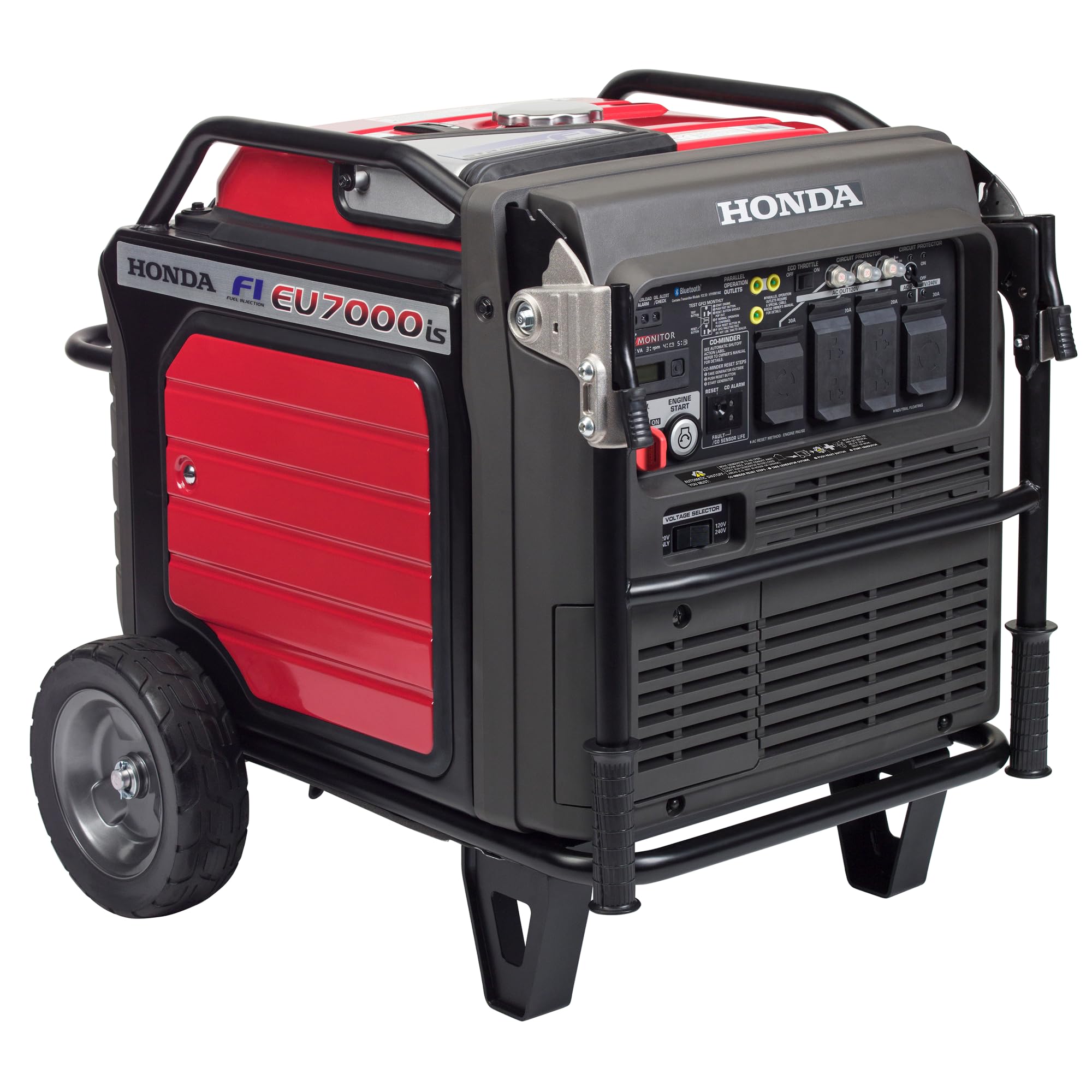
Honda EU7000iS — Clean, quiet power crews actually want
Best for: sensitive loads, occupied sites
If you run tools inside an occupied building, power a client event, or charge a dozen cordless batteries at once, clean and quiet output matters more than raw wattage. The EU7000iS delivers 5,500 running watts of inverter power at a rated 52 to 58 dBA, far quieter than open-frame units of similar output. Fuel injection means there is no carburetor to gum up during slow months, and Honda’s dealer network makes it the easiest pick on this list to keep running for a decade. Skip it if you regularly need 240V at 50 amps, because it tops out at a 30A twist-lock.
- Runs 6.5 to 18 hours on a 5.1-gallon tank, depending on load
- Inverter output is safe for chargers, laptops, and POS systems
- Fuel-injected GX390 engine skips seasonal carburetor cleaning
- Bluetooth app shows load and fuel data from a distance
- Weighs roughly 260 lbs, so it needs two people for truck loading
- Costs about double a conventional unit with the same output
- No 50A receptacle
| Running / max | 5,500 / 7,000 W |
| Engine | Honda GX390 EFI |
| Fuel tank | 5.1 gal gas |
| Noise | 52–58 dBA |
| Weight | Approx. 260 lbs |
9/10
9/10
10/10

DuroMax XP13000EH — Most running watts for the money
Best for: whole crews on a budget
Small contractors often need to power a compressor, a saw, and site lighting at once without spending inverter-level money. The XP13000EH puts out 10,500 running watts on gasoline from a 500cc engine with copper alternator windings, which is more usable power than anything else at its price tier. It also includes a 50A receptacle, so it can feed a spider box or a 240V welder directly. It is loud and its power is conventional, so it is the wrong pick for event work or electronics-heavy loads.
- 10,500 running watts on gas, enough for three tradespeople
- Copper windings hold up better to long, hot run cycles
- Dual fuel, with a propane hose included
- Loud enough that it needs to sit 20+ ft from the work area
- Conventional output, so chargers need surge protection
| Running / starting | 10,500 / 13,000 W (gas) |
| Engine | 500cc OHV |
| Fuel tank | 8.3 gal |
| Fuel type | Gas / propane |
| Weight | Approx. 240 lbs |
9/10
8/10
7/10

Honda EB10000 — Built to run every single workday
Best for: daily industrial loads
Rental yards and commercial crews that put hundreds of hours a year on a generator need something closer to industrial equipment than a homeowner unit. The EB10000 pairs 9,000 rated watts with Honda’s GX630 V-twin, a commercial engine designed to be rebuilt rather than thrown away. Its intelligent voltage regulator keeps output steady as compressors cycle, and GFCI-protected receptacles help satisfy OSHA inspections. The trade-offs are weight and gasoline-only operation, so look elsewhere if you need fuel flexibility or one-person handling.
- GX630 V-twin is a proven commercial engine with wide parts availability
- Voltage regulation holds steady under heavy motor starts
- GFCI-protected outlets suited to construction sites
- Well over 350 lbs, so it needs a ramp or liftgate
- Gasoline only, with no propane option
| Rated / max | 9,000 / 10,000 W |
| Engine | Honda GX630 V-twin |
| Regulation | Intelligent AVR |
| Start | Electric + recoil |
| Outlets | GFCI 20A, 30A twist-lock |
9/10
10/10
7/10

Westinghouse WGen9500DF — Easiest big generator to live with
Best for: gas or propane flexibility
If your crew stores fuel at the shop or works through storm season when gas stations run dry, fuel choice matters. The WGen9500DF makes 9,500 running watts on gasoline and 8,500 on propane, a smaller propane penalty than many rivals. A key-fob remote start and a digital display showing voltage, frequency, and run hours make it approachable for first-time commercial buyers. It is carbureted, so stabilize your gas or switch to propane during slow months.
- Up to 12 hours of runtime on a 6.6-gallon tank
- Remote start from a key fob
- Transfer-switch-ready L14-30R plus four GFCI 20A outlets
- Carbureted, so it is sensitive to stale ethanol fuel
- No 50A outlet for larger 240V loads
| Running (gas / LP) | 9,500 / 8,500 W |
| Starting (gas) | 12,500 W |
| Engine | 457cc OHV |
| Fuel tank | 6.6 gal |
| Start | Remote / electric / recoil |
8/10
8/10
9/10

Generac GP8000E — The dependable general contractor workhorse
Best for: general contractor sites
Remodelers and framers who start heavy motors all day need surge headroom more than extra features. The GP8000E’s PowerRush technology is rated to deliver over 50 percent more starting capacity than its 8,000 running watts suggest, so a compressor and saw can start back to back without tripping the breaker. COsense shuts the engine down automatically if carbon monoxide builds up, and never-flat tires handle gravel and mud. It runs on gasoline only and has no remote start.
- Up to 11 hours at 50 percent load on a 7.5-gallon tank
- COsense automatic carbon monoxide shutdown
- Never-flat tires and a fold-down handle for truck beds
- Gasoline only
- Conventional output, so it is not ideal for electronics
| Running / starting | 8,000 / 10,000 W |
| Engine | 420cc OHV |
| Fuel tank | 7.5 gal gas |
| Safety | COsense shutdown |
| Start | Electric + recoil |
8/10
8/10
8/10

Generac GP15000E — Powers multiple trades at once
Best for: multi-trade large sites
When electricians, plumbers, and drywall crews all plug into one source, mid-size generators run out of headroom by lunchtime. The GP15000E delivers 15,000 running watts from a 992cc V-twin, with a 16-gallon tank rated for about 10 hours at half load. Its 50A receptacle can feed a full distribution box, so you can run one unit instead of two. It is heavy, thirsty, and loud, so it only makes sense if you will actually use the output.
- 15,000 running and 18,750 starting watts
- 16-gallon tank covers a full shift at moderate load
- 50A outlet feeds spider boxes directly
- Roughly 310 lbs, so it is effectively a trailer-or-liftgate unit
- Burns fuel fast at light loads, which wastes money on small jobs
| Running / starting | 15,000 / 18,750 W |
| Engine | 992cc V-twin |
| Fuel tank | 16 gal gas |
| Runtime | About 10 hrs at 50% |
| Weight | Approx. 310 lbs |
10/10
8/10
6/10
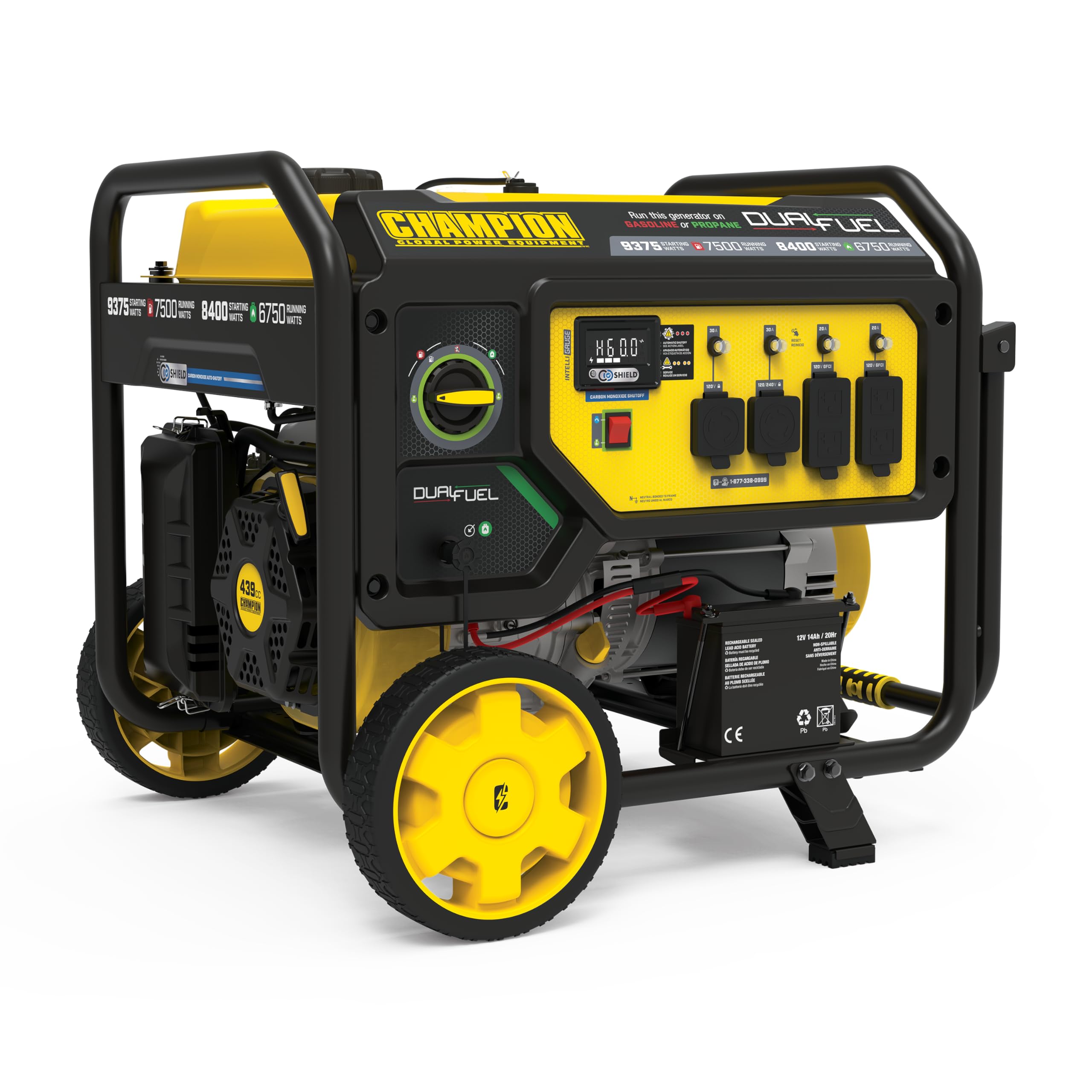
Champion 9375-Watt Dual Fuel — Sensible middle ground for small crews
Best for: two-person crews
Two-person crews rarely need 10,000+ watts, but they do need enough headroom to start a compressor while a saw is running. Champion’s 9375-watt dual-fuel model makes 7,500 running watts on gasoline, and its Intelligauge tracks voltage, frequency, and service hours so maintenance does not slip. CO Shield shutdown and Champion’s lifetime technical support add peace of mind. It tops out at a 30A receptacle, so it cannot power 50A equipment.
- Up to 8 hours on gasoline at 50 percent load
- Intelligauge logs hours for oil-change intervals
- CO Shield automatic shutdown
- Running watts drop noticeably on propane
- No 50A outlet
| Running / starting | 7,500 / 9,375 W (gas) |
| Engine | 439cc OHV |
| Fuel tank | 6.1 gal |
| Fuel type | Gas / propane |
| Start | Electric + recoil |
8/10
7/10
8/10

Honda EU3000iS — Quiet enough for customers at the window
Best for: food trucks and vendors
Food-truck owners and market vendors lose sales when a roaring generator drowns out conversation at the order window. The EU3000iS runs at 49 to 58 dBA and delivers 2,800 rated watts of inverter power, enough for refrigeration, lighting, and a POS system. It runs up to 20 hours on 3.4 gallons at light load, and Honda’s reputation makes it the safest gift on this list for a small-business owner. It will not run a fryer and a rooftop AC together, so larger trucks should step up to pick #1.
- 49–58 dBA, among the quietest units in its class
- 7.1 to 20 hours of runtime on one tank
- Inverter power protects POS terminals and card readers
- Only 2,800 rated watts
- At 131 lbs, it is heavy for a 3,000W unit
| Rated / max | 2,800 / 3,000 W |
| Engine | Honda GX200 |
| Fuel tank | 3.4 gal gas |
| Noise | 49–58 dBA |
| Weight | Approx. 131 lbs |
7/10
10/10
9/10

Briggs & Stratton Q6500 — Inverter power at mid-range cost
Best for: events and venues
Event caterers, AV crews, and wedding vendors need clean power for sound systems and warming equipment without the cost of a Honda. The Q6500 offers 5,000 running watts of inverter output and up to 14 hours of runtime at quarter load on a 4-gallon tank. Its QuietPower mode lowers engine speed to match demand, which keeps it unobtrusive during speeches. Briggs’ dealer network is thinner than Honda’s, so confirm a service center near you before buying.
- 5,000 running watts of inverter-clean power
- Up to 14 hours at 25 percent load
- Telescoping handle and wheels make it easy to roll across a venue
- Service network is less dense than Honda’s
- Recoil start only
| Running / starting | 5,000 / 6,500 W |
| Engine | 306cc Briggs |
| Fuel tank | 4 gal gas |
| Type | Inverter |
| Runtime | Up to 14 hrs at 25% |
8/10
7/10
8/10

Champion 4500-Watt Dual Fuel Inverter — Rides along in every service van
Best for: service vans, punch lists
HVAC techs, plumbers, and punch-list crews need a generator one person can lift into a van, not a 250-lb monster. This Champion inverter weighs roughly 95 lbs and delivers 3,500 running watts on gasoline, enough for a circular saw, a shop vac, and chargers. At 61 dBA, it is quiet enough for finished homes with occupants present. The 2.3-gallon tank means midday refueling under heavy load, and it cannot handle 240V tools.
- Light enough for one-person loading
- Up to 14 hours at 25 percent load on gasoline
- Runs on gas or propane
- Small 2.3-gallon tank
- 120V only, with no 30A twist-lock
| Running / starting | 3,500 / 4,500 W (gas) |
| Engine | 224cc |
| Fuel tank | 2.3 gal |
| Noise | 61 dBA |
| Weight | Approx. 95 lbs |
6/10
7/10
9/10
Top 3 Head-to-Head: EU7000iS vs XP13000EH vs EB10000
Most commercial buyers end up choosing between clean power, maximum watts for the money, and industrial durability. These three units represent each of those priorities best.
| Feature | #1 Honda EU7000iS | #2 DuroMax XP13000EH | #3 Honda EB10000 |
|---|---|---|---|
| Running watts | 5,500 W | 10,500 W — Best | 9,000 W |
| Power Delivery (quality) | Inverter — Best | Conventional AVR | Intelligent AVR |
| Build Durability | 9/10 | 8/10 | 10/10 — Best |
| Jobsite Usability | 10/10 — Best | 7/10 | 7/10 |
| Fuel options | Gas | Gas / propane — Best | Gas |
| Choose if… | You power electronics or work near occupied spaces | You need maximum watts and fuel flexibility on a budget | You log hundreds of hours a year and want a rebuildable engine |
Who These Commercial Portable Generators Are NOT For
Not every buyer searching for commercial power actually needs a portable unit.
The same applies if you run a full commercial kitchen line, multiple welders, or a site trailer with central air for weeks at a time. At that scale, a towable diesel generator rated for continuous duty is safer and cheaper per kilowatt-hour than any portable unit.
Common Mistakes to Avoid
These mistakes quietly shorten a generator’s life or put a crew at risk, even when the generator itself is a good one.
Frequently Asked Questions About Commercial Portable Generators
What is the difference between a commercial and a residential portable generator?
Commercial generators use engines designed for thousands of hours of service, heavier frames, and GFCI-protected outlets that meet jobsite rules. Residential units are built for occasional outage use and often wear out far sooner under daily loads.
How long can a commercial portable generator run continuously?
It can run as long as you keep it fueled and the oil topped up, but you should check the oil roughly every 8 hours of operation. Always shut it down and let it cool for a few minutes before refueling a gasoline tank.
Can I run a portable generator in the rain?
Only under a purpose-made generator tent or a canopy that keeps water off the outlets while allowing full airflow. Never run it uncovered in rain, and never move it into an enclosed space to keep it dry.
How many hours does a commercial portable generator last?
Well-maintained commercial engines commonly reach 2,000 to 3,000 hours or more, while budget open-frame units often need major repairs much sooner. Engines like Honda’s GX series can also be rebuilt rather than replaced.
Can two portable generators be connected in parallel?
Only inverter models specifically designed for parallel operation can be connected, and only with the manufacturer’s parallel kit. Conventional open-frame generators cannot be safely paralleled.
Do I need a permit to use a generator on a jobsite?
Usually not for portable cord-and-plug use, though OSHA GFCI rules still apply and some cities enforce noise ordinances for overnight operation. A permit is typically required only when the generator connects to a building’s wiring.
Are gas portable generators still legal to buy in California?
Yes for now, but California’s small off-road engine rules are scheduled to phase out sales of new gas-powered portable generators starting in 2028. Buy a CARB-compliant model today, and plan your fleet’s next replacement with those rules in mind.
Our Final Verdict
Commercial generator buyers generally fall into three groups: those who need clean power near people, those who need the most watts for the money, and those who run equipment nearly every day. The core tension is simple, because quiet inverter power costs more per watt while cheap watts are loud and less refined.
If you work inside occupied buildings or power electronics, the Honda EU7000iS (pick #1) is best because its inverter output and 52 to 58 dBA rating solve both problems at once. If your crew needs to run a compressor, saws, and lights together on a lean budget, the DuroMax XP13000EH (pick #2) wins with 10,500 running watts and a 50A outlet. If you log hundreds of hours a year, the Honda EB10000 (pick #3) is the one to buy because its GX630 V-twin is designed to be rebuilt, not replaced.

Hi, I’m Michael Turner. I own a generator workshop in the United States and founded HomeGeneratorBlog to share practical, hands-on guidance about generator installation, maintenance, troubleshooting, safety, and backup power solutions. My goal is to help homeowners make smarter, more confident decisions through clear and reliable information