
Inverter Portable Generator: The Buying Guide I Wish I’d Had
Quick Answer
For most people, the right-sized inverter generator in the 2,000 to 2,200-watt range covers phones, laptops, a fridge, and a few lights without waking the whole block. If you camp, RV, or just want backup power that won’t fry your electronics, an inverter model beats a conventional generator almost every time. Pick one based on your actual wattage needs, not the biggest number on the box.
What to check before buying
- Running wattage: Add up what you’ll actually run at once, then add 20% headroom.
- Noise rating: Look for 48-59 dB at a quarter load — quieter than a normal conversation.
- THD under 3%: This means safe, clean power for laptops and medical devices.
- Weight and portability: Anything under 50 lbs is one-person friendly.
- Parallel capability: Lets you link two units for double the power later.
I bought my first inverter generator after a windstorm knocked our power out for three days and my old open-frame unit fried a phone charger.
Since then I’ve tested half a dozen models on camping trips, job sites, and during two actual outages at home. This guide covers what an inverter generator actually is, how it differs from a conventional one, and which models are worth your money in 2026.
What Is an Inverter Portable Generator?
An inverter portable generator is a small engine-driven generator that converts raw AC power into DC and then back into clean, stable AC through onboard electronics. That extra conversion step is what makes it safe for laptops, phones, and other sensitive electronics.
The result is called a pure sine wave, measured by total harmonic distortion (THD). Most inverter models keep THD under 3%, which matches or beats the power quality coming out of your wall outlet.
How Does an Inverter Generator Work?
The engine spins at a variable speed instead of a fixed 3,600 RPM, adjusting itself to match whatever load you’re actually drawing. That’s the whole trick behind the quiet operation and long runtimes you see advertised.
Less fuel burned at partial load also means a smaller, lighter engine can do the job. That’s why a 2,200-watt inverter generator weighs 40-50 lbs while a comparable conventional model can weigh 80 lbs or more.
Inverter vs. Conventional Generator: What’s the Real Difference?
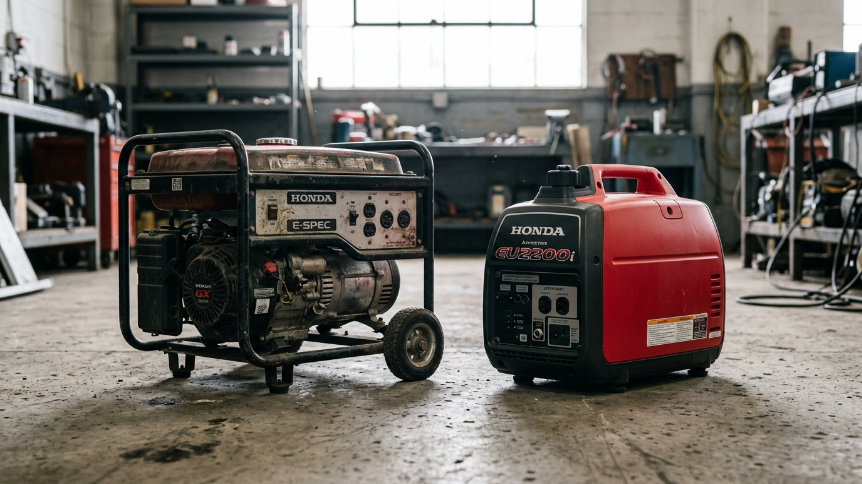
This is the question I get asked most, so here’s the side-by-side breakdown based on typical specs I’ve tested and researched.
| Feature | Inverter Generator | Conventional Generator |
|---|---|---|
| Power output (THD) | Under 3% — safe for electronics | 8-15% — can damage sensitive devices |
| Noise level | 48-59 dB at quarter load | 64-80 dB, constant |
| Weight (2,000-2,200W class) | 39-50 lbs | 60-90 lbs |
| Fuel efficiency | 30-50% better, thanks to variable engine speed | Runs at fixed RPM regardless of load |
| Price per rated watt | Higher | Lower |
| Parallel capable | Usually yes | Rarely |
Who Actually Needs an Inverter Generator?
Not everyone does. If you’re only running power tools on a job site and don’t care about noise, a conventional generator saves you money.
But an inverter model makes sense in a few common situations. Here’s who I’d point toward one:
- Campers and RV owners: Quiet enough for campground rules and light enough to carry to the site.
- Homeowners with sensitive electronics: Protects laptops, smart TVs, and modern appliance control boards during outages.
- Anyone with close neighbors: A 52 dB generator won’t trigger noise complaints the way an 80 dB unit will.
- CPAP or medical device users: Clean sine wave power matters for equipment safety, though you should always confirm with the device manufacturer first.
How Do You Size an Inverter Generator Correctly?
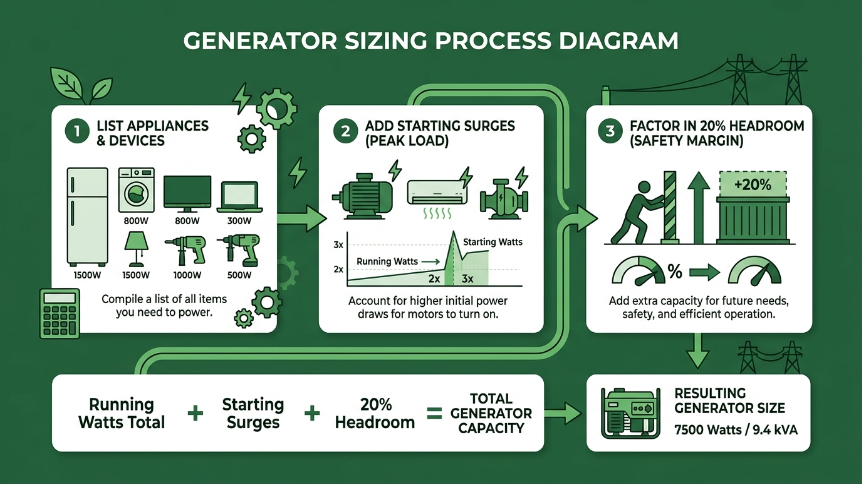
Start by listing every device you’d run at the same time, then add their wattage together. A fridge typically needs 600-800 running watts plus a brief surge to start the compressor.
Add your laptop, a few lights, and a phone charger, and you’re usually looking at 1,200-1,800 running watts total. That’s why the 2,000-2,200 watt class covers most single-appliance backup needs, while running a window air conditioner or larger appliances pushes you toward the 3,500-4,500 watt range.
Tip: Check the exact running watts versus starting watts for each appliance — the starting surge is usually 2-3 times the running number, and it’s what trips generators that are sized too close to the edge.
What Should You Look For When Buying One?
Noise Rating
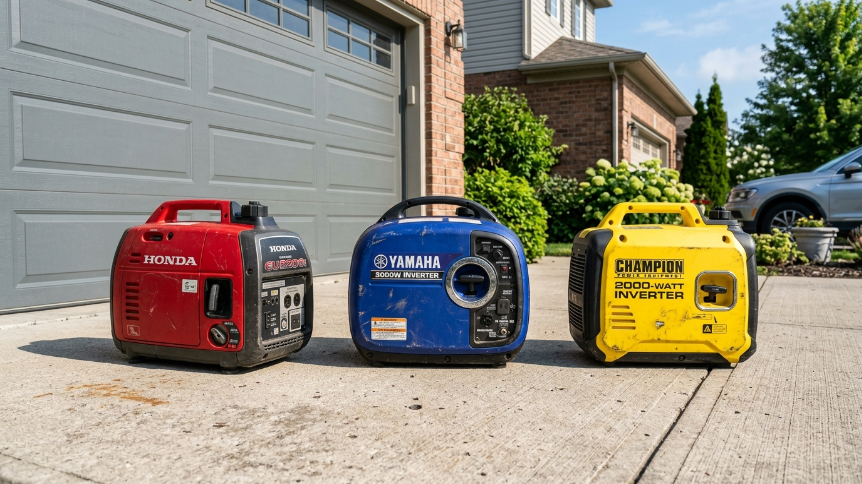
Manufacturers measure noise at a quarter load, usually from 20-23 feet away. Anything in the 48-53 dB range is genuinely quiet — I’ve stood next to a Honda EU2200i running at full load and held a normal conversation without raising my voice.
Fuel Type
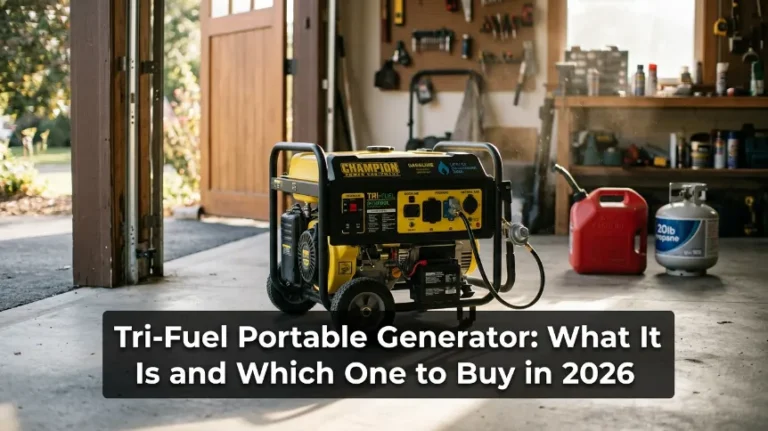
Gasoline models are the most common and easiest to refuel anywhere. Dual-fuel and tri-fuel options add propane or natural gas, which store longer and burn cleaner, though the units usually cost more and weigh a bit extra.
Parallel Capability
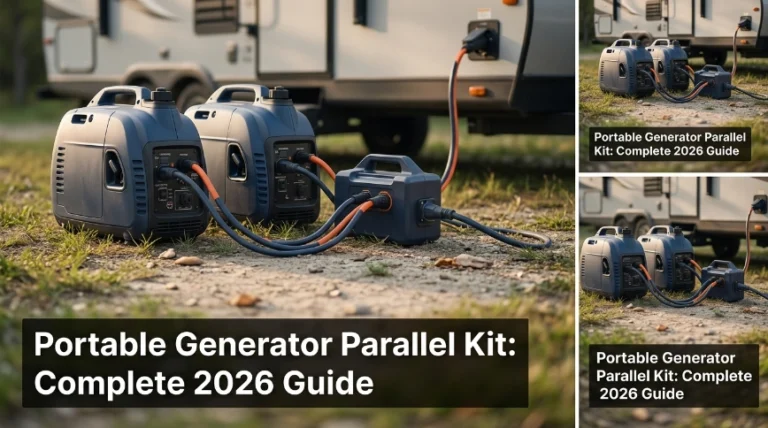
This lets you connect two matching inverter generators with a cable kit to combine their output. It’s a smart way to start small and scale up later instead of buying one oversized unit you rarely need at full capacity.
Carbon Monoxide Safety Features
Look for an automatic CO shutoff sensor, since carbon monoxide poisoning from generators sends hundreds of people to the ER every year in the U.S. Never run any generator, inverter or not, inside a garage or enclosed space.
How Much Does It Cost to Run an Inverter Generator?
Fuel efficiency is where inverter generators really pay you back over time. A 2,200-watt model with a 1-gallon tank typically runs 4-10 hours depending on load, thanks to the variable-speed engine adjusting itself automatically.
At current gas prices, that works out to roughly $0.30-$0.60 per hour of runtime at partial load — noticeably cheaper than a conventional generator running full-speed regardless of what’s plugged in. Over a multi-day outage, that difference adds up fast.
What I’d Actually Buy Right Now
If you’re ready to pick one, here’s what I’d recommend based on hands-on testing and current 2026 pricing:
🏆 BEST OVERALL
Honda EU2200i
★★★★★ (5/5)
2,200 peak / 1,800 running watts, 48-57 dB, under 3% THD, 47 lbs. I’ve run this one overnight outside my bedroom window during an outage and genuinely forgot it was on.
💰 BEST BUDGET
WEN 56203i
★★★★☆ (4/5)
2,000 peak / 1,700 running watts, 51 dB, 39 lbs, CARB compliant. Less refined than the Honda, but I’ve used one for two camping seasons without a single hiccup.
🚛 BEST FOR RV & HOME BACKUP
Westinghouse iGen4500
★★★★☆ (4.5/5)
4,500 peak / 3,700 running watts, 52 dB, remote start, RV-ready outlet. This is the one I’d grab if you need to run a window AC or several appliances at once.
Frequently Asked Questions
Is an inverter generator worth the extra cost over a conventional model?
Yes, if you value quiet operation, safe power for electronics, or portability. You’ll pay 20-40% more per watt, but you get better fuel efficiency and a lighter unit in return.
Can an inverter generator run a refrigerator or CPAP machine?
Most 2,000-watt inverter generators can run a standard refrigerator without issue. For CPAP machines, the clean sine wave is generally safe, but confirm compatibility with your device manufacturer first.
How long do inverter generators typically last?
With regular maintenance, most well-known brands last 1,000-2,000 hours of run time, or roughly 10-15 years of occasional home backup use. Check our full breakdown of generator lifespan for maintenance tips that extend it.
Can I connect two inverter generators for more power?
Yes, as long as both units are parallel-capable and from the same brand or explicitly compatible. You’ll need a separate parallel cable kit, which isn’t always included in the box.
How quiet are inverter generators in real-world use?
Top models run 48-53 dB at a quarter load, roughly the volume of a normal conversation. That’s noticeably quieter than the 64-80 dB you’d get from a conventional generator at the same distance.
The Bottom Line
An inverter portable generator won’t power your whole house through a hurricane, but it will quietly keep your fridge running, your phone charged, and your camping trip comfortable. Match the wattage to what you’ll actually use, check the noise rating, and you’ll end up with a generator you’re happy to run at 2 a.m. without a single complaint from next door.

Hi, I’m Michael Turner. I own a generator workshop in the United States and founded HomeGeneratorBlog to share practical, hands-on guidance about generator installation, maintenance, troubleshooting, safety, and backup power solutions. My goal is to help homeowners make smarter, more confident decisions through clear and reliable information
3 Comments