What Is the Difference Between Running Watts and Starting Watts? Surge, Sizing
Quick Answer
Running watts are the steady power a load needs to keep going, while starting watts are the short, higher burst needed to start a motor. A fridge may run on 150 watts but need 1,200 watts for a few seconds at start-up, so size your inverter generator for the highest starting load plus the running watts of everything else on at the same time. Use the wattage formula before you buy, not the big number on the box.
The difference in 15 seconds
- Running watts: Continuous power, measured while the appliance runs normally.
- Starting watts: Surge power, needed for a few seconds when a motor starts.
- Surge watts: Another name for starting watts, often shown on the spec sheet.
- Key rule: Add running watts for all loads, then add the largest starting watts once.
- Common mistake: Buying by running watts alone and tripping the overload on the first fridge start.
Do this first
- List every load you will run together, note its running and starting watts, then add a 10 to 20 percent buffer.
- Check the spec sheet, not the sales headline, for both numbers.
I’ve tripped an overload breaker at a campsite because I trusted the big number on the box.
That lesson stuck with me, and it shapes how I size every inverter generator I test now. This guide explains running watts and starting watts in plain language, with real appliance numbers, wattage math, and sizing examples for home backup, RV use, and camping in 2026.
In This Guide
- What Are Running Watts?
- What Are Starting Watts?
- Running Watts vs Starting Watts: Side-by-Side Comparison
- Why Do Some Appliances Need More Starting Watts?
- How Do You Calculate Running and Starting Watts?
- What Happens If You Ignore Starting Watts?
- How Do You Choose the Right Inverter Generator Size?
- Common Mistakes When Reading Generator Wattage Labels
- Frequently Asked Questions
What Are Running Watts?
Running watts are the power an appliance uses while it runs at a steady pace.
They are also called rated watts or continuous watts, and they tell you what the generator must supply hour after hour. A 100-watt laptop charger, for example, draws about 100 running watts the whole time it charges.
An inverter generator is a portable power source that makes clean, stable power for sensitive electronics. It uses an inverter to turn raw engine power into a smooth sine wave, which is why phones, laptops, and CPAP machines run safely on it.
Running watts matter most for loads that stay on. Think lights, a fan, a TV, a phone charger, or a fridge compressor once it has settled into its cycle.
How do you find running watts on a label?
Check the appliance label, the owner’s manual, or the spec sheet for watts, amps, or volt-amps.
If you only see amps and volts, multiply them to estimate watts. A 120-volt device drawing 5 amps uses about 600 watts, though the real number can shift with the load.
- Label watts: Use the listed wattage when it is printed clearly.
- Amps x volts: Multiply amps by volts for a close estimate.
- Measured watts: Use a plug-in watt meter for the most honest number.
- Running total: Add the running watts of every load running at once.
I measured my own fridge at home during a multi-day outage, and it settled near 150 running watts after start-up. That number looked small on paper, yet the start-up surge told a very different story.
Section Takeaway: Running watts are the steady, continuous load, so add them for every appliance you run at the same time.
What Are Starting Watts?
Starting watts are the short burst of power a motor needs to get moving from a dead stop.
They are also called surge watts or peak watts, and they last only a few seconds. That brief spike can be two to three times the running watts, and for some motors it can be even higher.
Think of pushing a heavy cart from rest. The first push takes the most effort, then it rolls with less force once it moves.
Motors work the same way. A compressor, pump, or air conditioner motor must overcome inertia and pressure before it spins freely, so it draws a surge at start-up.
Which appliances have high starting watts?
Anything with a motor or compressor has a starting surge. Fridges, freezers, sump pumps, well pumps, window AC units, and RV air conditioners are the usual suspects.
Resistive loads, by contrast, have little or no surge. A toaster, kettle, or incandescent bulb draws almost the same power at start and while running.
That split explains why a small fridge can stall a generator that easily runs a TV and lights. The TV load is steady, while the fridge compressor hits hard for a few seconds.
Check the spec sheet for both numbers before you size a generator, and learn how to read running watts, starting watts, and THD on a real rating label. THD, or total harmonic distortion, measures how clean the power is, and low THD matters for sensitive electronics.
Section Takeaway: Starting watts are a brief surge, not a continuous load, but your generator must cover that peak or the motor will not start.
Running Watts vs Starting Watts: Side-by-Side Comparison
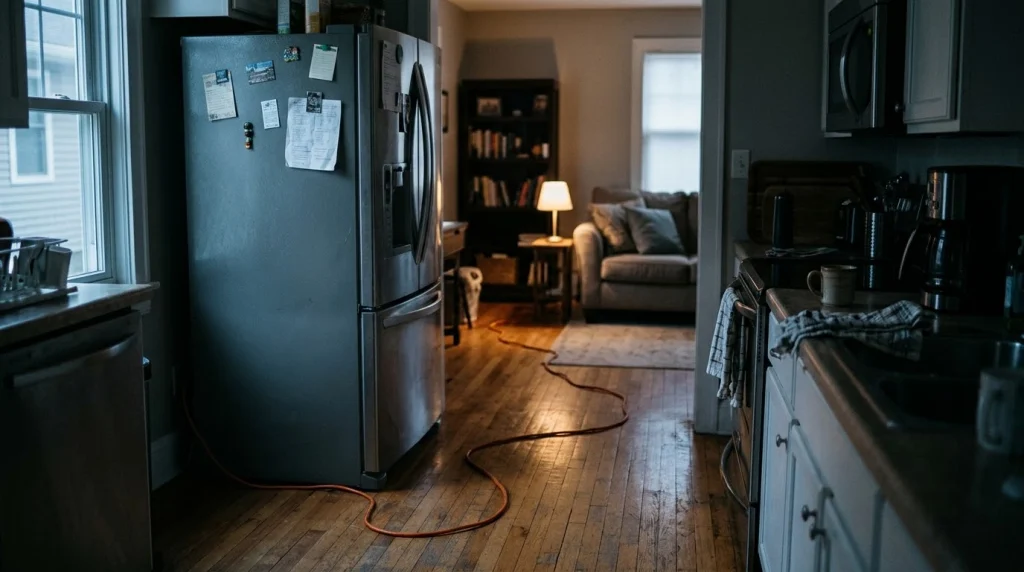
Running watts and starting watts describe two different moments in the same job.
One is the marathon pace, and the other is the sprint at the start line. You need both numbers to size a generator correctly, because the marathon number alone hides the sprint.
| Feature | Running Watts | Starting Watts |
|---|---|---|
| Also called | Rated watts, continuous watts | Surge watts, peak watts |
| Duration | As long as the load runs | A few seconds at start-up |
| Typical size | Lower, steady number | 2 to 3 times running watts for motors |
| Applies to | Every load while it runs | Mainly motors and compressors |
| What it decides | How much you can run at once | Whether the biggest motor will start |
| On the box | Often the smaller number | Often the big headline number |
A generator rated 2,000 starting watts and 1,600 running watts can start a 2,000-watt surge, but it cannot run 2,000 watts all day.
That gap is where most sizing mistakes happen. Buyers see 2,000 watts and plan a 2,000-watt load, then wonder why the overload light trips.
Section Takeaway: Running watts set your continuous limit, starting watts set your peak limit, and you must respect both.
Why Do Some Appliances Need More Starting Watts?
Motors need extra power to break free from rest and build speed.
A fridge compressor starts against pressure in the sealed system, a sump pump starts against water weight, and an AC compressor starts against refrigerant pressure. Each one draws a surge until it reaches full speed.
The surge size depends on the motor type, the load, and the condition of the appliance. An older fridge with a tired compressor can surge harder than a new, efficient model.
Typical running and starting watts by appliance
These are typical ranges, not exact figures for your model. Always check your own label or manual, because brands and sizes vary widely.
| Appliance | Running Watts | Starting Watts |
|---|---|---|
| Fridge, full-size | 120 to 200 | 800 to 1,200 |
| Freezer, chest | 100 to 200 | 600 to 1,200 |
| Sump pump, 1/3 HP | 800 to 1,000 | 1,300 to 2,000 |
| Well pump, 1/2 HP | 1,000 to 1,200 | 2,000 to 3,000 |
| Window AC, 10,000 BTU | 900 to 1,200 | 2,200 to 2,800 |
| RV AC, 13,500 BTU | 1,200 to 1,500 | 2,800 to 3,500 |
| Microwave, 1,000 watts | 1,000 to 1,200 | 1,000 to 1,200 |
| Laptop and phone charger | 60 to 150 | 60 to 150 |
Notice how the microwave and chargers show almost no surge, while the RV air conditioner nearly triples at start-up.
That pattern drives sizing. One motor load can use up most of your surge headroom, even when its running watts look modest.
Soft-start kits can lower the surge for some RV air conditioners, and they are worth a look if your generator is close to the limit. Check your AC manual first, and have the kit installed correctly.
Section Takeaway: Motors surge, resistive loads do not, so plan your size around the biggest motor you will start.
How Do You Calculate Running and Starting Watts?
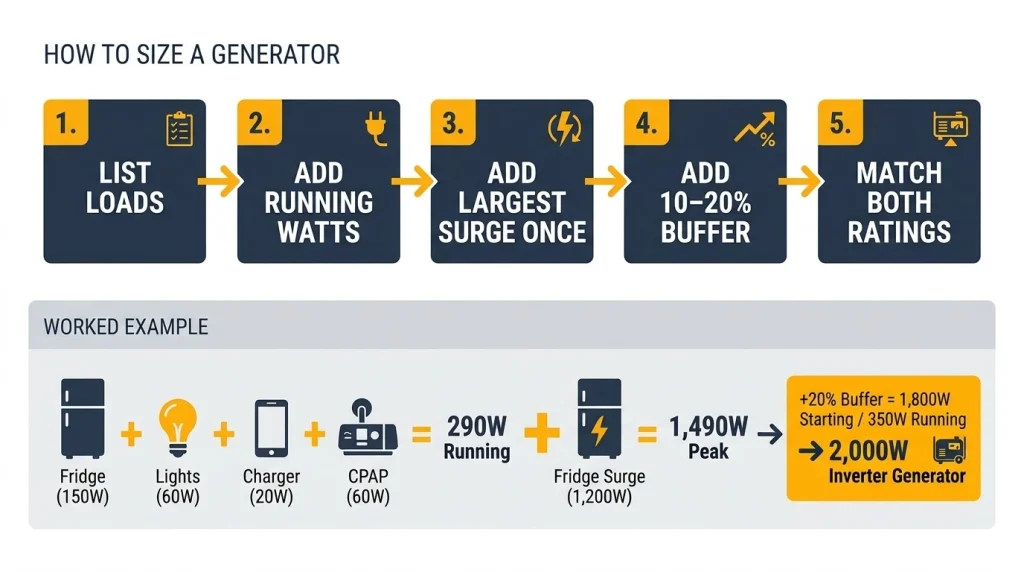
Use one simple formula, and do it on paper before you shop.
Add the running watts of every load you will run at once, then add the largest starting watts once. That total is your minimum running watts, and the surge total is your minimum starting watts.
- List loads: Write down each appliance, its running watts, and its starting watts.
- Add running watts: Add the running watts of all loads running together.
- Add the biggest surge: Add the largest starting watts once, not for every motor.
- Add a buffer: Add 10 to 20 percent for safety and for loads you forgot.
- Compare both ratings: Match the result to the generator’s running and starting watts.
Worked example: fridge, lights, and a CPAP
Take a home backup set-up with a fridge, LED lights, a phone charger, and a CPAP machine.
The fridge runs at 150 watts and starts at 1,200 watts, lights use 60 watts, the charger uses 20 watts, and the CPAP uses 60 watts. Add the running watts first: 150 plus 60 plus 20 plus 60 equals 290 watts.
Now add the largest starting watts once: 290 plus 1,200 equals 1,490 watts at start-up. With a 20 percent buffer, you need about 1,800 starting watts and at least 350 running watts.
A 2,000-watt inverter generator with 1,600 running watts would handle this set-up with room to spare. A 1,200-watt unit would not, even though the steady load is only 290 watts.
For a fridge-heavy set-up, read our guide to the best portable generator for a refrigerator before you pick a size. It shows how fridge surge shapes the whole choice.
Energy guidance from the U.S. Department of Energy also stresses sizing by total load, not by a single appliance. That advice lines up with what I see in real outages.
Safety note: Run generators outdoors and well away from windows, doors, and vents. Use a transfer switch or interlock installed by a licensed electrician for home hookups, and check your owner’s manual before use.
Section Takeaway: Add all running watts, add the largest starting watts once, then add a buffer before you compare generator ratings.
What Happens If You Ignore Starting Watts?
The generator overloads, and the load drops out.
Most inverter generators protect themselves with an overload shutoff, so the engine keeps running but the outlets cut out. You lose power to the fridge, the AC, or the pump at the worst moment.
Sometimes the motor tries to start, stalls, and draws high current for too long. That can heat the motor, trip a breaker, or shorten the life of the appliance.
Signs your generator is too small for the surge
- Overload light: The overload indicator flashes or stays on when a motor starts.
- Engine bogs down: The engine note drops hard, then the outlets cut out.
- Motor hums, then stops: The motor tries to spin but never reaches speed.
- Repeated restarts: The fridge or AC cycles, and the generator trips each time.
I once ran a window AC on a generator that looked big enough on running watts alone. It cooled for a few minutes, then the compressor cycled and the overload tripped. The fix was not more fuel or a new cord, it was a bigger surge rating.
Stagger motor starts when you can. Start the biggest motor first, let it settle, then add the next load.
Carbon monoxide safety still comes first, even when you are focused on watts. The CDC and the U.S. Consumer Product Safety Commission both warn that generators must run outdoors, far from the home, because CO can build up fast indoors.
Safety note: Never run a generator in a garage, basement, or enclosed porch, even with the door open. Keep it at least 20 feet from the house with the exhaust pointed away.
Section Takeaway: Ignore starting watts and you get overload trips, stalled motors, and lost power right when you need it most.
How Do You Choose the Right Inverter Generator Size?
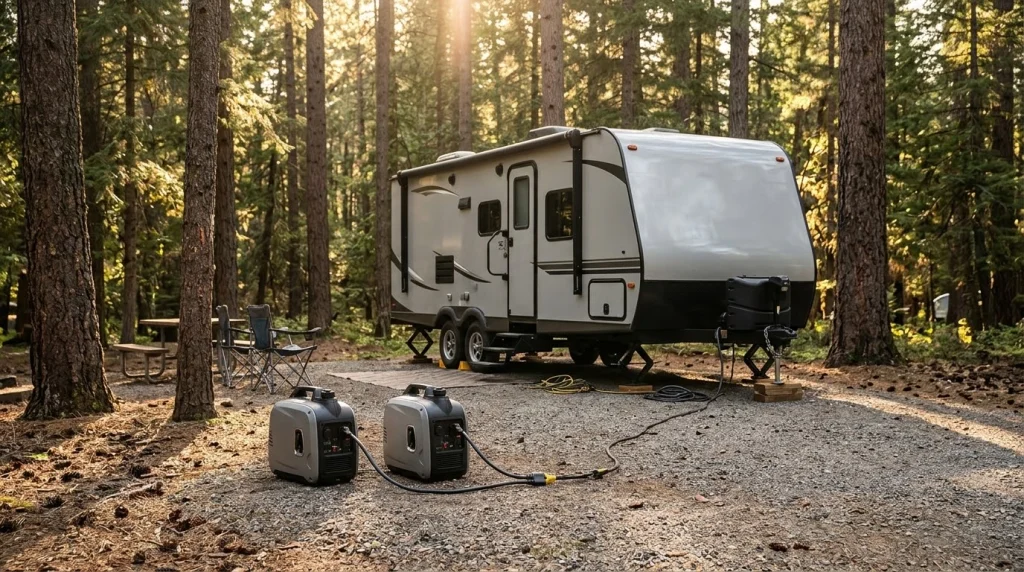
Start with your load list, not with a brand or a sale price.
Your use case sets the size band, and your biggest motor sets the surge you need inside that band. A camper with lights and phones needs far less than a home running a fridge, freezer, and sump pump.
Use the bands below as a starting point, then run your own math. Check the spec sheet for both running and starting watts, because two models with the same headline number can differ by hundreds of running watts.
- 1,000 to 2,000 watts: Phones, laptops, lights, CPAP, and a small fan for camping or tailgating.
- 2,000 to 3,000 watts: Fridge, lights, chargers, and a small TV for home backup or RV use.
- 3,000 to 4,500 watts: Fridge, freezer, microwave in turns, and a small window AC for longer outages.
- 4,500 watts and up: Multiple motor loads, a well pump, or an RV air conditioner plus other essentials.
Parallel capability can help when one unit is close but not quite enough. Two parallel-capable inverter generators can share the load, though you still need the right parallel kit and cables.
Eco mode, also called economy mode, lets the engine slow down at light load to save fuel and cut noise. It can delay the response to a sudden surge, so turn eco mode off when you start a big motor.
If you are weighing a mid-size unit, check the 3000-watt inverter generator cost guide to see what that size band buys in 2026. Price, runtime, and outlet options vary more than the headline watts suggest.
Independent testing notes from Consumer Reports also show that real-world output and noise can differ from the label. Use those notes as a cross-check, not as a replacement for your own load math.
Section Takeaway: Pick the size band by use case, then confirm both watt ratings against your own load list and biggest motor.
Common Mistakes When Reading Generator Wattage Labels
Labels are honest, but they are easy to misread.
The headline number is usually starting watts, not running watts. The running watts sit in smaller print on the spec sheet, and that is the number that sets your all-day limit.
Another trap is adding starting watts for every motor at once. Motors rarely start at the exact same second, so add the largest surge once and stagger the rest.
- Trusting the box alone: Use the spec sheet for running watts, starting watts, and runtime at 25% and 50% load.
- Forgetting altitude and fuel: Propane and high altitude can lower output, so check the manual for derating.
- Ignoring eco mode: Eco mode saves fuel at light load but can lag on a sudden motor start.
- Skipping the buffer: A tight fit leaves no room for a second motor cycle or a forgotten load.
- Mixing watts and watt-hours: Watts are power now, watt-hours are energy over time, and they are not the same.
Runtime claims also need a close read. A 10-hour runtime at 25% load is very different from 10 hours at 50% load, so match the claim to your real load.
When you compare models, read our checklist on what to look for in an inverter generator alongside the watt ratings. Outlets, THD, noise, fuel type, and parallel capability all shape the final choice.
The EPA also sets emission and fuel standards that affect how generators are built and sold in the U.S. Those rules do not change your watt math, but they explain why some models cost more than others.
Section Takeaway: Read the spec sheet, not the headline, and give yourself headroom for surge, altitude, fuel, and the load you forgot.
Frequently Asked Questions
Is starting watts the same as surge watts?
Yes, starting watts and surge watts mean the same thing in most generator specs. Both describe the short peak power a generator can supply for a few seconds when a motor starts.
Do I add starting watts for every appliance?
No, add the largest starting watts once to your running-watts total. Motors rarely start at the same instant, so adding every surge would oversize your generator by a wide margin.
Can a 2000-watt generator run a refrigerator?
Yes, in many cases, because a typical fridge runs at 120 to 200 watts and starts at 800 to 1,200 watts. A 2,000-watt generator with at least 1,600 running watts leaves room for lights and chargers too, though you should check your own fridge label first.
What size generator do I need for an RV air conditioner?
Most 13,500 BTU RV air conditioners need 2,800 to 3,500 starting watts and 1,200 to 1,500 running watts. That usually means a 3,000-watt class inverter generator or larger, unless you use a soft-start kit.
Why does my generator overload when the fridge starts?
The fridge compressor surge is likely higher than your generator’s starting watts, or other loads are already using most of the running watts. Try starting the fridge first, turn off eco mode, and remove other loads until the compressor settles.
Does eco mode affect starting watts?
Eco mode can slow the engine response to a sudden surge, which makes a motor start harder. Turn eco mode off before you start a fridge, pump, or air conditioner, then turn it back on for light, steady loads.
If you want a deeper sizing walkthrough, start with what size inverter generator do I need and run the math for your own loads. That guide pairs well with the formula above.
Running watts keep your power going, starting watts get your motors moving, and both numbers matter. List your loads, add the running watts, add the largest surge once, add a buffer, and buy the generator that clears both ratings with room to spare.

Hi, I’m Michael Turner. I own a generator workshop in the United States and founded HomeGeneratorBlog to share practical, hands-on guidance about generator installation, maintenance, troubleshooting, safety, and backup power solutions. My goal is to help homeowners make smarter, more confident decisions through clear and reliable information