How Much Power Does a 3000-Watt Inverter Generator Provide? What It Can Run, What It Cannot, and How to Use It Right
Quick Answer
A 3000-watt inverter generator provides 3,000 starting watts for short surges and about 2,500 to 2,800 running watts for steady use. That is enough for a fridge, lights, phones, a laptop, and many small appliances together, but it is not whole-house power. Use this generator wattage calculator guide to add up your loads before you plug anything in.
The power in plain terms
- Running watts, 2,500-2,800: This is the power you can use hour after hour.
- Starting watts, 3,000: This is the short burst for motors that need extra power to start.
- Clean power for electronics: Most inverter models produce a stable sine wave that suits laptops, phones, and CPAP machines.
- RV air conditioner, maybe: A small 13,500 BTU RV AC can work on some models, but a 15,000 BTU unit often needs a soft starter or a larger generator.
- Not for everything at once: A fridge plus a window AC plus a microwave will usually trip the overload protection.
Use it safely
- Add the running watts of everything you plan to run at the same time, then add the largest starting watts on top.
- Keep the total running load under about 80% of the rated running watts for longer, steadier use.
- Run it outdoors, at least 20 feet from your home, with the exhaust pointed away from windows and doors.
I’ve run a 3000-watt inverter generator through a long outage, and it kept the essentials going without the roar of a big open-frame unit. It powered my fridge, a few lights, phones, and a CPAP machine while I watched the load meter like a hawk.
That size sits in a sweet spot for many homes, RVs, and campsites. It is stronger than a 2000-watt model, yet it stays portable enough for one person to move. This guide shows what that power means in real life, what it can run, and where it falls short in 2026.
In This Guide
- What Does 3000 Watts Actually Mean?
- How Much Running Power Do You Get From a 3000-Watt Inverter Generator?
- What Can a 3000-Watt Inverter Generator Run?
- Can It Run an RV Air Conditioner?
- How Long Will a 3000-Watt Inverter Generator Run?
- 3000-Watt vs 2000-Watt vs 5000-Watt: Which Size Fits You?
- How Do You Size and Use a 3000-Watt Inverter Generator Safely?
- Is 3000 Watts Enough for Home Backup?
- Frequently Asked Questions
What Does 3000 Watts Actually Mean?
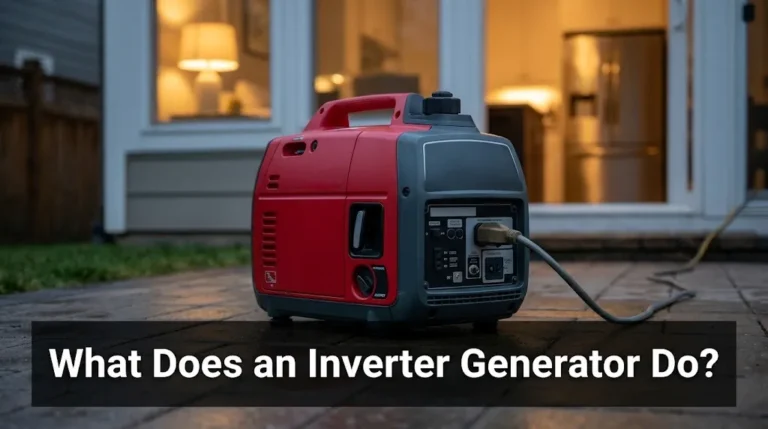
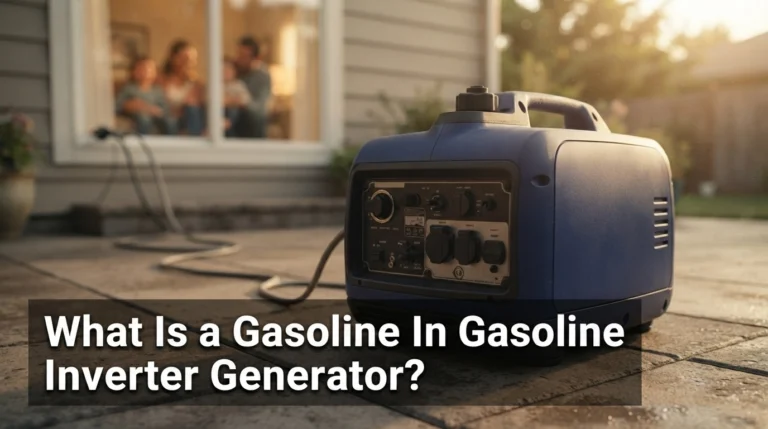
An inverter generator is a portable generator that makes clean, stable power by converting raw engine power into a smooth sine wave. That clean sine wave matters for phones, laptops, and medical devices. It also helps the engine run quieter and use less fuel at light loads.
The “3000-watt” label usually means 3,000 starting watts, not 3,000 watts all day. Most models in this class deliver 2,500 to 2,800 running watts. Check the spec sheet for both numbers before you buy.
Think of watts as the size of the pipe. Amps tell you how much current flows through that pipe at a given voltage. A 3000-watt generator on a 120-volt system can supply about 25 amps at peak, and about 21 to 23 amps on a steady basis.
What is the difference between running watts and starting watts?
Running watts are the power a device uses while it keeps working. Starting watts are the extra burst a motor needs for a few seconds when it turns on.
A fridge may run on 150 to 200 watts. It may need 1,200 watts for a second when the compressor starts. That surge is why a generator can run a fridge yet trip when the fridge and a freezer start together.
- Running watts: Steady power for lights, chargers, fans, and electronics.
- Starting watts: Short surge power for fridge compressors, pumps, and AC motors.
- THD: Total harmonic distortion, a measure of how clean the power is. Inverter generators often stay under 3% THD, which suits sensitive electronics.
Do not plan your loads around the 3,000-watt headline. Plan around running watts, then leave room for the largest single start-up surge.
Section Takeaway: A 3000-watt inverter generator gives you about 2,500 to 2,800 watts you can use steadily, plus a 3,000-watt burst for motor starts.
How Much Running Power Do You Get From a 3000-Watt Inverter Generator?
You get 2,500 to 2,800 running watts on most 3000-watt inverter models. The exact number depends on the brand, the engine, and whether you run on gasoline or propane.
Dual fuel models often make a little less power on propane. A model rated at 3,000 starting watts on gasoline may give about 2,700 starting watts on propane. Check both fuel ratings on the spec sheet.
Altitude and heat can also trim output. Thin air at high elevation can cut power by a few percent, and a hot day can make the engine work harder. I keep a 10% to 20% safety margin for that reason.
How many amps does a 3000-watt inverter generator provide?
A 3000-watt inverter generator provides about 25 amps at 120 volts at its peak rating. Its steady output is closer to 21 to 23 amps, based on 2,500 to 2,800 running watts.
That is enough for one 30-amp RV outlet in many cases, but not for a full 30-amp load at once. Most 3000-watt models have a 30-amp RV outlet, a 20-amp household outlet, and USB ports. The outlet does not create more power than the engine can make.
- At 2,500 running watts: About 20.8 amps at 120 volts.
- At 2,800 running watts: About 23.3 amps at 120 volts.
- At 3,000 starting watts: About 25 amps at 120 volts for a few seconds.
Use the watts first, then check amps. Watts tell you the total load, and amps tell you whether one outlet can carry it.
Why do two 3000-watt models feel different in real use?
Two models can share the same label yet behave very differently under load. One may hold voltage steady when a fridge starts, while another sags and trips.
Engine size, inverter quality, and overload protection all shape that feel. A larger engine with a good inverter recovers faster after a surge. A cheaper unit may shut down sooner to protect itself.
I test a new generator with the loads I plan to run, not just the label. I start the fridge first, then add lights and chargers one at a time. That simple test shows the real limit faster than any spec sheet.
Section Takeaway: Expect 2,500 to 2,800 running watts in steady use, and treat the 3,000-watt figure as a short surge rating, not all-day power.
What Can a 3000-Watt Inverter Generator Run?
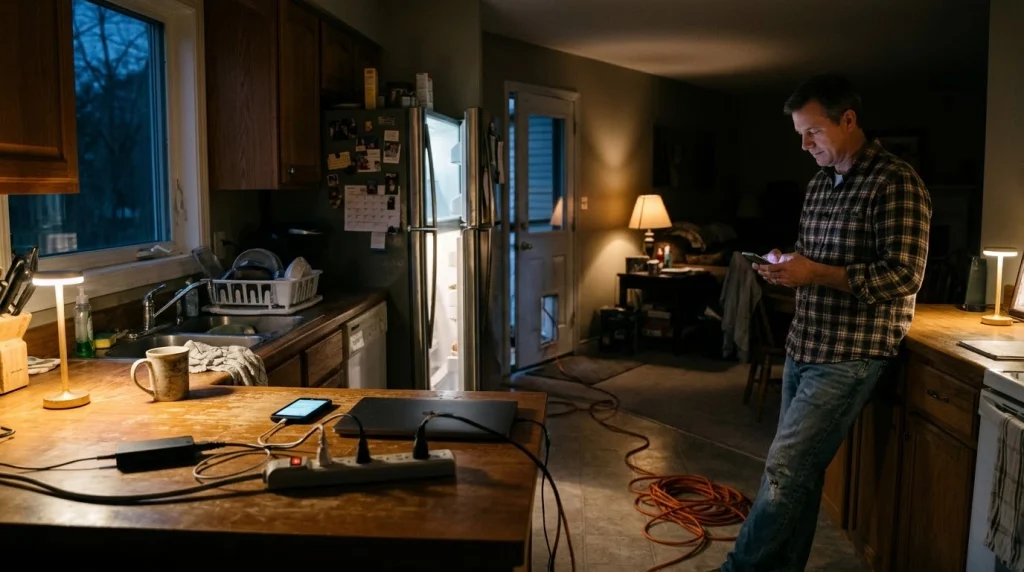
A 3000-watt inverter generator can run a fridge, lights, phones, a laptop, a TV, a fan, and a CPAP machine together in many homes. It can also run a microwave or a small window AC, but usually not both at the same time as the fridge.
The trick is to stagger motor starts. Start the largest motor first, let it settle, then add smaller loads. That order keeps the surge from stacking up at one moment.
During my outage test, I ran a full-size fridge, six LED lights, two phones, a laptop, and a CPAP machine overnight. The generator stayed in eco mode for long stretches, and the load stayed well under 1,500 watts.
| Appliance or Device | Running Watts (Typical) | Starting Watts (Typical) | Works on 3000W? |
|---|---|---|---|
| Full-size refrigerator | 150-200 | 1,000-1,200 | Yes |
| Chest freezer | 100-150 | 800-1,000 | Yes, alone or with light loads |
| LED lights (6 bulbs) | 50-70 | 50-70 | Yes |
| Laptop + phones | 100-150 | 100-150 | Yes |
| TV (50-inch LED) | 100-150 | 100-150 | Yes |
| CPAP machine | 30-60 | 30-60 | Yes |
| Microwave (1,000W) | 1,000-1,200 | 1,000-1,200 | Yes, if other loads are light |
| Window AC (8,000 BTU) | 700-900 | 1,800-2,200 | Often yes, with care |
| Sump pump (1/3 HP) | 800-1,000 | 1,300-2,000 | Often yes, alone |
| Electric water heater | 4,000-4,500 | 4,000-4,500 | No |
| Central AC | 3,000-5,000 | 5,000-8,000 | No |
| Electric stove or dryer | 3,000-5,000 | 3,000-5,000 | No |
Use the table as a starting point, not a promise. Your fridge, AC, and pump may draw more or less than these typical ranges. Check the label on each device before you rely on it.
What can it run at the same time?
A realistic home-backup combo is a fridge, a freezer, lights, phones, a laptop, and a fan. That mix often stays under 1,000 running watts once the motors settle.
Add a microwave and the load jumps by 1,000 watts or more. Add a window AC and the start-up surge can push the total past 3,000 watts. Pause other loads when you run a heavy device.
- Easy combo: Fridge, lights, phones, laptop, TV, and CPAP.
- Careful combo: Fridge plus a small window AC, with the microwave off.
- Risky combo: Fridge, freezer, microwave, and window AC all at once.
What can it not run?
It cannot run a central AC, an electric water heater, an electric stove, or an electric dryer. Those loads need 4,000 watts or more on their own.
It also struggles with two large motors starting at the same time. A fridge and a sump pump can each start fine alone, yet trip the generator together. Stagger them and keep one heavy load off while the other starts.
Safety note: Never plug a generator into a wall outlet to power your home. Use extension cords for separate devices, or a transfer switch or interlock installed by a licensed electrician.
Section Takeaway: A 3000-watt inverter generator handles a fridge, lights, electronics, and one heavy load at a time, but it cannot run a whole house or two large motors together.
Can It Run an RV Air Conditioner?
A 3000-watt inverter generator can run many 13,500 BTU RV air conditioners. It often struggles with a 15,000 BTU unit, especially at high altitude or in hot weather.
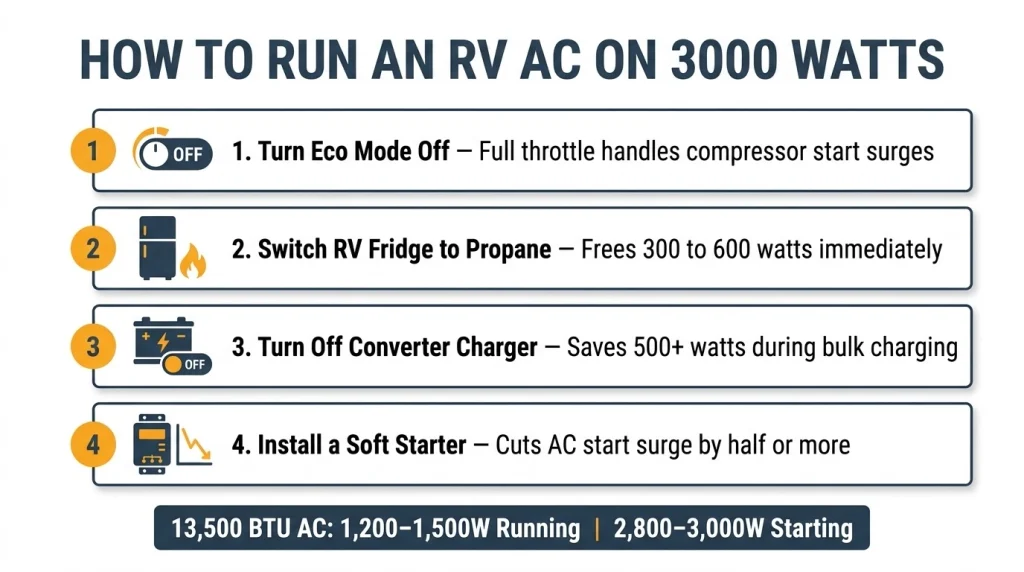
The problem is the start-up surge. A 13,500 BTU RV AC may run on 1,200 to 1,500 watts, yet need 2,800 to 3,000 watts to start. That leaves almost no room for a fridge or a converter charger at the same moment.
I learned this at a campsite in July. The AC started fine in the morning, then tripped the generator when the fridge compressor kicked in at noon. I turned off the RV fridge on electric, switched it to propane, and the AC held steady.
How do you make a 3000-watt generator run an RV AC more reliably?
Start the AC first, with other loads off. Let it run for a few minutes, then add lights and chargers slowly. That order gives the compressor the full surge it needs.
A soft starter can help a lot. It lowers the start-up surge of the AC compressor, so the generator does not see a sudden spike. Many RV owners add one to run a 15,000 BTU unit on a 3000-watt generator.
- Use eco mode off for AC starts: Full throttle responds faster to a surge than eco mode.
- Switch the RV fridge to propane: That frees 300 to 600 watts for the AC.
- Turn off the converter charger: A bulk-charging converter can draw 500 watts or more on its own.
- Consider a soft starter: It can cut the AC start surge by half or more on many models.
For more detail on RV AC loads and model choices, see this guide to the best generator for RV air conditioner use. It covers size, soft starters, and the trade-offs I see most often in the field.
Can it run an RV AC and a microwave together?
It usually cannot run a 13,500 BTU RV AC and a microwave at the same time. The AC alone may use 1,300 running watts, and a microwave adds 1,000 watts or more.
That total is close to the running limit, and any fridge start can push it over. Turn the AC fan to low, or pause the AC for the two minutes you need the microwave. That small pause keeps the generator from tripping.
Section Takeaway: A 3000-watt inverter generator can run a 13,500 BTU RV AC on its own, but a soft starter and careful load control make it far more reliable.
How Long Will a 3000-Watt Inverter Generator Run?
Runtime depends on tank size, load, and eco mode. Most 3000-watt inverter generators run 7 to 9 hours at 25% load, and 4 to 6 hours at 50% load, on a tank of about 2 to 3 gallons.
Light loads stretch fuel a long way. A fridge, lights, and chargers may use only 500 to 800 watts, so the engine can stay in eco mode and sip fuel. Heavy loads near 2,500 watts will drain the tank much faster.
Eco mode, also called economy mode or eco-throttle, slows the engine when the load is light. It cuts noise and fuel use, but it can react more slowly to a sudden surge. Turn it off when you start a motor.
How much fuel does it use per hour?
Fuel use varies by load, but a useful rule is about 0.3 to 0.5 gallons per hour at a moderate load. At a light load in eco mode, use can drop closer to 0.2 gallons per hour.
A 2.6-gallon tank at 25% load can last 8 hours or more on many models. The same tank at 75% load may last only 3 to 4 hours. Check the spec sheet for runtime at 25% and 50% load, not just the headline number.
- 25% load, eco on: About 7 to 9 hours on a typical tank.
- 50% load: About 4 to 6 hours on a typical tank.
- Near full load: About 3 to 4 hours, with more noise and heat.
How do you stretch runtime during an outage?
Run the fridge in cycles, not all day at full load. A closed fridge stays cold for hours, so you can run it for 30 minutes, then rest it while you charge phones.
Keep fuel fresh and store it safely. Gasoline can go stale in 30 days without stabilizer, and stale fuel is a top cause of hard starts. I add stabilizer, date the can, and rotate it every few months.
Safety note: Refuel only when the generator is off and cool, outdoors and away from sparks. Store fuel in an approved container, away from the home and away from heat.
Section Takeaway: Expect 7 to 9 hours at a light load and 4 to 6 hours at half load, and use eco mode plus load cycling to stretch each tank further.
3000-Watt vs 2000-Watt vs 5000-Watt: Which Size Fits You?
A 2000-watt inverter generator suits camping, tailgating, and light charging. It runs a small fridge or a laptop setup, but it cannot run a window AC and a fridge together.
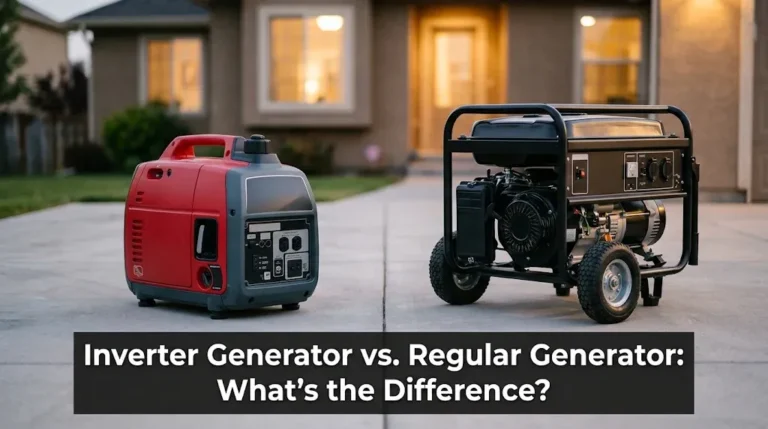
A 3000-watt model adds the headroom for a fridge, a small AC, and a microwave in turn. It stays quieter than a big open-frame unit, and it still fits in a car trunk or RV bay. That balance makes it the most useful size for many buyers.
A 5000-watt model suits larger home backup, with room for a fridge, a freezer, a sump pump, and more lights. It costs more, weighs more, and uses more fuel. It also needs a larger transfer setup for home use.
| Size | Running Watts | Best For | Main Limit |
|---|---|---|---|
| 2000-watt inverter | 1,600-1,800 | Camping, phones, laptop, small fridge | No window AC plus fridge |
| 3000-watt inverter | 2,500-2,800 | Home essentials, RV, small AC | No central AC or water heater |
| 5000-watt inverter | 4,000-4,500 | Larger home backup, RV with 15k AC | Heavier, louder, pricier |
Price also rises with size. A 3000-watt inverter generator often costs more than a 2000-watt model, yet less than a 5000-watt model with the same features. For a full price breakdown by brand and tier, see how much a 3000-watt inverter generator costs.
Parallel capability can change the math. Two 3000-watt inverter generators linked with a parallel kit can give you about 5,000 to 5,600 running watts together. That setup suits an RV with a larger AC, but it costs as much as a bigger single unit.
If you want a ready shortlist, compare the best 3000-watt portable generator options by running watts, noise, runtime, and outlets. Look for a 30-amp RV outlet, a low THD rating, and a clear overload indicator.
Section Takeaway: Choose 2000 watts for light camping, 3000 watts for home essentials and RV use, and 5000 watts when you need a larger backup load.
How Do You Size and Use a 3000-Watt Inverter Generator Safely?

Start with a simple watt list. Write down every device you want to run, note its running watts, and note the starting watts for any motor.
Add the running watts together, then add the largest starting watts once. If the total running watts stay under 2,500 watts, a 3000-watt model can often handle it. If the total is over 2,800 watts, you need a larger generator or fewer loads.
I use a small plug-in watt meter for the first test. It shows the real draw of my fridge and freezer, which is often lower than the label. That real number beats a guess every time.
What are the five steps to size it right?
- List your must-run loads: Fridge, lights, phones, CPAP, and any medical device come first.
- Find running watts: Read the label or manual for each device, and use a watt meter when you can.
- Add the biggest start: Add the starting watts of the largest motor, such as a fridge or AC, on top of the running total.
- Leave 20% headroom: Aim for a running total under 80% of the generator’s running watts.
- Test before an outage: Run the full combo for 30 minutes and watch for overload warnings.
What mistakes trip a 3000-watt generator most often?
The most common mistake is starting two motors at once. A fridge and a freezer can each start fine alone, yet trip the generator when they cycle together.
Another mistake is using a long, thin extension cord. A 16-gauge cord over 100 feet can drop voltage and make motors work harder. Use a short, heavy-duty 12-gauge cord for fridge and AC loads.
- Overload: Too many loads at once, or two motors starting together.
- Stale fuel: Old gasoline clogs the carburetor and causes surging or hard starts.
- Low oil: A low-oil shutdown protects the engine, but it can surprise you mid-outage.
- Blocked vents: A cover or wall too close to the exhaust can cause overheating and CO buildup.
Carbon monoxide is the most serious risk with any generator. The CDC warns that CO is colorless and odorless, and it can build up fast indoors. The Consumer Product Safety Commission also stresses outdoor use far from the home.
Safety note: Run generators outdoors and at least 20 feet from your home, with the exhaust pointed away from windows, doors, and vents. Use a battery-powered CO alarm inside the home, and never run a generator in a garage, even with the door open.
Section Takeaway: Add running watts, add the largest start once, leave 20% headroom, and test the full load before you need it in an outage.
Is 3000 Watts Enough for Home Backup?
Yes, 3000 watts is enough for home backup if you define backup as essentials, not the whole house. It keeps food cold, lights on, phones charged, and medical devices running through most outages.
It is not enough for central heat, central AC, an electric water heater, or an electric stove. Those systems need a standby generator or a much larger portable unit with a proper transfer switch.
For a fuller sizing walk-through, see what size inverter generator do I need. It helps you match your home, RV, or camping load to the right size without overspending.
What does a realistic outage day look like on 3000 watts?
In the morning, I run the fridge, a coffee maker, and phone chargers. The coffee maker uses 800 to 1,000 watts for a few minutes, so I keep the microwave off while it brews.
At midday, I run the fridge, a fan, a laptop, and lights. I cycle the freezer for 30 minutes every few hours to keep it cold. That rhythm uses far less fuel than running everything at once.
At night, I run the fridge, a CPAP machine, and two lights. The generator stays in eco mode, and the noise drops to a low hum. That quiet matters when neighbors are trying to sleep.
When should you go bigger than 3000 watts?
Go bigger if you need a sump pump plus a fridge plus a furnace blower at the same time. That mix can push past 2,800 running watts, especially when motors start.
Go bigger if you have a 15,000 BTU RV AC and you want to run it with a microwave and a fridge. A 4500-watt or 5000-watt inverter gives you the headroom to do that without constant load juggling.
The U.S. Department of Energy offers general guidance on home backup power and energy use. Consumer Reports also tests generator noise, runtime, and power quality, which helps when you compare models side by side.
Safety note: For home circuits, use a transfer switch or interlock installed by a licensed electrician. Never backfeed power through a wall outlet, and check your owner’s manual before you connect any load.
Section Takeaway: A 3000-watt inverter generator covers home essentials well, but move up in size when you need central systems or several large motors at once.
Frequently Asked Questions
How much power does a 3000-watt inverter generator provide?
It provides 3,000 starting watts and about 2,500 to 2,800 running watts. That steady power runs a fridge, lights, electronics, and one heavy load at a time.
Can a 3000-watt inverter generator run a refrigerator and freezer together?
Yes, in many cases, if you start them one at a time and keep other loads light. The pair often uses 250 to 350 running watts once both compressors settle.
Can a 3000-watt inverter generator run a 15000 BTU RV air conditioner?
It often struggles with a 15,000 BTU unit without a soft starter. A soft starter lowers the start surge, and turning off the fridge and converter helps it hold steady.
How long will a 3000-watt inverter generator run on a tank of gas?
Most models run 7 to 9 hours at 25% load and 4 to 6 hours at 50% load. Light loads in eco mode stretch runtime, while heavy loads drain the tank faster.
Is a 3000-watt inverter generator enough for a house?
It is enough for essentials such as a fridge, lights, phones, and a CPAP machine. It is not enough for central AC, an electric water heater, or an electric stove.
Can you parallel two 3000-watt inverter generators?
Yes, if both models support parallel operation and you use the correct parallel kit. Two linked units can provide about 5,000 to 5,600 running watts together.
What should you not plug into a 3000-watt inverter generator?
Do not plug in a central AC, electric water heater, electric stove, or electric dryer. Avoid two large motors starting at once, and check the manual for any load limits.
A 3000-watt inverter generator gives you real, usable power for the loads that matter most. Add up your running watts, leave room for the largest start, and test the combo before an outage hits. That simple prep turns a good generator into a reliable backup plan in 2026.

Hi, I’m Michael Turner. I own a generator workshop in the United States and founded HomeGeneratorBlog to share practical, hands-on guidance about generator installation, maintenance, troubleshooting, safety, and backup power solutions. My goal is to help homeowners make smarter, more confident decisions through clear and reliable information