Can an Inverter Generator Run a Window AC Unit? Sizing, Runtime & Safe Setup
Quick Answer
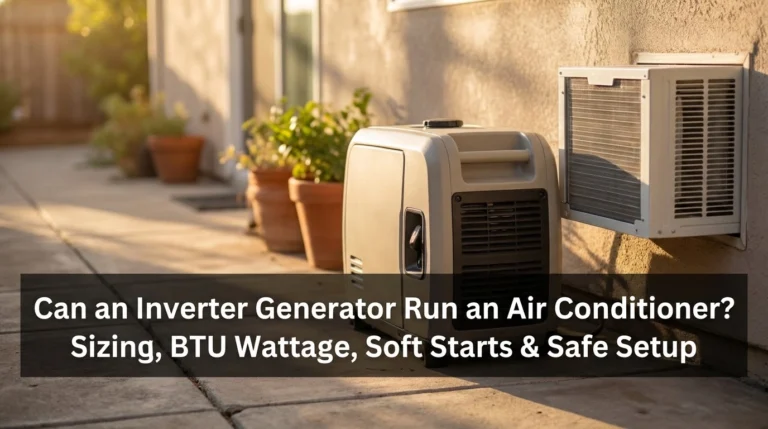
Yes, an inverter generator can run a window AC unit if its starting watts clear the compressor surge. Most 5,000 to 8,000 BTU units need 1,800 to 3,500 starting watts, so a 2,000 to 3,000-watt inverter generator works for many small units. Check your AC label first, then match both running watts and starting watts before you plug in. See the best generator for window AC picks for size-matched options.
What size do you need?
- 5,000 BTU unit: Often needs about 450 to 600 running watts and 1,200 to 1,800 starting watts.
- 8,000 BTU unit: Often needs about 700 to 900 running watts and 1,800 to 2,500 starting watts.
- 10,000 BTU unit: Often needs about 900 to 1,200 running watts and 2,500 to 3,500 starting watts.
- 12,000 BTU unit: Often needs about 1,100 to 1,400 running watts and 3,000 to 4,000 starting watts.
- Safe rule: Size for starting watts first, then check running watts second.
Start it the right way
- Turn the AC fan on first, wait a few seconds, then switch to cool.
- Run the generator outside, at least 20 feet from windows and doors.
- Use a short, heavy-duty outdoor cord rated for the load.
I’ve run a window AC on an inverter generator during a sticky summer outage, and the first try taught me the real lesson fast.
The AC hummed, the compressor kicked in, and my small generator tripped. That moment is why this guide goes deeper than a yes-or-no answer.
You’ll learn the wattage math, the right generator size by BTU, runtime, safe setup, and the mistakes that trip most people up.
In This Guide
- What Is a Window AC Unit and Why Is It Hard to Power?
- How Many Watts Does a Window AC Unit Use?
- What Size Inverter Generator Do You Need for a Window AC?
- Can a 2,000-Watt Inverter Generator Run a Window AC?
- How to Run a Window AC on an Inverter Generator Safely
- How Long Will an Inverter Generator Run a Window AC?
- Inverter Generator vs Conventional Generator for a Window AC
- Common Problems and Mistakes to Avoid
- Frequently Asked Questions
What Is a Window AC Unit and Why Is It Hard to Power?
An inverter generator is a portable generator that makes clean, stable power by converting raw AC power to DC, then back to clean AC power.
That clean sine wave matters for a window AC because its compressor and controls do not like rough, spiky power.
A window AC unit is a self-contained cooler that sits in a window frame. It pulls warm room air in, cools it over cold coils, and pushes hot air outside.
It sounds simple, yet the compressor inside creates a short, sharp power spike each time it starts.
Why does the compressor surge matter so much?
The compressor is a small motor, and motors need extra power to get moving. That extra burst is called starting watts, or surge watts.
Running watts keep the AC going once it is cold. Starting watts get it going in the first place.
Many people size a generator for running watts only. That is the most common sizing mistake I see.
The generator may look big enough on paper, then trip the second the compressor kicks on.
What makes a window AC different from a fan or a fridge?
A fan has a small motor and a low, steady draw. A window AC has a larger compressor motor plus a fan motor.
It also cycles on and off all day. Each restart asks for another surge.
That cycle is why you need headroom, not just a bare minimum match.
- Compressor: The main load, with the highest surge.
- Fan motor: A smaller, steadier load that runs with the compressor.
- Controls: A low load, but one that prefers clean power.
- Thermostat cycling: The reason surges repeat through the day.
Section Takeaway: A window AC is hard to power because its compressor needs a short surge that can be two to three times its running watts, so size for that surge first.
How Many Watts Does a Window AC Unit Use?
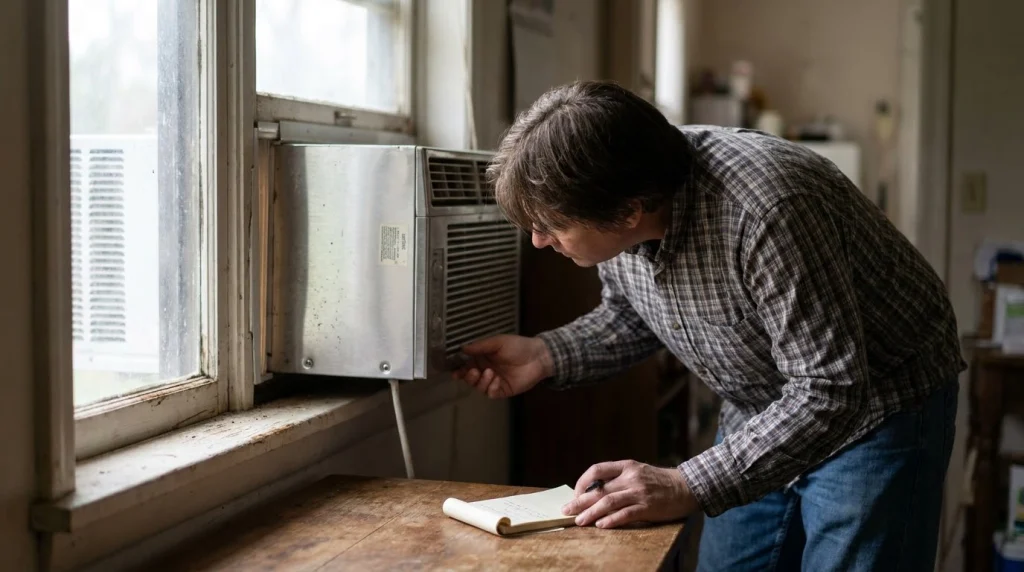
The short answer is that most small window AC units use 450 to 1,400 running watts. The exact number depends on BTU size, age, and efficiency.
BTU, or British Thermal Unit, measures cooling power. A higher BTU rating usually means a bigger compressor and more watts.
Check the label on the side of your unit for amps and volts. Multiply amps by volts to estimate running watts.
For example, 5 amps at 115 volts is about 575 watts. That math gives you a real starting point.
Window AC wattage by BTU size
Use this table as a planning guide, not a spec sheet. Your exact model may sit a little above or below these ranges.
Always confirm the label watts and the manual before you buy a generator for it.
| Window AC Size | Running Watts (Typical) | Starting Watts (Typical) | Best For |
|---|---|---|---|
| 5,000 BTU | 450–600 watts | 1,200–1,800 watts | Small bedroom, up to about 150 sq ft |
| 6,000 BTU | 500–700 watts | 1,500–2,100 watts | Small bedroom or home office |
| 8,000 BTU | 700–900 watts | 1,800–2,500 watts | Medium bedroom, up to about 350 sq ft |
| 10,000 BTU | 900–1,200 watts | 2,500–3,500 watts | Large bedroom or small living room |
| 12,000 BTU | 1,100–1,400 watts | 3,000–4,000 watts | Large room, up to about 550 sq ft |
| 14,000–15,000 BTU | 1,300–1,600 watts | 3,500–5,000 watts | Large living space, needs a bigger generator |
Why do older window AC units use more power?
Older units often have lower efficiency ratings and worn compressors. They may draw more watts for the same cooling output.
A newer inverter-style window AC, sometimes called a variable-speed unit, can start more gently. It may still surge, but often less sharply.
Check the EER or CEER rating on the label if you have it. A higher rating usually means less power per BTU.
What else adds watts while the AC runs?
The AC is rarely the only load in the room. A phone charger is tiny, but a fridge on the same circuit is not.
Add every load you plan to run at the same time. Then add a 20% buffer on top of the running total.
That buffer keeps the generator from running at its limit all day. It also leaves room for the next compressor restart.
Section Takeaway: Most 5,000 to 8,000 BTU window AC units need 450 to 900 running watts, but plan for 1,200 to 2,500 starting watts before you choose a generator.
What Size Inverter Generator Do You Need for a Window AC?
You need a generator whose starting watts beat your AC starting watts, with room to spare. A good target is at least 500 watts of headroom above the surge.
For a 5,000 BTU unit, a 2,000-watt inverter generator often works. For an 8,000 BTU unit, a 2,500 to 3,000-watt model is a safer pick.
For a 10,000 to 12,000 BTU unit, look at 3,500 to 4,500 starting watts. That range covers most mid-size units plus a few small loads.
Use the right inverter generator size for your home as a cross-check before you buy, then confirm it against your AC label.
How do you do the wattage math in 60 seconds?
Start with the AC label watts, or amps times volts. Write down that running-watt number.
Next, multiply running watts by 2.5 as a rough surge estimate if the manual gives no starting watts. That estimate is a planning tool, not a spec.
Then add the running watts of anything else on the same generator. Lights, a fan, and a phone charger add up fast.
Finally, pick a generator with starting watts above that total. If the math is close, go up one size.
For a full walkthrough, see how to calculate the generator wattage you need before your next outage.
Does eco mode help or hurt with a window AC?
Eco mode, also called economy mode, slows the engine when the load is light. It saves fuel and cuts noise.
It can hurt at startup, though, because the engine may react too slowly to a sudden surge. Many owners turn eco mode off for the first AC start.
Once the AC is running and stable, you can try eco mode again. Watch for surging or a trip, and switch it off if the AC struggles.
- Start with eco off: Give the engine full speed for the compressor surge.
- Stabilize first: Let the AC run for a few minutes before you change modes.
- Test eco on: Turn it on only after the room starts to cool.
- Turn it back off: Do this at once if the generator surges or the AC cuts out.
What about parallel capability?
Some inverter generators can link together with a parallel kit. Two 2,000-watt units can act like one larger unit.
That setup helps if you already own a small generator and want more surge power. It costs more than one larger unit, though, and adds cords and setup steps.
For most window AC owners, one right-sized generator is simpler. Parallel kits make sense when you want flexibility for camping and home backup in one system.
Section Takeaway: Pick a generator by starting watts first, add a 500-watt buffer, and turn eco mode off for the first compressor start.
Can a 2,000-Watt Inverter Generator Run a Window AC?
Yes, a 2,000-watt inverter generator can run many 5,000 and 6,000 BTU window AC units. It can also run some efficient 8,000 BTU units, but the margin gets tight.
Check the surge rating, not just the running watts. Many 2,000-watt models offer about 2,200 starting watts.
That is enough for a 5,000 BTU surge of 1,200 to 1,800 watts. It leaves little room for a fridge or other load at the same time.
A 3,000-watt inverter generator is often the sweet spot for an 8,000 BTU unit, because it clears the surge with room for lights and charging.
When will a 2,000-watt generator trip?
It will trip when the compressor surge beats its starting watts. It will also trip when you add too much load at once.
Hot weather makes this worse. A hot compressor can draw a higher surge than a cool one.
Long, thin extension cords make it worse too. They drop voltage and force the motor to work harder.
Can a soft start kit help a small generator?
Yes, a soft start kit can lower the compressor surge on some AC units. It eases the motor up to speed instead of slamming it on.
It is not a fix for every unit, and it needs correct wiring. Check your AC manual and, if needed, ask a qualified technician before you fit one.
Think of it as a helper, not a license to undersize your generator. The surge still exists, just in a gentler form.
- Best case for 2,000 watts: A 5,000 BTU unit, alone, with eco mode off at startup.
- Borderline case: An efficient 8,000 BTU unit, alone, on a cool day.
- Poor case: A 10,000 BTU unit, or an 8,000 BTU unit plus a fridge.
- Safer upgrade: A 3,000 to 3,500-watt inverter generator for most 8,000 to 10,000 BTU units.
Section Takeaway: A 2,000-watt inverter generator works for many small window AC units, but a 3,000-watt model gives most 8,000 BTU owners the headroom they need.
How to Run a Window AC on an Inverter Generator Safely
Safe setup starts before you plug anything in. Place the generator outside, on dry, level ground, at least 20 feet from your home.
Point the exhaust away from windows, doors, and vents. Carbon monoxide is colorless and odorless, and it can build up fast indoors.
Never run a generator in a garage, even with the door open. Never run it on a porch close to an open window.
Safety note: Run generators outdoors and well away from windows, doors, and vents. Use a transfer switch or interlock installed by a licensed electrician for any home hookup, and check your owner’s manual before use.
What is the safest way to connect the AC?
Plug the AC directly into the generator with a short, heavy-duty outdoor cord if you must use one. A 12-gauge cord under 25 feet is a good target for most window AC loads.
Do not use a light indoor cord or a long, coiled cord. Heat builds up in thin cords, and voltage drops over distance.
Do not backfeed your home through a wall outlet. That practice, sometimes called a suicide cord, can injure utility workers and damage your home.
For whole-room or multi-load backup, a proper inlet and interlock or transfer switch is the safe route. A licensed electrician should install it.
How do you start the AC without tripping the generator?
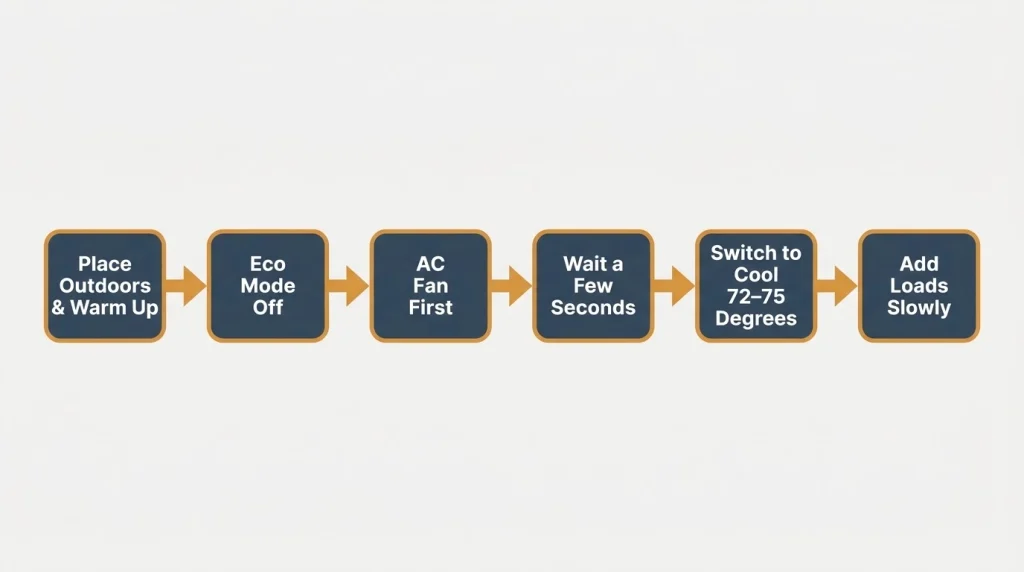
Start the generator first and let it warm up for a minute or two. Turn eco mode off for the first start.
Set the AC fan to low or medium, then switch it on. Wait a few seconds for the fan to settle.
Then switch to cool and set a moderate temperature, such as 72 to 75 degrees. A very low setting makes the compressor work harder at startup.
Let the room cool in stages instead of asking for max cold at once. Your generator will thank you for it.
- Place and start: Set the generator outside, start it, and let it warm up.
- Check the load: Unplug other heavy loads before the AC starts.
- Fan first: Turn the AC fan on, wait, then switch to cool.
- Watch the first cycle: Listen for surging and watch for an overload light.
- Add loads slowly: Add lights or charging only after the AC runs steady.
What does the CDC say about generator safety?
The CDC warns that generators can produce deadly carbon monoxide in minutes. Its guidance stresses outdoor placement far from the home.
Keep a battery-powered CO alarm in the room where you sleep. Test it before outage season, not during the outage.
The U.S. Consumer Product Safety Commission also publishes generator safety guidance. Its core message matches the CDC: outside only, far from openings, and never indoors.
Section Takeaway: Place the generator outside and far from the house, use a short heavy-duty cord, start the fan before cool, and never backfeed your home.
How Long Will an Inverter Generator Run a Window AC?
Runtime depends on tank size, load, and eco mode. A small inverter generator may run 6 to 10 hours at 25% load on one tank.
A window AC at 600 to 900 running watts is a medium load for a 2,000 to 3,000-watt unit. Expect shorter runtime than the light-load rating on the box.
Check your spec sheet for runtime at 25% and 50% load. Those two numbers tell you more than the headline runtime alone.
For example, a generator rated for 10 hours at 25% load may run about 5 to 7 hours at 50% load. Your AC plus a few small loads often lands near that middle range.
How can you stretch runtime during an outage?
Cool one room and close the door. That simple step cuts the AC cycle rate and saves fuel.
Use curtains or shades to block direct sun on the AC side of the house. Less heat gain means fewer compressor starts.
Set the thermostat a few degrees higher than usual. A 75-degree room uses less power than a 68-degree room.
- Cool one room: Close doors and seal obvious drafts around the AC.
- Run the fan: Use a small room fan to spread cool air further.
- Refuel safely: Turn the generator off and let it cool before you add fuel.
- Keep spare fuel: Store fresh fuel in an approved container, away from the generator.
Does eco mode help runtime once the AC is running?
Yes, eco mode can help once the AC is stable. It lets the engine slow down between compressor cycles.
Test it for 15 minutes before you trust it overnight. If the AC restarts cleanly in eco mode, keep it on.
If the generator surges or trips on a restart, turn eco mode off. Fuel savings mean nothing if the room heats up at 2 a.m.
Safety note: Let the generator cool before refueling, store fuel outside and away from ignition sources, and check your owner’s manual for fuel type and storage limits.
Section Takeaway: Expect 5 to 8 hours per tank for many small inverter generators running a window AC, and stretch it by cooling one room and setting the thermostat a few degrees higher.
Inverter Generator vs Conventional Generator for a Window AC
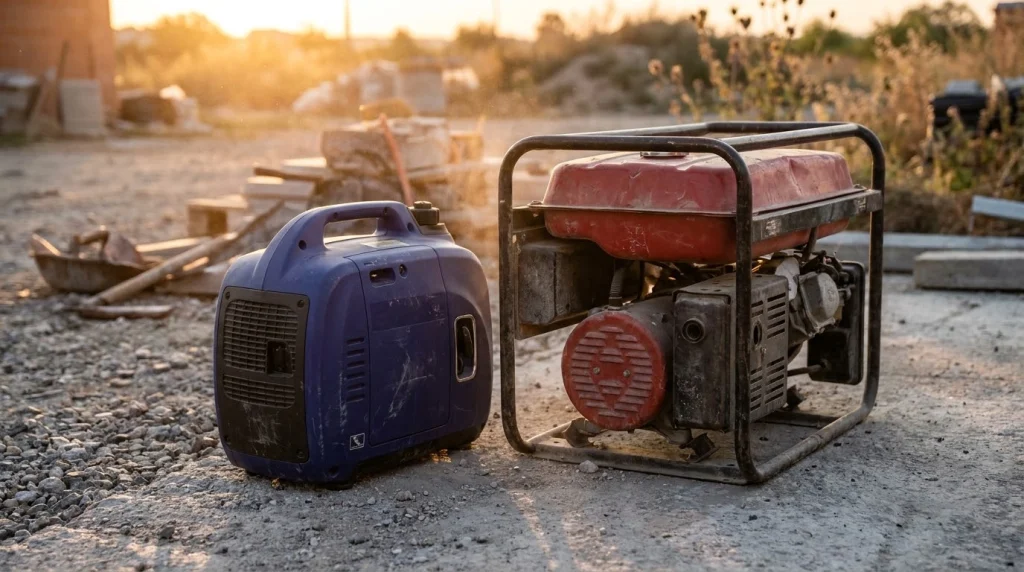
An inverter generator is usually the better pick for a window AC in a home or campsite. It makes cleaner power, runs quieter, and sips fuel at part load.
A conventional open-frame generator can also run a window AC. It often costs less per watt and offers more starting power for the price.
The trade-off is noise, fuel use, and power quality. That trade-off matters when you run an AC for hours near bedrooms or neighbors.
For a deeper look at air conditioner power needs, see the best generator for air conditioner guide alongside this article.
| Feature | Inverter Generator | Conventional Generator |
|---|---|---|
| Power quality | Clean sine wave, low THD, safer for controls | Rougher power, higher THD on many models |
| Noise | Quieter, often 50–60 dB at part load | Louder, often 70 dB or more |
| Fuel use | Better at part load, eco mode helps | Runs at fixed speed, uses more fuel at light load |
| Starting power | Good, but check surge rating closely | Often stronger surge per dollar |
| Weight and size | Lighter and easier to move | Heavier, bulkier for the same running watts |
| Best for | Bedroom AC, camping, long outage nights | Large AC, job sites, budget-first backup |
When does a conventional generator make more sense?
A conventional generator makes sense for a large 12,000 to 15,000 BTU unit on a tight budget. It also makes sense when you need to run the AC plus other heavy loads.
It still needs the same outdoor placement and CO safety rules. Noise and fuel use do not change the safety steps.
For most small to mid-size window AC units, though, the inverter wins on comfort. You sleep better, and your neighbors do too.
The U.S. Department of Energy publishes general energy and backup-power guidance that can help you compare fuel use and efficiency across generator types.
Section Takeaway: Choose an inverter generator for quiet, clean power with a small to mid-size window AC, and choose a conventional model only when budget or a very large AC pushes you to more watts per dollar.
Common Problems and Mistakes to Avoid
Most window AC failures on a generator come from the same few mistakes. The good news is that each one is easy to fix before the next outage.
Start with the load list, not the generator box. A generator that looks big enough can still trip on a hidden load.
Test your setup on a calm day, not during a heat wave. A test run shows the real surge before you need the AC most.
Why does my generator trip when the AC starts?
The most likely cause is a surge above the generator’s starting watts. Check the AC label and the generator surge rating side by side.
Another cause is a second load starting at the same moment. A fridge compressor can kick on just as the AC compressor starts.
Stale fuel can also cause a trip that looks like an overload. A surging engine cannot hold voltage when the AC asks for power.
Learn the difference in starting wattage in an inverter generator so you can spot a true overload from a fuel or maintenance issue.
Why does the AC run, then stop after a few minutes?
Low oil shutdown is one common cause. Check the oil level on level ground before each use.
Overheating is another cause, especially on a hot day with poor airflow around the generator. Keep vents clear and give the unit shade without blocking exhaust.
A dirty air filter can starve the engine at higher loads. Clean or replace it per your manual, and use fresh fuel.
- Check oil first: Top it up to the manual level, not above it.
- Check fuel: Use fresh gasoline and a fuel stabilizer for storage.
- Check the cord: Swap a long, thin cord for a short, heavy-duty one.
- Check the load: Unplug the fridge or other motor loads during the AC test.
- Check the filter: Clean the air filter and check the spark plug per the manual.
What mistakes should you avoid with extension cords?
Do not run the AC on a 100-foot light-duty cord. Voltage drop can damage the compressor over time.
Do not daisy-chain two cords together. Each connection adds resistance and heat.
Do not run a cord through a window that pinches it shut. A pinched cord can overheat and fail.
The EPA and Consumer Reports both publish general guidance on safe generator use and maintenance. Use those sources as a cross-check for your manual.
Safety note: Keep cords dry, uncoiled, and away from foot traffic. Inspect them for cuts or heat damage before each use, and replace a damaged cord at once.
Section Takeaway: Test your AC on the generator before an outage, keep fuel and oil fresh, and use a short heavy-duty cord to avoid most trips and stalls.
Frequently Asked Questions
Can an inverter generator run a window AC unit and a refrigerator at the same time?
Sometimes, but only if the combined starting watts fit the generator. A 3,000 to 4,500-watt inverter generator handles that pair far better than a 2,000-watt model.
Start the AC first, let it stabilize, then add the fridge. Never start both compressors at the same moment.
What size inverter generator do I need for a 5,000 BTU window AC?
A 2,000-watt inverter generator is often enough for a 5,000 BTU unit. Look for at least 1,800 starting watts and run the AC alone at startup.
If you want lights and charging too, a 2,200 to 3,000-watt model gives you more headroom.
What size inverter generator do I need for an 8,000 BTU window AC?
A 2,500 to 3,000-watt inverter generator is a safer pick for most 8,000 BTU units. It clears the 1,800 to 2,500-watt surge with room to spare.
Check your label first, because older 8,000 BTU units can surge higher than newer efficient models.
Can I run a window AC on a 1,000-watt inverter generator?
Usually no, because most window AC units surge above 1,000 watts at startup. Even a small 5,000 BTU unit often needs 1,200 to 1,800 starting watts.
A 1,000-watt generator may run a fan, but it is not a reliable choice for a compressor AC.
Will a window AC damage my inverter generator?
No, a right-sized AC will not damage a healthy inverter generator. Repeated overload trips, though, can stress the engine and the AC compressor.
Size the generator correctly, keep oil and fuel fresh, and stop using a setup that trips often.
Can I use eco mode with a window AC?
Yes, once the AC is running steady, but start with eco mode off. The engine needs full speed for the first compressor surge.
Test eco mode for 15 minutes, and turn it off if the generator surges or the AC restarts poorly.
Is it safe to run a window AC on a generator overnight?
Yes, if the generator stays outside, far from windows, with a working CO alarm indoors. Never bring the generator inside to refuel or to cut noise.
Check fuel, oil, and cord condition before bed, and set the thermostat a few degrees higher to cut cycling.
Yes, an inverter generator can run a window AC unit in 2026, and the right size makes all the difference. Match starting watts first, test the setup before you need it, and keep the generator outside and far from your home.
Start with your AC label, pick a generator with headroom, and cool one room well instead of trying to cool the whole house. That plan keeps you cool, safe, and ready for the next outage.

Hi, I’m Michael Turner. I own a generator workshop in the United States and founded HomeGeneratorBlog to share practical, hands-on guidance about generator installation, maintenance, troubleshooting, safety, and backup power solutions. My goal is to help homeowners make smarter, more confident decisions through clear and reliable information