What Appliances Can a 5000-Watt Inverter Generator Run? Full Load Guide
Quick Answer
A 5000-watt inverter generator can run a fridge, freezer, furnace fan, lights, Wi-Fi, phones, and a small window AC at the same time. It can also handle a sump pump, microwave, or washing machine one at a time, if you stagger the big motor starts. Learn how much power a 5000-watt inverter generator provides before you load it to the limit.
What it handles well together
- Home essentials: Fridge, freezer, furnace fan, LED lights, and internet router run together with room to spare.
- Cooling: A small 8,000 to 10,000 BTU window AC can run if you start it first and keep other big loads off.
- Kitchen: A microwave or coffee maker works well alone, but not with the AC compressor starting.
- RV and work: A 13,500 BTU RV AC, battery charger, and lights fit, plus a circular saw or drill in short bursts.
- Safe limit: Keep steady running watts under 4,000 to 4,500 for long, reliable use.
Do this first
- Add up running watts, then add the highest starting watts once.
- Start the biggest motor first, then add smaller loads one by one.
I have run a 5000-watt inverter generator through a three-day outage, and it changed how I think about backup power.
It kept the food cold, the furnace fan moving, and the phones charged. It also taught me fast that 5,000 watts is a budget, not a blank check.
This guide shows the real appliance combos that work in 2026, the ones that trip the overload, and the simple math that keeps you safe.
In This Guide
- What Does 5,000 Watts Actually Mean for Your Home?
- What Appliances Can a 5000-Watt Inverter Generator Run at the Same Time?
- Can a 5000-Watt Inverter Generator Run a Refrigerator, Freezer, and Furnace?
- Can It Run an Air Conditioner, Sump Pump, and Well Pump?
- What Can It Run in an RV, Camper, and on a Job Site?
- What Appliances Can a 5000-Watt Inverter Generator NOT Run?
- How Long Will a 5000-Watt Inverter Generator Run Your Appliances?
- How Do You Connect Appliances Safely Without Overloading It?
- Is a 5000-Watt Inverter Generator Enough for Your Home?
- Frequently Asked Questions
What Does 5,000 Watts Actually Mean for Your Home?
An inverter generator is a portable generator that makes clean, stable power for sensitive electronics. It converts raw engine power to DC, then inverts it back to smooth AC power.
That clean sine wave matters for laptops, phones, CPAP machines, and modern fridges. Total harmonic distortion, or THD, stays low on most inverter models.
Most 5000-watt inverter generators are rated 5,000 starting watts and 4,000 to 4,500 running watts. Check the spec sheet, because that split decides what you can run.
What is the difference between running watts and starting watts?
Running watts are the steady power an appliance needs while it runs. Starting watts, also called surge watts, are the short spike a motor needs for one to three seconds to start.
A fridge may run on 150 watts but need 1,200 watts to start its compressor. That spike is why two fridges starting together can trip a generator that handles them fine once running.
Learn the difference between running watts and starting watts before you size any load. It prevents most overload shutdowns I see in the field.
How many amps is 5000 watts?
At 120 volts, 5,000 watts equals about 41.6 amps in theory. In real use, most 5000-watt inverter generators give you 30 amps through a 120/240-volt outlet, plus standard 120-volt outlets.
That 240-volt option matters for a well pump or a larger furnace circuit. Many smaller inverter generators offer 120 volts only, so this size opens more home circuits.
Section Takeaway: Treat 5,000 watts as the short surge ceiling and 4,000 to 4,500 watts as your steady working budget.
What Appliances Can a 5000-Watt Inverter Generator Run at the Same Time?
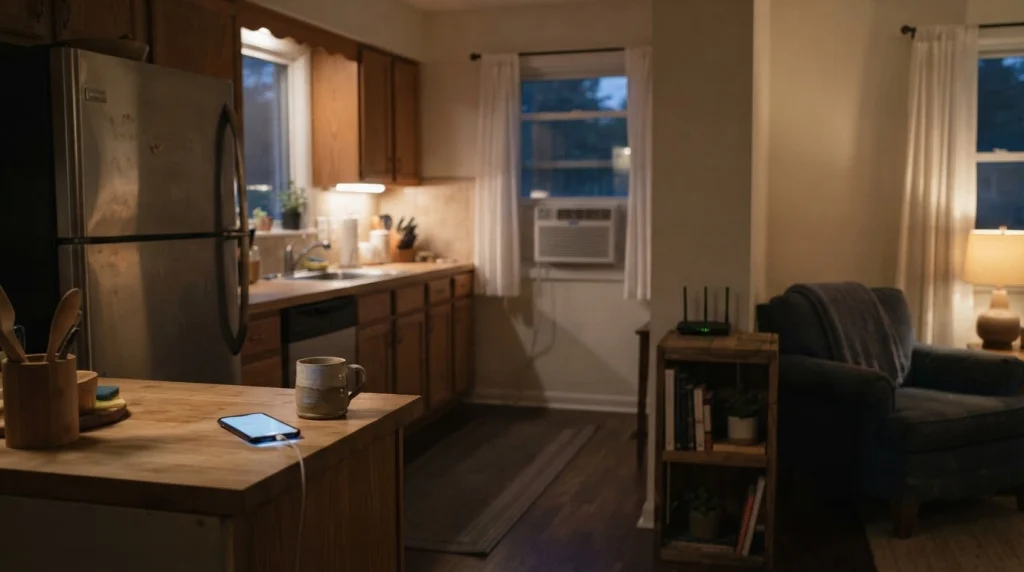
A 5000-watt inverter generator can run a full home-essentials kit at once. Think fridge, freezer, furnace fan, lights, router, and phone chargers together.
That combo usually lands near 1,500 to 2,500 running watts. It leaves headroom for a motor to start without tripping.
Use the table below as a planning guide, not a promise. Always check the label on your own appliance, because age and size shift the numbers.
| Appliance | Running watts (typical) | Starting watts (typical) | Can it run together? |
|---|---|---|---|
| Refrigerator | 150-250 | 800-1,200 | Yes, with freezer |
| Chest freezer | 100-200 | 800-1,200 | Yes, stagger starts |
| Furnace fan (gas furnace) | 500-800 | 1,200-1,800 | Yes, with fridge |
| Window AC, 8,000-10,000 BTU | 900-1,300 | 2,000-2,800 | Yes, start it first |
| Sump pump, 1/3 HP | 800-1,000 | 1,800-2,400 | Yes, with lights |
| Microwave, 1,000W | 1,000-1,300 | 1,000-1,300 | Alone or with small loads |
| Washing machine | 500-800 | 1,200-2,000 | Yes, without AC |
| Coffee maker | 900-1,200 | 900-1,200 | Yes, briefly |
| TV, laptop, phones, lights | 200-400 total | 200-400 | Yes, almost always |
| CPAP machine | 30-60 | 30-60 | Yes, easily |
What is a realistic 5000-watt load combo?
Here is a combo I have run overnight without a trip. Fridge (200W), freezer (150W), furnace fan (600W), LED lights (100W), router and chargers (100W), and a CPAP (50W) total about 1,200 running watts.
Add a 10,000 BTU window AC at 1,100 running watts and you sit near 2,300 watts. That leaves a wide margin for a compressor start.
- Winter combo: Fridge, freezer, furnace fan, lights, and CPAP.
- Summer combo: Fridge, window AC, fan, lights, and phone charging.
- Morning combo: Fridge, coffee maker, toaster, and lights, with the AC off.
Section Takeaway: A 5000-watt inverter generator runs home essentials together with ease, but big heat and big motors must take turns.
Can a 5000-Watt Inverter Generator Run a Refrigerator, Freezer, and Furnace?
Yes, it can run all three at once in most homes. A gas furnace needs power only for the fan, igniter, and controls, not for heat itself.
The trick is the start order. Start the furnace fan first, wait a minute, then plug in the fridge, then the freezer.
I learned this the hard way during a January outage. I plugged everything in at once, and the generator shut down on overload within seconds.
Can it run an electric furnace?
No, a 5000-watt inverter generator cannot run a full electric furnace or electric heat strips. Those loads often need 10,000 to 20,000 watts.
A heat pump in emergency heat mode also draws too much. Use a gas furnace, a small space heater on low, or blankets instead.
Safety note: Run generators outdoors and well away from windows, doors, and vents. Use a transfer switch or interlock installed by a licensed electrician for furnace circuits.
Section Takeaway: Fridge plus freezer plus a gas furnace fan is a perfect fit for 5,000 watts, but electric heat is out of reach.
Can It Run an Air Conditioner, Sump Pump, and Well Pump?
Yes, but not all three at full load at the same moment. Each one has a motor start that can spike past 2,000 watts.
A small window AC is the easiest win. A 1/3 HP sump pump is next, and a 1/2 HP well pump is the hardest of the three.
Can a 5000-watt inverter generator run a central AC?
Most central AC units need more than 5,000 watts to start. A 2-ton unit may need 3,500 running watts and 6,000 or more starting watts.
A soft-start kit can cut that spike, but check your AC manual and talk to an HVAC tech first. Do not guess on a $5,000 compressor.
Can it run a sump pump and a well pump together?
A 1/3 HP sump pump plus a 1/2 HP well pump can work if you stagger them. Start the well pump first, let it settle, then let the sump pump cycle on its float.
A 1 HP well pump or a 1/2 HP sump pump pushes the limit. Check the pump label for running and locked-rotor amps before you rely on it.
Safety note: Never run a generator in a basement, garage, or crawl space, even with a door open. Carbon monoxide can build up fast, so place it outdoors and point the exhaust away from the house.
Section Takeaway: Window AC and a sump pump fit well, but central AC and large well pumps usually need a bigger generator or a soft start.
What Can It Run in an RV, Camper, and on a Job Site?
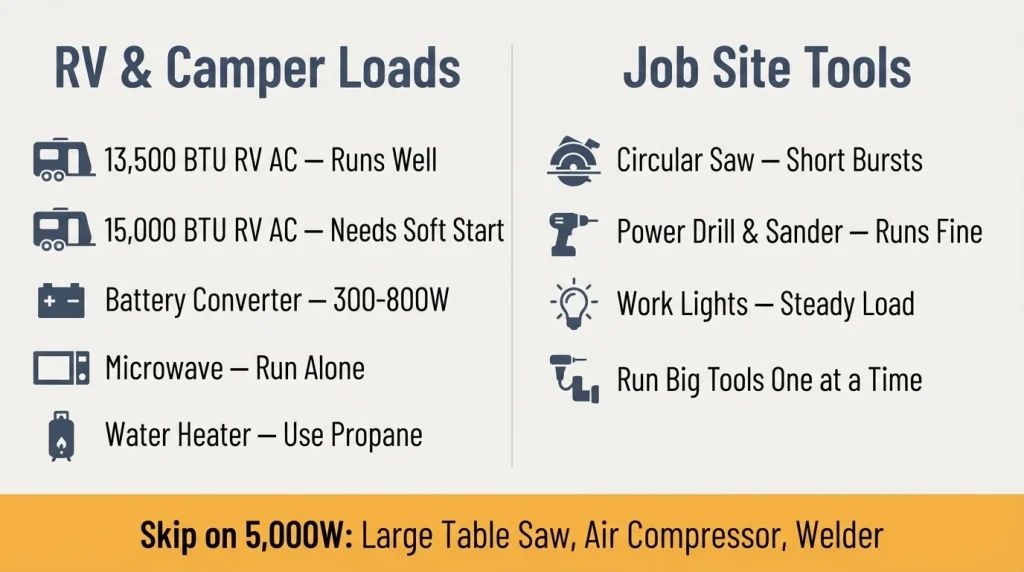
A 5000-watt inverter generator is a sweet spot for RVs. It can run a 13,500 BTU RV AC, the converter charger, lights, and a small fridge together.
A 15,000 BTU RV AC is tighter. It may need a soft start, and you will need to turn off the microwave and water heater on electric while it runs.
What RV appliances work best on 5000 watts?
- RV AC: 13,500 BTU runs well, 15,000 BTU needs care.
- Water heater: Use propane, not electric, to save watts.
- Microwave: Run it alone, with the AC fan on low.
- Battery charging: The converter draws 300 to 800 watts while bulk charging.
Can it run power tools on a job site?
Yes, for most hand tools and mid-size saws. A circular saw, drill, sander, and work lights run fine in rotation.
A large table saw, air compressor, or welder is a different story. Those tools spike hard on start and can trip the inverter under load.
Check how much power a 3000-watt inverter generator provides if your jobs are lighter. The 5000-watt size buys you the AC and the saw in the same day.
Section Takeaway: For RVs and job sites, 5,000 watts covers cooling, charging, and most tools, if you run the big loads one at a time.
What Appliances Can a 5000-Watt Inverter Generator NOT Run?
A 5000-watt inverter generator cannot run a whole house at once. It also cannot run most electric heat, large central AC, or a full electric range.
Knowing the no-list saves food, time, and a tripped breaker. Pick your essentials first, then add comfort loads only if watts remain.
- Electric furnace: 10,000 to 20,000 watts, far over the limit.
- Electric water heater: 3,000 to 4,500 watts alone, with no room left.
- Electric range or oven: 2,000 to 5,000 watts per burner or element.
- Central AC, 3-ton or larger: Starting watts often exceed 6,000.
- Electric clothes dryer: 4,000 to 5,500 watts, and it needs 240 volts at high amps.
- Large welder: High surge and steady draw trip most 5000-watt inverters.
A washing machine works, but a dryer does not. Wash on generator power, then line-dry or wait for grid power.
Section Takeaway: If it makes heat with electricity or cools a whole house, it is usually too big for 5,000 watts.
How Long Will a 5000-Watt Inverter Generator Run Your Appliances?
Runtime depends on load, tank size, and eco mode. A lighter load runs far longer than a full load on the same tank.
Most 5000-watt inverter generators hold 3 to 4 gallons of gas. At 25% load, many run 10 to 14 hours, while at 50% load that drops to 7 to 9 hours.
Does eco mode help with appliances?
Yes, eco mode, also called economy mode or eco-throttle, slows the engine when the load is light. It saves fuel and cuts noise at night.
Turn eco mode off before you start a big motor. The engine needs full speed ready for that surge, or the voltage can dip.
Check your fuel plan before a storm. Store fresh gas in approved cans, add stabilizer per the label, and rotate it so it does not go stale.
Safety note: Let the generator cool before refueling, and never fill it while it runs. Keep fuel away from the hot exhaust and store cans outdoors.
Section Takeaway: Light loads stretch a tank to a full night, while heavy loads cut runtime in half, so plan fuel for the load you will run.
How Do You Connect Appliances Safely Without Overloading It?
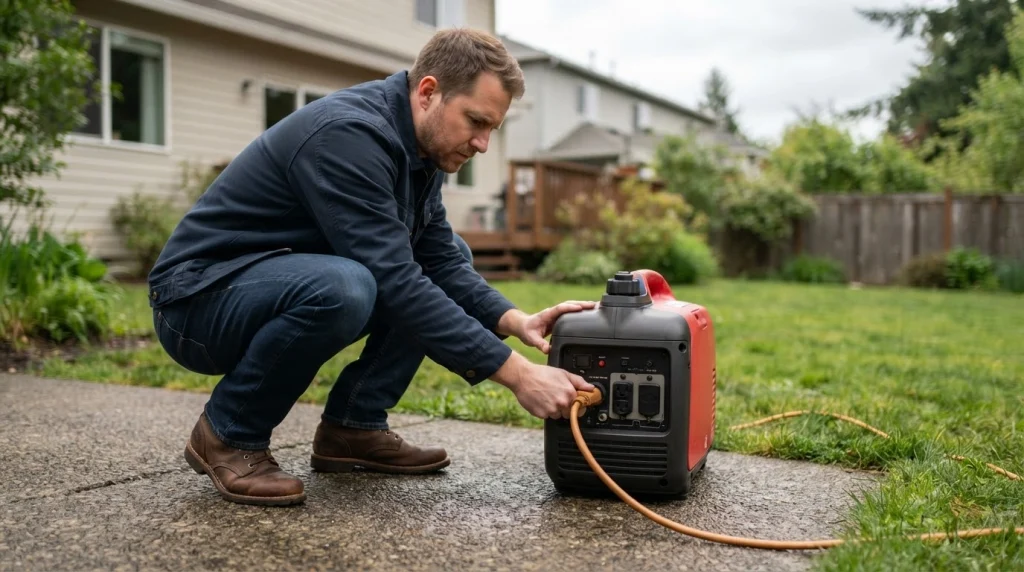
Start with a simple watt list. Write each appliance, its running watts, and its starting watts on one sheet.
Use how to calculate the generator wattage you need to check your total. Add running watts together, then add only the largest starting spike once.
- Place the generator outdoors, at least 20 feet from the house, with exhaust pointed away.
- Start it with no load, turn eco mode off, and let it warm up for two minutes.
- Plug in the biggest motor first, wait until it runs steady, then add the next load.
- Use heavy-duty outdoor cords rated for the amps, and keep connections dry.
- Watch the overload light and listen for strain, then shed a load fast if it trips.
Do you need a transfer switch for a 5000-watt generator?
Yes, for any hardwired load like a furnace, well pump, or house circuits. A transfer switch or interlock kit keeps generator power from backfeeding the grid.
Extension cords work for a fridge, freezer, and lamps. They are not a safe substitute for a proper inlet and interlock.
The Consumer Product Safety Commission and the Centers for Disease Control and Prevention both warn about carbon monoxide deaths from generators used indoors or too close to a home. Follow their placement guidance every time.
Safety note: Never backfeed a house through a dryer outlet or a suicide cord. Have a licensed electrician install the transfer switch or interlock, and check your owner’s manual before use.
Section Takeaway: Start big loads first, use proper cords, and use a transfer switch for hardwired circuits.
Is a 5000-Watt Inverter Generator Enough for Your Home?
For most homes, yes, if you choose essentials over everything. It covers food safety, heat, water, lights, and phones, which are the loads that matter in an outage.
It is not enough for whole-home cooling, electric heat, or running every kitchen appliance at once. That needs a larger portable or a standby unit.
Check what size inverter generator you need if your list is close to the limit. A short test run with your real appliances beats any chart.
Also check how much a 5000-watt inverter generator costs in 2026. Price, fuel use, noise, and weight all shift the best pick for your home.
The U.S. Department of Energy offers home backup guidance, and Consumer Reports tests generator safety and performance. Use those sources to compare models before you buy.
Section Takeaway: 5,000 watts is enough for a smart essentials plan, and it is the right size for most outages, RV trips, and job sites.
Frequently Asked Questions
Can a 5000-watt inverter generator run a house?
It can run essential circuits, not a whole house at once. Fridge, freezer, furnace fan, lights, and internet fit well, but central AC and electric heat do not.
Can a 5000-watt inverter generator run a refrigerator and freezer at the same time?
Yes, in most cases. Start one, wait a minute, then start the other so their compressor spikes do not hit together.
Can a 5000-watt inverter generator run a microwave and air conditioner together?
A small window AC plus a microwave can work if the AC is already running steady. A central AC plus a microwave will usually trip the generator.
Can a 5000-watt inverter generator run a washing machine and dryer?
It can run a washing machine alone with other small loads. It cannot run a standard electric dryer, which needs 4,000 to 5,500 watts by itself.
How many watts do I need to run a fridge and lights?
A fridge plus LED lights needs about 300 to 500 running watts, with a 1,200-watt start spike. A 2000-watt generator can handle it, but 5000 watts leaves far more headroom.
Is a 5000-watt inverter generator good for an RV?
Yes, it is one of the best RV sizes. It runs a 13,500 BTU AC, battery charging, lights, and a small fridge, with clean power for laptops and phones.
What should I not plug into a 5000-watt inverter generator?
Do not plug in electric heat, a large central AC, an electric range, or an electric dryer. Also avoid running two big motors at the exact same moment.
A 5000-watt inverter generator earns its place when you plan the load first. List your must-run appliances, stagger the motor starts, and keep steady watts under 4,500.
Test your real combo before the next outage. That one dry run tells you more than any chart, and it keeps the food cold when it counts.
For more on safe placement, see the U.S. Environmental Protection Agency guidance on portable generator use. Keep the unit outdoors, keep fuel fresh, and keep your essentials list on the fridge.

Hi, I’m Michael Turner. I own a generator workshop in the United States and founded HomeGeneratorBlog to share practical, hands-on guidance about generator installation, maintenance, troubleshooting, safety, and backup power solutions. My goal is to help homeowners make smarter, more confident decisions through clear and reliable information