How Much Power Does a 1000-Watt Inverter Generator Provide? What It Can Run and What It Cannot
Quick Answer
A 1000-watt inverter generator provides about 900 to 1,000 running watts and up to 2,000 starting watts for a few seconds. That is enough for lights, phones, laptops, a TV, a CPAP machine, and many small appliances, but not for a full-size fridge, microwave, or air conditioner at the same time. Check what size inverter generator you need before you buy, so you match the load to your real use.
What 1,000 watts means in plain terms
- Running watts: About 900 to 1,000 watts you can use nonstop.
- Starting watts: A short surge, often up to 2,000 watts, for motor startup.
- Usable amps: About 7.5 to 8.3 amps at 120 volts.
- Best fit: Light home backup, camping, tailgating, and charging gear.
- Not a fit: Whole-home backup, large heating loads, and big motor loads together.
Use it safely
- Add up running watts first, then add the largest starting load once.
- Start motor loads one at a time and keep a 10 to 20 percent safety margin.
- Run it outdoors only, at least 20 feet from your home, with exhaust pointed away.
I’ve run a 1000-watt inverter generator through a weekend outage, a quiet campsite, and a long tailgate. It kept the lights on, the phones charged, and a small fan turning.
It also taught me its limits fast. One extra load at the wrong moment tripped the overload, and the whole setup went dark.
This guide gives you the real numbers behind that 1,000-watt label. You’ll see what it can run, what it cannot, how long it lasts, and how to stretch every watt in 2026.
In This Guide
- What Does 1000-Watt Actually Mean?
- How Much Running Power Does a 1000-Watt Inverter Generator Provide?
- What Can a 1000-Watt Inverter Generator Run?
- What Can’t a 1000-Watt Inverter Generator Run?
- How Long Will a 1000-Watt Inverter Generator Run?
- How Do You Get the Most Power From a 1000-Watt Inverter Generator?
- Is a 1000-Watt Inverter Generator Enough for You?
- Frequently Asked Questions
- The Bottom Line
What Does 1000-Watt Actually Mean?
An inverter generator is a small portable generator that makes clean, stable power safe for phones, laptops, and other sensitive electronics. It converts raw engine power into a smooth sine wave, with low total harmonic distortion, or THD.
The “1000-watt” label usually means the peak, or starting, output in many listings. Other brands label the same class by running watts instead, so check the spec sheet every time.
What is the difference between running watts and starting watts?
Running watts are the steady power a generator can supply for hours. Starting watts are the short burst it can supply for a few seconds when a motor starts.
A fridge compressor, a fan motor, or a small pump needs that burst to spin up. Once it runs, its draw drops back to its running watts.
That gap matters on a small unit. A 1000-watt inverter generator may list 2,000 starting watts, but you cannot run 2,000 watts of load all day.
Why does the nameplate number mislead buyers?
Buyers see 1,000 watts and picture 1,000 watts of free headroom. In real use, the safe continuous load sits a little below the rated running watts.
Altitude, heat, and fuel type can trim output too. A hot day at elevation will not match a cool sea-level test.
I treat 900 watts as my working limit on a nominal 1000-watt unit. That buffer keeps the overload light off and the voltage steady.
Section Takeaway: The 1,000-watt label is a headline, not a promise. Plan around running watts, keep a safety margin, and check the spec sheet for both ratings.
How Much Running Power Does a 1000-Watt Inverter Generator Provide?
A 1000-watt inverter generator provides about 900 to 1,000 running watts, depending on the model. Most units in this class list 900 running watts and 1,000 starting watts, while a few list 1,000 running watts and 2,000 starting watts.
Read both numbers on the spec sheet. The running figure is the one that decides what you can use for hours.
How many amps is 1,000 watts?
At 120 volts, 1,000 watts equals about 8.3 amps. Use the simple formula watts divided by volts equals amps.
At 900 running watts, that drops to about 7.5 amps. That is one standard household circuit, with little room to spare.
- 900 running watts: About 7.5 amps at 120 volts.
- 1,000 running watts: About 8.3 amps at 120 volts.
- 2,000 starting watts: About 16.7 amps, for a few seconds only.
- Safe working load: About 720 to 800 watts, if you keep a 20 percent margin.
That amp limit explains why one big load can end the party. A 1,500-watt heater alone would draw more than the whole generator can supply.
Does eco mode change the power output?
Eco mode, also called economy mode or eco-throttle, slows the engine when the load is light. It saves fuel and cuts noise, but it does not add watts.
The peak output stays the same. The engine just revs up more slowly when a new load hits.
Turn eco mode off before you start a motor load. That gives the engine a faster response and a cleaner startup.
For backup-power basics and efficiency tips, the U.S. Department of Energy is a useful starting point. It covers portable power in plain terms, without brand hype.
Section Takeaway: Expect 900 to 1,000 running watts, about 7.5 to 8.3 amps, and a short surge for startup. Eco mode saves fuel, but it does not raise the ceiling.
What Can a 1000-Watt Inverter Generator Run?
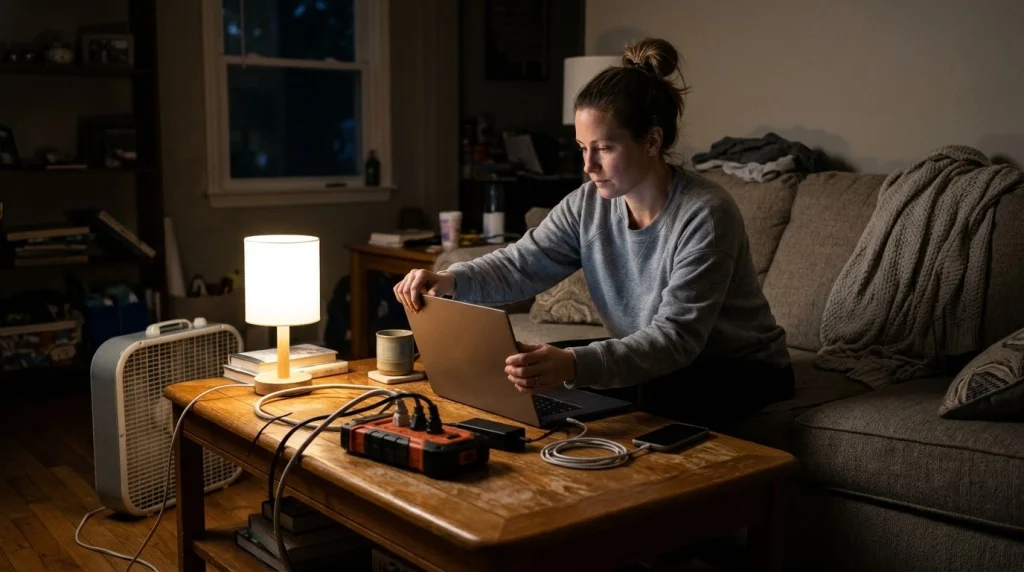
A 1000-watt inverter generator can run lights, phones, laptops, a TV, a fan, a CPAP machine, and small kitchen gear one or two items at a time. It shines as a light-duty portable power source, not as a whole-home backup.
The table below uses typical running and starting watts. Your exact appliance may differ, so check its label or manual.
| Appliance or device | Typical running watts | Typical starting watts | Fits a 1000-watt unit? |
|---|---|---|---|
| Phone charger | 5 to 20 | 5 to 20 | Yes, easily |
| Laptop charger | 45 to 90 | 45 to 90 | Yes |
| LED lights, several bulbs | 20 to 60 | 20 to 60 | Yes |
| 32-inch LED TV | 50 to 100 | 50 to 100 | Yes |
| Box fan or small fan | 50 to 100 | 100 to 200 | Yes |
| CPAP machine | 30 to 90 | 30 to 90 | Yes, without heated humidifier |
| Small dorm fridge | 75 to 150 | 400 to 800 | Often yes, alone |
| Full-size fridge | 150 to 250 | 800 to 1,500 | Maybe, with almost nothing else |
| Microwave, small | 800 to 1,200 | 800 to 1,200 | No, usually too much |
| Window AC, 5,000 BTU | 450 to 600 | 1,200 to 1,800 | Rarely, startup is too high |
What combos work in real life?
A good home-outage combo is LED lights, a phone charger, a laptop, and a fan. That load sits near 200 to 300 watts, well inside the limit.
A good camping combo is lights, phones, a small fan, and a portable speaker. Add a CPAP at night, and you still have headroom if you skip the heater.
A fridge-only run can work if you unplug everything else first. Let the compressor start, wait a minute, then add one small load at a time.
Can it run an RV?
It can charge RV batteries, run lights, and power small electronics. It cannot run a rooftop RV air conditioner on its own.
That AC needs a large startup surge, often over 2,000 watts. A 1000-watt unit will trip or stall on that first kick.
For a small trailer or van, it still earns its keep. I used one to top up batteries, run a fan, and keep a laptop going through a hot afternoon.
Compare models and features in our roundup of the best 1000-watt portable generators. Weight, noise, and outlets matter as much as watts at this size.
Section Takeaway: A 1000-watt inverter generator runs small electronics and one modest motor load with ease. Stack two or three big loads, and you will hit the ceiling fast.
What Can’t a 1000-Watt Inverter Generator Run?
A 1000-watt inverter generator cannot run a microwave, a space heater, a hair dryer, a full-size fridge plus other loads, or an air conditioner. Those loads either draw too much steady power or need too large a startup surge.
Heating loads are the worst offenders. They turn almost every watt into heat, with no motor surge to explain away.
- Space heater: 1,000 to 1,500 running watts, alone.
- Hair dryer: 1,000 to 1,800 running watts, on high.
- Microwave: 800 to 1,200 running watts, plus fan and light.
- Electric kettle: 1,000 to 1,500 running watts.
- Toaster: 800 to 1,400 running watts.
- Window AC: High startup surge, often 1,200 to 1,800 watts.
- Sump pump: High startup surge, often 1,000 to 2,000 watts.
- Power tools: Many saws and compressors need 1,500 watts or more to start.
Why do motor loads trip small generators?
A motor at rest needs extra current to start turning. That surge lasts a second or two, but it can be three to five times the running watts.
A 1000-watt unit has little surge headroom. One large motor can push it past its limit before it ever settles down.
Start the largest motor first, with other loads off. That gives the surge the full capacity of the generator.
What happens if you overload it?
Most inverter generators shut down or trip an overload breaker when you exceed the limit. Lights go out, and the engine may keep running with no output.
That shutdown protects the generator and your gear. Repeated overloads still stress the unit, so do not use the breaker as your sizing tool.
Unplug loads, reset the unit per the manual, and restart with a smaller load. Check the manual before you reset a tripped unit.
Safety note: Run generators outdoors and well away from windows, doors, and vents. Carbon monoxide is colorless and odorless, and the CDC warns that it can build up fast in enclosed spaces.
Review what not to plug into an inverter before you connect anything new. Some loads can damage the generator, the appliance, or both.
Section Takeaway: Heaters, kettles, dryers, microwaves, and large motors are out of reach for a 1000-watt unit. Respect the limit, and you avoid the overload shutdown.
How Long Will a 1000-Watt Inverter Generator Run?
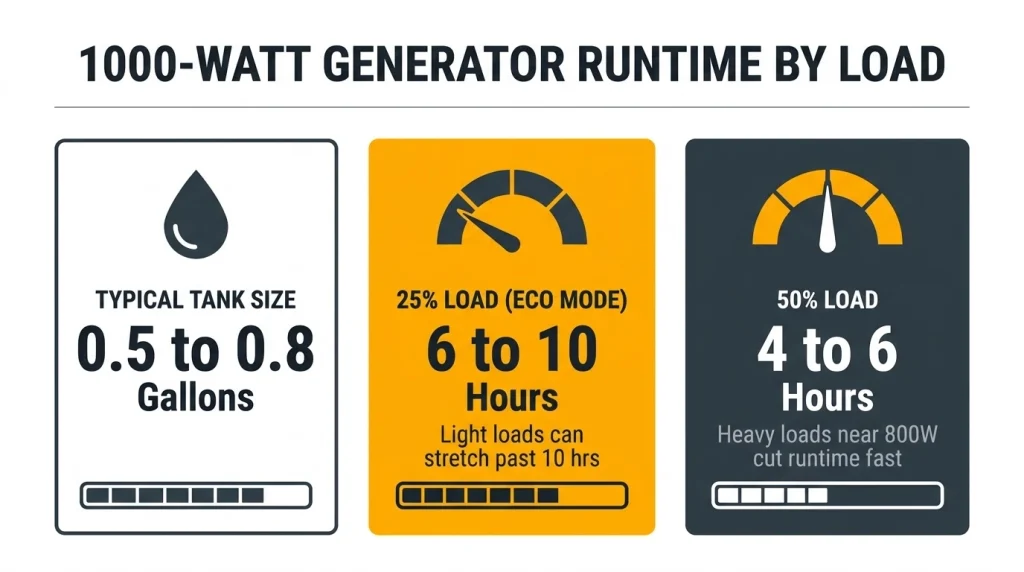
A 1000-watt inverter generator will run about 6 to 10 hours on a tank at 25 percent load, depending on tank size and eco mode. At 50 percent load, expect about 4 to 6 hours.
Most units in this class hold about 0.5 to 0.8 gallons of gasoline. Check the spec sheet for runtime at 25 percent and 50 percent load.
How does load change runtime?
Light loads sip fuel. A phone charger and a few LED lights may stretch a tank past 10 hours in eco mode.
Heavy loads drink fuel. A load near 800 watts will cut runtime sharply and raise noise.
Eco mode helps most at light load. It lets the engine slow down when demand drops, instead of holding full speed.
How do you plan fuel for an outage?
Plan fuel by hours, not by hope. Multiply your expected load by the hours you need, then check the tank size.
Keep fresh gasoline in an approved container, in a cool, ventilated spot away from the house. Stale fuel is the top cause of hard starts I see.
Use fuel stabilizer if the generator will sit for more than a month. Run it dry or follow the manual for storage.
Safety note: Let the engine cool before you refuel, and never refuel indoors or near an open flame. The U.S. Consumer Product Safety Commission stresses outdoor use and safe placement for portable generators.
Section Takeaway: Light loads give you a long, quiet night. Heavy loads shorten runtime fast, so plan fuel around your real load, not the best-case spec.
How Do You Get the Most Power From a 1000-Watt Inverter Generator?
You get the most power from a 1000-watt inverter generator by adding up loads first, starting the largest motor first, and keeping a safety margin. Small habits matter more than any add-on at this size.
Start with a simple load list. Write down each device, its running watts, and its starting watts.
- List every load: Add running watts for all devices you plan to use together.
- Add one surge: Add the starting watts for the largest motor, only once.
- Keep a margin: Stay under 800 watts of steady load on a 900-watt unit.
- Start big first: Start the motor load with other loads off, then add small loads.
- Turn eco off: Disable eco mode before a motor start, then turn it back on.
- Use short cords: Use a short, heavy-duty extension cord to cut voltage drop.
Can you parallel two 1000-watt generators?
Yes, if your model is parallel-capable and you use the correct parallel kit. Two units can combine to give about 1,800 running watts.
That setup costs more and adds weight. It also gives you a backup if one unit needs service.
Do not parallel units that are not rated for it. Check the manual and use only the kit made for your model.
What small changes save the most watts?
Swap old bulbs for LEDs. A single old 60-watt bulb uses as much as six LED bulbs.
Charge phones from a power bank during the day. Then charge the bank once, instead of running small loads all night.
Skip heated humidifiers and heated blankets on a small unit. They draw steady heat watts that leave no room for anything else.
Work through the math with our guide to calculate the generator wattage you need. A five-minute list beats a midnight overload every time.
Section Takeaway: Sizing is a habit, not a guess. List loads, start big first, keep a margin, and parallel only with a matched kit.
Is a 1000-Watt Inverter Generator Enough for You?
A 1000-watt inverter generator is enough if your loads are light, portable, and few at a time. It is not enough for whole-home backup, a fridge plus a microwave, or an air conditioner.
Match the tool to the job. A small unit is quiet, light, and cheap to run, and that is the point.
| Generator size | Typical running watts | Best for | Trade-off |
|---|---|---|---|
| 1,000 watts | 900 to 1,000 | Charging, lights, CPAP, camping | No large motors or heat |
| 2,000 watts | 1,600 to 1,800 | Fridge, small microwave, TV, lights | Heavier, louder, pricier |
| 3,000 watts | 2,600 to 2,800 | Fridge, small AC, more tools | Much heavier, more fuel |
Who should buy a 1000-watt inverter generator?
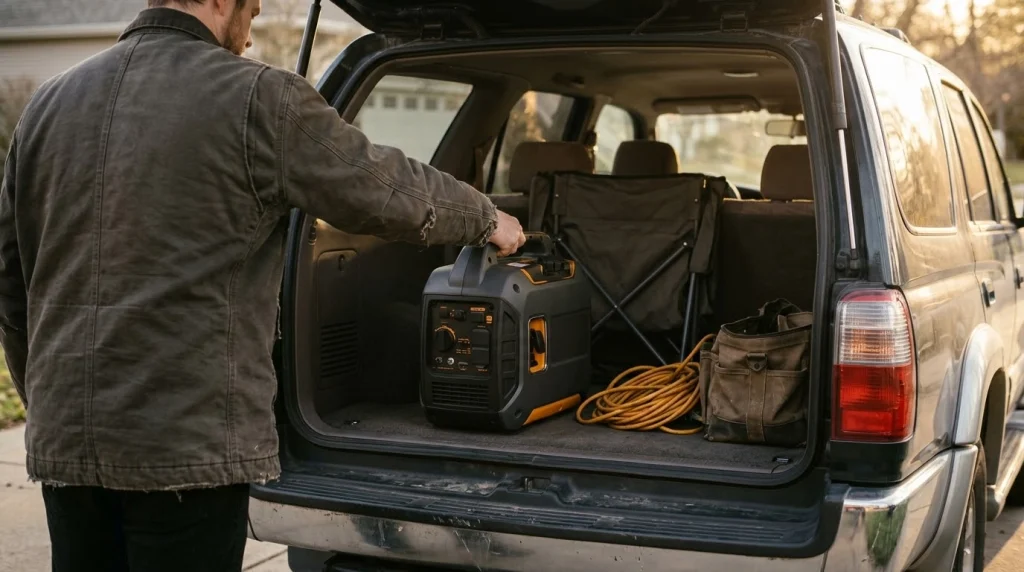
Buy one if you camp, tailgate, work remote, or need light outage cover. It fits in a car trunk, sips fuel, and runs quiet enough for a campsite.
Buy one if your must-run list is short. Lights, phones, a laptop, a fan, and a CPAP fit well.
Skip it if you need to run a fridge, a microwave, and lights together. Step up to a 2000-watt class instead.
How much does stepping up cost?
A 2000-watt inverter generator costs more up front, but it covers far more real loads. It can run a full-size fridge with lights and a TV, in many cases.
Check how much a 2000-watt inverter generator costs before you decide. The price gap is often smaller than the cost of buying twice.
Also compare how much an inverter generator costs across sizes. Fuel, oil, and upkeep add up over years, not just at checkout.
Independent reviews from Consumer Reports can help you compare noise, runtime, and ease of use. Look for real test notes, not just star ratings.
Section Takeaway: A 1000-watt unit is right for light, portable power. If your list includes a fridge plus anything big, move up a size.
Frequently Asked Questions
Can a 1000-watt inverter generator run a refrigerator?
Sometimes, but only with care. A full-size fridge needs 150 to 250 running watts and 800 to 1,500 starting watts, so start it alone and add almost nothing else. A small dorm fridge is a safer fit.
Can a 1000-watt inverter generator run a microwave?
Usually no. A small microwave draws 800 to 1,200 running watts, which leaves no headroom for lights or a fridge. A 2000-watt class unit is a better choice for microwave use.
Can a 1000-watt inverter generator run a CPAP machine?
Yes, in most cases. A CPAP draws about 30 to 90 watts without a heated humidifier, so it fits well overnight. Skip the heated humidifier, or check its watts first.
Can a 1000-watt inverter generator run a TV and lights?
Yes. A 32-inch LED TV uses about 50 to 100 watts, and several LED bulbs use about 20 to 60 watts. That combo leaves plenty of room for phone charging too.
How many watts can a 1000-watt generator handle at once?
It can handle about 900 to 1,000 running watts at once, with a short surge to about 2,000 watts. Keep steady load under 800 watts for a safety margin and smoother voltage.
Is a 1000-watt inverter generator good for camping?
Yes, for light camping power. It charges phones and laptops, runs lights and a fan, and stays quiet in eco mode. It will not run an RV air conditioner or a large heater.
The Bottom Line
A 1000-watt inverter generator gives you about 900 to 1,000 watts of steady, clean power. That covers the small stuff that matters most in an outage or at camp.
It does not cover big heat or big motors. Plan for that limit, and you will love how quiet and light it feels.
Make your load list tonight, before the next outage. Add up the watts, keep a margin, and pick the size that fits your real life.
If your list fits in 800 watts, a 1000-watt inverter generator is a smart buy. If it does not, step up now and skip the second purchase later.

Hi, I’m Michael Turner. I own a generator workshop in the United States and founded HomeGeneratorBlog to share practical, hands-on guidance about generator installation, maintenance, troubleshooting, safety, and backup power solutions. My goal is to help homeowners make smarter, more confident decisions through clear and reliable information