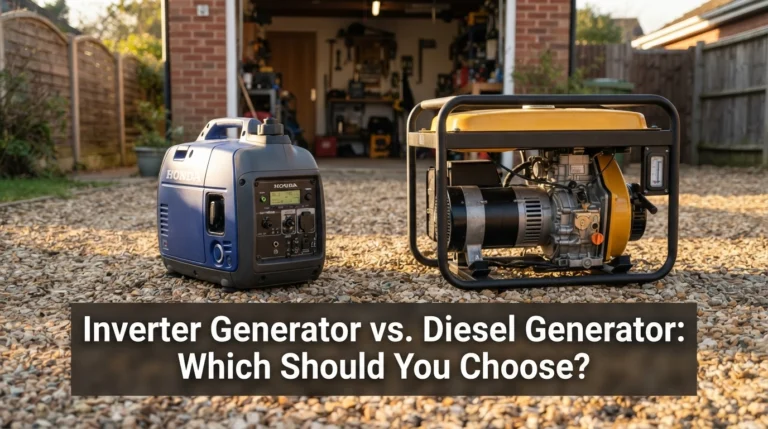
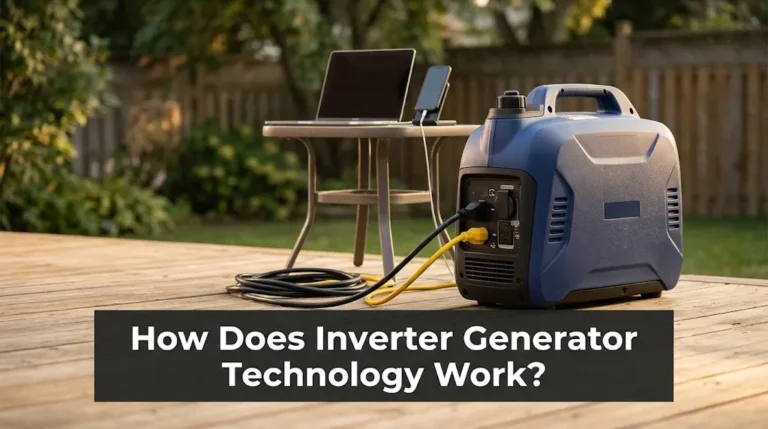
What Is the Difference Between a Standalone Power Inverter and an Inverter Generator?
Quick Answer
A standalone power inverter turns stored DC power from a battery into AC power for your devices, but it makes no power on its own. An inverter generator makes its own power by burning fuel, then cleans that power with an inverter, so it can run for hours without a battery. Learn how an inverter generator works before you choose between them.
The core difference in one line
- Power source: A standalone inverter needs a charged battery, while an inverter generator needs fuel.
- Runtime: An inverter stops when the battery runs out, while a generator keeps going as long as you add fuel.
- Best use: An inverter suits short, quiet jobs from a car or battery bank, while a generator suits longer outages, RV trips, and job sites.
- Noise and fumes: An inverter is silent and fume-free, while a generator makes engine noise and exhaust.
- Power quality: Both can give you clean sine wave power, but only if you buy a pure sine wave model.
Quick rule to remember
- If you already have a big battery, start with an inverter.
- If you need power for hours or days, start with an inverter generator.
I’ve owned both, and I’ve mixed them up in my own garage more than once.
The names sound almost the same, so the confusion makes sense. This guide clears it up with real tests, wattage math, and honest trade-offs, so you can pick the right tool for your home, RV, or campsite.
In This Guide
- What Is a Standalone Power Inverter?
- What Is an Inverter Generator?
- Standalone Power Inverter vs. Inverter Generator: How They Make Power
- Which One Powers What?
- How Do Runtime, Fuel, and Noise Compare?
- Which Should You Choose for Home Backup, RV, and Camping?
- Can You Use a Standalone Inverter and a Generator Together?
- Frequently Asked Questions
- The Bottom Line
What Is a Standalone Power Inverter?

A standalone power inverter is a box that turns DC power from a battery into AC power for normal household devices.
It creates nothing by itself. It only changes the form of power you already have stored.
Think of it like a translator. Your battery speaks DC, and your laptop, fan, or TV speaks AC.
The inverter sits between them and does the translation in real time.
How does a standalone inverter work?
A standalone inverter takes 12-volt or 24-volt DC power from a battery and turns it into 120-volt AC power.
Inside, fast electronic switches chop the DC current and rebuild it as a smooth AC wave. A pure sine wave inverter rebuilds a clean wave that looks like grid power.
A modified sine wave inverter rebuilds a rougher, stepped wave. That rough wave can buzz, overheat, or damage sensitive electronics, so I avoid it for laptops, CPAP machines, and modern chargers.
Where does its power come from?
Its power comes from a battery, and that battery has to get charged some other way.
Common sources include a car battery, a deep-cycle RV battery, a solar-charged battery bank, or a portable power station with a built-in battery. Once the battery drains, the inverter stops.
I learned this the hard way on a camping trip. I ran a small fan and a phone charger off my truck battery for a few hours, and the next morning the truck barely cranked.
That lesson stuck with me. An inverter is only as good as the battery behind it.
What can a standalone inverter run?
It can run small loads well, as long as the battery and the inverter size match the job.
- Phones and laptops: Easy loads, often under 100 watts.
- LED lights and fans: Low draw, good for overnight use.
- TVs and CPAP machines: Work well on a pure sine wave inverter with a healthy battery.
- Small fridges: Possible for a short time, but the starting watts can be 3 to 4 times the running watts.
- Microwaves and air conditioners: Usually too much for a single car battery, and they drain it fast.
Size matters here. A 1,000-watt inverter can pull about 80 amps from a 12-volt battery at full load.
That drains most car batteries in under an hour, so check the math before you plug in.
Section Takeaway: A standalone inverter is a converter, not a power source. It gives you quiet, clean AC power, but only for as long as your battery lasts.
What Is an Inverter Generator?
An inverter generator is a portable generator with a gas or propane engine, an alternator, and a built-in inverter that cleans the power before it reaches your devices.
It makes power from fuel, then it refines that power. That two-step design is the whole point.
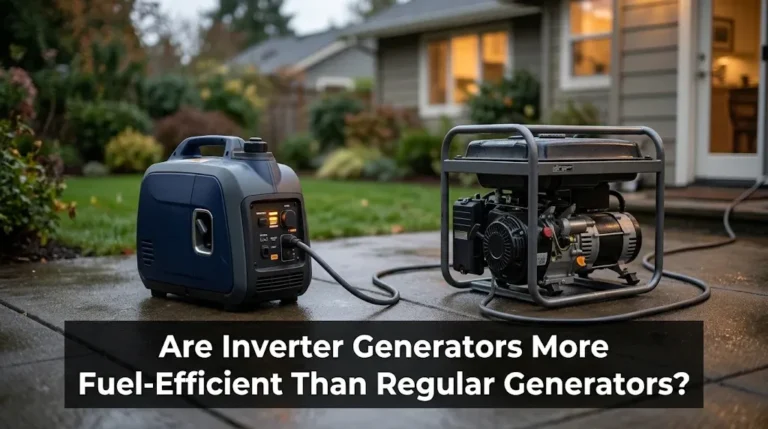
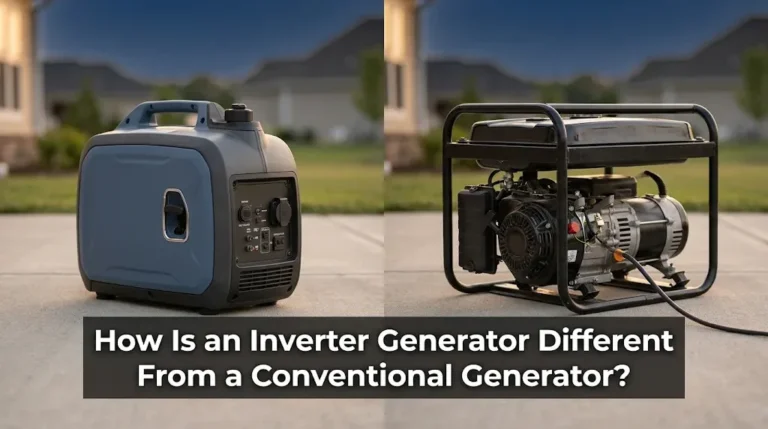
A conventional generator makes raw AC power straight from the engine. An inverter generator makes AC power, turns it into DC, then turns it back into clean AC.
That extra step sounds wasteful, but it gives you stable voltage and low total harmonic distortion, or THD. THD measures how clean the power wave is, and lower is better for electronics.
How does an inverter generator make clean power?
The engine spins an alternator and makes high-frequency AC power. The inverter module then turns that power into DC, then back into a clean 60 Hz sine wave.
Because the inverter controls the output, the engine does not have to spin at one fixed speed. It can slow down under light loads and speed up when you add a fridge or a power tool.
That variable speed is why inverter generators are quieter and use less fuel at part load. My 2,200-watt unit drops to a soft hum when it only charges phones, then ramps up when the fridge compressor kicks in.
Learn more about the inner parts in this guide to how inverter generator technology works.
What makes it different from a conventional generator?
Three things stand out in real use: noise, fuel use, and power quality.
Inverter generators usually run at 50 to 60 decibels at a quarter load, about the level of normal talk. Conventional open-frame models often run much louder, and that matters at a campsite or in a quiet neighborhood.
They also sip fuel in eco mode. A small inverter generator can run 8 to 10 hours on a gallon or two at light load, while a big open-frame unit can burn through that fuel much faster.
Most important for me, the power is safe for sensitive gear. I run laptops, routers, and a CPAP straight from my inverter generator without a second thought.
What can an inverter generator run?
It can run most of the same loads as a standalone inverter, plus bigger ones, for much longer.
- Home backup: Fridge, freezer, lights, router, phone chargers, and a furnace blower on a mid-size unit.
- RV use: Air conditioner on a 3,000-watt or larger unit, or two smaller units linked in parallel.
- Camping: Lights, fans, CPAP, and small cooking gear on a 1,000 to 2,200-watt unit.
- Job sites: Power tools, battery chargers, and lights, as long as you respect starting watts.
Parallel capability helps a lot here. Many inverter generators let you link two units with a parallel kit to double your running watts.
That flexibility is one reason I recommend them to first-time buyers. You can start small and grow later.
Safety note: Run any generator outdoors, at least 20 feet from your home, and well away from windows, doors, and vents. Never run one in a garage, even with the door open.
Section Takeaway: An inverter generator is a complete power plant in a box. It burns fuel, makes power, and cleans that power for your electronics, all in one unit.
Standalone Power Inverter vs. Inverter Generator: How They Make Power
The core split is simple: one converts stored power, and the other creates new power.
Once you see that split, every other difference falls into place.
Where does the power start?
A standalone inverter starts with a battery. No battery, no power.
An inverter generator starts with fuel in a tank. No fuel, no power.
That sounds obvious, but it changes how you plan. With an inverter, you plan around battery capacity in watt-hours. With a generator, you plan around fuel supply and runtime.
How is the power cleaned?
Both use inverter electronics to make a clean sine wave, but they clean power at different points.
A standalone inverter cleans battery DC into AC in one step. An inverter generator makes raw power first, then cleans it through its inverter module.
The result can be the same for your laptop: stable, low-THD power. The path to get there is different, and so is what happens when the source runs out.
What happens when the source runs low?
A standalone inverter shuts down or alarms when battery voltage drops. That protects the battery, but it cuts your power without warning if you are not watching the gauge.
An inverter generator gives you more warning. It slows down, it may show a low-fuel light, and you can refuel it in minutes.
During a multi-day outage in 2025, that refuel option mattered more than anything else. I could buy gas, but I could not recharge a dead battery bank without grid power or sun.
Which one is more efficient?
It depends on the load and the time frame. For short, light loads, a standalone inverter wins on efficiency.
It has no engine to warm up, no fuel to burn at idle, and no moving parts to waste energy. For a few hours of phone charging and LED lights, it is hard to beat.
For long, heavy loads, an inverter generator wins. Its engine can keep making power for hours, and its eco-throttle keeps fuel use low at part load.
See the broader generator vs. inverter comparison for more on how these designs differ across generator types.
Section Takeaway: Think source first, not size first. A battery-fed inverter is best for short, quiet power, while a fuel-fed inverter generator is best for long, steady power.
Which One Powers What?
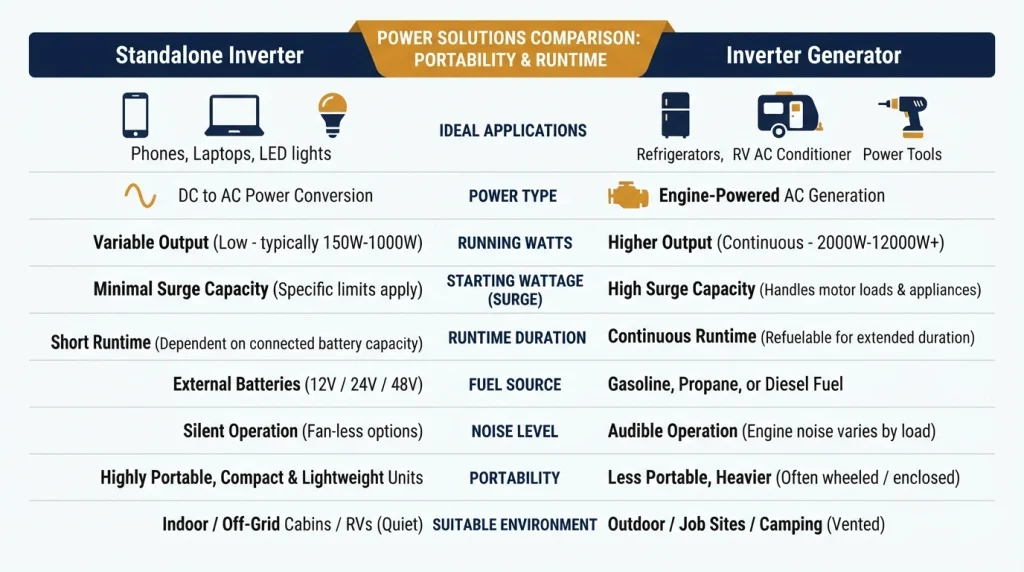
Use this table to match each tool to the loads it handles well in real life.
These are typical ranges, not promises for a specific model. Always check the spec sheet and the starting watts for your exact appliance.
| Feature | Standalone Power Inverter | Inverter Generator |
|---|---|---|
| Power source | Battery (12V / 24V DC) | Gasoline, propane, or dual fuel |
| Makes its own power? | No, it converts stored power | Yes, engine plus alternator |
| Typical size | 300 to 3,000 watts | 1,000 to 7,500 watts |
| Runtime | Minutes to hours, based on battery | Hours to days, with refueling |
| Noise | Silent, no engine | Quiet, often 50 to 60 dB at light load |
| Exhaust / fumes | None | Yes, must run outdoors |
| Best for | Short, quiet, indoor-safe loads | Outages, RVs, camping, job sites |
| Weak spot | Battery drains fast under load | Needs fuel, oil, and maintenance |
Now look at real loads. A phone charger draws 10 to 20 watts, so either tool handles it with ease.
A laptop draws 45 to 90 watts, so either tool still works. A fridge draws 100 to 200 running watts, but 600 to 800 starting watts when the compressor kicks on.
That startup surge is where the difference shows. A 1,000-watt inverter on a small battery may trip on fridge startup, while a 2,200-watt inverter generator handles it and keeps running.
Check your portable generator watts before you buy, and add up running watts plus the largest starting watts in your load list.
Section Takeaway: For small, short loads, both work well. For big, long, or motor-driven loads, the inverter generator pulls ahead fast.
How Do Runtime, Fuel, and Noise Compare?
Runtime is the question most buyers get wrong, so let’s do the math in plain terms.
A battery’s usable energy is measured in watt-hours. A 100 amp-hour, 12-volt battery holds about 1,200 watt-hours in theory, but you should only use about half of that on a lead-acid battery to protect its life.
That leaves you about 600 usable watt-hours. Run a 100-watt load, and you get about 6 hours. Run a 600-watt load, and you get about 1 hour.
How long does a standalone inverter really last?
It lasts as long as the battery, and not much longer. Solar can extend that time, but only while the sun shines and the panels keep up.
A car battery is built for short bursts, not deep use. It will start your car, but it will not run a fridge all night.
A deep-cycle battery does better, and a lithium battery does better still. Even so, you need a big, heavy bank to match a generator’s all-day runtime.
How long does an inverter generator really last?
It lasts as long as you have fuel and oil. Most small models run 8 to 12 hours on a tank at a quarter load in eco mode.
Refuel, check the oil, and you can run again. That cycle can stretch across a multi-day outage, as long as fuel stays available.
Fuel storage matters too. Gasoline goes stale in a few months without stabilizer, and a clogged carburetor is the most common reason a generator will not start after storage.
I rotate my fuel every few months and run the generator dry before I store it. That simple habit has saved me more than one frustrating morning.
What about noise in the real world?
A standalone inverter makes no noise at all. That is a clear win for apartments, quiet campsites, and overnight CPAP use.
An inverter generator is quiet for a generator, but it still makes engine sound. At 50 to 60 decibels from 20 feet away, it sounds like a low hum, not a roar.
Distance helps a lot. Move it from 10 feet to 20 feet away, and the perceived noise drops fast. A longer cord and a clear, open spot outdoors make a real difference.
Safety note: Keep the generator outdoors and downwind from tents, RVs, and open windows. Carbon monoxide is colorless and odorless, so never trust your nose to warn you.
For official guidance on generator placement and carbon monoxide risks, see the CDC and the U.S. Consumer Product Safety Commission.
Section Takeaway: An inverter wins on silence and indoor use, while an inverter generator wins on all-day runtime. Pick the trade-off that fits your outage, not just your budget.
Which Should You Choose for Home Backup, RV, and Camping?
Your use case decides this faster than any spec sheet will.
Start with three questions: how long do you need power, how much power do you need, and where will you use it?
Which is better for home backup during an outage?
An inverter generator is the better pick for most home outages. It can run a fridge, freezer, lights, and phone chargers for hours, and you can refuel it.
A standalone inverter can help for a short outage, but only if you have a large battery bank ready. A single car battery will not carry a home through the night.
If you want whole-home backup, talk to a licensed electrician about a transfer switch or interlock kit. That hardware lets you feed key circuits safely, without backfeeding the grid.
Safety note: Never plug a generator straight into a wall outlet. Use a transfer switch or interlock installed by a licensed electrician, and check your owner’s manual before use.
Which is better for an RV?
An inverter generator is the better pick for most RV owners, especially if you run an air conditioner.
RV air conditioners often need 2,000 to 3,000 starting watts. A 3,000-watt inverter generator, or two 2,200-watt units in parallel, handles that load well.
A standalone inverter can work in an RV with a big lithium bank and solar, but the cost and weight add up fast. Many RVers use both: a generator for air conditioning and a battery inverter for quiet overnight loads.
Which is better for camping and tailgating?
It depends on how much power you need and how quiet the site must stay.
For phones, lights, and a fan, a standalone inverter is perfect. It is silent, light, and easy to pack.
For a CPAP all night, a small fridge, or a coffee maker in the morning, a small inverter generator is the safer pick. It will not drain your car battery, and it will still be running at dawn.
Campsite etiquette matters too. I keep my generator at least 20 feet from other tents, and I shut it off at quiet hours. That small courtesy goes a long way.
What about cost and maintenance?
A standalone inverter costs less up front, often $100 to $500 for a good pure sine wave model. The real cost sits in the battery, which can cost more than the inverter itself.
An inverter generator costs more up front, often $500 to $2,500 for a quality portable model. It also needs oil changes, air filter checks, and fuel care, per your manual.
As of 2026, prices have stayed in those broad ranges for most mainstream brands, including Honda, Yamaha, Champion, and Westinghouse. Check current prices before you buy, and do not trust a deal that looks too good to be true.
For more on battery-based backup, see this power station vs. generator comparison.
Section Takeaway: Choose the inverter generator for outages, RV air conditioning, and long trips. Choose the standalone inverter for short, quiet, low-power jobs where silence matters most.
Can You Use a Standalone Inverter and a Generator Together?
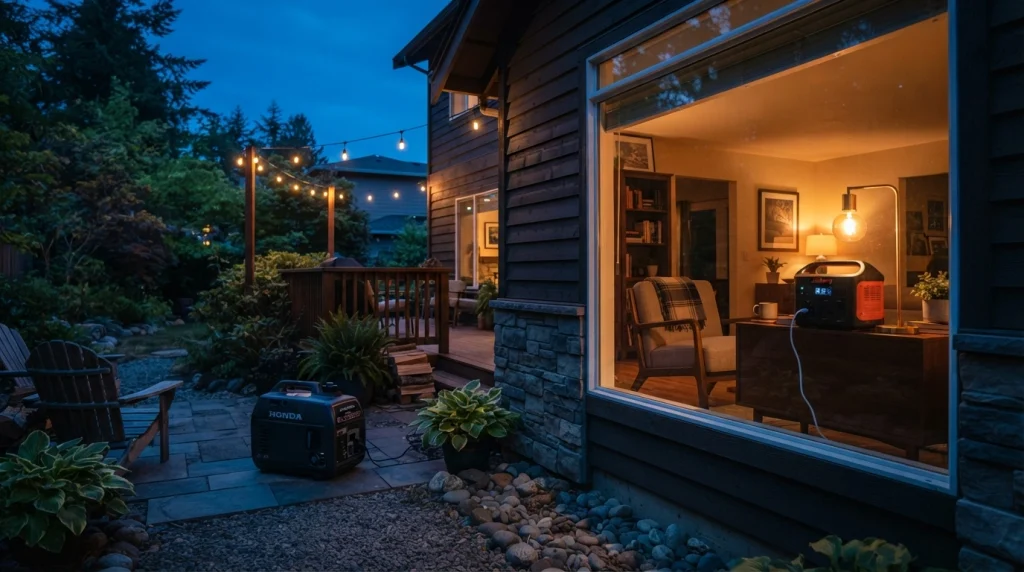
Yes, and in my setup, that combo works better than either tool alone.
The generator makes power during the day, and the inverter gives you silent power at night from a charged battery. That split gives you the best of both worlds.
How does the combo work in practice?
Run the generator during the day to power the fridge, charge batteries, and run heavier loads. Then shut it off at night and switch to the battery inverter for lights, phones, and a CPAP.
That routine saves fuel, cuts noise at night, and keeps your battery topped up. It also gives you a backup if one tool fails.
You can charge a battery bank from a generator with a battery charger, or from solar panels during the day. The inverter then turns that stored power into clean AC when you need it.
What should you not do?
Do not connect a standalone inverter’s output to a generator’s output. Do not try to parallel them unless both devices are built for it.
Do not use a modified sine wave inverter to charge a lithium power station or run sensitive medical gear. Use a pure sine wave model, and check the manual for both devices first.
Also, do not run a generator indoors to charge a battery faster. The carbon monoxide risk is the same, no matter why the generator is running.
For safety and efficiency guidance, the U.S. Department of Energy and the EPA offer useful background on portable power and generator use.
Explore the different types of inverter generators if you want to pair a generator with a battery setup and pick the right size.
Section Takeaway: Pairing them is smart when you do it right. Let the generator do the heavy, daytime work, and let the inverter do the quiet, nighttime work.
Frequently Asked Questions
Can a standalone inverter run a refrigerator?
It can for a short time, if the inverter and battery are large enough. A fridge needs 600 to 800 starting watts, so you need a pure sine wave inverter rated well above that, plus a deep-cycle or lithium battery.
Is an inverter generator the same as a power inverter?
No. A power inverter only converts battery DC to AC power, while an inverter generator makes power with an engine and then cleans it with a built-in inverter. The names overlap, but the jobs are different.
Do I need a pure sine wave inverter?
Yes, for laptops, CPAP machines, modern TVs, and variable-speed motors. A pure sine wave model costs more, but it protects sensitive electronics and avoids buzzing, overheating, and odd behavior.
Can I use a standalone inverter indoors?
Yes, because it makes no exhaust and no engine noise. Keep the battery ventilated if it is lead-acid, keep connections tight, and do not overload the inverter or the wiring.
How big an inverter generator do I need for home backup?
Most homes do well with 3,000 to 5,000 running watts for essentials like a fridge, freezer, lights, and a furnace blower. Add up your running watts, add the largest starting watts, and leave a 20 percent margin.
Can an inverter generator charge a battery bank?
Yes, with a proper battery charger or a solar charge setup. Plug the charger into the generator, not the battery straight into the generator, and follow the battery maker’s charge settings.
Which lasts longer in a multi-day outage?
An inverter generator lasts longer, as long as you have fuel. A standalone inverter stops when the battery drains, unless you can recharge it with solar or a generator.
The Bottom Line
A standalone power inverter and an inverter generator solve different problems, even though they share the word inverter.
Pick the inverter when you need quiet, short-term power from a battery you already own. Pick the inverter generator when you need steady, long-term power from fuel you can refill.
If you can, own both. Use the generator for the heavy work, and use the inverter for the quiet hours.
That combo has carried me through outages, RV trips, and campsites without a single dead battery surprise since I learned my lesson. Start with your longest outage in mind, size for your biggest load, and buy pure sine wave power for anything you care about.

Hi, I’m Michael Turner. I own a generator workshop in the United States and founded HomeGeneratorBlog to share practical, hands-on guidance about generator installation, maintenance, troubleshooting, safety, and backup power solutions. My goal is to help homeowners make smarter, more confident decisions through clear and reliable information