Best Oil for Portable Generator: 2026 Guide
Quick Answer
The best oil for a portable generator is the viscosity and API service grade specified in its owner’s manual. For many four-stroke portable generators, 10W-30 is a practical general-use choice, while synthetic 5W-30 often works better in cold or widely changing temperatures. Before choosing oil, understand the basics of your portable generator engine and confirm its exact requirements.
What I look for in generator oil
- Correct viscosity: Use the SAE grade listed in your generator manual for the expected temperature.
- Four-stroke formula: Most modern portable generators use separate engine oil rather than oil mixed with fuel.
- Proper API grade: Choose a quality detergent motor oil meeting the API service level required by the engine maker.
- Climate match: Synthetic 5W-30 can make cold-weather starting easier when the manufacturer allows it.
- Manual first: Never change viscosity simply because another generator uses a different grade.
My default starting point
- If the manual permits 10W-30, I consider a quality full-synthetic 10W-30 an excellent all-around choice for typical homeowner use.
Choosing generator oil looks simple until you see SAE 30, 10W-30, 5W-30, conventional, and synthetic bottles sitting beside each other.
My rule is straightforward: start with the manual, then use temperature and operating conditions to narrow the choice. This guide explains exactly how I make that decision.
What Is the Best Oil for a Portable Generator?
For most four-stroke portable generators, a high-quality 10W-30 or manufacturer-approved synthetic 5W-30 is the most useful starting point. However, your owner’s manual always overrides a general recommendation.
Definition: Generator engine oil is a lubricant that creates a protective film between moving engine parts while helping control heat, deposits, friction, and wear.
A portable generator’s air-cooled engine can work hard for hours during an outage. Its small oil supply makes using the correct grade especially important.
- 10W-30: A common multi-grade choice for changing temperatures and many four-stroke generator engines.
- Synthetic 5W-30: A strong option for cold starts and wider temperature swings when approved by the manufacturer.
- SAE 30: A single-grade oil commonly specified for warm-weather small-engine operation.
- Other grades: Use them only when your specific manual lists them.
Generator brands don’t all use identical recommendations. Generac, for example, lists different viscosities according to temperature in its portable generator oil guidance.
Why is 10W-30 so common in portable generators?
10W-30 stays thinner during a cold start than straight SAE 30 while maintaining an SAE 30 operating-temperature viscosity range. That makes it convenient when weather changes through the year.
Several common Honda GX engine manuals also recommend SAE 10W-30 for general use. Many portable generator engines follow similar small four-stroke designs.
- It supports easier starting in cooler weather than straight SAE 30.
- It covers a broader temperature range than a single-grade oil.
- It’s easy to find in conventional and synthetic formulas.
That doesn’t make 10W-30 universal. Some engines have different requirements, especially at temperature extremes.
Should I Use 10W-30, 5W-30, or SAE 30 in My Generator?
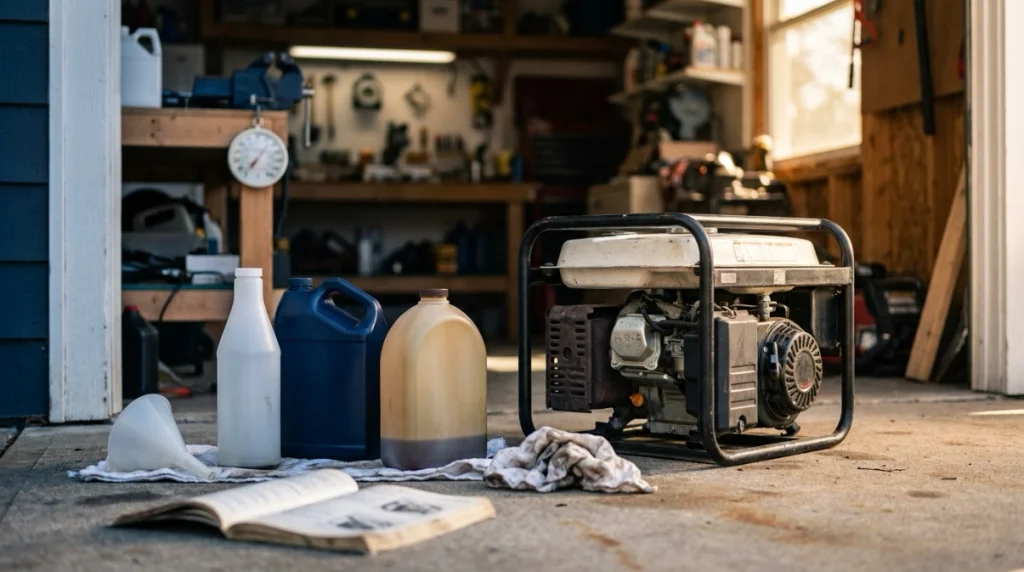
Use the grade your manual permits, then match that approved grade to your operating temperature. Synthetic 5W-30 usually has the strongest cold-start advantage, while SAE 30 is mainly a warm-weather choice.
| Oil Grade | Best Use | Example Manufacturer Guidance | Watch For |
|---|---|---|---|
| SAE 30 | Warm-weather operation | Generac recommends it above 32°F on applicable portable models; Briggs & Stratton commonly lists it above 40°F. | Can make cold starting harder. |
| 10W-30 | Changing or moderate temperatures | Common general-use recommendation on many Honda GX engines and Westinghouse portable generators. | Some small engines may consume more 10W-30 in high heat. |
| Synthetic 5W-30 | Cold starts and broad temperature swings | Generac permits synthetic 5W-30 across its stated portable-generator temperature range. | Only use it when your engine allows this viscosity. |
Notice that the temperature recommendations don’t line up perfectly between manufacturers. That’s exactly why I don’t rely on a generic temperature chart alone.
What do 5W-30 and 10W-30 mean?
The first number describes how the oil behaves when cold, while the second represents its viscosity at normal operating temperature. The “W” refers to winter-grade performance.
- 5W-30: Flows more readily during cold starting than 10W-30.
- 10W-30: Remains a useful multi-grade oil across many moderate conditions.
- SAE 30: Doesn’t have the same multi-grade cold-temperature behavior.
Is Synthetic Oil Better for a Portable Generator?
Synthetic oil can be an excellent generator oil when the manufacturer approves the viscosity. I especially like it for generators expected to start during cold weather or sit ready for emergency use across changing seasons.
Briggs & Stratton describes synthetic SAE 5W-30 as suitable across a wide temperature range and notes improved cold-weather starting in its small-engine oil recommendations.
- Cold starts: Synthetic oil generally maintains useful flow at lower temperatures.
- Temperature stability: Quality synthetics handle temperature changes well.
- Deposit control: Modern synthetic oils typically contain detergent and dispersant additive packages.
- Convenience: One approved multi-grade oil can cover more seasonal conditions.
There is one important catch. Synthetic oil doesn’t automatically extend the generator’s required oil-change interval.
Follow the interval in your generator manual even after switching from conventional to synthetic oil.
What API Rating Should Generator Oil Have?
Use an API service category that meets or exceeds the category required in your owner’s manual. Many small four-stroke engines specify detergent oil meeting older gasoline-engine categories such as API SJ or later.
The American Petroleum Institute oil-category guide explains that newer gasoline-engine service categories include the performance requirements of earlier categories.
- Read the API service requirement in the generator or engine manual.
- Check the API information printed on the oil bottle.
- Confirm that the viscosity also matches your temperature range.
- Don’t choose oil based on brand name alone.
I treat viscosity and service category as two separate checks. An expensive oil still isn’t the right oil when its viscosity is wrong for the engine.
Can I Use Car Motor Oil in a Portable Generator?
Yes, many four-stroke portable generators can use automotive motor oil when its SAE viscosity and API service classification match the engine manufacturer’s requirements. A generator doesn’t automatically require a bottle labeled “generator oil.”
For example, a quality automotive 10W-30 can be suitable when the manual specifically calls for 10W-30 four-stroke engine oil with the required API rating.
- Match the SAE viscosity exactly.
- Check the required API classification.
- Use detergent engine oil unless the manual says otherwise.
- Avoid friction modifiers or specialty additives unless explicitly approved.
Don’t apply this advice to a two-stroke engine. Two-stroke generators use a different lubrication system and may require oil mixed with the fuel at a specified ratio.
How Much Oil Should I Put in a Portable Generator?
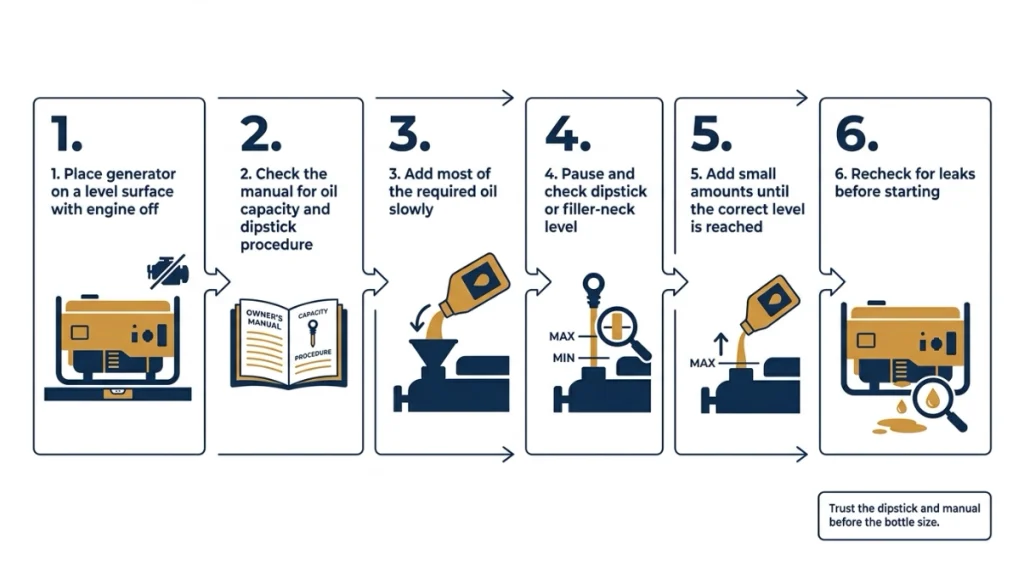
Use the exact oil capacity listed for your generator model rather than assuming it takes a full quart. Portable generator capacities vary considerably with engine size.
Overfilling can cause smoking, oil entering the air-cleaner system, increased crankcase pressure, or messy operation. Too little oil can trigger the low-oil shutdown or leave internal parts poorly lubricated.
- Place the generator on a level surface with the engine off.
- Check the manual for the specified oil capacity and dipstick procedure.
- Add most of the required oil slowly.
- Pause and check the dipstick or filler-neck level.
- Add small amounts until the correct level is reached.
- Recheck for leaks before starting the engine.
My practical rule is to trust the dipstick and manual before trusting the size of the bottle. A one-quart container doesn’t mean your generator needs one quart.
Does Generator Oil Affect Engine Life?
Yes. Correct oil level, viscosity, and change intervals are basic parts of protecting a small air-cooled generator engine. These engines can spend hours operating under a steady load during an outage.
Oil maintenance is one of the habits that can influence your portable generator’s useful lifespan.
- Check the oil level before extended operation.
- Follow the break-in oil-change schedule for a new generator.
- Change oil at the manufacturer’s hour or calendar interval.
- Check the level more frequently during long outage runs.
- Stop and investigate unusual oil consumption or blue smoke.
Some manufacturers call for an early first oil change because new engines shed small amounts of break-in material. Later service intervals differ by brand and model.
Mistakes I Would Avoid When Choosing Generator Oil
The biggest mistake is treating every portable generator as if it uses the same oil. Engine design, climate, and manufacturer specifications can change the correct choice.
- Guessing the viscosity: Don’t assume 10W-30 is correct without checking the manual.
- Using SAE 30 in freezing weather: Straight-weight oil can make cold starts harder when temperatures fall.
- Overfilling the crankcase: Add oil gradually and verify the level correctly.
- Ignoring oil during outages: Long continuous runs make frequent level checks more important.
- Extending intervals with synthetic: Synthetic oil doesn’t cancel the manufacturer’s maintenance schedule.
- Using two-stroke oil incorrectly: Four-stroke generators normally keep engine oil separate from fuel.
Good oil won’t compensate for stale fuel, a clogged air filter, or neglected maintenance. The engine and portable generator fuel system both need attention.
Best Portable Generator Oils I Would Consider
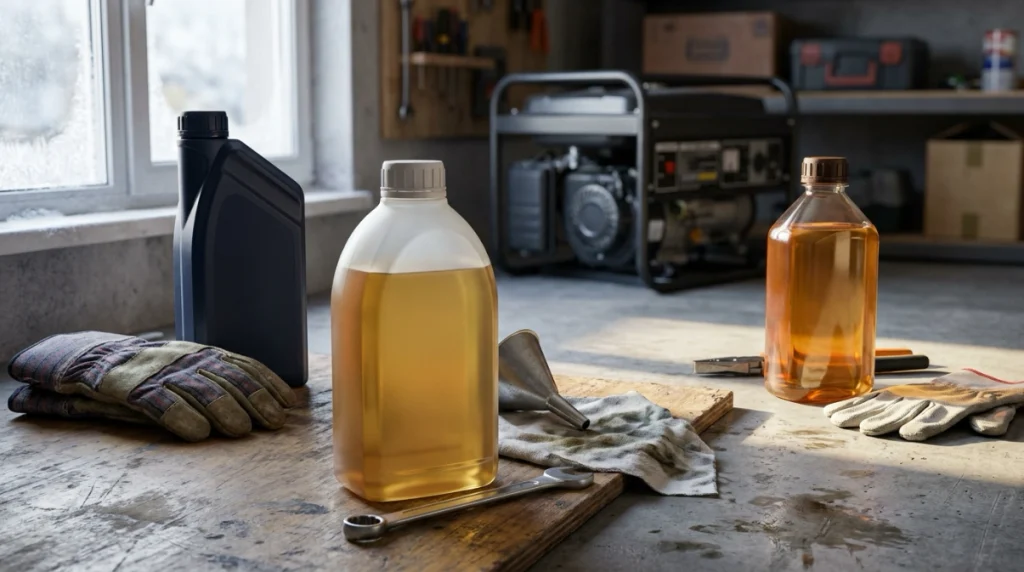
If your owner’s manual approves one of these viscosity grades, these are the types of oils I’d put at the top of my shopping list.
🏆 Best Overall
Mobil 1 Advanced Full Synthetic 10W-30
★★★★★ 4.8/5 editor score
A full-synthetic SAE 10W-30 that meets multiple modern API gasoline-engine service categories. I like this type of oil for a four-stroke generator that specifically approves 10W-30 and sees changing seasonal temperatures.
❄️ Best for Cold Weather
Briggs & Stratton 100074 5W-30 Synthetic Engine Oil
★★★★★ 4.8/5 editor score
This 32-ounce 100% synthetic 5W-30 is formulated for air-cooled four-cycle outdoor power equipment, including generators. I’d consider it when cold starting matters and the engine manual approves 5W-30.
☀️ Best for Warm Weather
Briggs & Stratton 100005 SAE 30 Engine Oil
★★★★☆ 4.6/5 editor score
This SAE 30 oil is formulated for higher operating temperatures in air-cooled four-cycle outdoor engines. It’s a simple choice for warm-weather use when your generator manufacturer specifically allows straight SAE 30.
Frequently Asked Questions
Can I use 10W-30 in my portable generator?
Yes, if your generator’s owner’s manual lists 10W-30 as an approved viscosity. It’s a common general-purpose grade for four-stroke generator engines because it works across a wider temperature range than straight SAE 30. Always confirm the manual before adding it.
Is 5W-30 or 10W-30 better for a generator?
Neither is universally better. Synthetic 5W-30 generally offers an advantage during colder starts, while 10W-30 is a common general-use grade on many engines. Choose between them according to your generator manufacturer’s viscosity chart and the temperatures where you’ll operate the unit.
Can I put full synthetic oil in a portable generator?
Yes, most modern four-stroke generators can use full synthetic oil when the viscosity and service classification meet the manufacturer’s specifications. Synthetic oil can be useful in changing or cold temperatures, but it doesn’t automatically allow longer oil-change intervals.
Is SAE 30 good for portable generators?
SAE 30 can be a good warm-weather oil when the generator manufacturer recommends it. It isn’t my first choice for cold conditions because straight SAE 30 thickens more during low-temperature starts. Check your manual’s temperature chart before using it.
How often should portable generator oil be changed?
The correct interval depends on the generator model. Some manufacturers require an early break-in change, followed by changes based on engine hours or time. Generac, for example, specifies an initial change after roughly 20–30 hours on applicable portable generators, then later scheduled service.
Final Takeaway
The best oil for a portable generator isn’t simply the most expensive synthetic on the shelf. It’s the oil that matches your engine’s required viscosity, API service category, temperature range, and maintenance schedule.
If your manual approves 10W-30, a quality full synthetic 10W-30 is my favorite general-purpose starting point. For colder conditions, manufacturer-approved synthetic 5W-30 deserves a close look.
Check the level before a long outage, keep the correct oil beside your generator, and never guess at capacity. Those simple habits matter when you need the machine to start and stay running.

Hi, I’m Michael Turner. I own a generator workshop in the United States and founded HomeGeneratorBlog to share practical, hands-on guidance about generator installation, maintenance, troubleshooting, safety, and backup power solutions. My goal is to help homeowners make smarter, more confident decisions through clear and reliable information