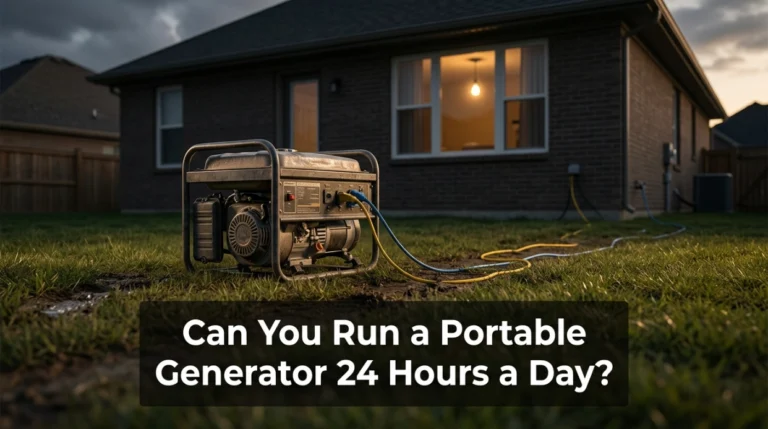
How Big of a Generator Do I Need If Power Goes Out?
Quick Answer
If the power goes out, a generator with 3,000–5,000 running watts can cover basic needs in many homes. Around 5,000–8,000 running watts offers more flexibility for refrigerators, pumps, heating blowers, and lights. Whole-house backup often requires 10,000–20,000 watts or more, especially with central air conditioning. Your exact size depends on the appliances you run together, their startup demands, and your generator wattage requirements.
Quick Generator Size Guide
- 2,000–3,000 watts: Limited essentials, such as lights, electronics, and possibly an efficient refrigerator.
- 3,000–5,000 watts: Refrigeration, basic electronics, lighting, and some additional appliances.
- 5,000–8,000 watts: A larger essential-load setup with selected pumps and heating equipment.
- 10,000–20,000+ watts: Larger backup systems, potentially including central cooling and multiple household circuits.
Before Choosing
- List essential appliances: Include only what must work during an outage.
- Calculate power: Check both running watts and extra motor-starting demand.
- Check connections: Confirm voltage, outlet capacity, and safe installation requirements.
When the electricity disappears, most homeowners immediately think about their refrigerator, lights, heating, and internet connection. I prefer calculating those needs before comparing generator sizes, because buying by square footage alone often leads to the wrong choice.
I’ll show you how to estimate your power requirements, choose a practical generator size, and avoid expensive mistakes.
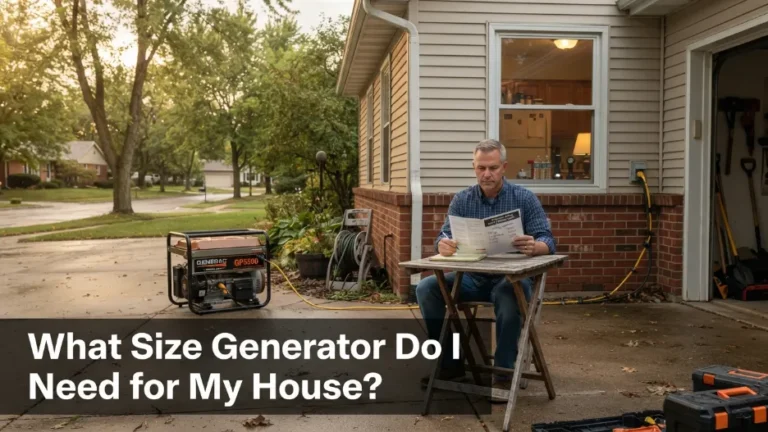
What Size Generator Do You Need During a Power Outage?
The right generator is one that can support your selected appliances continuously while handling their temporary starting surges. That number depends more on your electrical loads than your home’s physical size.
A small home with electric heating can require more backup power than a larger home with gas appliances. Start by deciding which comforts and safety systems matter most.
Generator Size by Household Needs
- Basic emergency power: A 2,000–3,000-watt generator may support lights, electronics, and one efficient refrigerator when its startup requirements fit.
- Moderate backup: A 3,000–5,000-watt generator provides room for more essential appliances.
- Multiple essential circuits: A 5,000–8,000-watt unit can support larger combinations involving pumps, furnace blowers, and refrigeration.
- Higher household demand: An 8,000–12,000-watt unit may support more circuits, provided its connection and surge capacities are adequate.
- Whole-house backup: A professionally sized standby system often falls around 10,000–20,000 watts or higher.
These ranges describe general planning categories, not guarantees. Check the generator’s running-watt rating rather than choosing solely by its advertised peak output.
How Do You Calculate the Generator Wattage You Need?

Start by adding the continuous wattage of everything you plan to operate simultaneously. Then account for the largest additional motor-starting surge and leave reasonable capacity for changing loads.
This is the method I recommend before shopping for equipment.
Step 1: List Your Essential Appliances
Think about what would happen during a two-day outage. Your emergency list should prioritize food preservation, water, medical equipment, heating or cooling, communication, and lighting.
- Refrigerator and freezer
- Well pump or sump pump
- Gas furnace blower
- Selected lighting circuits
- Internet router and phone chargers
- Necessary medical equipment
- Window air conditioner, if required
Leave optional appliances off your first list. You can add them later when you understand the remaining capacity.
Step 2: Understand Running Watts and Starting Watts
Running watts are the electrical power an appliance uses during normal operation. Starting watts describe the higher power needed briefly when certain motors begin operating.
A refrigerator might draw 200 watts while running but need 1,000 watts during compressor startup. Its extra startup demand is therefore 800 watts.
Motor-driven equipment makes this distinction especially important. For a deeper explanation, review my guide to running versus starting watts.
Step 3: Use This Appliance Wattage Table
The following figures are approximate planning ranges for common household equipment. Actual consumption and starting demand vary by model, voltage, condition, and operating mode.
| Appliance | Running Watts | Total Starting Watts |
|---|---|---|
| Refrigerator | 150–400 W | 800–1,200 W |
| Chest freezer | 100–350 W | 700–1,000 W |
| Sump pump | 800–1,050 W | 1,300–2,600 W |
| Well pump | 1,000–1,500 W | 2,000–3,500 W |
| Furnace blower | 300–800 W | 1,000–2,350 W |
| Window air conditioner | 800–1,500 W | 1,800–3,600 W |
| LED lights | 60–100 W total | No major motor surge |
| Internet router | 10–20 W | No major motor surge |
| Microwave | 900–1,500 W input | Check appliance label |
| Electric water heater | 3,000–4,500 W | Usually little extra surge |
Important: Starting watts in this table represent total startup demand, not the amount you add automatically. Subtract the appliance’s running watts to find its additional surge.
Use manufacturer nameplates or a suitable power meter for better accuracy. Appliances with variable-speed motors, heating cycles, or electronic controls may behave differently.
Step 4: Calculate a Realistic Emergency Load
Here is a hypothetical example using six essential household loads. I use this exercise to demonstrate the calculation without assuming every household needs the same generator.
- Refrigerator: 200 running watts
- Sump pump: 800 running watts
- Furnace blower: 500 running watts
- LED lighting: 100 running watts
- Internet equipment: 20 running watts
- Television: 100 running watts
The total continuous demand is 1,720 watts. Suppose the sump pump and furnace blower each have an additional 1,000-watt startup surge.
With only one of those motors starting at a time, the estimated peak is 1,720 + 1,000 = 2,720 watts. Adding a 25% planning margin gives approximately 2,150 running watts and 3,400 peak watts.
A generator rated for 3,900 running watts and 5,000 peak watts could accommodate that example in principle. Simultaneous motor starts, actual measurements, and generator receptacle limits still need checking.
Can a 5,000-Watt Generator Run a House During an Outage?
Yes, a 5,000-watt generator can operate selected essentials in many homes. It generally cannot power every household circuit and high-demand appliance simultaneously.
Always verify whether the advertised 5,000 watts are continuous or starting output. A generator sold as a 5,000-watt model may have a substantially lower running rating.
What Can You Usually Run?
- A refrigerator and freezer with compatible starting requirements
- Several LED lights and basic electronics
- A television and internet router
- A selected pump or furnace blower within the remaining power budget
- Small kitchen appliances used one at a time
A practical strategy is to avoid running your microwave, coffee maker, and other high-draw appliances together. Switching loads makes a smaller generator more useful.
Large central air conditioning systems, electric heating, and electric water heaters can quickly exceed the available power.
Do You Need a 7,500-Watt Generator or a Whole-House Generator?
A generator around 7,500 running watts can support a more substantial group of essential circuits. A whole-house standby system becomes more attractive when you want automatic operation and broader household coverage.
The difference is about convenience and electrical demand, not simply house size.
When a Larger Portable Generator Makes Sense
- Your home has a well pump or sump pump.
- You want to operate heating equipment and refrigeration together.
- You need several selected household circuits.
- You experience occasional multi-day outages.
- You can safely deploy, fuel, and maintain portable equipment.
Check 120/240-volt capability before choosing a generator for hardwired 240-volt equipment. A powerful 120-volt-only inverter cannot automatically supply a 240-volt well pump.
When Whole-House Standby Power Is Better
Consider standby backup when outages are frequent or your home depends on electrically powered systems that require continuous availability. Central air conditioning, electric water heating, and multiple large loads can raise the required capacity substantially.
As of 2026, manufacturers such as Generac emphasize professional load analysis for accurate standby sizing.
An electrician or generator installer should evaluate starting demand, load management, electrical service, and fuel supply before selecting a whole-house system.
What Type of Generator Is Best for Emergency Home Backup?
Choose based on the loads you need, your connection method, and available fuel. Portable inverter, conventional portable, and permanently installed standby generators solve different problems.
Inverter Generators
Inverter generators are appealing for smaller loads, quieter operation, and sensitive electronics. Many models also vary engine speed with demand to reduce fuel consumption.
However, compact inverter generators often have limited total output. Some cannot supply 240-volt household equipment.
Conventional Portable Generators
Open-frame portable generators commonly provide more power for the purchase price. Larger models can serve several important circuits with suitable connection equipment.
They tend to be heavier and louder than compact enclosed inverters. They also require fuel storage and manual setup.
Dual-Fuel and Standby Options
Dual-fuel generators can operate on gasoline or propane, giving you more flexibility during a long outage. Their rated output often decreases when operating on propane.
For a closer comparison of gasoline, propane, diesel, and natural gas, see my generator fuel comparison.
Standby units are permanently installed and can start automatically after utility power fails. Installation cost, maintenance, and fuel availability are important considerations.
How Do You Connect and Operate a Generator Safely?
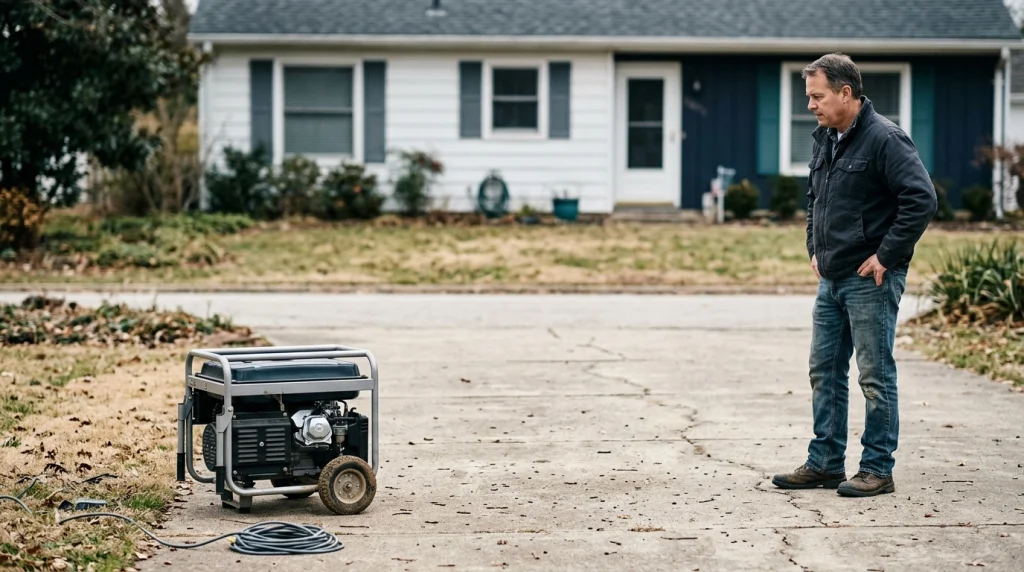
Generator capacity means little if the equipment is connected unsafely. Carbon monoxide, electrical backfeeding, fire, and shock hazards require careful preparation.
Never Operate a Portable Generator Indoors
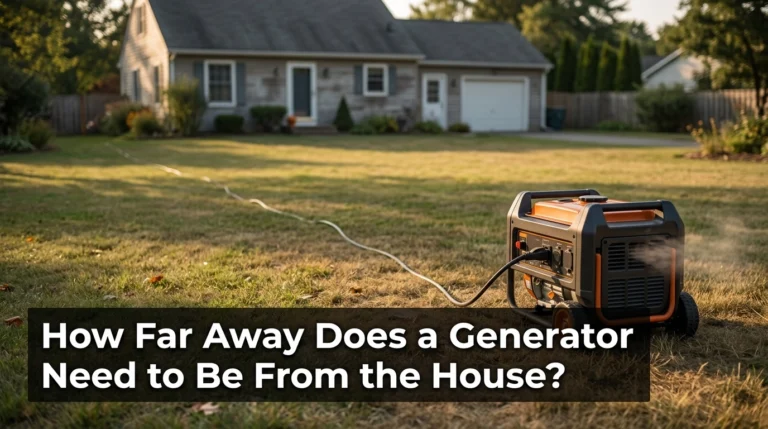
The CDC’s power outage guidance recommends placing fuel-burning portable generators outside, at least 20 feet from doors, windows, and vents.
Never use one inside a garage, basement, shed, or carport, even with doors open. Direct exhaust away from buildings and install working battery-powered or battery-backup carbon monoxide alarms.
Use Proper Electrical Connections
Never connect a generator to a household wall outlet to energize your home. That dangerous practice can send electricity back into utility lines.
According to OSHA generator safety guidance, a qualified electrician should install appropriate transfer equipment before connecting a portable generator to building wiring.
Read my portable transfer switch guide for information about electrical isolation, circuit selection, and compatible equipment.
Prepare Before the Outage
- Choose a location: Keep the generator outside, away from openings and exhaust exposure.
- Protect from weather: Follow the manufacturer’s instructions for approved outdoor weather protection.
- Inspect connections: Use undamaged, appropriately rated cords and connectors.
- Store fuel correctly: Use approved containers and follow local requirements.
- Refuel safely: Shut the generator off and let it cool first.
- Maintain equipment: Check oil, test the generator, and follow the maintenance schedule.
For outdoor positioning details, review my guide on safe generator placement.
The Consumer Product Safety Commission also recommends choosing generators with automatic carbon monoxide shutoff technology. Such protection supplements safe placement but never makes indoor operation acceptable.
Common Generator Sizing Mistakes to Avoid
I see more value in eliminating sizing mistakes than simply buying the largest available model. A thoughtful load plan can reduce cost and make your backup system easier to operate.
- Using peak watts: Check continuous output separately from the advertised starting rating.
- Ignoring startup demand: Refrigerators, pumps, and compressors can require substantial surge power.
- Assuming motors start separately: Plan for possible overlapping surges or use appropriate load management.
- Forgetting voltage: Verify whether essential equipment requires 120 or 240 volts.
- Overlooking propane ratings: A dual-fuel generator may deliver less power on propane.
- Ignoring fuel consumption: Check expected runtime at realistic electrical loads.
- Skipping professional installation: Permanent household electrical connections require properly designed transfer equipment.
One final detail matters: fuel availability can become a bigger problem than wattage during extended outages. Plan how much fuel you’ll need and where you’ll obtain it safely.
Generator Recommendations for Different Outage Needs
If you’re comparing generators, these three real models illustrate different backup-power levels. I selected them by published specifications and use case, not by claiming hands-on testing.
The star scores below are editorial suitability assessments, not customer review ratings.
🔋 Compact Essentials Pick
Honda EU2200i Inverter Generator
★★★★☆ 4/5 editorial fit
Produces 1,800 running watts and 2,200 maximum watts at 120 volts. I’d consider this for limited emergency loads, such as lights, electronics, and a compatible refrigerator, rather than broader home backup.
🏠 Mid-Range Essentials Pick
Westinghouse iGen5000DFc EFI
★★★★★ 4.5/5 editorial fit
Rated for 3,900 running watts on gasoline or 3,500 on propane, with lower peak limits on propane too. I like its dual-fuel flexibility for selected 120-volt appliances, but it is not a 240-volt whole-house solution.
⚡ Higher-Capacity Backup Pick
Westinghouse WGen9500DFc
★★★★☆ 4/5 editorial fit
Offers 9,500 running watts on gasoline and 8,500 on propane, with 120/240-volt output. I’d shortlist it for substantial selected-circuit backup where the home’s load calculation and professionally installed connections support its use.
Affiliate disclosure: As an Amazon Associate, this site may earn from qualifying purchases. Verify model specifications, availability, and installation compatibility before ordering.
Frequently Asked Questions
Will a 3,000-watt generator run a refrigerator and lights?
Yes, a generator with 3,000 running watts may power an efficient refrigerator, several LED lights, and basic electronics. Confirm the refrigerator’s compressor startup demand and the generator’s separate peak rating before connecting additional appliances.
Can a 7,500-watt generator run a whole house?
A 7,500-running-watt generator can support many essential household circuits, but it may not run every appliance simultaneously. Central air conditioning, electric heating, water heaters, and multiple motor startups can require more capacity.
What size generator do I need for a 2,000-square-foot house?
For essential circuits, a 5,000–8,000-running-watt generator may be sufficient in some 2,000-square-foot homes. Full-house backup can require roughly 14,000–22,000 watts or more, depending on HVAC equipment, electrical appliances, and startup requirements.
Should I buy a bigger generator than I need?
Some additional capacity helps accommodate motor starts and unexpected loads. However, significantly oversizing a generator can increase purchase cost, fuel consumption, weight, and maintenance requirements without delivering meaningful benefits.
Can I run a portable generator all night during a blackout?
Some generators are designed for extended operation within their maintenance and fuel limits. Overnight use requires a safe outdoor location, working carbon monoxide alarms, proper connections, sufficient fuel, and compliance with manufacturer instructions; never operate one indoors or refuel it while hot.
Final Takeaway: Choose the Generator That Fits Your Essential Loads
For many households, a generator providing 3,000–5,000 running watts is a practical starting point for basic outage needs. Homes with pumps, heating blowers, and more simultaneous appliances may benefit from 5,000–8,000 running watts or a larger professionally designed system.
My recommendation is simple: calculate your appliances first, verify motor-starting demand, and choose equipment that meets both requirements. A properly sized, safely connected generator can make your next power outage far more manageable.

Hi, I’m Michael Turner. I own a generator workshop in the United States and founded HomeGeneratorBlog to share practical, hands-on guidance about generator installation, maintenance, troubleshooting, safety, and backup power solutions. My goal is to help homeowners make smarter, more confident decisions through clear and reliable information