What Is Starting Wattage in an Inverter Generator? Surge Power, Wattage Math & Sizing Explained
Quick Answer
What is starting wattage in an inverter generator? It is the short burst of extra power a motor-driven appliance needs for a few seconds to start, often 2 to 3 times its running watts. A fridge that runs on 150 watts may need 600 watts to start, so you must size for that peak, not just the steady load. Choose the right generator size by adding your highest starting watts to the running watts of everything else.
The 3-second rule to remember
- Starting watts are brief: They last only a few seconds while a motor spins up to full speed.
- Running watts are steady: They are the power an appliance uses once it is already running.
- Motors need the most: Fridges, freezers, pumps, and air conditioners have the highest starting surge.
- Electronics need almost none: Phones, laptops, and LED lights start at close to their running watts.
- Size for the peak: If the surge exceeds your generator, it will trip, stall, or refuse to start the load.
Do this first
- List every appliance you plan to run, note its running watts and starting watts, then add the largest starting watts to the rest of the running watts.
- Start motor loads one at a time, with the largest motor first, and leave 20% headroom when you can.
I’ve tripped an inverter generator with a fridge that looked easy on paper.
It ran fine on 150 watts once it was cold. It needed four times that power for the first two seconds, and my small generator said no.
That moment taught me the real lesson of this guide. Starting wattage is not a footnote on the spec sheet, it is the number that decides whether your backup plan works when you need it most.
In this guide, I’ll explain what starting wattage means in plain language, how it differs from running watts, and how to do the math for your home, RV, or campsite in 2026.
In This Guide
- What Is Starting Wattage in an Inverter Generator?
- Starting Watts vs Running Watts: What’s the Difference?
- Why Do Some Appliances Need So Much Starting Wattage?
- How Much Starting Wattage Do Common Appliances Need?
- How to Calculate Starting Wattage for Your Setup
- What Happens If Your Inverter Generator Doesn’t Have Enough Starting Wattage?
- How to Reduce Starting Wattage and Start Hard Loads Safely
- Starting Wattage by Generator Size: What Can Each Size Handle?
- How to Choose an Inverter Generator With Enough Starting Wattage
- Frequently Asked Questions
What Is Starting Wattage in an Inverter Generator?
An inverter generator is a portable generator that makes clean, stable power for sensitive electronics.
Starting wattage, also called surge watts or peak watts, is the extra power it can deliver for a very short time when a motor starts.
Think of it like pushing a heavy cart from a standstill. The first push takes the most effort, then it rolls with far less force once it moves.
A motor works the same way. It needs a surge of current to overcome inertia and get its parts spinning, then it settles down to a lower, steady draw.
How long does starting wattage last?
Most surges last 1 to 3 seconds. Some large motors, like a well pump or a big air conditioner compressor, can draw high power for up to 5 seconds.
That short window still matters. Your generator must cover it, or the motor will not start at all.
Where do you find starting watts on a generator?
Manufacturers print two numbers on the box and the spec sheet. The larger number is starting watts, and the smaller number is running watts.
A model sold as a 2,200-watt generator, for example, may offer 2,200 starting watts and 1,800 running watts. Check the spec sheet before you buy, because the headline number is almost always the surge number.
Section Takeaway: Starting wattage is the brief peak power your generator must supply to start a motor, and it is the number that decides whether that motor starts at all.
Starting Watts vs Running Watts: What’s the Difference?
Starting watts and running watts measure two different jobs. One is a sprint, and the other is a steady jog.
Running watts, also called rated watts or continuous watts, are the power an appliance uses minute after minute once it is running. Starting watts are the short peak needed to get it moving in the first place.
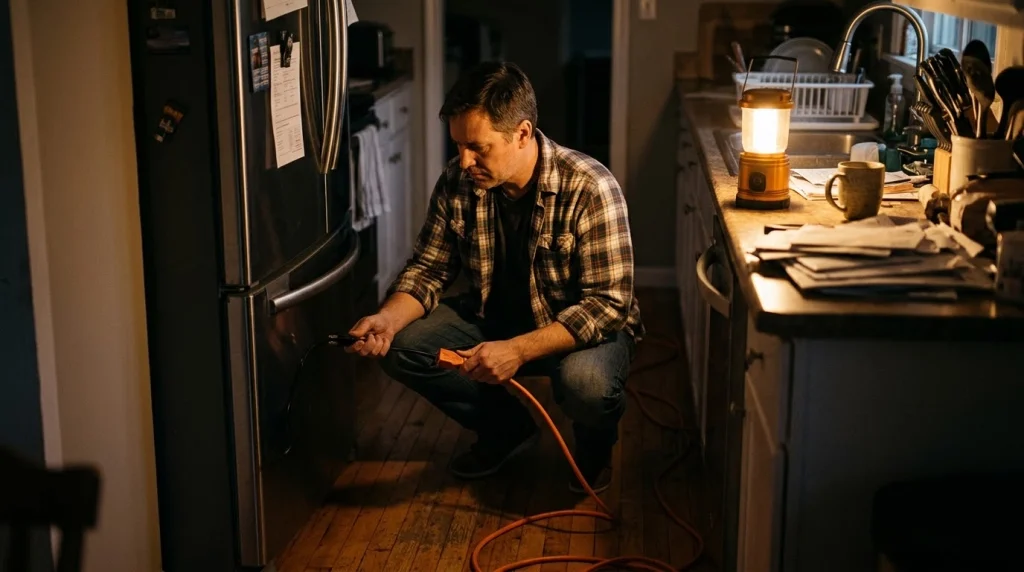
I learned this the hard way during a multi-day outage. My fridge, a few lights, and a CPAP machine added up to about 400 running watts, which looked easy for a 2,000-watt inverter generator.
The fridge compressor kicked on while the CPAP was running, and the surge pushed the total past the limit for a split second. The generator overloaded and shut down, and I had to restart everything in the right order.
Why do brands advertise starting watts first?
The bigger number looks better in a headline. It also tells you the true peak the generator can handle for a few seconds.
That does not make it a trick, but it does mean you should read both numbers. Plan your steady load around running watts, and plan your motor starts around starting watts.
For a deeper look at how to read both numbers on a label, see this guide to inverter generator ratings and reviews.
| Feature | Starting Watts | Running Watts |
|---|---|---|
| Also called | Surge watts, peak watts | Rated watts, continuous watts |
| How long it lasts | 1 to 3 seconds, rarely up to 5 seconds | As long as the appliance runs |
| Typical size | 2 to 3 times running watts for motors | The steady draw after startup |
| What it decides | Whether a motor can start at all | How much you can run at once, all day |
| Highest for | Fridges, pumps, AC units, power tools | Heaters, lights, chargers, fans |
Section Takeaway: Use running watts to plan your steady load, and use starting watts to plan each motor start, because the peak is what trips a generator.
Why Do Some Appliances Need So Much Starting Wattage?
Not every appliance surges. The ones that do almost always have a motor or a compressor inside.
A motor at rest has no momentum. It needs a large inrush of current to create the magnetic field that turns the rotor and gets the parts moving.
Once it spins up, friction drops and the current falls fast. That is why the surge is short, but also why it is so high.
Which appliances surge the most?
- Refrigerators and freezers: The compressor motor needs 3 to 4 times its running watts to start.
- Air conditioners: RV and window AC units are the hardest loads for a small inverter generator, often needing 2 to 3 times their running watts.
- Well pumps and sump pumps: Pumps move water against pressure, so they draw a heavy surge at startup.
- Power tools: Circular saws, air compressors, and table saws surge when the blade or pump first spins up.
- Furnace blowers: The blower motor surges, even though the furnace itself uses little power once running.
Which appliances barely surge at all?
- LED lights: They draw almost the same power at startup as they do while running.
- Phones and laptops: Chargers ramp up gently, with little or no surge.
- TVs and routers: Most modern electronics have a small startup draw, close to their running watts.
- Resistive heaters: A space heater or kettle draws steady power, with no motor surge to plan for.
Age and condition matter too. An older fridge with a worn compressor can surge harder than a new one, and a pump with a clogged filter works harder at startup.
Safety note: Run generators outdoors and well away from windows, doors, and vents. Carbon monoxide can build up fast indoors, even in a garage with the door open.
Section Takeaway: Motors and compressors cause the surge, while lights and electronics do not, so your hardest loads are almost always the ones with a motor.
How Much Starting Wattage Do Common Appliances Need?
The table below uses typical ranges I see in owner manuals and wattage guides. Your exact model may differ, so check its label or manual before you size a generator.
Use these numbers as a planning guide, not as a spec for a specific model. When in doubt, use the high end of the range.
| Appliance | Running Watts | Starting Watts |
|---|---|---|
| Refrigerator | 100 to 200 | 600 to 800 |
| Chest freezer | 100 to 150 | 500 to 700 |
| Window AC, 8,000 BTU | 700 to 900 | 1,800 to 2,200 |
| RV AC, 13,500 BTU | 1,200 to 1,500 | 2,800 to 3,500 |
| Sump pump, 1/3 HP | 800 to 1,000 | 1,300 to 2,000 |
| Well pump, 1/2 HP | 1,000 to 1,200 | 2,000 to 2,500 |
| Furnace blower | 300 to 800 | 900 to 1,500 |
| Microwave, 1,000 W | 1,000 to 1,200 | 1,000 to 1,200 |
| Circular saw | 1,200 to 1,400 | 2,000 to 2,400 |
| CPAP machine | 30 to 60 | 30 to 60 |
| Laptop charger | 50 to 90 | 50 to 90 |
Notice the pattern. A fridge looks small on running watts, but its starting watts are four times higher.
An RV air conditioner is the opposite problem in plain sight. It needs a large generator even before you add lights, a fridge, and chargers.
Section Takeaway: Check starting watts for every motor load, because a small running number can hide a surge that is 3 to 4 times larger.
How to Calculate Starting Wattage for Your Setup
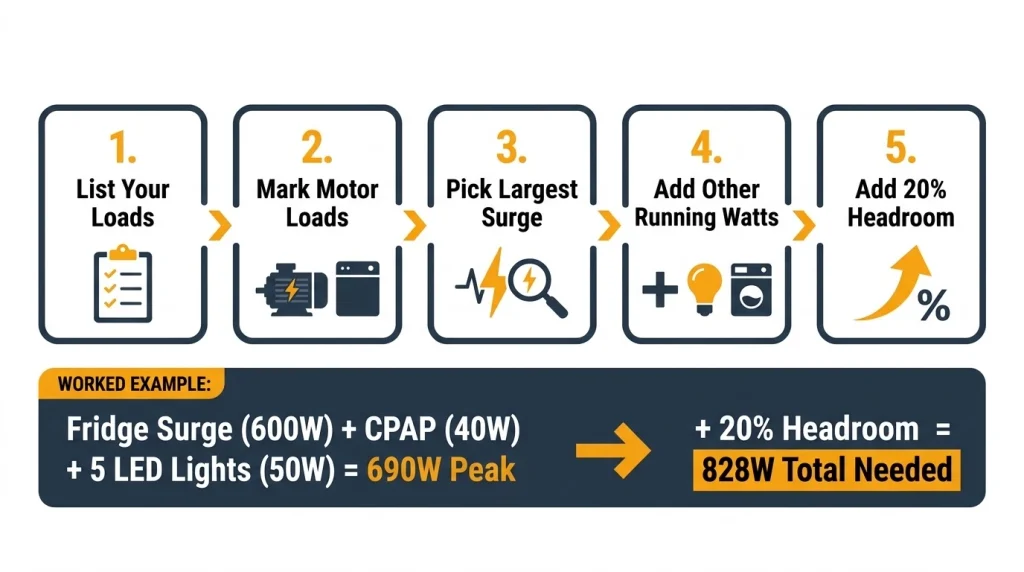
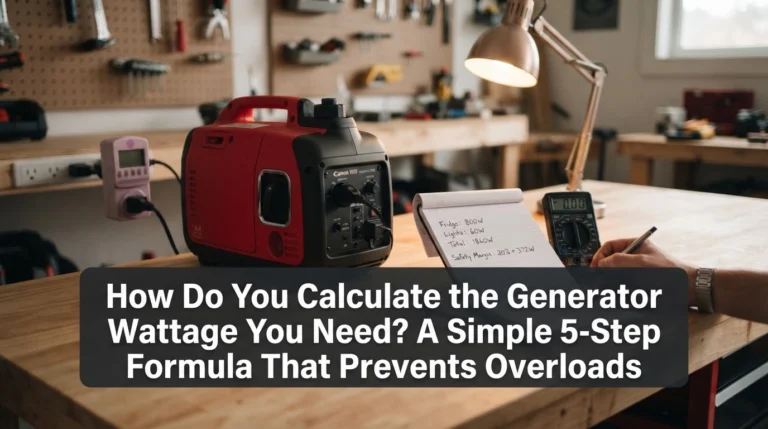
How do you calculate the starting wattage you need? Add the running watts of everything you will run at once, then add the extra surge for the largest motor only.
You do not add the starting watts of every motor together. You add the largest surge, because you will start motors one at a time.
This is the method I use at home and at a campsite, and it has kept me from overloading a generator more than once.
The 5-step formula
- List your loads: Write down every appliance, with its running watts from the label or manual.
- Find the motor loads: Mark the fridge, freezer, pump, AC, and any power tools in the list.
- Find the largest surge: Take the highest starting watts among those motor loads.
- Add the rest as running watts: Add the running watts of all the other appliances you will run at the same time.
- Add 20% headroom: Multiply the total by 1.2 if you can, so a hot day or an older motor does not push you over the limit.
Here is a real example. A fridge needs 150 running watts and 600 starting watts, a CPAP needs 40 watts, and five LED lights need 50 watts together.
Add the largest surge first: 600 watts for the fridge. Then add the other running watts: 40 plus 50 equals 90 watts. That gives 690 watts at the moment the fridge starts.
With 20% headroom, that becomes about 828 watts. A 2,000-watt inverter generator handles that easily, with room for a phone charger and a small fan.
Now try a harder case. Add a window AC at 800 running watts and 2,000 starting watts to the same list, and start the AC first.
The peak becomes 2,000 watts for the AC, plus 150 for the fridge running, plus 90 for the CPAP and lights. That is 2,240 watts at the peak, which needs a generator rated above that number.
For the full step-by-step method, with more worked examples, use this guide to calculate the generator wattage you need.
Safety note: Never backfeed your home through a wall outlet, and use a transfer switch or interlock installed by a licensed electrician for any home hookup. Check your owner’s manual before use.
Section Takeaway: Add the largest starting watts to the running watts of everything else, then add headroom, and you will have a number you can trust.
What Happens If Your Inverter Generator Doesn’t Have Enough Starting Wattage?
The generator will usually protect itself first. It will trip its overload breaker, shut down, or drop voltage for a second and stall the motor.
That is better than damage, but it still leaves you without power at the worst time. I have seen a fridge compressor hum, try to start, and fail three times in a row on an undersized generator.
Common signs you are short on starting watts
- Overload light or alarm: The generator trips as soon as a motor tries to start.
- Motor hums but does not spin: The compressor or pump gets power, but not enough to turn over.
- Lights dim sharply: Voltage sags for a second when a large load starts.
- Generator surges or stalls: The engine revs hard, then cuts out under the sudden load.
- Breaker trips on the generator: The outlet breaker opens to protect the inverter.
Can low starting watts damage your appliances?
Repeated failed starts can stress a motor. A compressor that tries to start on low voltage can overheat if it keeps cycling without spinning up.
Most modern inverter generators cut power fast enough to limit that risk. The bigger risk is food spoilage, a flooded basement, or a dead CPAP battery when the load will not start at all.
If your generator trips once, turn off other loads and try the motor alone. If it still will not start, you need more surge capacity, a soft starter, or a different load order.
Section Takeaway: Too little starting wattage usually means a trip or a failed start, not a ruined generator, but it still leaves the load you needed most without power.
How to Reduce Starting Wattage and Start Hard Loads Safely
You cannot change what a motor needs to start, but you can change how you ask for it. Small changes in order and setup often make a borderline generator work.
Start with the simplest fix first. Turn off everything else, start the largest motor, wait for it to settle, then add the next load.
Start loads in the right order
- Largest motor first: Start the AC, fridge, or pump before you add lights and chargers.
- One motor at a time: Wait 10 to 20 seconds between motor starts so each surge clears.
- Turn off eco mode for the start: Eco-throttle can lag when a sudden load hits, so switch it off for a hard start, then turn it back on.
- Unplug non-essentials: A microwave or space heater can wait until the motor is running.
Use a soft starter for an RV air conditioner
A soft starter is a small device wired into an RV AC unit. It ramps the compressor up slowly and can cut starting watts by 50% or more in many cases.
It does not change running watts. It only smooths the first few seconds, which is often enough to let a 2,200-watt inverter generator start a 13,500 BTU AC that would otherwise trip it.
Check your AC manual and have a qualified tech install it if you are not comfortable with wiring. A soft starter is not a fix for a generator that is far too small, but it can bridge a close gap.
Parallel two inverter generators
Many inverter generators are parallel-capable. A parallel kit links two matching units and combines their running and starting watts.
Two 2,200-watt units, for example, can give you about 4,400 starting watts together. That is a clean way to grow capacity without buying a much larger, heavier generator.
Safety note: Use only the parallel kit made for your model, and follow the manual for the connection order. Never parallel generators that are not designed for it.
Section Takeaway: Start the biggest motor first, turn off eco mode for the start, and consider a soft starter or parallel kit when you are close but not quite there.
Starting Wattage by Generator Size: What Can Each Size Handle?
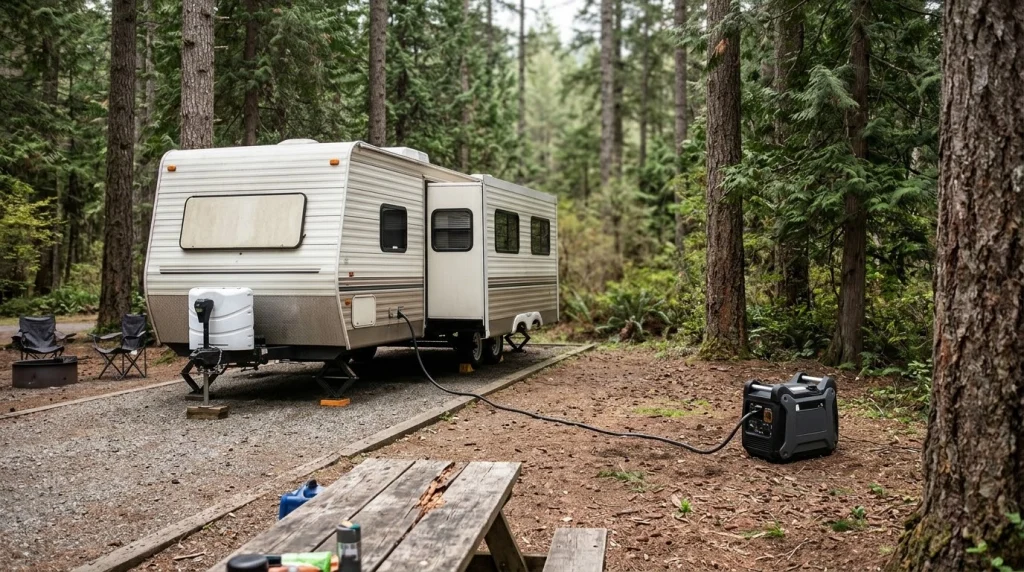
Generator size is not just about running watts. The starting watts tell you which motors you can actually start, and that is where most buyers get surprised.
Use this table as a rough guide for 2026 inverter generators. Brands vary, so always check the spec sheet for the exact model you are considering.
| Generator Size | Typical Starting Watts | What It Can Usually Start |
|---|---|---|
| 1,000 watts | 1,000 | Phones, laptops, lights, CPAP, small fan |
| 2,000 to 2,200 watts | 2,000 to 2,200 | Fridge or freezer, plus lights and chargers |
| 3,000 to 3,500 watts | 3,000 to 3,500 | Fridge, small window AC, sump pump |
| 4,500 to 5,000 watts | 4,500 to 5,000 | RV AC with soft starter, fridge, well pump |
A 2,000-watt inverter generator is the sweet spot for most campers and light home backup. It can start a fridge, run lights and a CPAP, and charge phones without much fuss.
For prices and what that size can run in practice, see how much a 2000-watt inverter generator costs.
A 3,000-watt unit opens up a window AC and a sump pump, plus a fridge at the same time if you start them in order. For that size, see how much a 3000-watt inverter generator costs.
Section Takeaway: A 2,000-watt unit covers a fridge and essentials, a 3,000-watt unit adds a window AC or pump, and an RV AC usually needs 4,500 watts or a soft starter.
How to Choose an Inverter Generator With Enough Starting Wattage
Start with your load list, not with a brand or a sale price. The right generator is the smallest one that covers your largest surge with headroom to spare.
I have watched buyers pick a generator by running watts alone, then learn on the first hot night that their AC will not start. The fix is simple, but it has to happen before you buy.
What should I look for on the spec sheet?
- Both watt numbers: Starting watts and running watts should both be printed clearly.
- THD under 3%: Low total harmonic distortion means clean sine wave power for laptops, CPAP machines, and TVs.
- Parallel capability: A parallel port lets you add a second unit later if your needs grow.
- Eco mode: Eco-throttle saves fuel at light loads, but remember to turn it off for a hard motor start.
- Outlets you need: Look for a 30-amp RV outlet if you plan to run an RV, and GFCI outlets for outdoor use.
- Runtime at 25% load: A longer runtime at light load means fewer refuels overnight.
Noise matters too, especially at a campsite. Check the dB rating at a stated distance, and remember that a generator working hard to start a motor will be louder for a few seconds.
For a full buying checklist, see what to look for in an inverter generator before you compare models.
When you compare brands, look at real owner feedback on surge performance, not just the headline watts. Honda, Yamaha, Champion, Westinghouse, and DuroMax all make capable inverter models, but the exact starting watts vary by model and fuel type.
Dual fuel models often have slightly lower watts on propane than on gasoline. Check both numbers if you plan to run on propane during an outage.
Safety note: Follow the break-in and maintenance schedule in your owner’s manual, and store fuel safely in an approved container away from living spaces.
Section Takeaway: Pick the smallest generator that covers your largest starting surge with 20% headroom, clean power, and the outlets you actually need.
Frequently Asked Questions
What is starting wattage in an inverter generator?
Starting wattage is the short burst of extra power, also called surge watts, that an inverter generator can supply for 1 to 3 seconds to start a motor. It is often 2 to 3 times the running watts for fridges, pumps, and air conditioners.
Is starting wattage the same as surge wattage?
Yes. Starting watts, surge watts, and peak watts all mean the same thing: the brief maximum power a generator can deliver at startup. Running watts are the lower, steady power it can supply continuously.
How do I find the starting watts for my fridge?
Check the label on the back of the fridge or the owner’s manual for running watts and locked-rotor amps. If only running watts are listed, multiply by 3 to 4 as a safe estimate for a compressor motor.
Can a 2000-watt inverter generator start a refrigerator?
Yes, in most cases. A typical fridge needs 600 to 800 starting watts, which fits easily within a 2,000-watt surge rating, as long as you do not start a second large motor at the same time.
Can a 2000-watt inverter generator run an RV air conditioner?
Usually not without help. A 13,500 BTU RV AC often needs 2,800 to 3,500 starting watts, which exceeds a 2,000-watt unit. A soft starter or a parallel kit can sometimes bridge the gap.
Do I add up all the starting watts together?
No. Add the largest starting watts once, then add the running watts of everything else you will run at the same time. Start motors one at a time, largest first, so their surges do not overlap.
What happens if I exceed the starting watts?
The generator will usually trip its overload protection, shut down, or fail to start the motor. Turn off other loads, try the motor alone, and consider a larger generator, a soft starter, or parallel operation if it still will not start.
If you size for the surge first and the steady load second, your generator will start what you need, when you need it. That is the whole point of starting wattage, and it is worth the extra five minutes of math before you buy or plug in.
Start with your largest motor, add the rest as running watts, and leave headroom. Your fridge, your pump, and your AC will thank you on the first hot, dark night of an outage.

Hi, I’m Michael Turner. I own a generator workshop in the United States and founded HomeGeneratorBlog to share practical, hands-on guidance about generator installation, maintenance, troubleshooting, safety, and backup power solutions. My goal is to help homeowners make smarter, more confident decisions through clear and reliable information