Portable Generator Wheel Kit: How to Choose, Install, and Use One
Quick Answer
A portable generator wheel kit adds wheels, a handle, and usually a support leg to an open-frame generator, making a heavy machine much easier to move. The safest choice is a kit specifically approved for your generator model or frame, because axle mounts and handle brackets are not universal. Before ordering, check your generator’s model number and compare it with the compatible portable generator parts.
What to Check Before Buying
- Model compatibility: Confirm the kit lists your exact generator model or supported series.
- Wheel size: Larger wheels generally handle rough ground better, while compact wheels take less storage space.
- Tire type: Never-flat tires need little maintenance, while pneumatic tires can ride more smoothly over uneven terrain.
- Handle design: A folding handle makes storage easier and gives you better leverage when moving the generator.
- Mounting hardware: Choose a complete kit with axles, pins, brackets, bolts, and support feet.
My First Rule
- Never drill or modify the generator frame unless the manufacturer specifically approves that installation method.
A wheel kit sounds like a small upgrade until you try carrying a full-size open-frame generator across a driveway. Even a machine that feels manageable in the garage becomes awkward when you add fuel, cords, uneven ground, and bad weather.
When I look at a wheel kit, I care more about correct fit and balance than appearance. This guide explains what fits, what matters, how installation works, and which types I would consider in 2026.
What Is a Portable Generator Wheel Kit?
A portable generator wheel kit is a mobility accessory that converts a carry-style generator frame into a rollable setup. Most kits use two wheels on one end and a support foot or legs on the opposite end.
A handle then gives you enough leverage to tilt the generator slightly and roll it rather than lifting its entire weight.
Definition: A generator wheel kit is a set of wheels, axles, mounting hardware, supports, and often a folding handle designed to attach to a compatible portable-generator frame.
A typical kit may contain:
- Two wheels
- One axle or two axle pins
- Washers and cotter pins
- Mounting brackets
- A folding or fixed handle
- A support leg or rubber feet
- Bolts, nuts, and basic assembly hardware
The wheel kit does not change how the engine or alternator produces power. If you want to understand those components first, my guide to how a portable generator works explains the complete system.
Do You Really Need a Wheel Kit for a Portable Generator?
You probably need a wheel kit if moving your generator requires two people, uncomfortable lifting, or repeated carrying. The upgrade is most useful on heavy open-frame machines.
I find it especially useful when a generator moves between storage and an outdoor operating location during outages.
- Garage-to-driveway movement: Wheels make repeated setup much easier.
- RV use: A handle helps maneuver the machine around campsites and storage areas.
- Jobsite use: Rolling reduces the amount of lifting between work areas.
- Large generators: High-output open-frame models can become difficult to carry safely.
- Limited storage: Folding handles can reduce the space needed after use.
A compact suitcase-style inverter generator may not need an add-on kit. Many already have molded handles or built-in wheels.
How Do You Choose the Right Portable Generator Wheel Kit?
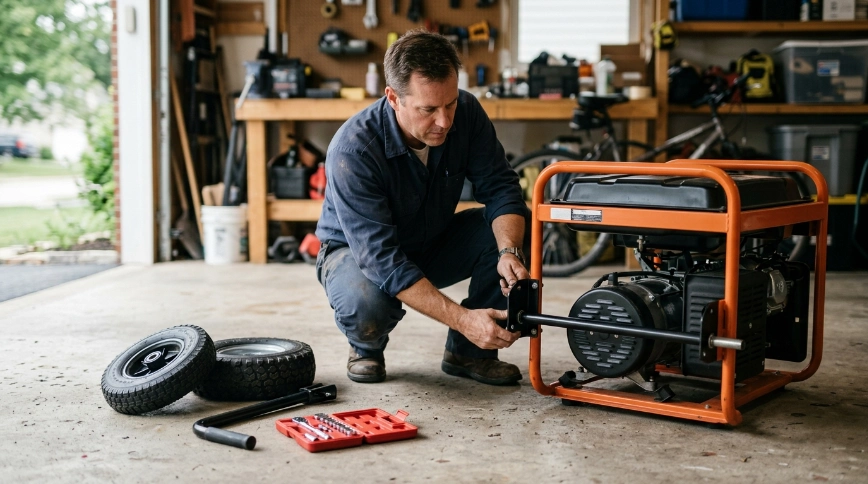
Start with your generator’s exact model number, not its wattage alone. Two generators with similar output can use completely different frame dimensions and mounting points.
These are the checks I make before buying.
1. Confirm Exact Frame Compatibility
Manufacturer-specific kits are usually the safest option. Champion, FIRMAN, and Westinghouse all sell kits with defined compatibility ranges or model lists.
Do not assume a kit marked “3,500-watt generator wheels” fits every 3,500-watt machine.
2. Choose the Right Wheel Type
Never-flat wheels are convenient because they cannot lose air from an ordinary puncture. They work well on concrete, pavement, and typical residential yards.
Pneumatic tires contain air and can provide a softer ride on rough terrain. They require more maintenance and can eventually lose pressure.
3. Look at Wheel Diameter
Many manufacturer kits use 8-inch wheels. Larger 10-inch or 11-inch wheels can be useful on rough ground when the generator and frame are designed for them.
Bigger is not automatically better. Changing wheel diameter can change frame height, support-foot angle, and overall balance.
4. Check the Handle
A folding handle is my preferred setup for home backup generators. It gives good leverage during transport but folds out of the way in storage.
Make sure the handle cannot swing toward the muffler, fuel valve, control panel, or other hot and delicate parts.
Are Portable Generator Wheel Kits Universal?
No. Most generator wheel kits should not be treated as universal. Mounting holes, frame tubing, axle locations, and handle brackets differ between brands and models.
Current manufacturer specifications show how specific these kits can be.
| Wheel Kit | Wheel Setup | Stated Compatibility | Useful Feature |
|---|---|---|---|
| Champion 40065 | 8-inch never-flat wheels | Compatible Champion generators in the stated 2,800–4,800W range; manufacturer restrictions apply | Folding handle and vibration-mounted support leg |
| FIRMAN 1003 | Two 8-inch wheels | FIRMAN generators in the stated 3,000–4,900W range | High-leverage folding handle and vibration-reducing rubber mounts |
| Westinghouse WGen3600 Series Kit | Two 8-inch never-flat wheels | WGen3600DFc and WGen3600DF | Fold-flat handle and rubber-foot support brackets |
This is why I treat model compatibility as a pass-or-fail requirement. A great wheel kit is useless if its brackets do not align with your generator.
How Do You Install a Portable Generator Wheel Kit?
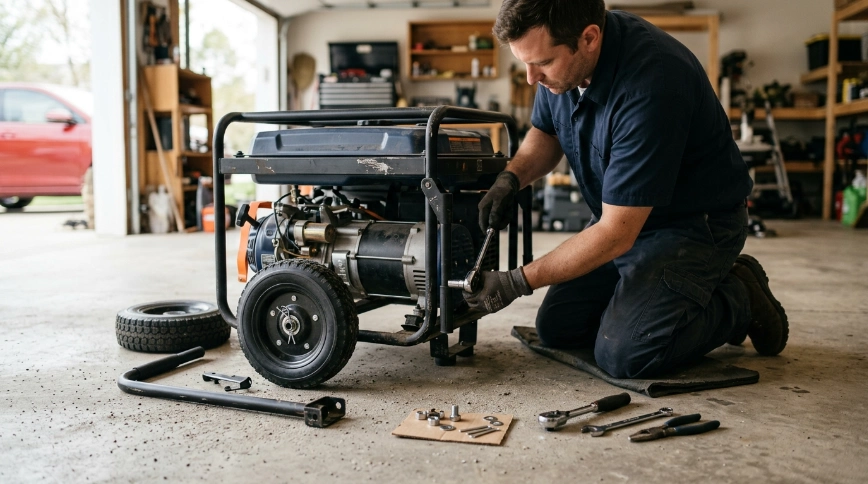
Most bolt-on wheel kits install with basic hand tools, but the exact procedure depends on the generator. Follow the instructions supplied with your model rather than improvising mounting points.
For an existing generator, let the engine cool fully before beginning. Work on a level surface with the generator switched off.
- Read the kit instructions. Identify the wheel side, support side, handle position, and supplied fasteners.
- Prepare the generator. Disconnect loads and the spark-plug lead if the manufacturer instructs you to do so. Close the fuel valve before moving or tilting the machine.
- Position the frame safely. Use a second person when necessary. Do not balance a heavy generator on a loose block.
- Install the axle or axle pins. Use the manufacturer’s existing frame mounting points.
- Fit the wheels. Install the washers, pins, clips, or fasteners in the specified order.
- Attach the support leg and handle. Tighten hardware securely without crushing thin brackets or frame tubing.
- Test the setup. Lower the generator onto all supports, check for wobble, then roll it slowly before returning it to service.
Some manufacturer procedures require a generator to be tipped during assembly. If yours does, follow its manual closely because oil or fuel can move into places where you do not want it.
I also recheck the mounting bolts after the first few moves. Fresh hardware can settle slightly once the machine’s weight starts loading the brackets.
Can You Put Bigger Wheels on a Portable Generator?
You can only safely use larger wheels when the kit and frame support them. Installing oversized wheels just because the axle diameter matches can create new problems.
The generator needs to sit level and remain stable when the handle is released.
- Larger wheels may raise one end of the frame.
- The support foot may no longer sit flat.
- A different tire width may rub against the frame.
- Axle loads may change.
- The handle angle may become uncomfortable.
- The generator may become easier to tip on a slope.
If you regularly cross gravel or rough yards, look for a manufacturer-approved kit with larger pneumatic or terrain-oriented wheels instead of modifying a smaller kit.
How Should You Move a Generator After Installing Wheels?
Move the generator only when the engine is off and the machine is stable enough to control. Wheels are for transport, not for relocating a running generator.
Keep both hands available when moving a large unit and avoid steep slopes whenever possible.
- Turn the generator off before moving it.
- Allow hot exhaust components to cool.
- Keep the fuel cap securely closed.
- Pull or push slowly over uneven surfaces.
- Never tow a generator behind a vehicle unless it was specifically designed for that purpose.
- Secure the generator properly when transporting it in a truck or trailer.
Once you reach the operating area, the wheel kit does not change generator safety rules. My guide on where to place a portable generator covers the setup in detail.
The CDC advises operating portable generators outside, more than 20 feet from windows, doors, and vents. Exhaust should face away from the building.
The U.S. Consumer Product Safety Commission also warns against using portable generators inside homes, garages, basements, sheds, or other enclosed spaces.
For more detail, read my portable generator carbon monoxide safety guide before your next outage.
What Problems Can a Generator Wheel Kit Cause?
A properly matched kit should feel solid, roll straight, and leave the generator stable when parked. Wobbling or dragging usually means something needs attention.
- Wheel wobble: Check axle pins, washers, clips, and loose mounting hardware.
- Generator leans: Confirm the support leg is installed in the correct position.
- Wheel rub: Stop using the kit until you verify wheel spacing and bracket orientation.
- Loose handle: Inspect the pivot hardware and locking mechanism.
- Pneumatic tire goes soft: Check pressure and inspect the tire for leaks.
- Frame flexes: Stop moving the generator and confirm the kit is intended for that frame.
I would not solve a fit problem by drilling random holes into the generator cradle. The frame protects and supports the engine, alternator, fuel tank, and control components.
Portable Generator Wheel Kits I Would Consider
If you’re ready to pick one, I would start with a manufacturer-specific kit rather than a generic set whose fit is uncertain.
🏆 Best Overall for Compatible Champion Models
Champion Power Equipment 40065 Wheel Kit
★★★★★ 4.8/5 editorial fit rating
It uses 8-inch never-flat wheels, a folding handle, and a support leg with vibration mounts. I like it because Champion clearly defines compatibility instead of forcing you to guess whether the frame will fit.
🔧 Best for Compatible FIRMAN Generators
FIRMAN 1003 8-Inch Wheel Kit and Handle
★★★★★ 4.7/5 editorial fit rating
The kit uses two 8-inch wheels, axle pins, a folding high-leverage handle, and vibration-reducing support mounts. I would choose it for a compatible FIRMAN unit that needs simple driveway and yard mobility.
🧰 Best for WGen3600 Series
Westinghouse WGen3600 Series Wheel and Handle Kit
★★★★☆ 4.6/5 editorial fit rating
It includes two 8-inch never-flat wheels, a foam-grip folding handle, support brackets, and hardware. The narrow model compatibility limits its audience, but that specific fit is exactly what I want from a generator accessory.
Frequently Asked Questions
Can I add wheels to a generator that did not come with them?
Yes, if the generator manufacturer offers a compatible wheel kit or confirms that your frame supports one. Check the model number and mounting points before buying. Avoid drilling or welding the frame unless the manufacturer specifically approves that modification.
Are never-flat generator wheels better than pneumatic tires?
Never-flat wheels are better when you want low maintenance and predictable performance on pavement, concrete, and normal yards. Pneumatic tires can absorb bumps better on rough ground, but they require air pressure checks and can develop punctures or leaks.
What size wheels are best for a portable generator?
There is no single best diameter. Many manufacturer kits use 8-inch wheels, while some larger units use 10-inch or 11-inch wheels. Use the size designed for your frame so the generator remains level, stable, and properly supported.
Can I move my portable generator while it is running?
I would not move a running portable generator. Shut it down first, disconnect electrical loads, and move it carefully once conditions are safe. Hot exhaust components, fuel movement, cords, and uneven terrain create unnecessary hazards during relocation.
Can I use a universal wheel kit on any generator?
No. A universal-style kit may fit some tubular frames, but mounting dimensions and load requirements vary. Manufacturer-specific compatibility is the safer choice because the axle, brackets, support leg, and handle are designed around a known generator frame.
Final Takeaway
A good portable generator wheel kit turns an awkward machine into equipment you can move with much less effort. The key is buying for the generator you own rather than choosing wheels by appearance or wattage alone.
Check the exact model, use approved mounting points, install every support component, and test stability before relying on the setup. Once the generator reaches its operating position, follow the same outdoor placement and carbon monoxide rules you would without wheels.
If I had to reduce the whole decision to one rule, it would be simple: fit first, wheel size second. A properly matched 8-inch kit is far better than an oversized wheel setup that makes the generator unstable.
Hi, I’m Michael Turner. I own a generator workshop in the United States and founded HomeGeneratorBlog to share practical, hands-on guidance about generator installation, maintenance, troubleshooting, safety, and backup power solutions. My goal is to help homeowners make smarter, more confident decisions through clear and reliable information