
Portable Generator Alternator: How It Works & Fixes
The first time I had a generator run perfectly, sound perfectly normal, and still refuse to put a single volt into my extension cord, I assumed the worst — a fried alternator, a few hundred dollars gone. Turned out the thing just needed to be “woken up.” That’s the part nobody explains well, so let’s start there.
What a Portable Generator Alternator Actually Does
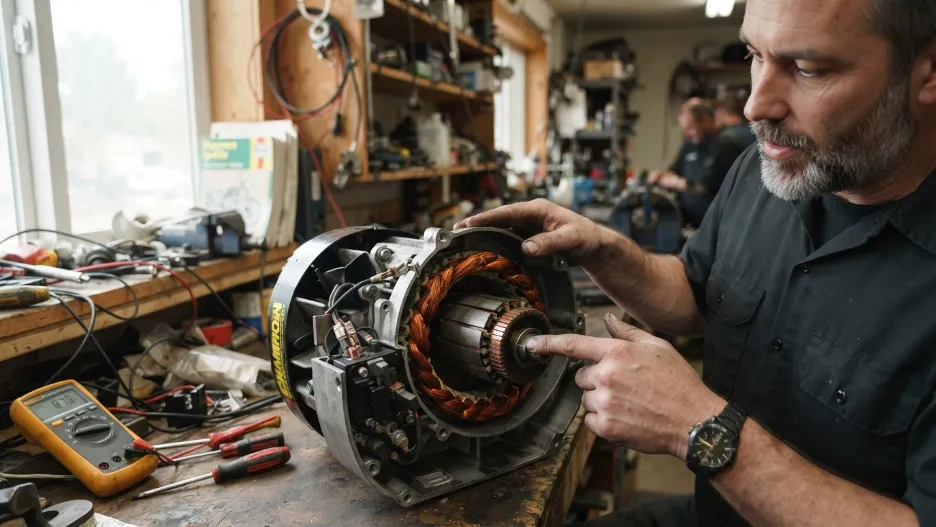
The alternator is the part of your generator that makes the electricity — the engine just supplies the muscle. Inside a metal housing bolted to the front of the engine, a rotor spins inside a set of stationary copper windings called the stator. That spinning motion induces an electrical current in the windings, which is what shows up at your outlets.
Most portable generators use one of two alternator designs, and knowing which one you have changes how you troubleshoot it:
- Brush-type (conventional) alternators use small carbon brushes to carry current to the rotor. They’re simpler and cheaper to repair, but the brushes wear out over years of use.
- Brushless alternators use a capacitor and a rotating diode assembly instead of brushes. There’s less to physically wear out, but when something fails, it’s usually the capacitor or the automatic voltage regulator (AVR) rather than a worn part you can see.
Both types depend on something called residual magnetism — a small, leftover magnetic charge in the rotor from the last time it ran. That tiny charge is what lets the alternator “self-excite” and start building voltage the instant the engine reaches running speed. Lose that residual charge, and the engine will run fine while the outlets stay completely dead.
Generator Running But No Power? Diagnose It Fast
Before pulling the alternator cover, walk through this table in order. Most no-power complaints are solved in the first three rows — the alternator windings themselves are the least common cause.
| Symptom | Likely Cause | Fix |
|---|---|---|
| Engine runs fine, 0–5V at outlets | Lost residual magnetism | Field-flash the alternator (see below) |
| Voltage present but unstable or low (50–90V) | Failed or misadjusted AVR | Test and replace the AVR |
| Some outlets dead, others work | Tripped breaker, blown fuse, or bad outlet | Reset breaker, test outlet with a multimeter |
| Power cuts in and out under load | Worn brushes (brush-type units only) | Inspect and replace brushes |
| Burning smell, visible scorch marks | Burnt stator windings | Alternator rebuild or full replacement |
| Intermittent power, worse when the unit vibrates | Loose or corroded wiring connection | Tighten terminals, clean corrosion |
Cause 1: Lost Residual Magnetism (the Most Common Fix)
If your generator has sat in the garage over winter, or you ran it dry with a load still plugged in, the rotor’s residual charge fades. No charge, no self-excitation, no power — even though the engine sounds perfectly healthy.
This is usually fixable in under five minutes on a conventional brush-type unit. It’s called field flashing, and it means briefly feeding a small DC charge into the field winding to “wake up” the magnetism.
How to Field Flash a Portable Generator
- Shut the generator off and unplug everything from it.
- Locate the field winding leads inside the alternator housing (consult your model’s wiring diagram — colors vary by brand).
- Disconnect those leads from the AVR. Skipping this step can fry the regulator.
- Using a fully charged 12V battery, briefly touch the leads to the correct battery terminals for 2–3 seconds — matching polarity matters.
- Reconnect the leads to the AVR exactly as they were.
- Start the generator and check outlet voltage with a multimeter.
If that sounds like more electrical work than you’re comfortable with, it’s a completely reasonable call to have a small-engine shop do it — a bad connection during flashing can take out the AVR, turning a free fix into a $100+ repair.
Cause 2: A Failing Automatic Voltage Regulator (AVR)
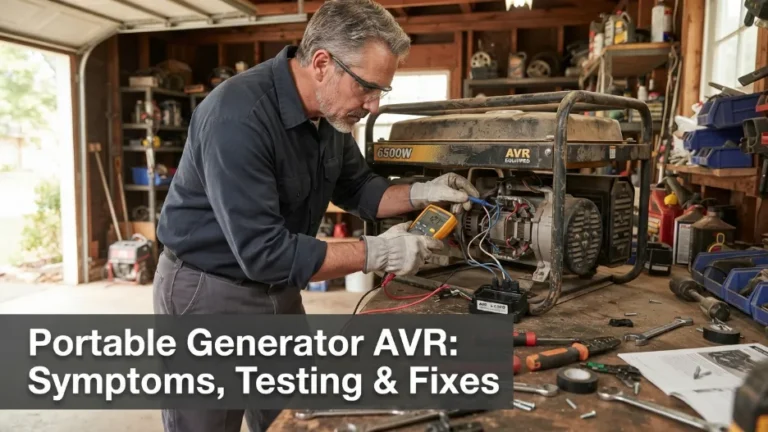
The AVR is the alternator’s traffic cop — it constantly fine-tunes how much current reaches the rotor to keep output steady. When it fails, you’ll usually see voltage that’s present but wrong: readings in the 50–90V range instead of a clean 120V, or output that drifts as the engine load changes.
AVRs don’t get “repaired” in any practical sense — they’re a sealed circuit board. If yours tests bad after you’ve ruled out the breaker and residual magnetism, budget $30–80 for a replacement board matched to your generator’s model.
Cause 3: Worn Brushes or a Bad Capacitor
On brush-type alternators, the carbon brushes that transfer current to the rotor wear down like the brushes in a cordless drill. Pull the alternator cover and look for brushes that are visibly short, chipped, or not springing back out when pressed.
On brushless models, check the capacitor instead. A weak capacitor still lets the engine run normally but starves the alternator of the current it needs to regulate voltage — the telltale sign is power that’s present but noticeably low across every outlet, not just one.
How to Test a Generator Alternator With a Multimeter
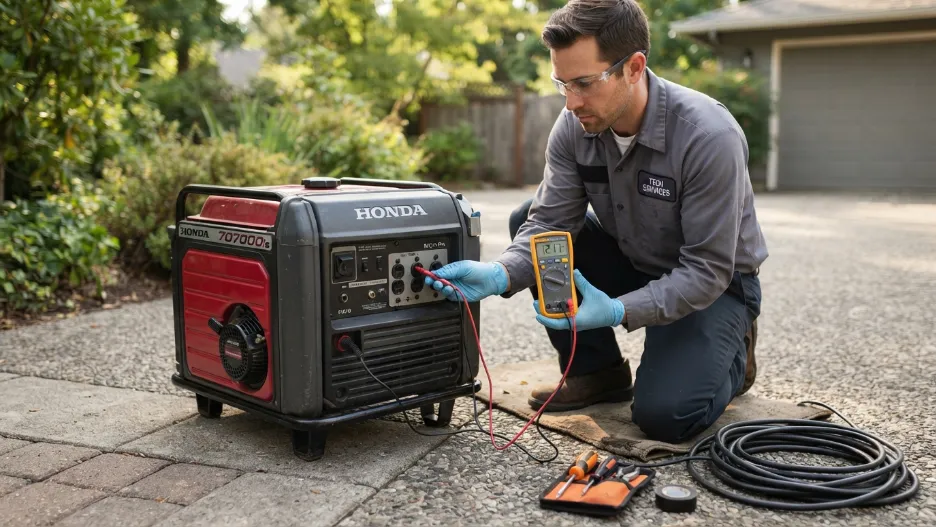
You don’t need an electrician’s toolbox for this — a basic multimeter and 15 minutes will usually tell you exactly which of the causes above you’re dealing with.
- Set the multimeter to AC voltage, 200V+ range.
- Start the generator and let it reach full running speed.
- Insert the probes into a 120V outlet. A healthy reading is 115–125V.
- 0–5V points to lost residual magnetism. 50–90V points to a failing AVR. A clean 120V with no power reaching your device points to the outlet, cord, or breaker instead of the alternator.
- If you suspect the stator windings specifically, switch the meter to resistance (ohms) with the generator off and check continuity across the winding leads per your service manual — an open or infinite reading means a broken winding.
When to Stop DIY and Call a Pro
Field flashing and swapping an AVR are within reach for most patient homeowners. Stop and call a small-engine or generator repair shop if you see scorch marks or a burning smell, if you’re not confident identifying the correct field leads on your specific model, or if the alternator has been submerged or run through standing water. Those situations carry real shock and fire risk, and a $75 shop diagnostic is cheaper than replacing a whole unit you damaged mid-repair.
Whenever you’re working near a running generator, keep the carbon monoxide risks in mind — never troubleshoot or run a portable unit indoors, in a garage, or near open windows, even briefly.
Repair vs. Replace: What a New Alternator Actually Costs
A full replacement alternator (or “generator head”) for a common 5,000–8,500 watt portable unit typically runs $150–350 for the part alone, plus labor if you’re not installing it yourself. Compare that against the cost of the individual pieces:
- AVR replacement: $30–80
- Brush set: $10–25
- Capacitor: $15–40
- Full alternator rebuild or swap: $150–350+
If your generator is under 10 years old and otherwise running well, replacing just the failed component almost always beats buying a whole new alternator. If the windings themselves are burnt, or the unit is older than the alternator’s typical 10–15 year service life, a full replacement — or a new generator entirely — usually makes more financial sense than chasing a rebuild.
Keeping Your Alternator From Failing Again
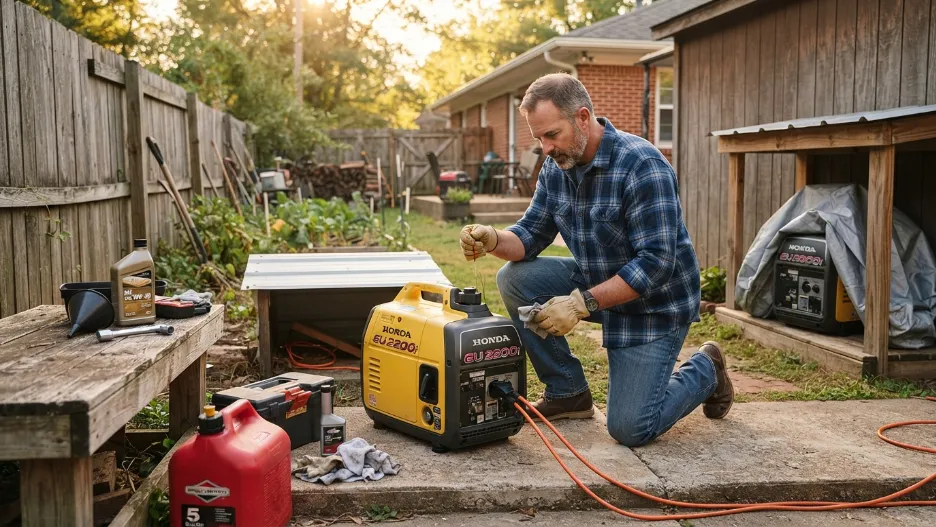
A little routine care prevents most of the failures in the diagnostic table above:
- Run the generator under load for 20–30 minutes every 1–2 months, even when there’s no outage, to keep residual magnetism from fading.
- Never store it with anything still plugged into the outlets — a connected load drains residual charge faster than sitting idle.
- Keep it dry. Moisture is the single fastest way to corrode alternator windings and connections.
- Avoid running it flat out of fuel under a heavy load — that combination is a common trigger for lost magnetism.
Conclusion
Most “dead alternator” scares turn out to be a five-minute fix, not a replacement job. Work through the breaker, residual magnetism, and AVR in that order before you assume the worst. If you take one thing from this guide, let it be that a multimeter reading tells you exactly where to look — no guessing required. As Michael Turner, I’ve chased this exact problem more times than I can count, and it’s almost never the part you’d expect.
A basic clamp-style digital multimeter makes every step in this guide faster and safer — checking outlet voltage, testing continuity on a suspect winding, or confirming an AVR is dead before you buy a replacement.
Frequently Asked Questions
How do I know if my generator’s alternator is bad?
Check outlet voltage with a multimeter while the engine runs at full speed. A reading under 5V usually means lost residual magnetism, not a dead alternator. If you still get 0V after field flashing, or the windings show visible burn damage, the alternator itself has likely failed.
Can I fix a generator alternator myself?
Field flashing, replacing brushes, and swapping an AVR are all doable with basic tools and a multimeter. Rewinding a stator or replacing rotating diode assemblies is more specialized work best left to a small-engine repair shop.
How much does it cost to replace a generator alternator?
A full replacement alternator for a typical portable generator runs roughly $150–350 for the part, plus labor if a shop installs it. Individual components like an AVR or brush set are far cheaper, usually $10–80.
Why does my generator run but not produce power?
The engine and the alternator are separate systems — the engine can run perfectly while the alternator fails to generate voltage. The most common causes are lost residual magnetism, a tripped breaker, or a failing AVR, roughly in that order of likelihood.
How do I test a generator alternator with a multimeter?
Set the meter to AC voltage, start the generator, and probe a 120V outlet while the engine is at full running speed. Compare the reading against the diagnostic table above to identify whether the issue is residual magnetism, the AVR, or the windings themselves.

Hi, I’m Michael Turner. I own a generator workshop in the United States and founded HomeGeneratorBlog to share practical, hands-on guidance about generator installation, maintenance, troubleshooting, safety, and backup power solutions. My goal is to help homeowners make smarter, more confident decisions through clear and reliable information
One Comment