What Size Generator Should I Get to Run a House?
Quick Answer
Most homes need about 5,000 to 8,500 running watts to keep essential appliances working during an outage. If you want central air, electric water heating, and most household circuits available, you may need 12,000 to 20,000+ watts; use this generator power capacity guide to calculate your actual load instead of choosing by house size alone.
Typical generator sizes for a house
- 3,000–5,000 watts: Refrigerator, lights, internet equipment, chargers, and a few small appliances.
- 5,000–7,500 watts: Adds a furnace blower, sump pump, well pump, or selected larger loads.
- 7,500–10,000 watts: A practical range for homeowners who want several essential circuits operating together.
- 10,000–14,000 watts: Can support heavier household loads and some air-conditioning systems when sized carefully.
- 14,000–20,000+ watts: Common territory for broad whole-house backup with central air and major electric appliances.
Before you choose
- Add the running watts of everything you want on together, then account for the largest motor starting surge.
I’ve seen homeowners make generator sizing harder than it needs to be. The mistake is usually starting with square footage instead of asking which appliances must stay powered.
A 2,500-square-foot house with gas heat may need less generator power than a 1,600-square-foot all-electric home. Let’s work from the electrical load instead.
How Do I Calculate What Size Generator My House Needs?
Your generator should cover the combined running load plus enough capacity for the largest starting surge. Starting watts matter because refrigerators, pumps, furnaces, and air conditioners briefly draw extra power when their motors start.
I use a simple process when estimating a homeowner’s backup requirement.
- List every appliance you want during an outage.
- Write down each appliance’s running watts.
- Add those running watts together.
- Identify the largest motor starting requirement.
- Add reasonable capacity headroom instead of operating at the generator’s limit.
Don’t automatically add every appliance’s maximum starting wattage together. In a planned backup setup, large loads can be started one at a time.
If the distinction is confusing, my guide to portable generator watts explains running and surge capacity in more detail.
What are running watts and starting watts?
Running watts are the continuous electricity an appliance needs after it starts. Starting watts are the short burst some motors need when compressors, pumps, or fans first switch on.
That difference explains why a generator can seem powerful enough on paper but still trip when an air conditioner starts.
- Resistive loads: Lights and many simple heating devices usually have little additional startup demand.
- Motor loads: Refrigerators, pumps, furnace blowers, and compressors can require substantially more power at startup.
- Electronic loads: Routers, televisions, computers, and chargers usually draw modest power but still count toward the continuous total.
What Generator Size Is Enough for Common Household Appliances?
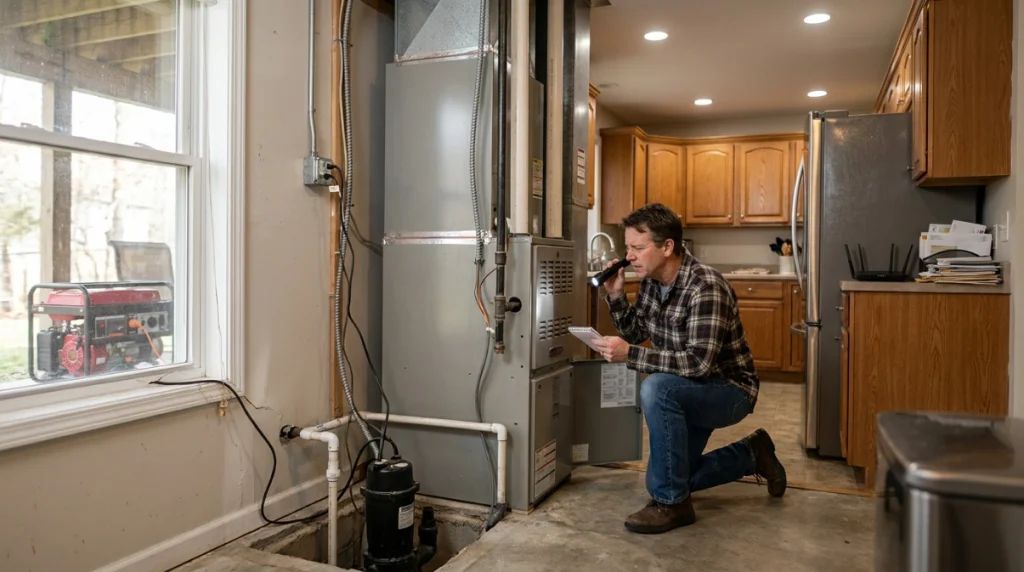
A generator around 5,000–7,500 watts is often enough for an essentials-only outage setup. Moving toward air conditioning, electric water heating, and multiple major appliances increases the requirement quickly.
The values below are planning examples rather than substitutes for your appliance labels. Always check the nameplate or owner’s manual before buying.
| Household Load | Typical Planning Load | Generator Range to Consider |
|---|---|---|
| Fridge, lights, router, chargers | Light emergency load | 3,000–5,000 W |
| Above + sump pump or furnace blower | Standard essentials | 5,000–7,500 W |
| Essentials + well pump + window AC | Heavier emergency load | 7,500–10,000 W |
| Essentials + central AC | Large residential load | 10,000–14,000+ W |
| Most circuits + HVAC + major electric appliances | Whole-house load | 14,000–20,000+ W |
Those ranges show why the phrase “run a house” can be misleading. Running six essential circuits is a completely different job from powering every breaker in the panel.
Can a 5,000-Watt Generator Run a House?
Yes, a 5,000-watt generator can run essential loads in many homes, but it usually cannot operate the entire house normally. Think refrigerator, furnace blower, lights, electronics, and perhaps one pump instead of central air, an electric range, and a clothes dryer together.
I consider this size a practical emergency generator when the homeowner is comfortable managing loads.
- Refrigerator or freezer
- Several LED lights
- Wi-Fi router and phone charging
- Gas-furnace blower
- Selected sump or well pump, if startup requirements fit
- Television or small electronics
The trouble starts when several motor-driven appliances cycle at the same time. That’s why I prefer some reserve capacity over buying a generator that barely matches the calculated minimum.
Will a 7,500-Watt Generator Run My House?
A 7,500-watt generator is one of the more useful sizes for residential emergency backup. It can often support the refrigerator, furnace blower, pumps, lights, electronics, and another moderate load when circuits are managed carefully.
For many homes, this is where a portable generator begins to feel comfortable instead of constantly overloaded.
- Good fit: Essential-circuit backup during storms and short outages.
- Possible: Window air conditioner or another substantial appliance with proper load management.
- Less suitable: Central AC plus several large electric appliances simultaneously.
- Important: Check output on the fuel you actually plan to use.
A multi-fuel generator may produce different running wattage on gasoline, propane, and natural gas. Size from the lowest-output fuel mode you expect to depend on.
What Size Generator Do I Need to Run Central Air?
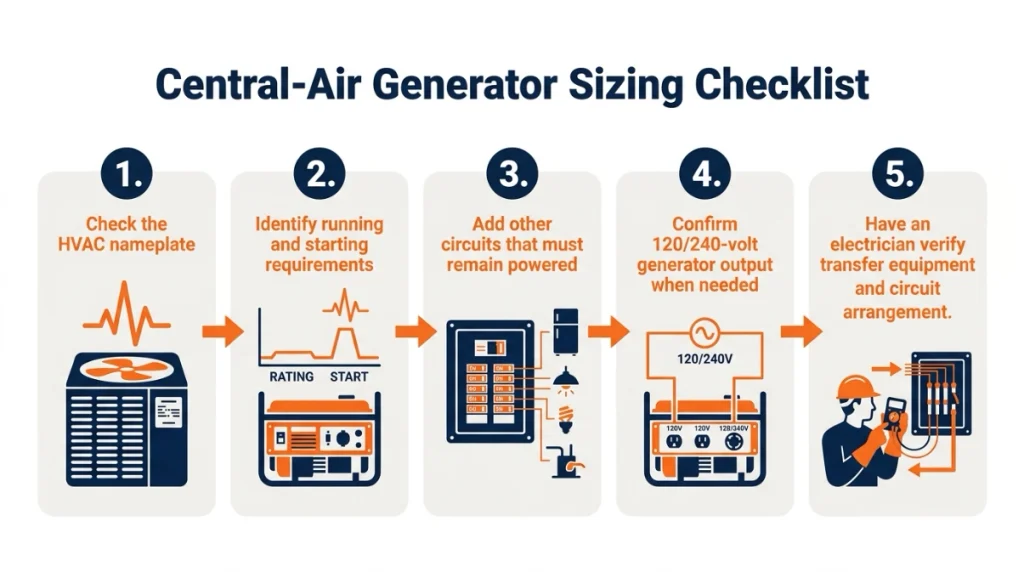
Central air conditioning often pushes residential generator sizing into the 10,000-watt-and-up range. The exact requirement depends on compressor size, startup current, efficiency, other loads, and whether the HVAC system uses a compatible soft-start device.
Don’t size central AC from tonnage alone. Check the condenser data plate and electrical specifications first.
I cover those calculations separately in my generator sizing guide for air conditioners.
Why does central AC change the calculation so much?
The compressor creates a large momentary electrical demand when it starts. Your generator must survive that event while still supplying whatever other appliances are already running.
This is also where professional load calculations become worthwhile.
- Check the HVAC nameplate.
- Identify running and starting requirements.
- Add other circuits that must remain powered.
- Confirm the generator provides 120/240-volt output when needed.
- Have an electrician verify the transfer equipment and circuit arrangement.
Do I Need a 20,000-Watt Generator to Run a Whole House?
You may need roughly 14,000–20,000 watts or more if “whole house” means operating central HVAC and major electric appliances with minimal load management. Homes with gas heating, gas water heating, and gas cooking can often get by with much less electrical capacity.
An all-electric home changes the picture dramatically.
| Backup Goal | Portable Generator | Standby Generator |
|---|---|---|
| Essential appliances | Excellent fit | More capability than necessary for some homes |
| Several large circuits | Possible with careful sizing | Good fit |
| Automatic whole-house backup | Not the ideal tool | Best fit |
| Automatic startup | Usually no | Yes |
Once homeowners tell me they want the house to behave almost normally during an outage, I stop thinking in terms of extension cords. That becomes a permanently installed standby-system conversation.
Does House Square Footage Determine Generator Size?
No, generator size should not be selected from square footage alone. Your electrical appliances and their simultaneous demand determine how much power you need.
Two houses with identical floor plans can require completely different generator capacities.
- Gas-equipped home: Gas furnace, water heater, and range reduce generator demand.
- All-electric home: Electric heating, water heating, cooking, and HVAC can create a much larger load.
- Well-water home: A well pump adds another significant motor load.
- Basement home: A sump pump may be one of the most important circuits during a storm.
- Medical needs: Essential medical devices should be planned separately and conservatively.
I’d rather know your appliance list than your square footage. That tells me far more about the generator you need.
Should I Buy a Portable or Standby Generator?
Choose a portable generator when you want affordable emergency power for selected appliances and don’t mind manual setup. Choose standby when you want automatic operation, permanent connection, and broader whole-house coverage.
There isn’t one right answer for everyone.
A portable generator makes sense when:
- Outages are occasional.
- You mainly want refrigerator, heat, pumps, lights, and communications.
- You can safely move, start, fuel, and monitor the generator.
- You are comfortable managing which circuits run together.
A standby generator makes sense when:
- You experience frequent or long outages.
- You want automatic startup.
- Central air conditioning is a priority.
- You want most of the electrical panel available.
- Manual fueling or generator setup would be difficult.
How Do I Connect a Generator to My House Safely?
Use a properly installed transfer switch or other code-compliant transfer equipment when connecting a portable generator to household wiring. Never connect a generator to the house by plugging it into an ordinary wall receptacle.
That unsafe practice is called backfeeding. It can energize utility wiring and put lineworkers and other people at risk.
If you’re planning a panel connection, read my portable generator transfer switch guide before choosing hardware.
- Use a qualified electrician: Household generator connections involve service equipment, grounding, bonding, and circuit protection.
- Match the inlet and switch: The connection equipment must suit the generator’s voltage and amperage.
- Choose backup circuits: Decide which loads matter before the outage.
- Follow the generator manual: Grounding and neutral configurations vary between models and installations.
OSHA states that a portable generator should not be attached directly to a structure’s electrical system unless an appropriate transfer switch has been installed. See the OSHA portable generator grounding guidance for additional safety information.
Where Should a Portable Generator Be Placed?
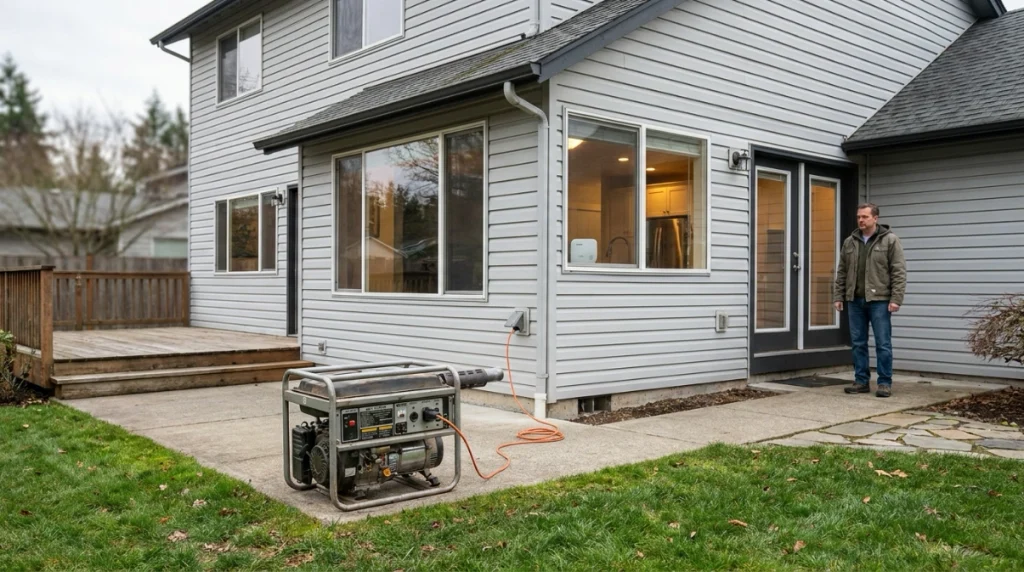
A portable generator should operate outdoors, at least 20 feet away from the home, with exhaust directed away from doors, windows, and vents. Never run one inside a house, garage, basement, crawlspace, shed, porch enclosure, or carport.
Carbon monoxide has no color or smell, so you cannot rely on your senses to know when dangerous exhaust is entering the home.
- Keep the generator outdoors.
- Maintain at least 20 feet of separation from the home.
- Point exhaust away from buildings and openings.
- Use working carbon-monoxide alarms inside the house.
- Follow the manufacturer’s wet-weather instructions.
- Never refuel a hot or running generator.
The CDC’s carbon monoxide guidance recommends using generators outdoors more than 20 feet from windows, doors, and vents. The Consumer Product Safety Commission gives similar generator safety advice.
FEMA also recommends planning which appliances you will prioritize because you may not be able to power everything simultaneously. See Ready.gov power-outage guidance before storm season.
My Practical Generator Size Recommendations
For most homeowners asking what size generator they should get to run a house, these are the ranges I would start investigating. Your appliance data still has the final say.
- 3,500–5,000 watts: Basic emergency electricity.
- 5,000–7,500 watts: Strong essentials-only setup.
- 7,500–10,000 watts: My practical portable-generator range for heavier residential backup.
- 10,000–14,000 watts: Large portable or partial whole-home territory.
- 14,000–20,000+ watts: Consider a professionally sized standby generator.
If you’re ready to pick one, here are three models I would put on the comparison list rather than choosing a generator by wattage alone.
🏆 BEST FOR HIGH-CAPACITY PORTABLE BACKUP
Westinghouse WGen9500DFc
★★★★☆ 4.7/5
Rated for 9,500 running watts and 12,500 peak watts on gasoline, with dual-fuel capability and a carbon-monoxide sensor. I like this size when a homeowner wants more breathing room than a typical 7,500-watt unit without moving straight to a permanent standby system.
⛽ BEST FUEL FLEXIBILITY
Champion 201176 Tri-Fuel Inverter
★★★★☆ 4.6/5
This model provides 7,250 running watts on gasoline, 6,525 on propane, and 5,875 on natural gas, with 9,000 starting watts. I like the tri-fuel design because it gives homeowners more options when gasoline availability becomes unpredictable during a long outage.
🏠 BEST TRI-FUEL HEAVY-DUTY OPTION
Generac GP9500E Tri Fuel
★★★★☆ 4.8/5
The GP9500E produces 9,500 running watts and 12,500 starting watts on gasoline and can operate on gasoline, propane, or natural gas. Its COsense system and high output make it a strong candidate when I want both fuel flexibility and substantial portable home-backup capacity.
Frequently Asked Questions
What size generator do I need for a 2,000-square-foot house?
A 2,000-square-foot house often needs roughly 5,000–8,500 watts for essential backup, but square footage doesn’t determine the final size. Add your required appliances’ running loads and account for the largest starting surge before selecting a generator.
Can a 10,000-watt generator run a whole house?
A 10,000-watt generator can power a substantial portion of many homes, including several major appliances. It may still be too small for central air, electric water heating, cooking, and other large loads operating together, especially in an all-electric home.
Is a 12,000-watt generator enough for a house?
A 12,000-watt generator can provide strong residential backup and may handle air conditioning plus essential circuits when the load is managed. True whole-house operation depends on HVAC startup demand, electric heating, water heating, cooking appliances, pumps, and other simultaneous loads.
Should I oversize my generator?
Some extra capacity is useful because it provides room for startup surges and avoids operating continuously at maximum load. However, buying far more capacity than you need increases purchase cost, fuel consumption, size, and weight without necessarily improving your backup experience.
What is the best generator size for most homes?
For essential portable backup, I usually start around the 5,000–8,500-running-watt range. Homeowners wanting central air or near-normal whole-house operation should calculate their loads carefully and may be better served by a larger professionally installed standby generator.
Final Takeaway
If you’re asking, “What size generator should I get to run a house?” start with your appliances, not the size of your house. For many homeowners, 5,000–8,500 running watts covers emergency essentials, while central air and broad whole-house coverage can push the requirement into the 12,000–20,000+ watt range.
Write down what you absolutely need during an outage, check each appliance’s electrical data, and size around that list. A few minutes of load planning now can save you from an overloaded generator when the power actually goes out.

Hi, I’m Michael Turner. I own a generator workshop in the United States and founded HomeGeneratorBlog to share practical, hands-on guidance about generator installation, maintenance, troubleshooting, safety, and backup power solutions. My goal is to help homeowners make smarter, more confident decisions through clear and reliable information