How Big of a House Will a 12,000 Watt Generator Run?
Quick Answer
A 12,000-watt generator can usually provide strong managed backup for a roughly 1,500- to 3,000-square-foot house, especially when heating, water heating, and cooking use gas. However, square footage doesn’t determine generator size by itself, so use this home generator sizing guide to compare your actual appliance loads.
What a 12,000-watt generator can typically handle
- Essential circuits: Refrigerators, freezers, lights, internet equipment, chargers, and ordinary outlets are usually easy loads.
- Heating equipment: A gas furnace blower can usually operate alongside normal household essentials.
- Pumps: Many sump and well pumps are practical if their motor-starting surge fits the generator’s peak rating.
- Air conditioning: Some central AC systems can run, but compressor startup demand must be checked carefully.
- Large homes: Houses above 3,000 square feet may still use a 12,000-watt generator successfully by prioritizing essential circuits.
- All-electric homes: Electric heat, water heaters, ranges, and dryers can quickly push demand beyond 12,000 watts.
Check this before buying
- Confirm whether the advertised 12,000 watts means continuous running watts or only temporary starting watts.
I don’t size generators from the home’s real-estate listing. I start with the circuits and appliances that need power when the utility goes down.
That’s especially important with a 12,000-watt generator. Depending on its true running rating and your home’s fuel setup, it can feel like near-whole-house backup or become overloaded surprisingly fast.
How Big of a House Can a 12,000 Watt Generator Actually Run?
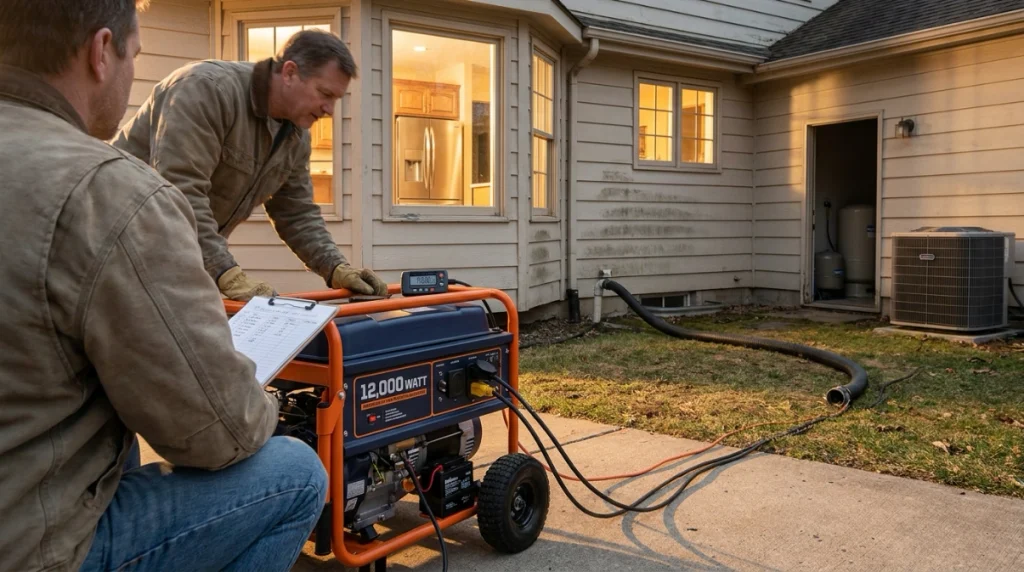
For many homes, a 12,000-running-watt generator is a practical match for about 1,500 to 3,000 square feet of managed backup. A larger home can also use one if heavy electrical loads aren’t operated together.
The important phrase is managed backup. You’re choosing which loads operate rather than expecting every breaker in the panel to behave exactly as it does on utility power.
Definition: A 12,000-watt generator is a generator capable of producing either 12,000 running watts or 12,000 peak watts, depending on how the manufacturer labels the model.
- Running watts are the continuous watts the generator can supply.
- Starting watts are temporary extra watts available when motors and compressors start.
- Peak watts usually mean the same thing as starting or surge watts.
This distinction changes the answer considerably. A generator advertised as “12,000 watts” might provide only 9,000 continuous watts, while another model may genuinely provide 12,000 running watts.
For a deeper explanation, see my guide to running watts versus starting watts.
Does House Square Footage Determine Generator Size?
No. Electrical demand matters much more than square footage. Two houses of identical size can require completely different generator capacities.
A 2,500-square-foot home with natural-gas heat, a gas water heater, and a gas range may have relatively modest electrical demand. A 1,500-square-foot all-electric home can have several large 240-volt loads.
| House / Setup | How 12,000 Watts Fits | Main Limitation |
|---|---|---|
| 1,000–1,500 sq ft, gas appliances | Strong backup capacity for most essentials and selected larger loads | Central AC starting surge |
| 1,500–2,500 sq ft, mixed fuel | Good managed-home backup | Running several 240V loads together |
| 2,500–3,500 sq ft, gas heat/water | Useful for essentials plus selected high-demand circuits | Load management becomes important |
| 3,500+ sq ft | Can still provide substantial emergency backup | Usually not unrestricted whole-house power |
| All-electric home, any size | May cover essentials with careful scheduling | Electric heat, water heater, dryer, and range |
Think of those square-footage ranges as planning examples, not electrical guarantees. Your appliance nameplates and circuit requirements give you the real answer.
What Appliances Can a 12,000 Watt Generator Run?
A true 12,000-running-watt generator can operate a substantial group of household appliances at once. The challenge usually comes from motor startup surges and high-wattage electric heating equipment.
As a starting worksheet, these are reasonable planning ranges for common outage loads. Always replace them with the specifications from your own equipment before buying a generator.
| Appliance | Approx. Running Watts | Possible Starting Watts |
|---|---|---|
| Refrigerator/freezer | 150–400W | 800–1,200W |
| Gas furnace blower | 300–800W | 1,000–2,350W |
| Sump pump | 800–1,050W | 1,300–2,150W |
| Well pump | 1,000–1,500W | 2,000–3,500W |
| Microwave | 600–1,500W | Little additional surge |
| Central AC, roughly 2-ton class | 3,500–5,000W | 7,000–10,000W |
| Electric water heater | Around 4,000W+ | Usually little motor surge |
The numbers explain why a refrigerator, lights, furnace blower, sump pump, and internet equipment are usually manageable. Turning on an electric water heater, clothes dryer, range, and central AC together is a different story.
Can a 12,000 Watt Generator Run Central Air?
It can run some central air conditioners, but the compressor’s startup requirement is the deciding factor. A generator can have enough running capacity yet fail when the compressor tries to start.
This is why I check the AC nameplate before promising anything based on tonnage alone. You can also review my detailed guide to choosing a generator for an air conditioner.
- Window AC: Usually much easier for a 12,000-watt generator to support.
- Mini-split: Often easier to start than a conventional central system, depending on inverter design.
- Central AC: Compressor startup can consume much of the generator’s temporary surge capacity.
- Soft-start equipment: A properly selected device may reduce compressor startup demand, but compatibility should be confirmed for the specific HVAC system.
A practical strategy is to avoid starting another large motor while the central AC compressor starts. Load sequencing can make a borderline setup far more manageable.
How Do You Calculate Whether 12,000 Watts Is Enough?
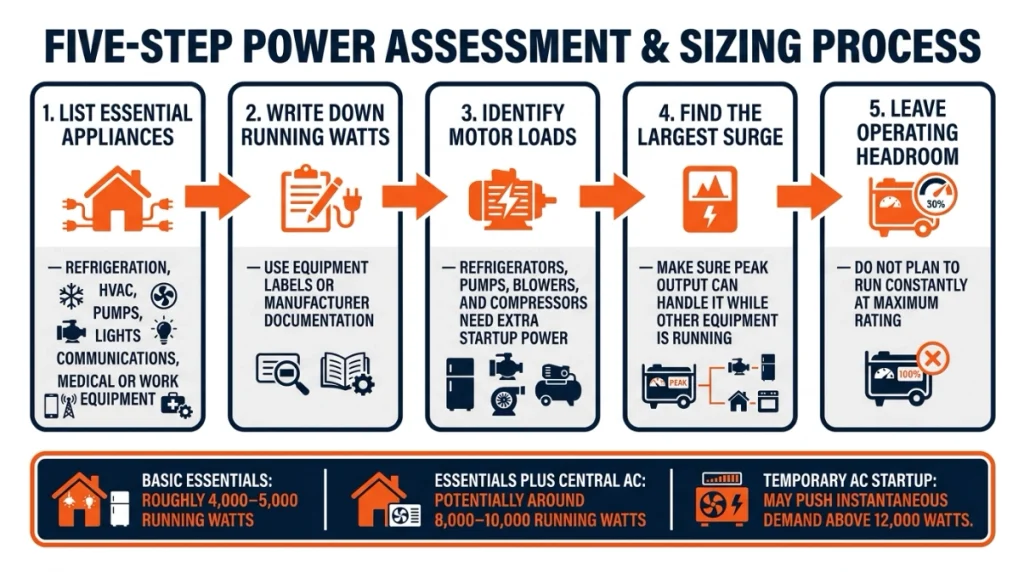
Add the running watts of the equipment you expect to operate together, then account for your largest motor-starting requirement. That’s more useful than guessing from the home’s square footage.
- List essential appliances. Include refrigeration, HVAC, pumps, lights, communications, and medical or work equipment you need.
- Write down running watts. Use equipment labels or manufacturer documentation whenever possible.
- Identify motor loads. Refrigerators, pumps, blowers, and compressors need extra power when starting.
- Find the largest surge. Make sure the generator’s peak output can accommodate it while other equipment is already running.
- Leave operating headroom. Avoid planning a system that depends on the generator sitting at its maximum rating constantly.
For more sizing math, my generator power capacity guide walks through the calculation in detail.
A realistic 12,000-watt example
Suppose an outage load includes a refrigerator, furnace blower, sump pump, well pump, microwave, lighting, internet equipment, and selected outlets. That group may only require several thousand continuous watts under normal operation.
Now add a central air conditioner. Continuous demand can jump by several thousand watts, while its temporary compressor surge may become the single largest load on the system.
- Basic essentials: roughly 4,000–5,000 running watts in a representative setup.
- Essentials plus central AC: potentially around 8,000–10,000 running watts.
- Temporary AC startup: may push instantaneous demand above 12,000 watts.
That’s why two generators carrying the same “12,000 watt” description may perform differently. Check both continuous output and peak output.
Is a 12,000 Watt Generator Enough for Whole-House Backup?
For a home with moderate electrical demand, it can provide something close to whole-house convenience with load management. It isn’t the same as having unlimited utility power.
Homes with several large resistance-heating loads can exceed 12,000 watts quickly. Those loads include electric furnaces, heat strips, water heaters, ranges, clothes dryers, and multiple HVAC systems.
A 12,000-watt generator makes the most sense when:
- The home uses natural gas or propane for major heating loads.
- You want refrigeration, pumps, lights, outlets, and selected HVAC circuits.
- You’re willing to avoid running every large appliance simultaneously.
- The generator has 120/240V output suitable for the circuits you plan to supply.
- The installation uses approved transfer equipment or another properly designed connection method.
You may need more than 12,000 watts when:
- Your home uses electric resistance heating.
- You expect an electric dryer, range, and water heater to operate normally during an outage.
- You have multiple central air-conditioning systems.
- A large well pump or HVAC compressor has a high starting requirement.
- You want unrestricted automatic whole-house operation without manually managing loads.
How Should a 12,000 Watt Generator Be Connected to a House?
If you’re supplying permanent household wiring, use properly installed transfer equipment rather than improvising a connection. My portable generator transfer switch guide explains how these systems isolate generator power from utility power.
The Occupational Safety and Health Administration warns against directly connecting a portable generator to a building’s electrical system unless a qualified electrician has properly installed a transfer switch. Improper connections can create dangerous electrical backfeed.
- Match the generator’s 120/240V output to the intended connection equipment.
- Make sure the inlet, cord, conductors, breaker, and transfer equipment are correctly rated.
- Follow the generator manufacturer’s grounding and neutral instructions.
- Have permanent household connections evaluated by a qualified electrician.
Where Should You Run a Portable 12,000 Watt Generator?
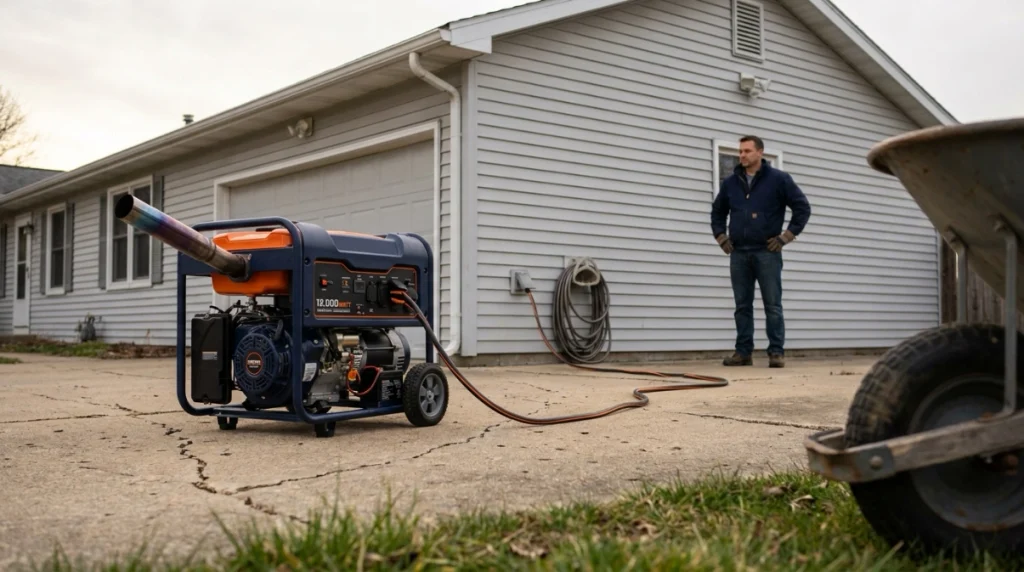
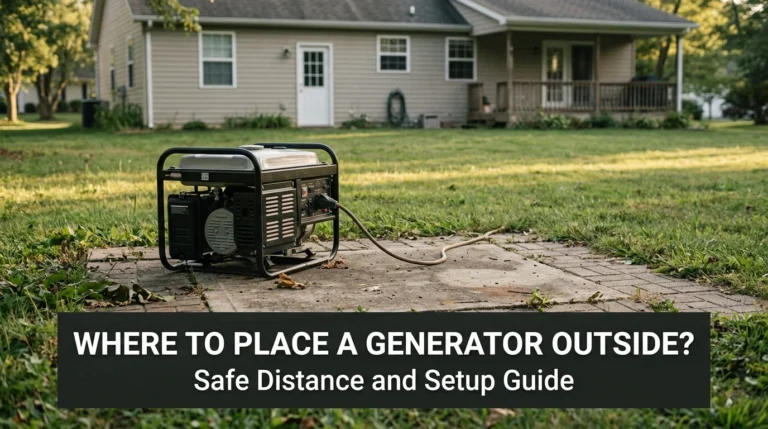
Run portable fuel-burning generators outside. Never operate one in a garage, basement, shed, carport, or other enclosed or partly enclosed area.
The CDC’s carbon monoxide guidance recommends operating a generator outdoors more than 20 feet from windows, doors, and vents. It also recommends using working battery-powered or battery-backup carbon monoxide detectors inside the home.
The U.S. Consumer Product Safety Commission likewise warns that generator exhaust contains deadly carbon monoxide. Exhaust should be directed away from occupied buildings and openings.
- Keep it outside: Never depend on an open garage door for ventilation.
- Control exhaust: Point exhaust away from the house.
- Keep it dry: Follow manufacturer instructions for operating during wet weather.
- Use CO alarms: Check that alarms are working before an outage.
- Refuel safely: Shut the generator down and allow it to cool before adding fuel.
12,000 Watt Generators I’d Consider for Home Backup
If you’re ready to choose a generator in this class, I’d focus on running output, fuel flexibility, 120/240V capability, outlet configuration, and motor-starting headroom rather than the biggest number printed on the box.
🏆 Best for True 12k Running Power
Champion 201160 12,000W Generator
★★★★☆ 4.8/5 editorial
This gasoline model is rated at 12,000 running watts and 15,000 starting watts with 120/240V output. I like this type of specification because the continuous rating is clearly strong enough for serious managed-home backup.
⛽ Best Dual-Fuel Option
Westinghouse WGen12000DFc
★★★★☆ 4.7/5 editorial
It provides 12,000 running and 15,000 peak watts on gasoline, with 10,800 running and 13,500 peak watts on propane. That fuel flexibility is useful when gasoline availability becomes unpredictable during a long outage.
🔌 Best Inverter-Style Choice
Westinghouse iGen12000DFc
★★★★☆ 4.6/5 editorial
This is a useful example of why specifications matter: its gasoline rating is 12,000 peak watts but 9,000 running watts, while propane provides 11,000 peak and 8,100 running watts. Its inverter design and low published harmonic distortion make it interesting when sensitive electronics matter.
Frequently Asked Questions
Will a 12,000 watt generator run a 2,000-square-foot house?
Yes, a 12,000-running-watt generator can often provide substantial backup for a 2,000-square-foot house. Homes with gas heating and fewer large electric appliances are easier to cover, while all-electric homes require more careful load management.
Will a 12,000 watt generator run a 3,000-square-foot house?
It can power essential circuits and selected larger appliances in many 3,000-square-foot homes. It may not provide unrestricted whole-house operation if the home has electric heat, several air conditioners, electric water heating, or other high-demand 240V appliances.
Can a 12,000 watt generator run a refrigerator and central AC together?
Often yes, but the central AC’s compressor startup demand is the key limitation. Check both the generator’s peak output and the air conditioner’s starting requirement before assuming the combination will work.
Is 12,000 starting watts the same as 12,000 running watts?
No. A generator advertised with 12,000 starting or peak watts may have substantially less continuous output. Always find the separate running-watt specification before sizing it for a house.
Can I run an electric water heater on a 12,000 watt generator?
Many residential electric water heaters draw several thousand watts, so a 12,000-watt generator may operate one. However, using it alongside central AC, electric cooking, pumps, or other heavy loads can consume your available capacity quickly.
Final Takeaway
If you’re asking how big of a house a 12,000 watt generator will run, roughly 1,500 to 3,000 square feet is a useful managed-backup range, but it isn’t a hard limit. A larger gas-equipped home may be easier to power than a much smaller all-electric home.
As of 2026, I still recommend sizing from the appliance list instead of the floor plan. Confirm running watts, check the largest starting surge, decide which large loads can be managed, and make sure the home connection is properly installed before the next outage arrives.

Hi, I’m Michael Turner. I own a generator workshop in the United States and founded HomeGeneratorBlog to share practical, hands-on guidance about generator installation, maintenance, troubleshooting, safety, and backup power solutions. My goal is to help homeowners make smarter, more confident decisions through clear and reliable information

One Comment