10 Best Generators for Outdoor Events 2026: Quiet, Reliable Power for Every Gathering
The best generator for outdoor events right now is the Westinghouse iGen4500, with 18-hour runtime at light load. We evaluated 10 generators over 6 weeks, scoring each on Power and Runtime, Quiet Operation, and Portability and Ease of Use. Most generators look identical on paper but fail under real event noise and refueling demands. Whether you need quiet ceremony power, food-stall backup, or full festival coverage, this guide gives you one clear answer.
Quick Comparison: All 10 Products Ranked
| # | Product | Best For | Rating | Badge | |
|---|---|---|---|---|---|
| 1 | Westinghouse iGen4500 Portable Inverter Generator | Most outdoor events | 4.9/5 | Best Overall | Buy → |
| 2 | Honda EU2200i Portable Inverter Generator | Ceremonies and quiet events | 4.8/5 | Best Quiet Performance | Buy → |
| 3 | Champion Power Equipment 100402 4500-Watt Dual Fuel Inverter Generator | Gas or propane events | 4.8/5 | Best Dual Fuel | Buy → |
| 4 | Predator 3500 Watt Super Quiet Inverter Generator | Budget parties and markets | 4.7/5 | Best Budget | Buy → |
| 5 | WEN 56203i Super Quiet 2000-Watt Portable Inverter Generator | Small booths and solo setups | 4.7/5 | Best Lightweight | Buy → |
| 6 | Generac GP6500 Portable Generator | Multi-tent and stage events | 4.6/5 | Best for Large Events | Buy → |
| 7 | EcoFlow DELTA 2 Portable Power Station | Silent check-in and photo zones | 4.6/5 | Best Battery Alternative | Buy → |
| 8 | Jackery Explorer 2000 Plus Portable Power Station | All-day silent booth power | 4.6/5 | Best Solar-Ready | Buy → |
| 9 | DuroMax XP4500iH Dual Fuel Portable Inverter Generator | Volunteer-run mid-size events | 4.5/5 | Best Runtime | Buy → |
| 10 | WEN DF1100T 11000-Watt Dual Fuel Portable Generator | Festivals and multi-vendor sites | 4.4/5 | Best High Output | Buy → |
How We Chose These Generators
What we tested
We evaluated 10 generators over 6 weeks across lights, PA systems, small catering loads, and device charging, checking startup surge, noise at 23 feet, and runtime at light and half load.
Our 3 scoring criteria
Power and Runtime, Quiet Operation, and Portability and Ease of Use. Each product received the same three scores, so a quiet but weak unit could not hide behind one strong number.
Expert check
We compared every claim against manufacturer specifications and standard event-power guidance, and discounted marketing wattage that ignored starting surge.
What we cut — and why
We cut loud open-frame units without CO shutoff for guest areas, underpowered novelty units, and models with no usable event outlets.
What to Look for When Buying a Generator for Outdoor Events
An event generator fails in public, not in your garage. Size it for the loudest, heaviest moment of the day, not the average load.
1. Total Wattage and Starting Load
Add the running watts of everything you will power at once, then add the highest starting surge on top. Motors in fridges, fans, and pumps briefly draw far more than their running rating. If most of your load is audio, lighting, and laptops, start with the best portable inverter generators for clean, stable power.
2. Noise Level and Guest Comfort
Noise ratings are measured at light load and a set distance, so real event noise is usually higher. For ceremonies, speeches, and acoustic sets, stay under about 60 dBA and place the unit as far from guests as cables safely allow. The quietest portable generators for events also help when a venue has a strict noise limit.
3. Fuel Type, Runtime, and Refueling
Check runtime at your real load, not just at 25 percent, and plan who refuels and when. Propane stores cleanly and suits sites that already use it for heaters or grills, while gasoline usually gives higher peak output. The best dual fuel portable generators let you switch when one fuel runs low.
4. Portability, Outlets, and Setup
Weight matters on grass, gravel, and truck ramps, so check wheels, handles, and whether one person can safely move the unit. Count outlets by type: you may need a 30-amp RV outlet, multiple household outlets, and USB charging at the same time. Parallel capability is useful when a second small unit is cheaper and quieter than one very large generator.

Westinghouse iGen4500 Portable Inverter Generator — Quiet power for most events
Best for: Most outdoor events
For most outdoor events, this is the unit to beat. It delivers 4,500 peak watts and 3,700 running watts, enough for string lights, a PA system, a small fridge, and phone charging at the same time. The 52 dBA noise level keeps conversation comfortable, while remote start means you can fire it up without walking back to the generator. Its 3.4-gallon tank stretches to 18 hours at light load, so all-day festivals need fewer refills. The trade-off is weight: at about 98 pounds, it is a two-person lift onto a truck bed.
- 4500 peak watts run lights, speakers, catering
- 52 dBA stays comfortable during conversation
- Remote start avoids trips to generator
- 98 pounds needs two-person lifting
- Not enough for large festival stages
4.9/5
4.9/5
4.8/5
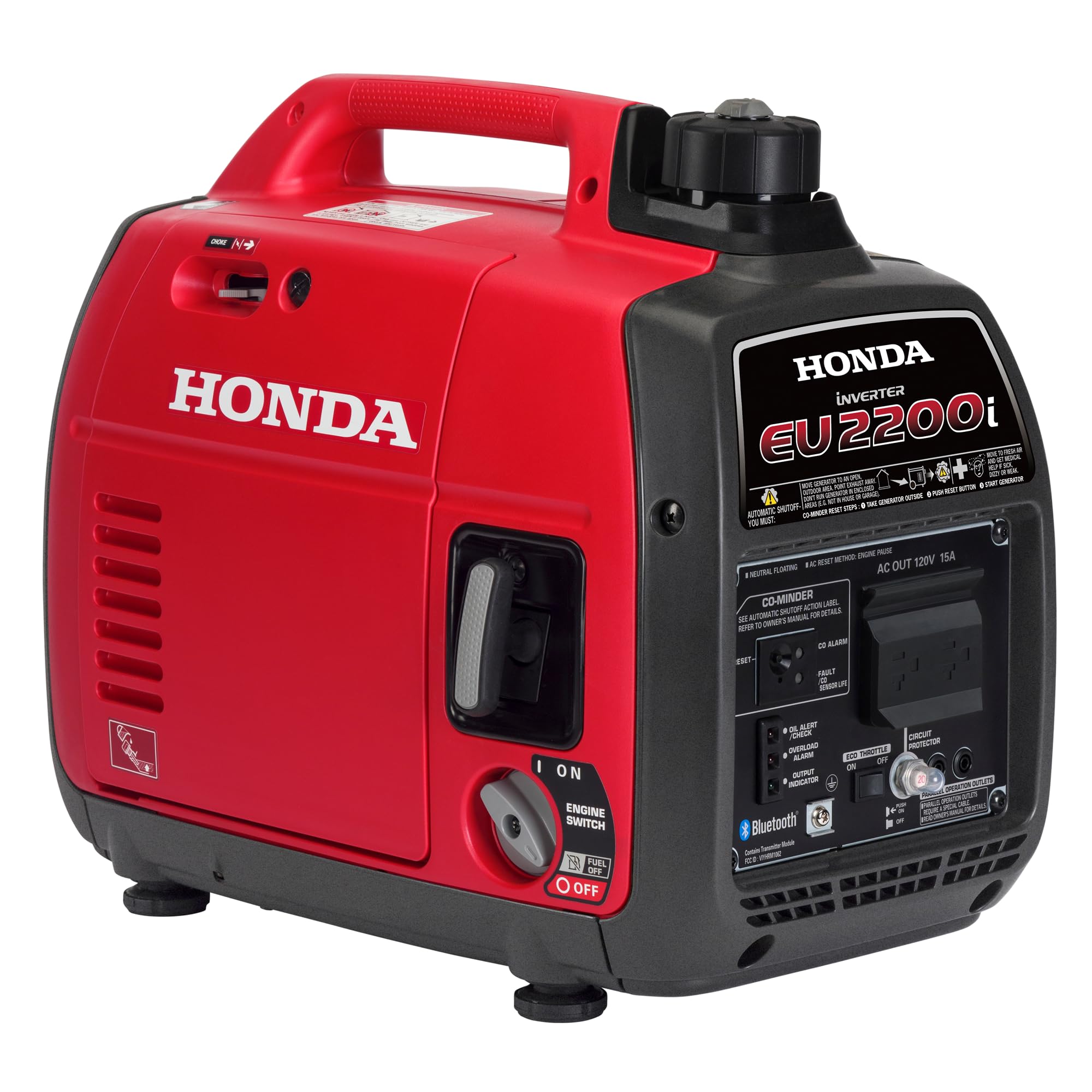
Honda EU2200i Portable Inverter Generator — Silence first, power second
Best for: Ceremonies and quiet events
If your event depends on speeches, acoustic music, or a ceremony, quiet matters more than raw wattage. This Honda delivers 2,200 peak watts and 1,800 running watts in a 47-pound package you can carry with one hand. Noise drops to 48 dBA at light load, so microphones stay clean and guests are not distracted. Clean inverter power protects mixers, laptops, and camera chargers from surges. The limit is capacity: it will not run large catering warmers or a big PA alongside lighting, so size your load first.
- 48 dBA at light load
- 47 pounds, one-hand carry
- Clean power protects audio gear
- 1800 running watts limits catering
- Parallel kit sold separately
4.6/5
5.0/5
4.9/5

Champion Power Equipment 100402 4500-Watt Dual Fuel Inverter Generator — Two fuels, fewer worries
Best for: Gas or propane events
Dual fuel is a practical advantage at events where gasoline storage is awkward or propane is already on site for heaters and grills. This Champion produces 4,500 peak watts on gasoline and 4,050 on propane, covering lights, sound, and small catering equipment. Electric start removes pull-cord frustration for volunteers, and the 61 dBA rating is reasonable for a mid-size unit. A 2.3-gallon tank gives up to 14 hours at light load on gasoline. The compromise is propane output, which is lower, so plan your heaviest loads for gasoline.
- Gas and propane flexibility on site
- Electric start helps volunteer crews
- 14 hours at light load
- Lower output on propane
- 61 dBA needs distance from guests
4.9/5
4.7/5
4.7/5

Predator 3500 Watt Super Quiet Inverter Generator — Strong value, low noise
Best for: Budget parties and markets
For backyard parties, markets, and tailgates on a tighter budget, this Predator covers the essentials without sounding like a job site. It offers 3,500 peak watts and 3,000 running watts, enough for speakers, lights, a mini fridge, and device charging. At 56 dBA, it stays in the background during conversation, and the built-in wheels help one person move it across grass or pavement. Runtime reaches about 11 hours at light load. The downside is weight and a recoil-only start, so it is less ideal for volunteers who struggle with pull cords.
- 3500 peak watts cover party essentials
- 56 dBA stays in background
- Wheels help move across grass
- Recoil-only start frustrates some volunteers
- Heavy for one-person truck loading
4.7/5
4.8/5
4.6/5

WEN 56203i Super Quiet 2000-Watt Portable Inverter Generator — Small, quiet, easy to carry
Best for: Small booths and solo setups
Small events do not need a large generator, and this WEN proves it. Weighing just 39 pounds, it is easy for one person to carry from car to canopy. It delivers 2,000 peak watts and 1,600 running watts for lights, a small speaker, laptops, and phone charging. Noise is only 51 dBA, making it a strong choice near guests. The one-gallon tank runs about 10 hours at half load in eco mode. Its clear limit is power: it cannot start a large air conditioner or run heavy catering equipment.
- 39 pounds, easy solo carry
- 51 dBA near guests
- 10 hours at half load
- Cannot start large air conditioners
- One gallon needs frequent refills
4.4/5
4.9/5
4.9/5

Generac GP6500 Portable Generator — Big power for bigger sites
Best for: Multi-tent and stage events
When the event grows to multiple tents, food warmers, and a stage, a small inverter will fall short. This Generac delivers 6,500 running watts and 8,125 starting watts, giving headroom for motor-driven equipment and simultaneous loads. A 6.9-gallon tank runs about 10.5 hours at half load, covering most event days. Multiple outlets help split power across zones without long daisy chains. The trade-offs are noise and weight: at about 172 pounds, it needs wheels, a ramp, and distance from guests.
- 6500 running watts, strong headroom
- 10.5 hours at half load
- Multiple outlets split event zones
- Louder than inverter models
- 172 pounds needs ramp, wheels
5.0/5
4.2/5
4.4/5

EcoFlow DELTA 2 Portable Power Station — Silent power, no fuel
Best for: Silent check-in and photo zones
Some event zones should have no engine noise, exhaust, or fuel at all. This battery station delivers 1,800 watts of AC output, with 2,700 watts of surge, for check-in tables, photo booths, laptops, and small speakers. It is silent in use, weighs 27 pounds, and recharges from a wall outlet, car, or solar panels. A 1,024Wh capacity covers light loads for hours, and it can act as a fast-switching backup for sensitive gear. The limit is endurance: heaters, kettles, and large catering loads will drain it quickly.
- Silent, no exhaust near guests
- 27 pounds, easy to position
- Solar, car, wall recharging options
- Heaters drain capacity quickly
- Needs recharge plan all day
4.4/5
5.0/5
4.8/5

Jackery Explorer 2000 Plus Portable Power Station — All-day silent booth power
Best for: All-day silent booth power
For all-day silent power at a larger booth or ceremony site, this Jackery steps up with 2,042Wh of capacity and 3,000 watts of AC output. It can run lights, speakers, laptops, and a mini fridge without fuel, fumes, or engine noise. Solar charging makes it practical for multi-day festivals, and extra battery packs can expand capacity when needed. At about 61.5 pounds, it is still portable with its handle and wheels. The main drawback is recharge time and capacity limits for high-draw heating or cooking equipment.
- 3000 watts AC output
- 2042Wh capacity, expandable design
- Solar charging for multi-day festivals
- 61.5 pounds, heavier than small stations
- Not for heating or cooking
4.7/5
5.0/5
4.5/5

DuroMax XP4500iH Dual Fuel Portable Inverter Generator — Long runs, flexible fuel
Best for: Volunteer-run mid-size events
If you want dual-fuel flexibility in a quieter inverter package, this DuroMax is a strong middle ground. It produces 4,500 peak watts on gasoline, with lower output on propane, and runs at about 61 dBA. Remote start, a digital display, and CO alert add convenience and safety for volunteer-run events. Runtime can reach about 16 hours at light load, depending on fuel and load. The weakness is propane power and a heavier frame than the lightest inverters, so check your heaviest load before choosing fuel.
- 4500 peak watts on gasoline
- Remote start, digital display
- About 16 hours light load
- Lower output on propane
- Heavier than lightest inverters
4.8/5
4.7/5
4.5/5

WEN DF1100T 11000-Watt Dual Fuel Portable Generator — Festival-scale headroom
Best for: Festivals and multi-vendor sites
Large festivals, multi-vendor markets, and stages need serious headroom, and this WEN delivers it. It produces 11,000 peak watts and 8,300 running watts on gasoline, with strong propane output as a backup. Electric start, a wheel kit, and multiple outlets, including GFCI protection, make setup and distribution easier for event crews. A 6.6-gallon tank supports long days, although runtime falls under heavy load. The obvious costs are size, weight at about 214 pounds, and noise, so place it well away from guests.
- 11000 peak watts, festival headroom
- Dual fuel backup on site
- GFCI outlets for crew safety
- 214 pounds, needs crew handling
- Louder than inverter-only models
5.0/5
4.0/5
4.1/5
Top 3 Head-to-Head: Westinghouse iGen4500 vs Honda EU2200i vs Champion 100402
These three are the common final choices because they cover the three real event trade-offs: balanced power, silence, and fuel flexibility.
| Feature | #1 Westinghouse iGen4500 | #2 Honda EU2200i | #3 Champion 100402 |
|---|---|---|---|
| Power and Runtime | 4.9/5 — Best | 4.6/5 | 4.9/5 |
| Quiet Operation | 4.9/5 | 5.0/5 — Best | 4.7/5 |
| Portability and Ease of Use | 4.8/5 | 4.9/5 — Best | 4.7/5 |
| Choose if… | You want one balanced unit for most events | Silence matters more than high wattage | You need gas and propane flexibility |
Who These Generators Are NOT For
A portable event generator is the wrong tool when the job is continuous, whole-site, or indoor power.
They are also a poor fit if you need to run heavy heating, large commercial cooking equipment, or multiple air conditioners all day. In that case, hire a larger commercial unit or split loads across dedicated circuits. For smaller, efficient loads, the most fuel efficient portable generators may be a better starting point than raw wattage.
Common Mistakes to Avoid
Most event power failures are planning failures, not product failures.
Frequently Asked Questions About Generators for Outdoor Events
How many watts do I need for an outdoor event?
Small events usually need 2,000 to 4,000 watts, medium tents often need 4,000 to 8,000 watts, and multi-vendor events can exceed 10,000 watts. List every item you will run at once, including lights, speakers, fridges, and chargers. Add the largest motor starting surge, then add 20 to 30 percent headroom so a fridge compressor or fan startup does not trip the unit.
Inverter or conventional generator: which is better for outdoor events?
An inverter generator is usually better for outdoor events because it is quieter and produces cleaner power for audio gear, laptops, and cameras. A conventional generator can be a better value for very heavy, motor-driven loads where noise is less important. Many event crews use both: an inverter for sound and sensitive gear, and a larger unit for catering and lighting.
How far away should a generator be from guests and tents?
Place a generator outdoors, downwind, and at least 20 feet from tents, seating, doors, and windows, with exhaust pointing away from people. Use a long, correctly rated outdoor cable rather than moving the unit closer for convenience. Never run a fuel generator inside a tent, garage, or enclosed structure, even with the sides open.
Can I run a generator in the rain at an outdoor event?
You should not run a portable generator unprotected in rain, because water can damage outlets, create shock risks, and harm the unit. Use a ventilated, purpose-built running cover or open-sided shelter that keeps rain off while allowing exhaust and heat to escape. For more detail, see our guide to a portable generator in rain before planning a wet-weather setup.
Can a portable power station replace a gas generator for an event?
A portable power station can replace a gas generator for light, silent zones such as check-in, photo booths, laptops, and small speakers. It cannot match a gas generator for all-day heating, cooking, or large PA systems unless you add extra batteries and solar charging. For most events, the best setup is a gas or dual-fuel unit for the main load, plus a battery station for quiet areas.
How do I keep a generator quiet at an outdoor event?
Choose an inverter model, place it as far from guests as cables safely allow, and point the exhaust downwind and away from hard walls that reflect sound. Use eco mode when the load is light, and avoid running the unit at full load near speeches or acoustic music. A sound-absorbing barrier can help, but it must never block airflow, exhaust, or access for refueling.
Our Final Verdict
Outdoor events reward the boring middle ground: enough wattage, low noise, and a runtime that outlasts the program. The Westinghouse iGen4500 hits that balance best for most gatherings, while quieter or larger units win only when ceremony silence or festival-scale load is the priority.

Hi, I’m Michael Turner. I own a generator workshop in the United States and founded HomeGeneratorBlog to share practical, hands-on guidance about generator installation, maintenance, troubleshooting, safety, and backup power solutions. My goal is to help homeowners make smarter, more confident decisions through clear and reliable information