
Where to Place a Portable Generator: The Complete Safety Guide
Place a portable generator at least 20 feet away from your home, garage, and any other structure. Point the exhaust away from doors, windows, and vents. Never run it indoors, in a garage, or under a covered porch. Always use it on a dry, flat, stable surface outdoors.
You’ve got a generator ready for the next power outage. But where does it actually go?
Most people get this wrong. They put it too close to the house, run it in the garage with the door open, or set it up on the covered porch because the weather’s bad. Every one of those choices is dangerous. I’m Michael, and after years of researching generator safety and backup power setups, I can tell you that generator placement is the single most important thing you can control. Get it right, and your generator is a lifeline. Get it wrong, and it can kill.
Let’s go through exactly where to place your portable generator — and what spots to avoid at all costs.
- Always place your generator at least 20 feet from your home, as recommended by the CDC and CPSC.
- Point the exhaust away from windows, doors, vents, and any structure a person can enter.
- Never run a generator indoors, in a garage, on a covered porch, or under any overhang.
- Set it on a dry, flat, stable surface — a driveway, concrete pad, or level patch of ground all work well.
- Install carbon monoxide detectors inside your home any time you run a portable generator.
Why Generator Placement Matters More Than You Think
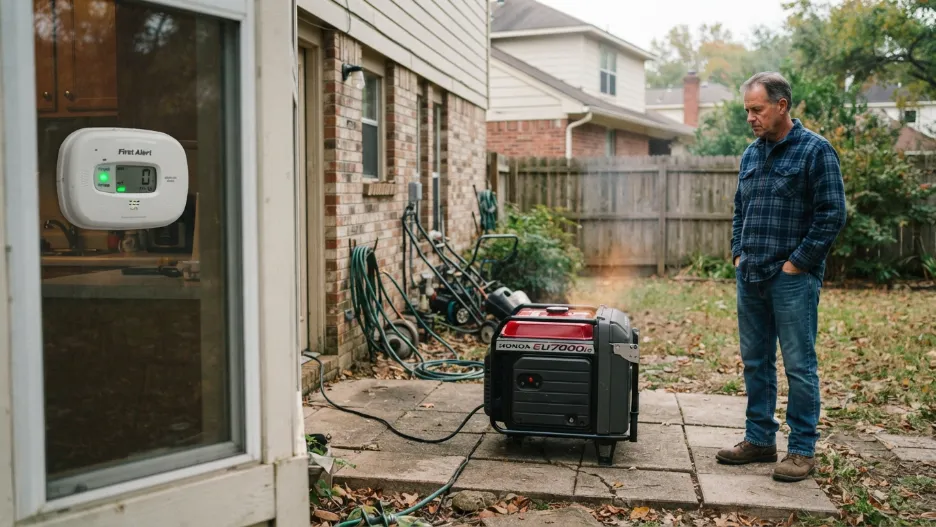
Portable generators produce carbon monoxide (CO) — a colorless, odorless gas that can kill in minutes. According to the CDC’s generator safety fact sheet, each year more than 400 Americans die from unintentional CO poisoning not linked to fires, and the U.S. Consumer Product Safety Commission (CPSC) estimates that roughly 100 of those deaths each year are linked directly to portable generators.
Here’s what makes CO so dangerous: you can’t detect it without a sensor. It has no smell, no color, and no taste. By the time you feel the symptoms — dizziness, headache, nausea — you may already be too impaired to get outside.
Carbon monoxide (CO) is an invisible, odorless gas produced by burning fuel. A portable generator creates as much CO as 100 cars running at the same time, according to the National Institute of Standards and Technology (NIST).
CO isn’t the only risk. Generators also create heat, sparks, and electrical hazards. Placing one too close to wood siding, dry grass, or a fuel container creates a real fire risk. Placement isn’t just about distance — it’s about angle, surface, and what’s around the generator.
Let’s look at the rules you need to follow.
How Far Away Should a Portable Generator Be From Your House?
A portable generator must be at least 20 feet away from your home, garage, shed, or any enclosed structure. The CDC, CPSC, and the National Fire Protection Association (NFPA) all agree on this number. It’s not a soft guideline — it’s a hard minimum.
Here’s why 20 feet is the magic number. NIST and the CDC ran detailed simulations of CO movement in and around a model home. They placed a generator outside and tested different distances. Even at 15 feet, CO still entered the house at unsafe levels when air was calm. At 20 feet with the exhaust pointed away from the home, concentrations dropped to much safer levels in most conditions.
Even with windows and doors closed, CO can seep inside through vents, soffits, crawl space openings, and tiny cracks in the siding. Distance is your first and most important line of defense.
Wind complicates things. On calm days, CO tends to pool near the house. On windy days, exhaust can be pushed toward your home even from beyond 20 feet. That’s why the exhaust direction matters as much as the distance.
Always point the exhaust pipe away from your house. And on windy days, be extra cautious — consider turning off the generator if the wind is blowing straight toward your home from where the generator sits.
The Best Spots to Place a Portable Generator Outside
Good generator placement comes down to four things: distance, surface, drainage, and exhaust direction. Here are the best outdoor spots to use.
- Driveway or concrete pad: A flat, stable, non-combustible surface. One of the safest options available. Easy access, good drainage, and far enough from the house in most layouts.
- Level patch of grass: Works fine as long as it’s dry and at least 20 feet from any structure. Avoid soft or uneven ground where the generator could tip.
- Stone or brick patio: Good if the patio is away from the house and fully open to the sky — not under an overhang or roof.
- Side yard or backyard: Ideal if the space gives you 20 feet of clearance from the home and from neighboring structures.
No matter which spot you choose, the exhaust must point away from your house, your neighbor’s house, and any windows or vents.
Before you need your generator in an emergency, walk your yard and identify the safest spot now. Measure the distance from your house. Mark it mentally — or even physically — so you’re not guessing in the dark during a storm.
Where Should You Never Place a Portable Generator?
Portable generator placement mistakes happen most often because a spot feels “close enough to outside.” It isn’t. Here are the locations you must always avoid.
Inside Your Home
Running a generator indoors is never safe — not in a bedroom, living room, basement, or any room in your home. CO builds up in minutes. Even one hour of operation indoors can be fatal.
In the Garage (Even With the Door Open)
This is the most common deadly mistake. A garage feels like “outside” when the door is open. It isn’t. The CPSC warns that a garage with an open door still traps CO because the structure blocks airflow. Fumes seep through the door into your home almost immediately. The garage is one of the most dangerous places to run a generator.
On a Covered Porch or Under an Overhang
A porch roof or overhang acts like a funnel. It traps exhaust beneath the structure and channels it toward your home’s entry points. Federal guidance from FEMA and the CPSC explicitly warns against running generators on porches or under carports — even if those spaces feel “open.”
In a Shed, Crawl Space, or Basement
Any enclosed or partially enclosed space will trap CO. Even a ventilated shed is not safe for generator operation. Basements and crawl spaces are especially dangerous because CO is slightly lighter than air and rises directly into living spaces above.
Near Windows, Doors, or Vents
Even if the generator is technically outdoors, placing it within 20 feet of any opening invites CO inside. This includes air conditioning units, dryer vents, exhaust fans, and attic vents — not just doors and windows you can open.
Never place a portable generator indoors, in a garage, under a porch roof, in a shed, near windows, or near vents — even if the space feels open. “Feels like outside” is not the same as actually being outside with 20 feet of clear air between you and the exhaust.
Safe Generator Placement: A Side-by-Side Comparison
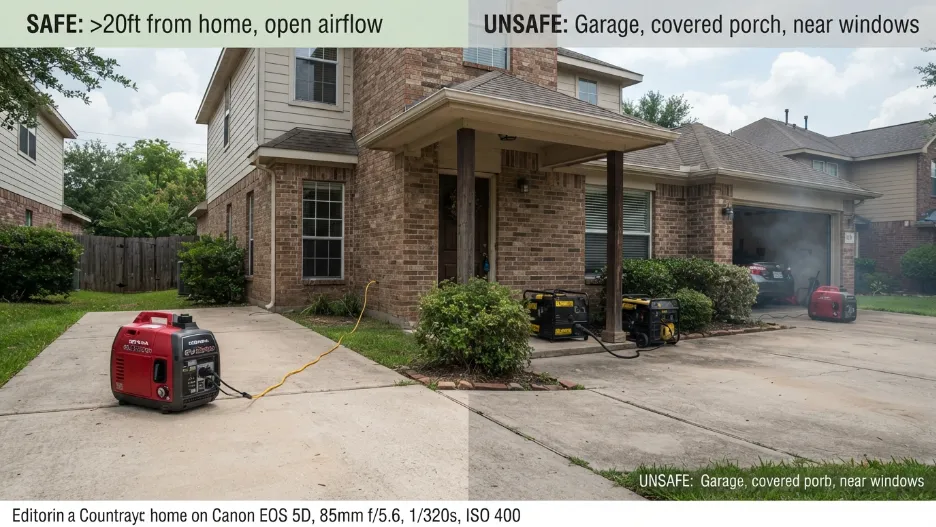
| Location | Safe? | Why |
|---|---|---|
| Driveway (20+ ft from house) | ✔ Yes | Open air, stable surface, easy 20-ft clearance |
| Open backyard, 20+ ft from any structure | ✔ Yes | Full airflow, exhaust disperses safely |
| Covered porch or carport | ✘ No | Roof traps CO and funnels it toward the house |
| Garage (door open) | ✘ No | CO seeps into home through the connecting door |
| Inside any room of the home | ✘ No | CO accumulates to lethal levels within minutes |
| Shed or enclosed outbuilding | ✘ No | Enclosed space traps CO even with vents open |
| Outdoors, near window or vent (less than 20 ft) | ✘ No | CO enters through openings even if generator is “outside” |
How to Set Up a Portable Generator the Right Way
Getting your generator to the right spot is step one. Setting it up correctly is step two. Here’s exactly how to do it safely every time.
- Measure and confirm you’re at least 20 feet from your home, garage, and any other structure.
- Set the generator on a dry, flat, stable surface — concrete, asphalt, or firm ground.
- Point the exhaust pipe away from all doors, windows, vents, and neighboring structures.
- Check the wind direction. Reposition if wind is blowing exhaust toward your home.
- Connect to your home using a transfer switch or heavy-duty, outdoor-rated extension cords only.
- Install or test CO detectors inside your home before starting the generator.
- Let the generator run for one minute before connecting any appliances.
- Never refuel a hot generator. Turn it off and let it cool for at least 15 minutes first.
Does Weather Change Where You Place the Generator?
Rain and snow create real problems for generator placement. But the solution is never to bring the generator inside or under cover.
When it’s raining, use a generator canopy tent designed specifically for outdoor use. These covers allow airflow while shielding the unit from rain and snow. Never use a tarp draped directly over the generator — it blocks airflow, traps heat, and increases the risk of CO buildup around the unit.
Never use a DIY wooden or plastic enclosure either, unless it was purpose-built for generator ventilation with the correct clearances. The most important rule in wet weather: keep the generator outdoors, at full distance, with shelter that allows open airflow on all sides.
Buy your generator canopy before storm season. During a power outage, shelters sell out fast. Having one ready means you won’t be tempted to move the generator to an unsafe location when it’s raining.
What About Extension Cords and Transfer Switches?
Where your generator sits affects how you connect it to your home. There are two safe methods: extension cords and transfer switches. Each has rules worth knowing.
Using Extension Cords With a Generator
Extension cords are the most common connection method. Use only outdoor-rated, heavy-duty cords with a 12-gauge wire or thicker. Never use indoor extension cords — they overheat under generator load and can cause fires.
Be aware of voltage drop. The farther the generator is from your home, the more power is lost over the cord length. According to Consumer Reports, this is a real trade-off: the 20-foot distance rule is non-negotiable for safety, but it does mean slightly longer cords and some voltage loss on sensitive electronics.
Never run cords under rugs or through windows in a way that pinches them. Use a rubber doorstop to prevent doors from crushing the cord. And never use a male-to-male “suicide cord” — the CPSC has repeatedly warned that these are deadly.
Using a Transfer Switch
A transfer switch is the safest and most practical way to connect a generator to your home’s power system. A licensed electrician installs it at your electrical panel. It lets you safely power specific circuits without the risk of backfeeding power into utility lines.
A transfer switch is a device installed by an electrician that safely connects your generator to your home’s wiring — preventing dangerous backfeed into the power grid and making outage management much easier.
If you plan to use a generator regularly, a transfer switch is worth the investment. The CPSC recommends having a qualified electrician install one that meets local electrical codes.
Does Wind Affect Where to Place a Portable Generator?
Wind is an underrated placement factor. On calm days, CO tends to pool near the generator and drift slowly toward your home. On windy days, exhaust can be pushed directly at your house — even from well beyond 20 feet away.
Before starting your generator, check the wind direction. Position the unit so the exhaust faces away from your home and blows downwind. If the wind is pushing fumes toward the house, move the generator to a different angle or position. A 90-degree shift in exhaust direction can make a significant difference in CO concentration near windows and doors.
Fences, retaining walls, and hedges can also trap CO by blocking airflow and creating dead pockets where the gas accumulates. Avoid placing your generator in a position where nearby structures funnel exhaust back toward your home.
Even at 25 or 30 feet, wind can carry CO into your home if the exhaust is pointing in the wrong direction. Distance is necessary, but it’s not enough on its own. Exhaust direction matters equally.
Should You Use a Carbon Monoxide Detector With a Generator?
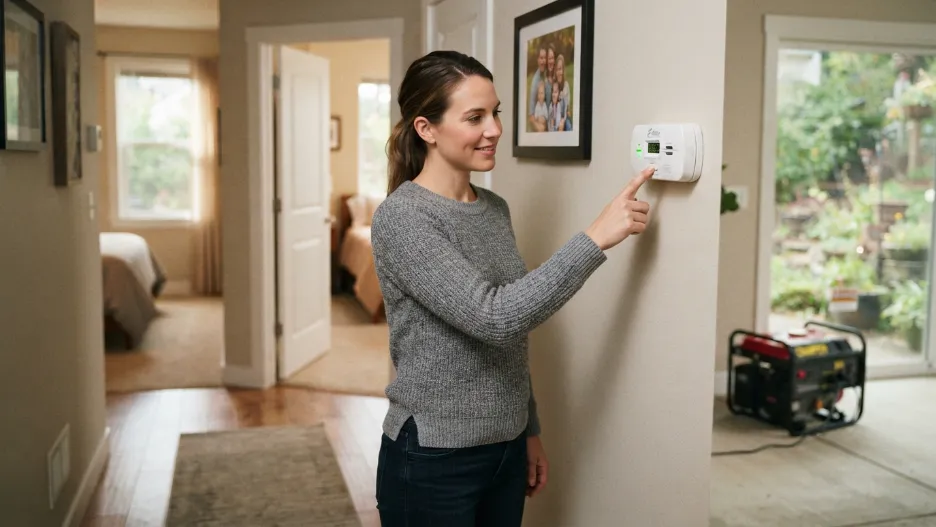
Yes — always. A CO detector inside your home is a critical backup safety measure whenever you’re running a portable generator. No placement strategy is perfect. Wind shifts. Vents you forgot about exist. A CO detector catches what you might miss.
Install battery-operated CO detectors (or detectors with battery backup) outside sleeping areas and on every level of your home. The CPSC recommends testing detectors every month and replacing them every 10 years.
Many newer portable generators now include automatic CO shutoff technology. This feature senses rising CO levels near the unit and shuts it down before reaching dangerous concentrations. According to Consumer Reports, they only test and recommend generators that pass CO safety technology testing — a useful filter if you’re shopping for a new unit.
But here’s the honest truth: a CO shutoff sensor on the generator doesn’t protect you from CO entering your home through a vent 15 feet away. The shutoff is a backup for the generator’s immediate surroundings — not a replacement for proper placement and indoor CO detectors.
Here’s the thing most people don’t realize: one in four generator owners doesn’t think it’s necessary to stay 20 feet away from people and pets, according to UL Solutions’ 2023 research report. That’s a dangerous misconception — and it’s why generator CO deaths still happen every single year.
What Are the Legal Rules About Generator Placement?
Generator placement isn’t just a safety question — it’s often a legal one. Many local building codes and municipalities have specific rules about where portable generators can operate.
The National Fire Protection Association standard NFPA 37 requires generators to be at least 5 feet from any operable openings in a building. The CDC and CPSC raise that to 20 feet for portable generators. Local codes can be even stricter — some areas require 20 feet from both your home and your neighbor’s home.
Noise ordinances also apply. In North Carolina, for example, state rules limit generator noise to 85 decibels measured from 10 feet away. Similar rules exist in many other states and municipalities.
Home insurance is another factor. Some insurers won’t cover damage caused by an improperly placed or operated generator. Placement that violates local codes can result in denied claims — on top of any fines you might face.
If you’re not sure about local rules, contact your city or county permitting office. A licensed electrician familiar with your area’s codes can also help you identify the safest and most compliant placement on your property.
Unique Insight: The “Close Enough” Problem Is the Real Danger
After looking at generator accident reports, one pattern stands out that almost no safety guide mentions directly: most generator CO deaths don’t happen because someone was reckless. They happen because someone made a “close enough” decision that felt reasonable in the moment.
The garage with an open door feels close enough to outside. The covered porch feels close enough to the backyard. Fifteen feet feels close enough to twenty. And in a stressful power outage — at night, in bad weather, with no lights — those small compromises are even more tempting.
The real lesson isn’t just “follow the 20-foot rule.” It’s to pre-decide where your generator goes before an emergency happens. Know the spot. Measure it. Keep the path to it clear. When the power goes out, you should be executing a plan, not improvising in the dark.
If you’re running your generator in wet or unpredictable weather, a purpose-built generator canopy keeps it protected without blocking airflow — so you never have to choose between shelter and safety.
Your Next Step
The 20-foot rule from the CDC and CPSC exists because it works — but only if you actually use it. Pick your spot now, before the next storm hits. Measure it, clear it, and make sure your exhaust direction is safe.
Add CO detectors inside your home if you don’t already have them. Those two steps will protect your family every time you run your generator. I’m Michael, and if you take one thing from this guide, make it this: placement isn’t a detail — it’s the whole ballgame.
Frequently Asked Questions
Can I run a portable generator under a canopy or tent?
You can use a ventilated generator canopy designed specifically for outdoor generator use — these allow full airflow while blocking rain. Never use a solid tarp or any enclosed shelter. The generator must remain in open air with at least 20 feet of clearance from your home, even under a canopy.
Is it safe to place a generator on a wood deck?
Running a generator on a wood deck is not recommended. Generator exhaust and hot surfaces can ignite wood, and vibration can cause the unit to shift. If a deck is the only option, place a fire-resistant, non-combustible mat underneath — but make sure the deck is fully open (no roof), the unit is 20 feet from any wall or window, and the exhaust points away from the house.
How far should a generator be from a neighbor’s house?
Treat your neighbor’s house the same as your own — maintain at least 20 feet of clearance. Many local codes specifically require this. CO doesn’t respect property lines, and your neighbor can be affected by fumes from a poorly placed generator just as easily as you can.
Can I run a portable generator in an apartment or condo?
Running a gas-powered portable generator in an apartment is extremely difficult to do safely. Balconies and breezeways are often partially enclosed and rarely allow 20 feet of clearance. Most building rules and HOAs prohibit fuel generators outright. For apartment use, a battery-powered portable power station is a far safer alternative — it produces no CO and can be used indoors.
Does it matter which direction the generator exhaust faces?
Yes — exhaust direction matters as much as distance. Always point the exhaust pipe away from your home, neighboring homes, windows, doors, and vents. Wind can carry CO toward your home even from 25 or 30 feet away if the exhaust is aimed in that direction. Check wind direction before you start the generator, and reposition the exhaust angle if needed.

Hi, I’m Michael Turner. I own a generator workshop in the United States and founded HomeGeneratorBlog to share practical, hands-on guidance about generator installation, maintenance, troubleshooting, safety, and backup power solutions. My goal is to help homeowners make smarter, more confident decisions through clear and reliable information
2 Comments