Portable Generator Fuel Stabilizer: How to Use It for Reliable Starts
Quick Answer
A portable generator fuel stabilizer helps fresh gasoline resist deterioration while the generator sits unused. Add the correct amount to fresh gasoline before storage, then run the generator long enough to move treated fuel through the carburetor or fuel system. Honda’s generator fuel recommendations also stress that stabilizer cannot turn stale gasoline back into fresh fuel.
Best way to use fuel stabilizer
- Start fresh: Mix stabilizer with gasoline that is still fresh rather than trying to rescue badly degraded fuel.
- Measure accurately: Follow the dosage printed on your stabilizer bottle because concentrations vary widely.
- Treat the system: Run the generator outdoors after adding stabilizer so treated fuel reaches the carburetor.
- Check the manual: Some manufacturers still recommend draining the carburetor during longer storage periods.
- Store safely: Keep gasoline in an approved fuel container away from living areas, flames, sparks, and heat.
One important limit
- Fuel stabilizer slows deterioration. It does not make gasoline last forever or replace the storage instructions in your generator’s owner’s manual.
I use fuel stabilizer for generators that may sit between outages because stale gasoline can turn an easy start into carburetor work. The key is using stabilizer before the fuel has already deteriorated.
This guide explains when you need it, how much to use, and when draining the carburetor makes more sense.
What Is a Portable Generator Fuel Stabilizer?
A portable generator fuel stabilizer is a gasoline additive designed to slow fuel deterioration during storage. It helps reduce the gum, varnish, and deposits that can interfere with small fuel passages.
Definition: Fuel stabilizer is preventive treatment for fresh gasoline. It is not a substitute for fresh fuel, carburetor maintenance, or manufacturer-recommended storage procedures.
Gasoline begins changing as it sits and reacts with air. Heat, humidity, sunlight, and a partially filled container can make storage conditions worse.
- Oxidation: Gasoline gradually loses desirable fuel qualities as it ages.
- Gum and varnish: Deposits can restrict small carburetor jets and passages.
- Moisture: Water contamination can contribute to corrosion and running problems.
- Volatility loss: Older fuel may become harder to ignite during starting.
In my workshop, a common storage problem is gasoline left sitting in the carburetor bowl. That small amount of fuel often causes more trouble than owners expect.
Do You Need Fuel Stabilizer in a Portable Generator?
You should strongly consider fuel stabilizer when gasoline may sit unused for roughly a month or longer. It also makes sense when you keep emergency gasoline stored for unpredictable power outages.
Briggs & Stratton’s fuel-storage guidance notes that gasoline can begin degrading in as little as 30 days. Your generator’s specific manual should still take priority.
Fuel stabilizer makes the most sense when:
- Your generator may sit for more than 30 days.
- You store emergency gasoline in portable fuel cans.
- Power outages in your area are unpredictable.
- You use the generator only a few times each year.
- Your generator has a carbureted gasoline engine.
- You want treated fuel ready before storm season.
You may not need stabilizer when you constantly rotate fresh gasoline and consume it quickly. Even then, good fuel-storage habits still matter.
What about dual-fuel generators?
Fuel stabilizer only applies to the gasoline side of a typical gasoline-and-propane dual-fuel generator. Do not pour gasoline stabilizer into a propane system.
Diesel generators also need products specifically labeled for diesel fuel. Never assume a gasoline stabilizer is compatible with diesel.
When Should You Add Fuel Stabilizer to Generator Gas?
Add fuel stabilizer while the gasoline is fresh, preferably when you fill your storage can. This gives the additive the best opportunity to protect the fuel from the beginning.
I prefer treating the fuel can instead of trying to remember which generator tank received stabilizer. That approach also keeps emergency reserve gasoline treated.
- At fuel purchase: Add the measured treatment to fresh gasoline.
- Before seasonal storage: Treat the generator if it may sit unused.
- Before storm storage: Treat emergency fuel that might remain unused for weeks or months.
- After refilling reserves: Date the container so you know the fuel’s age.
Do not wait until gasoline smells stale or the generator runs poorly. Stabilizer works best as prevention.
How Do You Use Fuel Stabilizer in a Portable Generator?
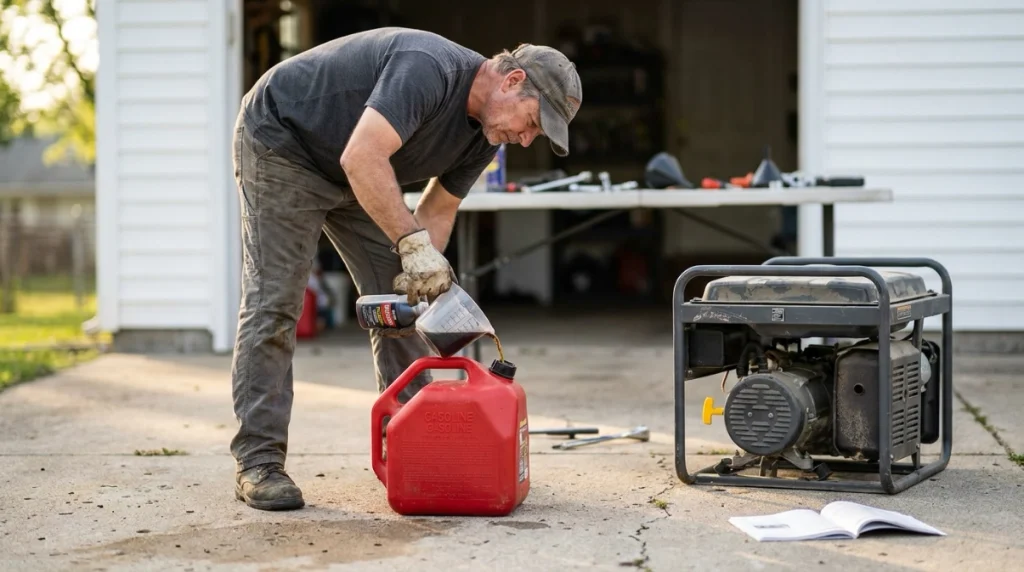
Measure the stabilizer according to its own label, mix it with fresh gasoline, and run the generator outdoors afterward. The run time allows treated fuel to reach parts beyond the tank.
Step 1: Check your generator manual
Read the storage section before adding anything. Some manufacturers recommend different procedures depending on how long the machine will sit.
Step 2: Start with fresh gasoline
Use gasoline that meets your generator manufacturer’s fuel requirements. Do not assume stabilizer can correct months-old, badly deteriorated gasoline.
Step 3: Measure the correct dose
Concentrations vary significantly between brands. More is not automatically better, so use the dosage printed on the bottle.
For example, a five-gallon gas can requires different amounts depending on the product:
| Product | Manufacturer Storage Dose | Approx. Amount for 5 Gallons | Claimed Storage Protection |
|---|---|---|---|
| STA-BIL Storage | 1 oz per 2.5 gallons | 2 oz | Up to 24 months |
| Star Tron Classic Gas Formula | 1 oz per 6 gallons | About 0.83 oz | Up to 2 years |
| Sea Foam Motor Treatment | 1 oz per gallon for storage | 5 oz | Up to 2 years |
Important: Product formulas and directions can change. Always follow the current bottle label rather than relying only on an older dosage chart.
Step 4: Get treated fuel into the carburetor
Add the treated gasoline and start the generator outdoors. Run it long enough for stabilized fuel to move through the fuel system.
Honda gives a 10-minute procedure for several EU-series generators after stabilizer is first added. STA-BIL currently directs users to run an engine for five minutes after treatment.
Step 5: Finish the manufacturer’s storage procedure
Turn the fuel valve off when the manual calls for it. For longer storage, your manufacturer may also tell you to drain the carburetor or tank.
Fuel Stabilizer vs. Draining Gas: Which Is Better?
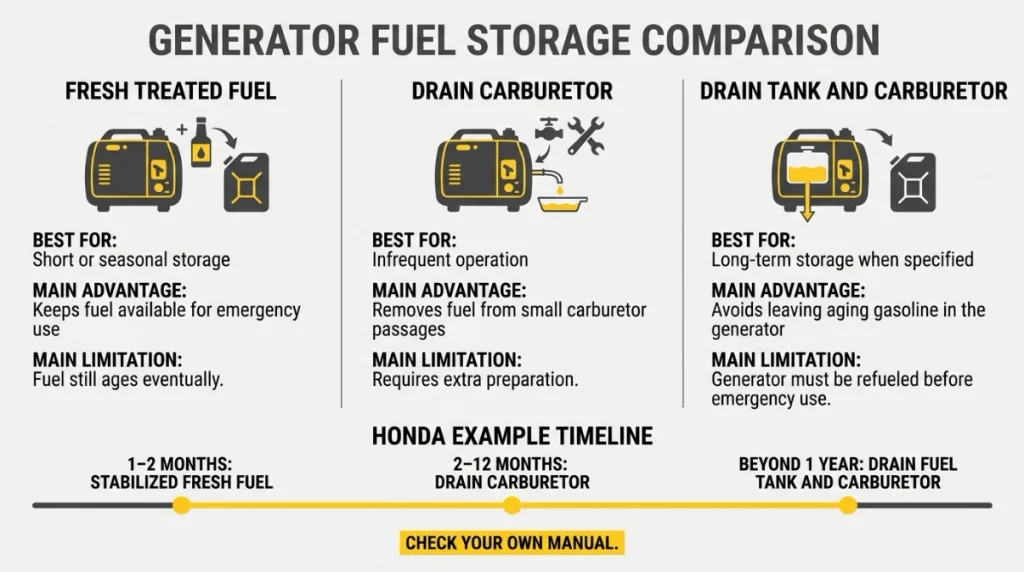
Neither method is universally better because storage procedures depend on generator design and storage length. For many carbureted generators, treated fuel plus carburetor draining gives stronger protection during longer idle periods.
| Method | Best For | Main Advantage | Main Limitation |
|---|---|---|---|
| Fresh treated fuel | Short or seasonal storage | Keeps fuel available for emergency use | Fuel still ages eventually |
| Drain carburetor | Infrequent operation | Removes fuel from small carburetor passages | Requires extra preparation |
| Drain tank and carburetor | Long-term storage when specified | Avoids leaving aging gasoline in the generator | Generator must be refueled before emergency use |
Honda provides a useful real-world example. For several EU-series models, it recommends stabilized fresh fuel for one to two months of storage.
For two to twelve months, Honda also calls for draining the carburetor. Storage beyond one year calls for draining both the fuel tank and carburetor on those models.
Those numbers are not universal. Check your own manual before copying another generator’s procedure.
How Long Does Stabilized Gas Last in a Generator?
Many current stabilizer products advertise protection for roughly two years when used as directed. That does not guarantee your gasoline will perform like newly purchased fuel after 24 months.
Fuel quality, temperature, humidity, container sealing, and gasoline formulation all affect storage life. Generator manufacturers may therefore recommend shorter storage intervals than the stabilizer manufacturer.
- STA-BIL Storage: Claims fuel protection for up to 24 months.
- Star Tron Classic: Claims stabilization for up to two years.
- Sea Foam Motor Treatment: Claims stabilization for up to two years.
- Generator manual: May require carburetor or tank draining sooner.
I rotate emergency gasoline instead of deliberately trying to reach the maximum advertised storage period. Fresh fuel gives me fewer variables when a generator needs to start during an outage.
What Mistakes Make Fuel Stabilizer Less Effective?
The biggest mistake is treating stabilizer as a repair product for gasoline that has already degraded. Prevention is cheaper and more reliable.
- Adding it too late: Stabilizer cannot reliably return stale gasoline to its original condition.
- Guessing the dosage: Different products use very different treatment ratios.
- Skipping the run cycle: Untreated gasoline may remain inside the carburetor.
- Ignoring the manual: Some generators still require carburetor draining for extended storage.
- Using the wrong additive: Gasoline, diesel, and propane systems require different treatment approaches.
- Leaving fuel in heat: High storage temperatures can accelerate gasoline deterioration.
- Keeping unmarked cans: Without a date, it’s easy to lose track of fuel age.
A permanent marker and a piece of tape solve the last problem. I mark each fuel can with the purchase date and stabilizer used.
How Should You Store Generator Gas Safely?
Fuel stabilizer does not make gasoline less flammable. Handle treated gasoline with the same care as untreated gasoline.
OSHA generator safety guidance recommends approved fuel containers and keeping generator fuel away from flames, heat, and living areas.
- Shut the generator down before refueling.
- Allow a hot generator to cool first.
- Use containers specifically approved for gasoline.
- Keep fuel away from water heaters, furnaces, sparks, and flames.
- Follow local fire-code limits for residential gasoline storage.
Never run a portable generator indoors while circulating treated fuel. The U.S. Consumer Product Safety Commission says generators should operate outdoors at least 20 feet from the home, with exhaust directed away.
Portable Generator Fuel Stabilizers I Would Consider
If you’re ready to choose one, I would focus on clear dosing instructions, gasoline compatibility, and storage duration rather than marketing claims alone.
🏆 Best Overall
STA-BIL Storage Fuel Stabilizer
★★★★☆ My rating: 4.8/5
The current formula uses a storage dose of 1 ounce per 2.5 gallons and claims protection for up to 24 months. I like it for ordinary generator storage because the measurement is simple and the directions specifically include generators.
⛽ Best Concentrated Option
Star Tron Enzyme Fuel Treatment Classic Gas Formula
★★★★☆ My rating: 4.6/5
The Classic Gas Formula lists generators among its intended applications and claims fuel stabilization for up to two years. Its concentrated dosing makes it appealing when I am treating several fuel cans.
🔧 Best Multipurpose Pick
Sea Foam Motor Treatment
★★★★☆ My rating: 4.5/5
Sea Foam specifies 1 ounce per gallon for fuel storage and claims stabilization for up to two years. I would choose it when I also want a widely applicable fuel-system maintenance product instead of a storage-only treatment.
Portable Generator Fuel Stabilizer FAQs
Can I put fuel stabilizer directly into my generator?
Yes, if the product is approved for gasoline engines and you follow its dosage directions. I prefer treating fresh gasoline in the fuel can first because it improves measurement and ensures my stored reserve fuel is treated too.
Can you add fuel stabilizer to old gasoline?
You can add stabilizer to older fuel, but it cannot reliably make seriously degraded gasoline fresh again. If the fuel smells stale or has caused starting problems, follow your generator manufacturer’s instructions for removing old fuel and refill with fresh gasoline.
Should I run my generator after adding fuel stabilizer?
Yes. Running the generator outdoors allows the treated gasoline to reach the carburetor or fuel-injection system. The exact run time varies by product and generator, so follow both the stabilizer directions and the generator owner’s manual.
Should I use fuel stabilizer every time I fill my generator?
You do not always need stabilizer when gasoline will be consumed quickly. However, treating fuel at purchase can be convenient for emergency generators because you rarely know how long reserve gasoline will sit before the next outage.
Is fuel stabilizer enough for winter generator storage?
Sometimes, but not always. Some generator manufacturers recommend draining the carburetor after a certain storage period even when stabilized gasoline remains in the tank. Use the storage schedule in your specific owner’s manual as the final authority.
Final Takeaway
A portable generator fuel stabilizer is cheap prevention when your generator spends more time waiting than running. Use it with fresh gasoline, measure it correctly, and circulate treated fuel through the system before storage.
Most importantly, don’t treat stabilizer as permission to ignore old fuel. Rotate emergency gasoline, follow your owner’s manual, and prepare the generator before the outage arrives.

Hi, I’m Michael Turner. I own a generator workshop in the United States and founded HomeGeneratorBlog to share practical, hands-on guidance about generator installation, maintenance, troubleshooting, safety, and backup power solutions. My goal is to help homeowners make smarter, more confident decisions through clear and reliable information