Portable Generator Low Voltage: Causes, Tests, and Fixes
Quick Answer
Portable generator low voltage usually comes from too much electrical load, low engine speed, a weak AVR, worn brushes, a bad capacitor, or a poor electrical connection. First remove every load, then compare the outlet reading with your generator’s rated output and check frequency; this portable generator voltage guide explains what the basic voltage readings mean.
Signs that point to low generator voltage
- Dim lights: Lamps stay noticeably dim instead of briefly dipping when another load starts.
- Weak motors: Fans, pumps, and compressors struggle, hum, or take too long to start.
- Low meter reading: A 120-volt receptacle remains well below its rated voltage after the generator warms up.
- Load-related sag: Voltage looks normal with nothing connected but drops sharply when a moderate load is added.
- Stable engine, weak output: The engine sounds normal while electrical output remains low, pointing toward regulation or excitation problems.
Best confirmation test
- Measure both AC voltage and frequency with no load, then repeat with one controlled load. Low voltage plus low frequency usually sends me toward the engine or load first; low voltage with normal frequency pushes the diagnosis toward the AVR, excitation system, brushes, capacitor, or wiring.
If your generator runs but the outlets feel weak, don’t start ordering parts yet. I can usually narrow this problem down quickly by looking at voltage and frequency together instead of treating every low reading as a failed alternator.
That distinction matters even more in 2026 because conventional and inverter generators regulate their output differently. I’ll walk through a safe diagnosis for both types, starting with the simple checks that cost nothing.
What Does Low Voltage Mean on a Portable Generator?
Portable generator low voltage means the AC output remains meaningfully below the voltage the generator is designed to supply. In the United States, a standard household-style generator receptacle is normally designed around 120-volt AC power.
A 120/240-volt generator normally provides roughly 120 volts from either hot leg to neutral and about 240 volts across the two hot legs. Your owner’s manual and data plate remain the final reference for your specific machine.
- Brief voltage dip: Often normal when a refrigerator, pump, or other motor starts.
- Continuous low voltage: Needs diagnosis before you connect sensitive equipment.
- Low voltage only under heavy load: Often points to overload or insufficient engine power.
- Low voltage even with no load: Makes regulation, excitation, wiring, or engine-speed problems more likely.
I care more about the pattern than a single number. A meter reading becomes useful when I know the load, frequency, generator type, and whether the engine is holding speed.
Why Is My Portable Generator Producing Low Voltage?
The most common causes are excessive load, low engine speed, AVR trouble, worn alternator components, and poor connections. Work through them in that order because the cheap causes often look exactly like expensive failures.
1. The Generator Is Overloaded
Start here if the voltage is normal with nothing connected but drops after you add appliances. Motors and compressors can demand a large burst of starting power even when their normal running wattage looks reasonable.
Compare your connected load against the generator’s continuous rating, not only its larger surge number. My generator power capacity guide explains how running and starting watts affect this calculation.
- Disconnect nonessential appliances.
- Start motor-driven loads one at a time.
- Check each appliance nameplate for watt or amp ratings.
- Retest voltage after reducing the load.
2. Engine Speed Is Too Low
On a conventional generator, engine speed and electrical frequency are closely related. If the engine slows too much, frequency drops and the generator may also struggle to maintain proper voltage.
That’s why I check the portable generator frequency before touching the voltage regulator. A conventional U.S. generator should operate around its designed 60 Hz frequency when running normally.
Low engine speed can result from several basic problems:
- A dirty air filter.
- Old or contaminated gasoline.
- A partially restricted carburetor.
- A worn or fouled spark plug.
- Governor linkage that cannot maintain speed as load increases.
Don’t randomly turn governor adjustment screws to raise voltage. An incorrect adjustment can send both frequency and voltage in the wrong direction.
3. The AVR Is Not Regulating Correctly
An automatic voltage regulator, or AVR, controls excitation so the alternator can maintain steadier output as the load changes. Honda describes AVR technology as a way to keep generator voltage more constant as load varies on compatible generator designs.
You can read more about voltage regulation at Honda Power Equipment’s DAVR information.
If frequency is near normal but voltage remains seriously low, I start looking harder at the electrical side. The portable generator AVR troubleshooting guide covers regulator symptoms and testing in more detail.
4. Brushes, Slip Rings, or a Capacitor Are Failing
Many conventional generators use carbon brushes to feed the rotating field. Worn brushes or dirty slip rings can weaken excitation and leave you with low or intermittent output.
Other generator designs use capacitors or different excitation arrangements. A weak capacitor can produce symptoms similar to a failing AVR, so identify your alternator design before buying parts.
5. A Connection, Breaker, or Outlet Is Damaged
A loose terminal or heat-damaged receptacle can create resistance and voltage drop. This becomes more suspicious when one outlet acts differently from every other outlet.
- Reset the generator’s AC breakers.
- Reset GFCI receptacles when fitted.
- Inspect plugs and extension cords for heat damage.
- Look for loose external connectors with the generator shut down.
- Test another generator receptacle before blaming the alternator.
6. The Alternator Has an Excitation or Winding Problem
The alternator contains the rotor and stator that produce usable electricity. Excitation problems can leave the engine running perfectly while outlet voltage stays low or disappears.
If the simple checks fail, my portable generator alternator guide explains the major components and common failure patterns. Internal winding tests should follow the service information for your exact model.
7. An Inverter Generator Has an Electronic Control Fault
Don’t troubleshoot an inverter generator exactly like an open-frame AVR generator. An inverter model electronically processes the generated power before sending regulated AC to the receptacle.
Low output with an inverter generator can therefore involve overload protection, current sensing, control electronics, or the inverter module itself. Avoid AVR-adjustment advice unless your specific service documentation actually shows an adjustable regulator.
How Do I Test a Portable Generator for Low Voltage?
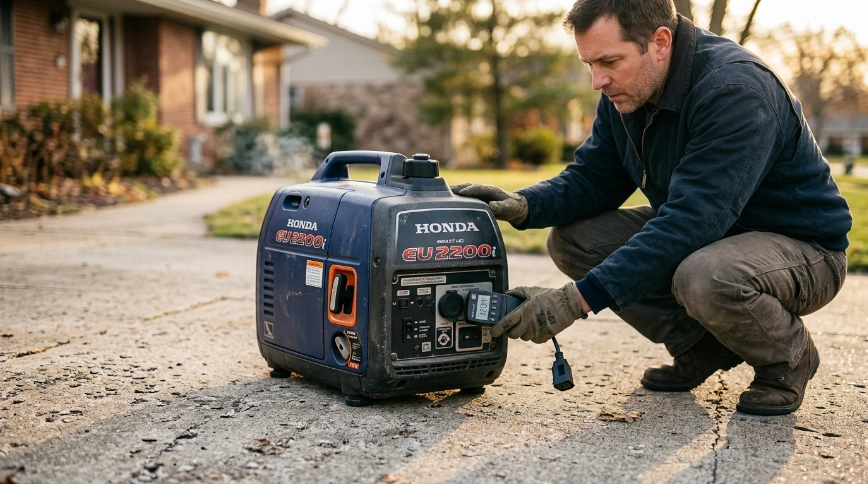
The safest useful test compares no-load voltage, frequency, and loaded voltage. You don’t need to expose internal wiring to collect those three measurements.
Safety first: Run the generator outdoors and keep it dry. The CDC says portable generators should operate more than 20 feet from windows, doors, and vents because of carbon monoxide risk.
See the CDC carbon monoxide guidance before running a generator for testing. Don’t troubleshoot one inside a garage, shed, basement, or home.
Step 1: Disconnect Every Load
Turn off and unplug everything from the generator. Reset its breakers and let the engine reach normal operating speed.
If the unit has an economy or idle-control setting, follow the owner’s manual for voltage testing. Some generators change engine behavior when that mode is active.
Step 2: Measure the 120-Volt Outlet
A plug-in voltage/frequency monitor is the easiest option for most homeowners. A properly rated digital multimeter also works if you already know how to safely measure a live receptacle.
For guidance on meter functions, see Fluke’s digital multimeter resources. Never use damaged probes, wet equipment, or an incorrectly configured meter.
Step 3: Check Frequency
Record frequency immediately after recording voltage. On a conventional 60 Hz generator, a low-frequency reading alongside low voltage is a strong clue that engine speed or load is involved.
If frequency stays close to normal while voltage remains low, the electrical regulation and excitation system becomes more suspicious. That’s one of the fastest diagnostic splits you can make.
Step 4: Add One Controlled Load
Use one simple load whose wattage is well inside the generator’s continuous rating. A resistive load is preferable to a computer, television, refrigerator, or other sensitive device while you’re diagnosing questionable power.
Watch what happens to both voltage and frequency. Don’t keep increasing the load after the output clearly becomes unstable.
Low Voltage vs. Low Frequency: What Do the Readings Tell You?
Voltage and frequency together tell a much better story than voltage alone. This is the comparison I use before deciding whether to work on the engine side or electrical side.
| Test Pattern | Example Reading | Most Likely Direction | First Check |
|---|---|---|---|
| Voltage and frequency both near rated values | About 120V / 60Hz on a U.S. 120V output | Normal baseline | Repeat under controlled load |
| Voltage drops and frequency also drops | For example, 105V with 55Hz | Engine slowing or excessive load | Remove load; check engine condition |
| Voltage low while frequency stays near normal | For example, 85V with roughly 60Hz | AVR, excitation, brushes, capacitor, or wiring | Inspect electrical regulation system |
| Normal no-load voltage but severe loaded sag | 120V unloaded, then sharp drop under moderate load | Overload, weak engine, or regulation problem | Reduce load and compare frequency |
| Only one receptacle or 120V leg reads low | Other outputs remain normal | Outlet, breaker, connection, or leg-specific problem | Stop and inspect the affected circuit |
The numbers in the table are diagnostic examples, not universal pass/fail specifications. Always compare your final readings with the voltage and frequency listed for your exact generator.
How Do I Fix Portable Generator Low Voltage?
Fix the cause indicated by your tests rather than adjusting voltage blindly. I work from the outside inward so I don’t turn a maintenance problem into an electrical repair.
- Remove excess load. Disconnect appliances and retest the generator unloaded.
- Correct engine problems. Service the air filter, fuel system, and spark plug if frequency is low or the engine cannot hold speed.
- Check cords and receptacles. Replace overheated, loose, damaged, or undersized connections.
- Verify switches and breakers. Confirm voltage selectors and circuit protection are in the correct operating positions.
- Inspect regulation components. With the generator shut down, inspect accessible AVR wiring, brushes, and connections according to the service manual.
- Use model-matched replacement parts. Don’t assume a similar-looking AVR or capacitor has the correct electrical specification.
- Refer inverter faults for proper diagnosis. Inverter modules and their control circuits require model-specific procedures.
If a governor adjustment, AVR replacement, or internal alternator test is needed, follow the manufacturer’s service procedure. Don’t experiment on exposed energized components.
When Does Low Voltage Mean the AVR or Alternator Is Bad?
I suspect the AVR or excitation system when the engine is running steadily, frequency is reasonable, and every outlet remains low. The diagnosis becomes stronger if voltage doesn’t recover after all external loads are removed.
- AVR more likely: Voltage exists but is consistently too low or changes abnormally with load.
- Brush problem more likely: Output cuts in and out with vibration or has become progressively weaker.
- Connection problem more likely: One outlet differs from the others.
- Alternator winding problem more likely: Regulation components and wiring test correctly but output remains abnormal.
- Engine problem more likely: Low voltage appears together with noticeably low frequency.
Don’t replace the AVR solely because voltage is low. A clogged carburetor or worn brush set can imitate a bad regulator and cost much less to correct.
What If Only One 120V Outlet or Leg Has Low Voltage?
A leg-specific problem deserves different treatment from low voltage across every outlet. Stop adding loads and compare only the generator’s externally accessible receptacles unless you’re qualified to perform internal electrical measurements.
Possible causes include a damaged receptacle, breaker problem, loose neutral or conductor, selector-switch fault, or poor connection inside the control panel. A 120/240V system that’s feeding a building through a transfer system should be checked by someone qualified to work on that installation.
The OSHA electrical safety resources provide useful background on shock, fire, and electrocution hazards. Never bypass a breaker or protection device just to see whether voltage returns.
Can Low Generator Voltage Damage Appliances?

Yes, sustained low voltage can cause trouble, particularly for motors and compressors. A motor may draw more current or fail to accelerate normally when the supplied voltage is inadequate.
Refrigerators, pumps, air conditioners, and similar equipment shouldn’t become your diagnostic test loads when you already know the generator output is abnormal. Disconnect them until the cause is found.
- Don’t judge generator quality by whether a light still turns on.
- Don’t repeatedly attempt to start a struggling compressor.
- Don’t connect sensitive electronics while voltage is unstable.
- Don’t assume a surge protector can correct sustained low voltage.
Once you’ve corrected the problem, test unloaded and under a controlled load again. Only reconnect important appliances after the readings stay stable.
Tools I Recommend for Diagnosing Generator Low Voltage
You don’t need a pile of replacement parts to diagnose this problem. I would rather spend money on one meter that tells me what’s happening than start swapping AVRs, capacitors, and brushes by guesswork.
🏆 Best Overall
Fluke 117 Electrician’s Multimeter
★★★★★ 5.0/5 for this job
This true-RMS CAT III 600V meter measures AC voltage and frequency and includes Min/Max/Average functions. It’s my premium pick when I want one durable meter for generator work and general electrical troubleshooting.
💰 Best Value
Klein Tools MM420 Digital Multimeter
★★★★☆ 4.7/5 for this job
The MM420 is a true-RMS, CAT III 600V auto-ranging meter with voltage and frequency measurement from 1 Hz to 50 kHz. I like it for homeowners who want serious diagnostic functions without stepping into premium-meter pricing.
🔌 Easiest Plug-In Check
P3 P4400 Kill A Watt
★★★★☆ 4.5/5 for this job
The P4400 plugs into a standard 120V-style receptacle and displays volts, amps, watts, VA, and line frequency. I like it for quick 120V generator checks because there are no handheld probes to position, but it is not a 240V diagnostic tool.
Frequently Asked Questions
Why is my generator only putting out 90 volts?
A steady reading around 90 volts from a 120V generator can point to an excitation, AVR, brush, capacitor, wiring, or engine-speed problem. Check the generator unloaded and measure frequency too; low frequency sends the diagnosis toward engine speed, while near-normal frequency makes an electrical regulation fault more likely.
Can an overloaded generator cause low voltage?
Yes. Excessive load can pull engine speed and output down, especially when a motor or compressor starts. Disconnect everything and retest; if voltage returns near the generator’s rated output, calculate the running and starting wattage of your loads before reconnecting them.
Can a bad AVR cause low generator voltage?
Yes. A weak or failed automatic voltage regulator can prevent a conventional generator from maintaining proper excitation and output voltage. However, worn brushes, bad connections, weak capacitors, and engine-speed problems can produce similar symptoms, so confirm the pattern before replacing the AVR.
Why does generator voltage look normal until I plug something in?
That pattern usually points to excessive load, insufficient engine power, or a regulation system that cannot respond correctly to demand. Check the appliance’s starting wattage, watch frequency during the voltage drop, and repeat the test using a smaller controlled load.
Should I adjust generator RPM to increase low voltage?
Don’t use engine-speed adjustment as a general voltage control. On conventional generators, changing RPM also changes frequency, so raising speed without measuring frequency can create another problem. Follow the manufacturer’s governor procedure or have a technician adjust it if the engine cannot hold its designed speed.
Final Takeaway
Portable generator low voltage becomes much easier to diagnose when you check voltage, frequency, and load together. Low voltage plus low frequency usually makes me investigate load and engine speed first, while low voltage with normal frequency points more strongly toward regulation, excitation, brushes, capacitors, or wiring.
Start with the free checks, keep sensitive appliances disconnected, and don’t open energized generator components unless you’re qualified to work around live electricity. A ten-minute diagnosis with the right meter can save you from replacing a perfectly good AVR or alternator.

Hi, I’m Michael Turner. I own a generator workshop in the United States and founded HomeGeneratorBlog to share practical, hands-on guidance about generator installation, maintenance, troubleshooting, safety, and backup power solutions. My goal is to help homeowners make smarter, more confident decisions through clear and reliable information