Portable Generator Surging: Causes, Diagnosis, and Fixes
Quick Answer
Portable generator surging is a repeated rise and fall in engine speed, sound, frequency, or voltage. The most common causes are restricted fuel flow, stale gasoline, a dirty carburetor, a blocked fuel-tank vent, incorrect choke operation, or governor problems. Start by checking the portable generator fuel system before changing electrical parts.
Most likely signs and causes
- Rhythmic RPM hunting: Often points to a lean fuel mixture, clogged carburetor jet, or governor constantly correcting engine speed.
- Improves with choke: Usually suggests the engine isn’t getting enough fuel or is pulling in extra air.
- Stops with cap loose: A restricted fuel-cap vent may be creating vacuum inside the tank.
- Only under heavy load: Check generator loading, starting watts, fuel delivery, and governor response.
- Stable engine, unstable voltage: The problem may be the AVR, wiring, brushes, or inverter electronics instead of the engine.
Quick verification
- Warm the generator with no appliances connected, then compare its behavior at no load and under a moderate load before replacing parts.
I’ve found that generator surging becomes much easier to diagnose once you separate engine problems from electrical output problems. The sound alone can fool you.
This guide follows the diagnostic order I use: fuel and airflow first, then governor behavior, load, ignition, and voltage regulation.
What Does Portable Generator Surging Mean?
Generator surging is a repeating increase and decrease in engine speed or electrical output instead of steady operation. Mechanics often call this RPM fluctuation “hunting.”
Definition: A surging generator repeatedly speeds up and slows down while the throttle or electrical demand should remain relatively steady.
On a conventional generator, engine speed directly affects electrical frequency. That makes RPM hunting especially important to diagnose.
If you want the mechanical side explained first, this guide to how a portable generator engine works covers the combustion and speed-control basics.
Why Is My Portable Generator Surging?
The most common cause is an unstable air-fuel mixture, especially after gasoline has sat inside the carburetor. However, several problems can produce nearly identical symptoms.
- Dirty carburetor: Gum or varnish can partially block the pilot or main fuel passages.
- Stale gasoline: Old fuel may burn poorly and leave deposits inside small carburetor passages.
- Restricted fuel flow: A dirty filter, pinched fuel line, debris, or partially closed valve can starve the carburetor.
- Blocked tank vent: Fuel flow weakens as vacuum develops inside a tank that can’t vent properly.
- Air leak: A damaged intake gasket or loose carburetor connection can create a lean mixture.
- Choke problem: A choke plate that stays partly closed can make the engine run rich and unevenly.
- Governor problem: A binding linkage, damaged spring, or incorrect adjustment can cause repeated speed corrections.
- Excessive load: Motors, pumps, compressors, and air conditioners can create large starting loads.
- Ignition problem: A worn plug, damaged plug lead, or intermittent ignition fault can cause misfiring.
- Electrical regulation fault: A steady-running engine with unstable voltage points toward the AVR or inverter system.
Why a Dirty Carburetor Causes Hunting
A gasoline carburetor has small passages that meter fuel into the incoming air. Even a partial restriction can make the mixture too lean.
The governor then opens the throttle because engine speed drops. More fuel arrives, RPM rises, the governor closes the throttle, and the cycle starts again.
That repeating correction creates the familiar “vroom…quiet…vroom…quiet” surging sound.
Does Partial Choke Stop the Surging?
If applying a little choke makes the engine noticeably smoother, I suspect a lean mixture first. The choke reduces incoming air and temporarily enriches the mixture.
Don’t treat partial choke as the repair. Use it briefly as a diagnostic clue, then find the fuel restriction or air leak.
Can a Blocked Gas Cap Vent Cause Surging?
Yes. A fuel tank must admit air as gasoline leaves the tank, or vacuum gradually restricts fuel flow.
With the generator outdoors and safely positioned, loosening the cap briefly can provide a useful clue. If the engine immediately smooths out, inspect the cap vent before rebuilding the carburetor.
Is It Engine Surging or Voltage Surging?
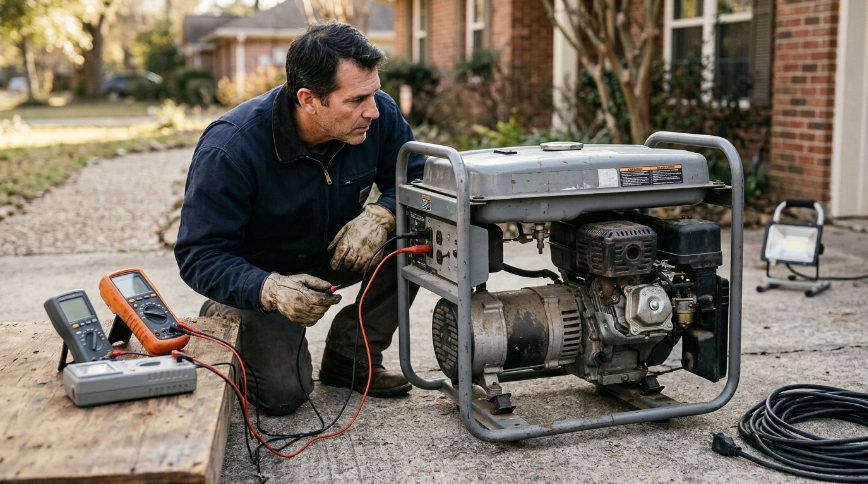
Listen to the engine first. Changing RPM usually points toward fuel, airflow, governor, ignition, or load problems, while a steady engine with unstable voltage suggests an electrical regulation fault.
On U.S. equipment rated for 120 volts and 60 Hz, readings should remain close to the manufacturer’s specified output. Large repeated swings deserve investigation.
| What You Notice | Most Likely Area | First Check |
|---|---|---|
| RPM rises and falls every few seconds | Fuel, carburetor, air leak, governor | Fresh fuel and no-load test |
| Surging improves with partial choke | Lean mixture | Carburetor, fuel flow, intake leaks |
| Engine is steady but lights brighten and dim | AVR, brushes, wiring, inverter | Measure outlet voltage |
| Frequency repeatedly moves away from 60 Hz | Engine speed or governor | Observe frequency and RPM behavior |
| Problem begins when a motor starts | Starting load or undersized generator | Disconnect loads and reconnect gradually |
You can compare your readings with my guide to portable generator frequency. Voltage behavior is covered separately in the portable generator voltage guide.
How Do You Fix a Portable Generator That Keeps Surging?
Start with simple fuel and load checks before touching the governor. This prevents unnecessary adjustments and often finds the problem within the first few steps.
- Disconnect all electrical loads. Start the generator outside and let it warm up according to its manual. If it still hunts with nothing connected, the load probably isn’t the main cause.
- Replace questionable gasoline. Drain stale or contaminated fuel safely and refill with fresh fuel that meets the engine manufacturer’s requirements.
- Check the fuel valve and line. Make sure the shutoff valve opens fully and inspect the line for kinks, cracking, leaks, or obvious restriction.
- Test the tank vent. Briefly loosen the fuel cap outdoors. A sudden improvement points toward a plugged or faulty vent.
- Inspect the air filter and choke. Replace or clean the filter as your manual specifies. Confirm the choke opens fully after the engine warms.
- Check the carburetor. Shut the engine off, let it cool, close the fuel valve, and inspect the bowl and jets for deposits. Follow the engine manufacturer’s cleaning procedure rather than pushing wire through precision jets.
- Inspect governor linkage. With the engine off, look for disconnected springs, bent linkage, binding, or debris. Don’t randomly stretch springs or change governed speed.
- Test again under a moderate load. Reconnect loads gradually and watch for the exact point where hunting begins.
I use that order because carburetors get blamed for everything. I’ve also seen generators run poorly because of something as simple as a tank that couldn’t vent.
Briggs & Stratton’s carburetor maintenance guidance also identifies dirt, varnish, and gasoline deposits as common sources of small-engine carburetor trouble.
Can a Generator Surge Because of Too Much Load?
Yes, especially when a large motor or compressor starts. A refrigerator, well pump, air conditioner, or power tool may briefly demand much more power during startup than during normal operation.
The generator’s governor responds by opening the throttle. A healthy unit should recover instead of continuing to oscillate.
- Surges only when one appliance starts: Check that appliance’s starting-watt requirement.
- Surges as several loads accumulate: Reduce the total load and compare it with the generator’s continuous rating.
- Surges even with no load: Focus on fuel, airflow, governor, or ignition instead.
- Engine stays smooth while voltage moves: Investigate voltage regulation rather than increasing engine speed.
Can a Bad Governor Cause Portable Generator Surging?
Yes. The governor keeps engine speed from falling when electrical demand increases and prevents excessive speed as demand drops. Binding linkage or a damaged spring can make those corrections unstable.
Inspect the linkage with the engine stopped. It should move freely without sticking, but exact spring position and adjustment depend on the engine model.
I don’t recommend changing governor spring tension just to “see what happens.” Incorrect governed speed can push generator frequency too high or too low.
If the mechanical speed sounds stable but electrical output still moves, use the portable generator AVR troubleshooting guide before changing the governor.
What If My Inverter Generator Surges in Eco Mode?
Some inverter generators intentionally change engine speed as electrical demand changes. A small RPM change when a load turns on isn’t necessarily a fault.
Repeated hunting with a constant load isn’t normal. Temporarily disabling economy mode, when your owner’s manual allows it, can help separate load-response behavior from a fuel or control problem.
- Smooth with Eco mode off: Check load type, throttle control, and Eco-control operation.
- Surges in both modes: Investigate fuel, airflow, intake leaks, and ignition.
- RPM sounds stable but power fluctuates: The inverter electronics or sensing system may need service.
When Should You Stop DIY Troubleshooting?
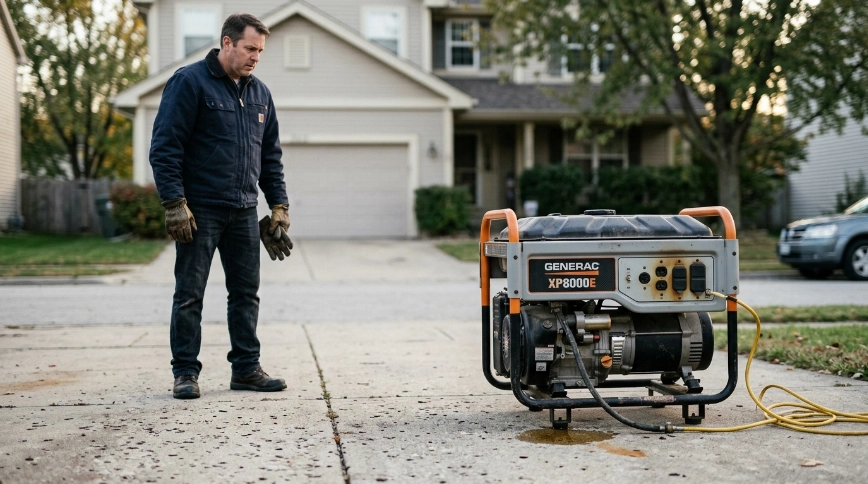
Stop using the generator when the problem involves dangerous voltage, overheating, fuel leaks, damaged wiring, or uncontrolled engine speed. Those symptoms go beyond routine cleaning and maintenance.
- Fuel dripping from the tank, carburetor, valve, or hose
- Burning insulation or an electrical burning smell
- Visible sparks, melted connectors, or scorched wiring
- Engine speed that rises uncontrollably
- Output voltage that climbs far above the generator’s rated value
- Surging that remains after fuel, airflow, and load checks
- Internal governor, alternator, or inverter repairs you’re not trained to perform
Run gasoline generators outdoors only. The U.S. Consumer Product Safety Commission recommends operating portable generators at least 20 feet from the home, with exhaust directed away from buildings.
For broader electrical and operating precautions, OSHA maintains portable generator safety resources. Never troubleshoot a fuel-burning generator inside a garage, shed, basement, or other enclosed space.
Tools and Products I Keep Around for Surging Problems
You usually don’t need expensive diagnostic equipment. These are the three products I’d keep available for the most common fuel and output checks.
🏆 Best for Prevention
STA-BIL Storage Fuel Stabilizer
★★★★½ 4.7/5
One ounce treats about 2.5 gallons, and the manufacturer rates it for protecting stored gasoline for up to 24 months. I prefer preventing varnish buildup instead of cleaning a neglected carburetor before every storm season.
🛠️ Best for Carb Cleaning
Gumout Small Engine Carb & Choke Cleaner
★★★★½ 4.5/5
This cleaner is designed to remove gum, varnish, and dirt from carburetor and choke components. I use cleaner only after shutting the engine down and following the carburetor manufacturer’s procedure.
⚡ Best Diagnostic Tool
Klein Tools MM325 Digital Multimeter
★★★★☆ 4.4/5
The MM325 measures AC/DC voltage up to 600 volts plus resistance, continuity, diodes, and batteries. I like a basic meter because it quickly shows whether the engine is hunting or the electrical output itself is unstable.
Frequently Asked Questions About Portable Generator Surging
Why does my generator surge with no load?
Surging with no load usually points away from overload and toward fuel delivery, a dirty carburetor, an intake leak, tank-vent restriction, choke trouble, or governor hunting. Start with fresh gasoline, inspect the air filter, and test whether loosening the fuel cap briefly changes the behavior.
Why does my generator stop surging when I use the choke?
If partial choke makes the engine run smoothly, the normal mixture is probably too lean. Common causes include a restricted carburetor jet, weak fuel flow, or an intake air leak. The choke test is a diagnostic clue, not a permanent fix.
Can bad gasoline make a portable generator surge?
Yes. Old gasoline can lose useful volatility and leave gum or varnish in small carburetor passages. Replace questionable fuel before making adjustments, because diagnosing a carburetor while feeding it poor fuel can send you in the wrong direction.
Can a bad spark plug cause generator surging?
A fouled, worn, incorrectly gapped, or damaged spark plug can cause intermittent combustion that feels like surging. However, rhythmic hunting that improves with choke more strongly suggests a fuel-mixture problem. Inspect the plug according to the engine manufacturer’s maintenance schedule.
Is it safe to run a generator while it is surging?
Don’t power sensitive electronics until you know the voltage and frequency are stable. Shut the generator down immediately if you notice uncontrolled RPM, excessive voltage, overheating, leaking fuel, burning smells, sparks, or damaged wiring.
Final Takeaway
When a portable generator surges, I start with fuel quality, tank venting, airflow, and the carburetor before touching the governor or electrical system. That order solves the common problems without creating new ones.
If the engine itself remains steady but the outlets don’t, change direction and troubleshoot voltage regulation instead. A few careful observations can save hours of unnecessary parts swapping.

Hi, I’m Michael Turner. I own a generator workshop in the United States and founded HomeGeneratorBlog to share practical, hands-on guidance about generator installation, maintenance, troubleshooting, safety, and backup power solutions. My goal is to help homeowners make smarter, more confident decisions through clear and reliable information