Is It Cheaper to Run Your Generator on Propane or Gas?
Quick Answer
Gasoline is usually cheaper to run in a portable generator when the two fuels have similar per-gallon prices. Propane contains less energy per gallon and many dual-fuel generators also produce slightly less power on propane. However, propane can be cheaper over long-term standby use because it stores well and avoids stale-gas fuel-system problems. See how each fuel reaches the engine in this portable generator fuel system guide.
The main cost differences
- Energy per gallon: Gasoline contains about 120,214 Btu per gallon versus about 91,452 Btu for propane.
- Break-even price: On energy content alone, propane needs to cost roughly 24% less per gallon to match gasoline.
- Generator output: Many dual-fuel models make fewer running watts on propane.
- Fuel storage: Propane is easier to keep ready for long periods without fuel stabilizer.
- Refill method: Propane cylinder exchanges may cost much more per gallon than bulk refills.
My simple rule
- Use gasoline when minimizing immediate fuel cost matters most. Choose propane when long storage life, cleaner fuel-system storage, and outage readiness matter more.
If you’re comparing propane and gasoline for backup power, don’t stop at the price posted on the pump. What matters is how much usable generator runtime and electrical output that money buys.
I compare the fuels three ways: cost per unit of energy, cost per hour in the actual generator, and the cost of storing fuel between outages. That gives a much more useful answer than simply asking which fuel costs less per gallon.
Why is gasoline usually cheaper than propane for a generator?
Gasoline usually has the advantage because each gallon contains more energy. That means an engine has more potential energy available before differences in engine efficiency are considered.
The U.S. Energy Information Administration lists about 120,214 Btu in a gallon of motor gasoline and 91,452 Btu in a gallon of propane. You can check the conversion figures on the EIA energy units and calculators page.
| Factor | Gasoline | Propane |
|---|---|---|
| Energy per gallon | About 120,214 Btu | About 91,452 Btu |
| Energy relative to gasoline | 100% | About 76% |
| Typical generator output | Full gasoline rating | Often somewhat lower |
| Long-term storage | Requires more management | Excellent |
| Fuel-system residue | Can leave deposits as fuel ages | No liquid gasoline left in carburetor |
Propane has roughly 76% of gasoline’s energy per gallon. On raw energy alone, propane therefore needs to cost about 76% of your gasoline price to break even.
For example, if gasoline costs $3.50 per gallon, the equivalent propane break-even price is about $2.66 per gallon. Above that level, gasoline has the lower raw fuel-energy cost.
How do I calculate whether propane or gasoline is cheaper?
The best calculation uses your local prices and your generator’s published runtime. Manufacturer runtime figures are more useful than generic national averages because generator size and load change consumption.
Start with these calculations:
- Gasoline cost per hour: gallons consumed ÷ runtime hours × gasoline price per gallon.
- Propane cost per hour: gallons consumed ÷ runtime hours × propane price per gallon.
- Cost per kWh: hourly fuel cost ÷ approximate electrical output in kilowatts.
A standard 20-pound propane cylinder holds roughly 4.6 to 4.7 gallons when filled to its normal capacity. Don’t assume the exchange price represents the same per-gallon cost as a refill station.
If you pay $22 for an exchange containing less propane than a full refill, your effective price per gallon can climb quickly. That’s one reason propane sometimes appears cheap until you calculate the actual fuel received.
A quick break-even formula
If you don’t have generator-specific runtime numbers, this shortcut gives you a useful starting point. Multiply your gasoline price by 0.76.
- If gas is $3.00 per gallon, propane’s energy break-even price is about $2.28.
- If gas is $3.50 per gallon, propane’s break-even price is about $2.66.
- If gas is $4.00 per gallon, propane’s break-even price is about $3.04.
- If gas is $4.50 per gallon, propane’s break-even price is about $3.42.
This isn’t a perfect generator efficiency calculation. It is a practical screening tool before you check the manufacturer’s runtime chart.
Does a generator use more propane than gasoline?
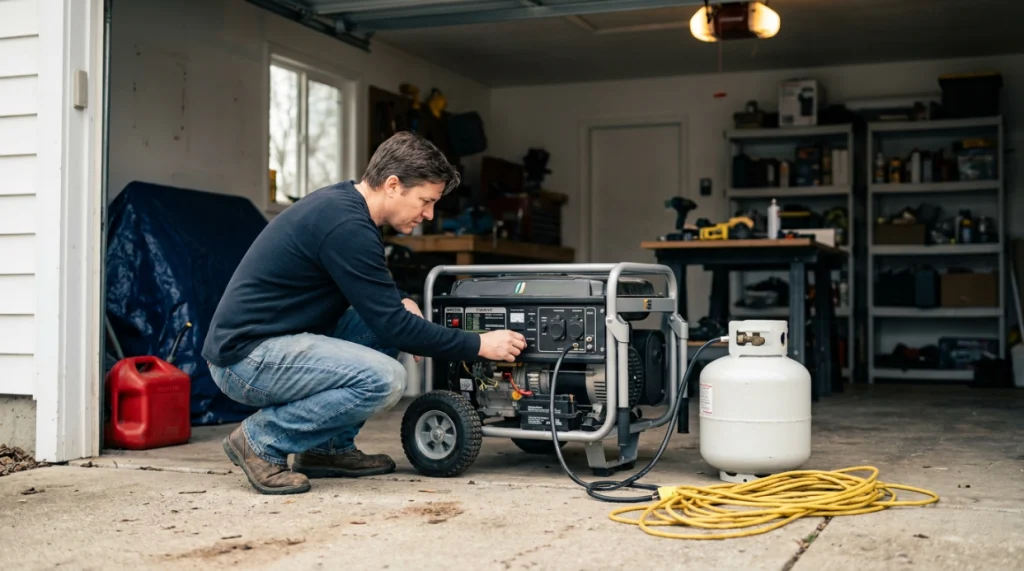
In many dual-fuel generators, yes, especially when you compare equivalent units of fuel. Propane contains less energy per gallon, and the generator may also be rated for fewer running watts on propane.
For example, Westinghouse rates its WGen9500DF at 9,500 running watts on gasoline and 8,500 running watts on propane. Champion’s 201183 inverter is rated at 1,850 gasoline running watts and 1,665 propane running watts.
- Gasoline advantage: More available energy and usually higher rated output.
- Propane advantage: Simple long-term fuel storage without gasoline sitting in the carburetor.
- Load matters: A generator powering 2,000 watts consumes far less than the same machine near maximum load.
If you want both fuels available, a dual-fuel portable generator lets you choose whichever fuel makes sense during that outage.
When can propane be cheaper overall?
Propane can win once you include storage losses, maintenance, and emergency availability. That’s especially true for a generator that may sit unused for months.
Gasoline’s biggest weakness isn’t combustion cost. It’s what can happen while the generator waits for the next outage.
- Stored fuel management: Gasoline needs more attention during long storage periods.
- Carburetor deposits: Aging gasoline can leave varnish and deposits in small fuel passages.
- Fuel rotation: Stored gasoline should be managed instead of forgotten for years.
- Emergency supply: Gas stations may be closed or unable to pump during widespread outages.
Propane doesn’t create the same stale-liquid-fuel problem inside the generator. That can make the propane generator option attractive for occasional emergency use.
My rule is simple. If the generator runs frequently, I focus heavily on fuel cost per hour.
If it spends most of the year waiting for an outage, I give storage reliability much more weight. Paying slightly more per operating hour can be reasonable if the fuel is ready when needed.
When does gasoline make more financial sense?
Gasoline makes the strongest case when the generator runs regularly and local gasoline is inexpensive. It also gives most dual-fuel machines their highest available wattage.
That matters if you’re close to your generator’s capacity. A machine rated at 9,500 watts on gasoline may lose hundreds of running watts when switched to propane.
- Frequent operation: Fuel doesn’t sit long enough to become a major storage concern.
- High electrical loads: The extra gasoline wattage can reduce the need to buy a larger generator.
- Easy fuel access: Nearby operating gas stations make refueling straightforward.
- Low local gas prices: The energy-per-gallon advantage becomes harder for propane to overcome.
A conventional gasoline portable generator can therefore be the lowest-cost choice for routine use.
What about runtime: propane vs. gasoline?
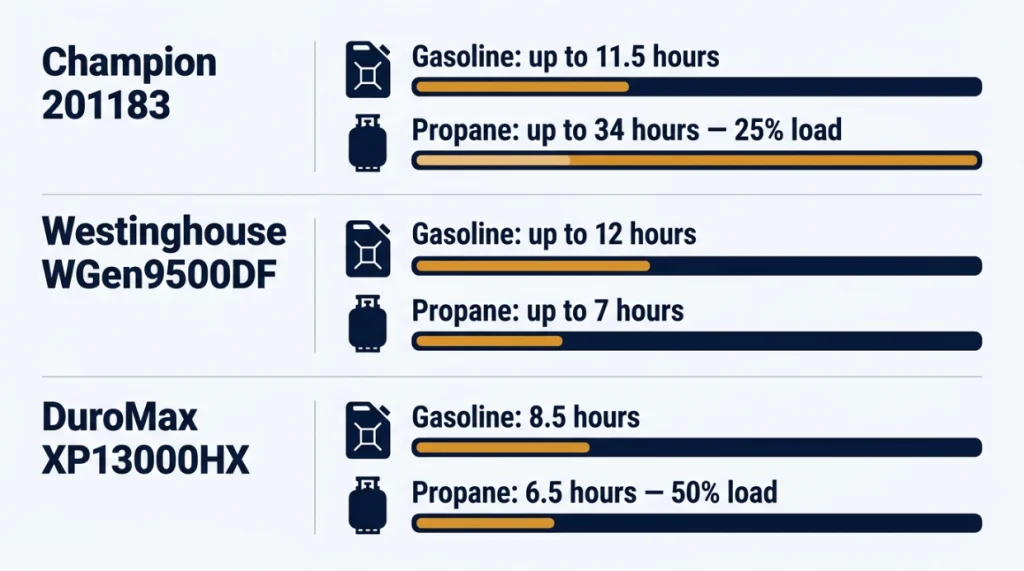
Don’t compare “one tank” with “one tank.” A built-in gasoline tank and a 20-pound propane cylinder hold different amounts of energy.
Use the manufacturer’s test load whenever possible. Runtime claims measured at 25% load should not be compared with numbers measured at 50% load.
| Generator | Gasoline output | Propane output | Published runtime example |
|---|---|---|---|
| Champion 201183 | 1,850 running watts | 1,665 running watts | Up to 11.5 hours gasoline or 34 hours on a 20-lb propane tank at 25% load |
| Westinghouse WGen9500DF | 9,500 running watts | 8,500 running watts | Up to 12 hours on its 6.6-gallon gasoline tank; up to 7 hours on a 20-lb propane tank |
| DuroMax XP13000HX | 10,500 running watts | 10,000 running watts | 8.5 hours gasoline and 6.5 hours propane at 50% load under the manufacturer’s listed conditions |
The examples show why there isn’t one universal propane-versus-gas runtime ratio. Tank size, generator design, load, temperature, and fuel system all affect the answer.
If you’d like the mechanical side of the comparison, this guide explains how a portable generator converts fuel into electricity.
Is propane better for storing emergency generator fuel?
Propane is usually the easier emergency fuel to keep ready for long periods. A properly maintained cylinder doesn’t have the same fuel-degradation issue as gasoline stored in a generator carburetor.
That doesn’t mean propane cylinders can be stored anywhere. Keep cylinders outside and follow local storage rules.
- Keep cylinders upright: Secure them against tipping.
- Avoid enclosed spaces: Don’t store portable propane cylinders inside living areas.
- Keep away from heat: Follow cylinder safety guidance and local codes.
- Inspect connections: Check the regulator, hose, and cylinder condition before use.
The Propane Education & Research Council provides additional portable propane cylinder safety guidance.
Which fuel should I use during an outage?
If both are available, choose based on price, expected outage length, load, and what you need to preserve for later. A dual-fuel generator gives you useful flexibility.
I like to think of gasoline as the high-output fuel and propane as the long-storage reserve. That approach also prevents you from relying on one supply chain during a major storm.
- Short outage: Gasoline is often the economical first choice.
- Long outage: Use whichever fuel you can replenish reliably.
- Maximum load: Check whether gasoline provides higher rated wattage.
- Stored backup: Propane is convenient to keep ready between emergencies.
Does propane burn cleaner enough to make it safe near the house?
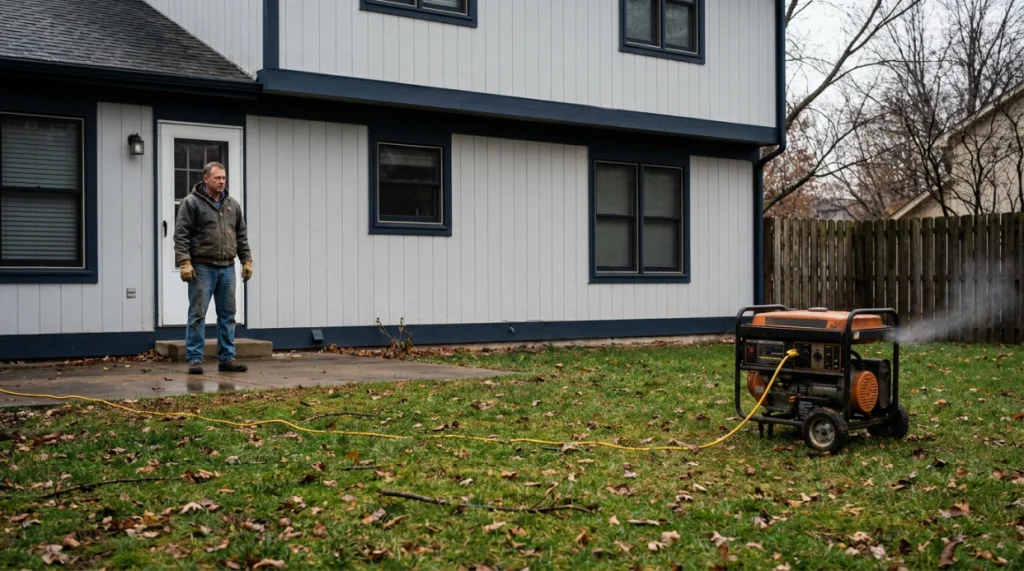
No. Propane generators still produce dangerous carbon monoxide. Fuel choice never makes a portable combustion generator safe indoors, in a garage, or close to doors and windows.
The U.S. Consumer Product Safety Commission says portable generators should operate outdoors, at least 20 feet from the home, with exhaust directed away. Review the CPSC carbon monoxide safety guidance before running any portable generator.
- Operate outdoors: Never run the unit in a house, garage, basement, crawlspace, or shed.
- Allow distance: Keep the generator at least 20 feet from occupied buildings.
- Point exhaust away: Keep fumes away from doors, windows, and vents.
- Use CO alarms: Maintain working carbon monoxide alarms inside the home.
- Cool before refueling: Never add gasoline to a hot or running generator.
My 2026 verdict: propane or gas, which is cheaper?
For pure operating fuel cost, gasoline usually wins unless propane is substantially cheaper per gallon. The raw energy break-even point puts propane at roughly 76% of the gasoline price.
But fuel cost isn’t the whole ownership cost. Propane’s long storage life can reduce wasted fuel and fuel-system headaches for a generator used only during occasional outages.
- Choose gasoline if you want the lowest likely cost per usable unit of energy and maximum generator output.
- Choose propane if dependable long-term storage matters more than squeezing out the lowest operating cost.
- Choose dual fuel if outage flexibility matters and you want to buy whichever fuel is cheaper or easier to find.
For most emergency-backup households, I prefer the flexibility of dual fuel. It lets the local fuel market make the decision instead of locking you into one option.
If you’re ready to choose a generator that can use both fuels, these are three useful configurations to compare.
🏆 Best compact inverter
Champion 201183 2500W Dual Fuel Inverter
★★★★½ 4.7/5
It delivers 1,850 gasoline running watts or 1,665 propane running watts and weighs about 39 pounds. I like this format for camping, electronics, refrigerators, and smaller emergency loads where portability matters more than whole-house output.
🏠 Best for home backup
Westinghouse WGen9500DFc
★★★★½ 4.8/5
This dual-fuel model provides 9,500 gasoline running watts and 8,500 propane running watts, plus transfer-switch-ready connections and a CO sensor. I’d shortlist it when refrigerators, pumps, lighting, and larger household loads need substantial backup capacity.
⚡ Best high-output option
DuroMax XP13000HX
★★★★½ 4.6/5
The XP13000HX offers 10,500 running watts on gasoline and 10,000 on propane, with 120/240-volt output and CO shutdown protection. I would consider it when larger motor loads make a mid-sized backup generator feel too close to its limit.
Frequently Asked Questions
Is it cheaper to run a generator on propane or gasoline?
Gasoline is usually cheaper when propane and gasoline have similar per-gallon prices because gasoline contains more energy per gallon. Propane can still be the better long-term value for occasional backup use because it stores well and doesn’t create the same stale-gasoline problems inside the fuel system.
How much cheaper does propane need to be than gas?
Based only on fuel energy content, propane needs to cost roughly 24% less per gallon than gasoline. Multiply your gasoline price by about 0.76 for a quick break-even estimate, then check your generator’s actual runtime specifications for a more accurate comparison.
Does a generator produce less power on propane?
Many dual-fuel generators do produce fewer running watts on propane. The exact difference varies by model. Always use the propane running-watt rating when sizing appliances instead of assuming the gasoline rating applies to both fuels.
Is propane better for a generator that sits unused?
Propane is convenient for standby storage because the fuel doesn’t degrade like gasoline sitting in a carburetor or fuel tank. You still need to inspect cylinders, hoses, regulators, oil, batteries, and the generator itself before emergency use.
Can I switch between gasoline and propane during an outage?
A dual-fuel generator is designed to operate on either fuel, but switching procedures vary by model. Follow the owner’s manual closely. Some units require shutdown before switching, while certain designs provide different fuel-change procedures.
Final Takeaway
If your only goal is the lowest fuel bill, start with gasoline and compare it against propane using local per-gallon prices. Propane usually needs a meaningful price discount to offset its lower energy content.
For emergency backup, though, I wouldn’t choose on fuel price alone. A dual-fuel generator gives you gasoline’s output and propane’s storage convenience, which can be worth more than a small difference in hourly operating cost when the power is already out.

Hi, I’m Michael Turner. I own a generator workshop in the United States and founded HomeGeneratorBlog to share practical, hands-on guidance about generator installation, maintenance, troubleshooting, safety, and backup power solutions. My goal is to help homeowners make smarter, more confident decisions through clear and reliable information