10 Best Portable Generator for Off Grid in 2026: Quiet, Fuel-Smart Picks
The 10 best portable generator for off grid list starts with the Honda EU7000iS, WEN 56203i, and EcoFlow DELTA Pro 3. We evaluated 10 generators and power stations by comparing manufacturer specifications and retailer data, scoring each on Off-Grid Runtime, Portability, and Noise Comfort. Most models look alike on paper but fail off-grid on fuel, noise, or weight, and this comparison targets that gap. Whether you need cabin backup, silent solar power, or a budget camp unit, this guide has one answer.
5.1-gal tank
About 39 lb
2,600W solar input
Quick Comparison: All 10 Products at a Glance
| # | Product | Best For | Rating | Badge | |
|---|---|---|---|---|---|
| 1 | Honda EU7000iS | Permanent off-grid cabins and home backup | 4.8/5 | Best Overall | Buy → |
| 2 | WEN 56203i | Budget camp setups and light cabin loads | 4.3/5 | Best Budget | Buy → |
| 3 | EcoFlow DELTA Pro 3 | Silent, fuel-free cabin and home backup | 4.7/5 | Best Silent Power | Buy → |
| 4 | Westinghouse iGen4500 | RVs and mid-size cabin power | 4.5/5 | Best Mid-Size Inverter | Buy → |
| 5 | Champion 100263 | Fuel-flexible RV and cabin power | 4.4/5 | Best Dual Fuel | Buy → |
| 6 | DuroMax XP13000EH | Homesteads with heavy electrical loads | 4.2/5 | Best High Output | Buy → |
| 7 | Honda EU2200i | Backcountry camping and van life | 4.5/5 | Best Lightweight | Buy → |
| 8 | BLUETTI AC200L | Growing cabin solar systems | 4.5/5 | Best Cabin Solar Setup | Buy → |
| 9 | Jackery Explorer 1000 v2 | Weekend camping and van trips | 4.4/5 | Best Compact Station | Buy → |
| 10 | Anker SOLIX C1000 Gen 2 | Quick top-ups between sunny gaps | 4.5/5 | Best Fast Recharge | Buy → |
How We Chose These Generators
What we compared
10 products: 6 gas and dual-fuel generators and 4 LiFePO4 power stations, covering 1,024Wh to 13,000-watt classes.
Our 3 scoring criteria
Off-Grid Runtime, Portability, and Noise Comfort, each scored out of 5 from published specifications. The overall rating weighs real-world off-grid usefulness.
Sources we used
Manufacturer spec sheets from Honda, Westinghouse, Champion, DuroMax, EcoFlow, BLUETTI, Jackery, and Anker, plus retailer listings. We did not run lab tests.
What we cut and why
We left out ultra-compact power banks and any model without published wattage and runtime figures, since neither can be compared fairly off-grid.
What to Look for When Buying a Portable Generator for Off-Grid Use
Off-grid buying fails when the generator matches a spec sheet instead of your daily routine. These four factors decide whether a model works at a remote cabin, camp, or homestead.
1. Power Needs and Wattage
List every device you will run at once and add their running watts. Motors, pumps, and compressors also need a surge, which is why running watts versus starting watts matters more than the headline number on the box. A small cabin with lights, a fridge, and electronics often fits a 2,000 to 3,500-watt unit.
2. Fuel Type and Refueling
Gasoline is easy to find but goes stale in storage, propane keeps for years, and solar needs no delivery at all. If you want flexibility, learn how dual-fuel generators work before choosing between gas and propane models. Battery stations remove refueling entirely but depend on sun hours and panel size.
3. Noise and Safe Placement
Inverter generators run in the 48 to 59 dBA range at light loads, open-frame models run much louder, and battery stations are nearly silent. Any engine-driven unit must sit outdoors and away from windows, so review portable generator carbon monoxide safety before you place one near a cabin.
4. Weight, Runtime, and Lifespan
Weight ranges from about 24 pounds for compact stations to 261 pounds for the Honda EU7000iS, so decide whether it stays put or travels. Check runtime at 25 and 50 percent load, not only the best-case figure. For long-term value, read about how long portable generators last and plan on routine oil changes for gas models.
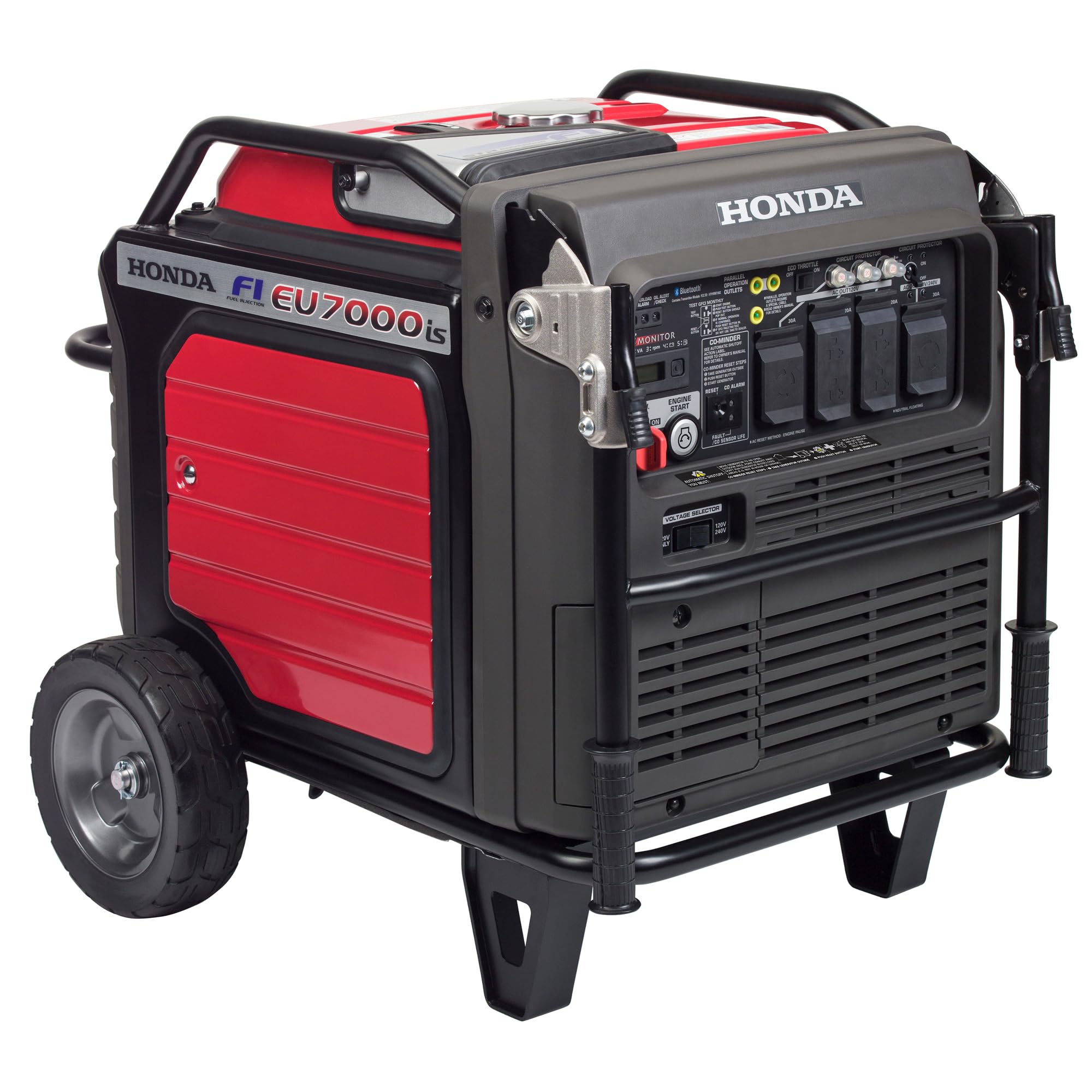
Honda EU7000iS 7000-Watt Inverter Generator — Quiet, efficient power for permanent cabins
Best for: Permanent off-grid cabins and home backup
Remote cabins and off-grid homes need a generator that starts every time and runs for days on a few tanks. The Honda EU7000iS delivers 5,500 running watts at 120/240V from a fuel-injected GX390 engine, enough to operate a well pump, refrigerator, and furnace fan. A 5.1-gallon tank lasts up to 18 hours at quarter load, and noise stays between 52 and 58 dBA. The trade-off is weight: at 261 pounds, it is a wheeled fixture rather than something you carry. Skip it for backpacking or truck-bed camping, and choose it for permanent off-grid power.
- 5,500 running watts at 120/240V
- Up to 18 hours per 5.1-gallon tank
- Quiet: 52 to 58 dBA
- Electric start with fuel-injected engine
- 261 pounds, wheeled use only
- Premium-priced versus similar wattage
4.9/5
2.6/5
4.5/5

WEN 56203i 2000-Watt Portable Inverter Generator — Budget-friendly inverter power you can carry
Best for: Budget camp setups and light cabin loads
Off-grid beginners often need basic power for lights, a laptop, and a small fridge without overspending. The WEN 56203i gives 1,700 running watts in a package weighing roughly 39 pounds, which makes it the easiest model here to carry into a campsite or load into a truck. Its one-gallon tank runs up to 10.8 hours at quarter load, and a fuel shutoff helps protect the carburetor between trips. Total harmonic distortion stays under 1.2 percent at full load. Output is limited, so air conditioners and well pumps are out of reach unless you buy a second unit and a parallel kit.
- 1,700 running watts at roughly 39 pounds
- Up to 10.8 hours at quarter load
- Fuel shutoff protects the carburetor
- Budget-friendly entry into inverter power
- Cannot start air conditioners or pumps alone
- Parallel kit sold separately
3.4/5
4.8/5
4.2/5

EcoFlow DELTA Pro 3 Portable Power Station — Fuel-free 4,000W power with silent operation
Best for: Silent, fuel-free cabin and home backup
Quiet cabins and van setups often cannot tolerate engine noise or exhaust. The EcoFlow DELTA Pro 3 stores 4,096Wh in a LiFePO4 battery and delivers 4,000W continuous, with 6,000W available through X-Boost for resistive loads. Solar input reaches 2,600W across two ports, so sunny days can refill it without any fuel run. Retailer specifications list operation near 30 dB below 2,000W. The catch is weight and capacity: at 113.5 pounds it is heavy for a battery, and a long cloudy week will drain it faster than a fuel tank would.
- 4,096Wh capacity, 4,000W continuous output
- No fuel, no exhaust, no engine
- Up to 2,600W solar input
- Expandable with Smart Extra Batteries
- 113.5 pounds, heavy for a battery
- Cloudy weeks demand a backup charger
4.5/5
2.8/5
5.0/5

Westinghouse iGen4500 Inverter Generator — Strong mid-size inverter with remote start
Best for: RVs and mid-size cabin power
Weekend cabins and RVs often need more than a 2,000-watt unit but less than a 260-pound machine. The Westinghouse iGen4500 produces 3,700 running watts, enough for a refrigerator and small appliances at once, and includes a TT-30R RV outlet. Its 3.4-gallon tank runs up to 18 hours at quarter load, and noise starts as low as 52 dBA. A key-fob remote start is handy in cold weather. The unit weighs about 105 pounds, so lifting it into a truck takes two people, and the standard model runs on gasoline only.
- 3,700 running watts with RV-ready outlet
- Remote, electric, and recoil starting
- Noise as low as 52 dBA
- LED display shows runtime and fuel
- About 105 pounds, awkward to lift
- Gasoline only in standard model
4.5/5
3.6/5
4.4/5

Champion 100263 3400-Watt Dual Fuel Inverter Generator — Dual-fuel flexibility in a quiet inverter
Best for: Fuel-flexible RV and cabin power
Off-grid power gets harder when gasoline is scarce or stale. The Champion 100263 runs on either gasoline or propane, so a stored propane cylinder can keep it going when the gas can runs dry. It makes 3,100 running watts on gasoline, includes electric start, and runs at 59 dBA. A 1.6-gallon tank gives about 7.5 hours at quarter load, which is shorter than larger inverters. Propane output drops somewhat compared with gasoline, and at roughly 96 pounds it is manageable on its wheels but awkward to lift into a vehicle.
- Runs on gasoline or propane
- 3,100 running watts on gasoline
- Electric start with RV-ready outlet
- Parallel-ready for added output
- Small tank: 7.5 hours at 25%
- Lower output on propane
3.8/5
3.9/5
4.0/5

DuroMax XP13000EH 13,000-Watt Dual Fuel Generator — Maximum wattage for heavy off-grid loads
Best for: Homesteads with heavy electrical loads
Off-grid homesteads with a well pump, welder, or central air need serious wattage. The DuroMax XP13000EH delivers 10,500 running watts on gasoline and 9,975 on propane, so a large propane cylinder can replace gas runs. Its 8.3-gallon tank gives about 8 hours at half load and 17 hours at quarter load. This is an open-frame design, so expect far more noise than an inverter model and less refined power for sensitive electronics. At 234 pounds dry, it stays where you put it, and fuel consumption is much higher than smaller units.
- 10,500 running watts at 120/240V
- Runs on gasoline or propane
- Up to 17 hours at quarter load
- Electric start, propane hose included
- Open-frame design is loud
- 234 pounds dry, needs space
- Thirsty at heavy loads
4.7/5
1.8/5
2.4/5
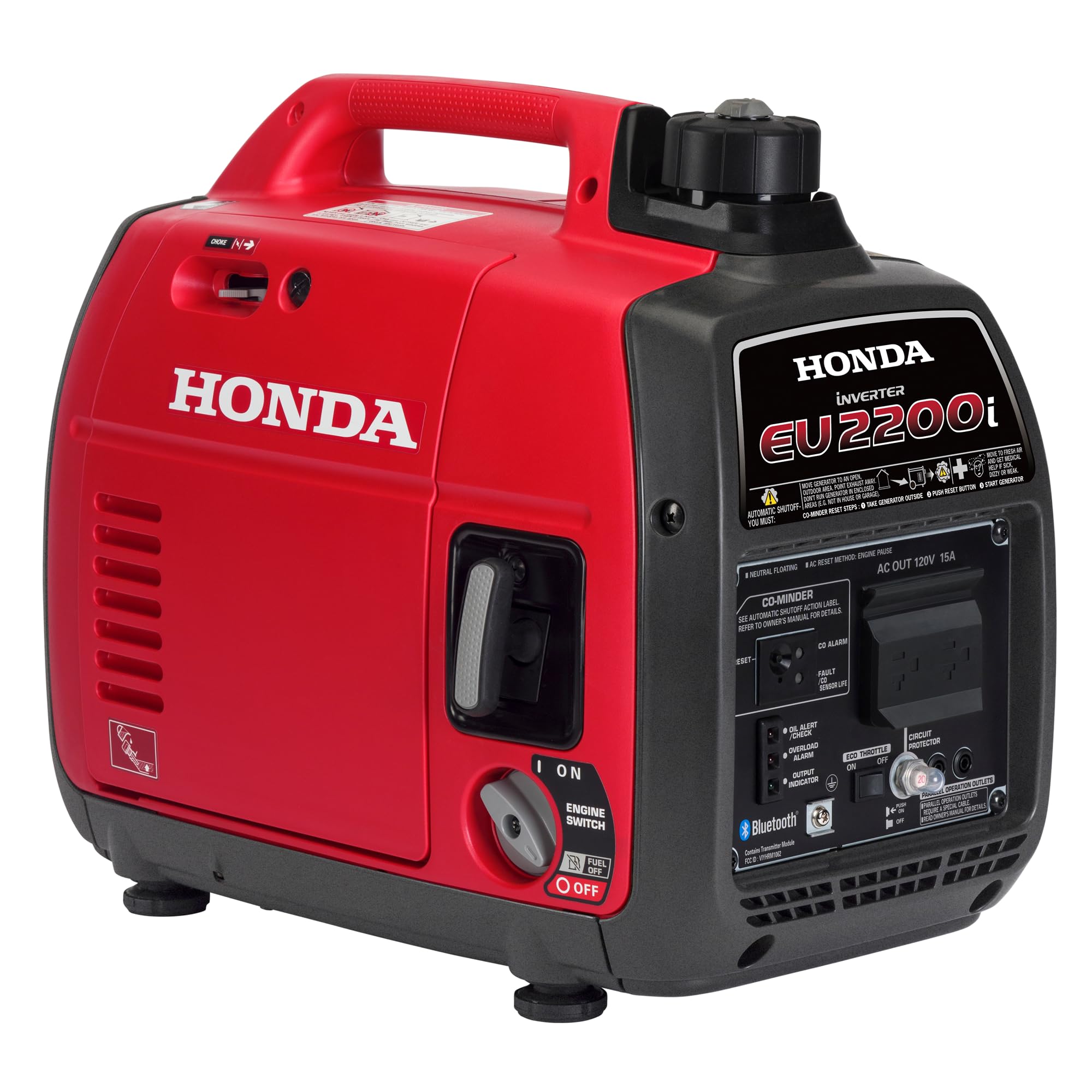
Honda EU2200i 2200-Watt Inverter Generator — Whisper-quiet power at 46.5 pounds
Best for: Backcountry camping and van life
Backpackers, hunters, and van lifers need power they can lift with one hand. The Honda EU2200i weighs 46.5 pounds, produces 1,800 running watts, and runs between 3.2 and 8.1 hours on its 0.95-gallon tank depending on load. Noise sits between 48 and 57 dBA, among the lowest figures for gas models in this roundup. A parallel cable lets two units reach 3,600 rated watts. The compromise is capacity: it cannot run most air conditioners or well pumps alone, and the small tank means refueling every night during extended trips.
- Easy to carry at 46.5 pounds
- Quiet: 48 to 57 dBA
- Parallel with second unit for 3,600W
- Fuel shutoff valve included
- Small 0.95-gallon tank needs frequent refills
- Premium-priced for only 1,800 watts
3.2/5
4.9/5
4.9/5

BLUETTI AC200L Portable Power Station — Expandable solar storage for cabins
Best for: Growing cabin solar systems
Cabin owners who want a growing solar system need a station that can expand later. The BLUETTI AC200L stores 2,048Wh and delivers 2,400W through pure sine wave outlets, enough to run a refrigerator, lights, and a laptop together. Solar input reaches 1,200W, and compatible expansion batteries add capacity over time. Its LiFePO4 cells are rated for 3,000 cycles to 80 percent, and an app tracks power flow from your phone. At 62.4 pounds it is awkward to carry far, and 2,048Wh will not run an electric heater or air conditioner for long.
- 2,400W output from a 2,048Wh battery
- Up to 1,200W solar input
- Expandable with compatible batteries
- App control via WiFi and Bluetooth
- 62.4 pounds, heavy for carrying
- Capacity limits heater or AC use
4.1/5
2.9/5
5.0/5

Jackery Explorer 1000 v2 Portable Power Station — Light, quiet power for short trips
Best for: Weekend camping and van trips
Weekend campers and van owners want clean power without fuel, fumes, or noise. The Jackery Explorer 1000 v2 packs 1,070Wh and 1,500W of pure sine wave output into a 23.8-pound LiFePO4 unit. It recharges from a wall outlet in about 1.7 hours and accepts up to 400W of solar. That is enough for laptops, lights, a small fridge, and a coffee maker for short stretches. The limit is energy: 1,070Wh is modest, so full-time off-grid living requires a much larger battery or a fuel generator as backup.
- Light at 23.8 pounds
- 1,500W output, 3,000W surge
- Recharges in about 1.7 hours
- Silent, no fuel or exhaust
- 1,070Wh runs out fast with appliances
- 400W solar limit slows recharging
3.0/5
4.8/5
5.0/5
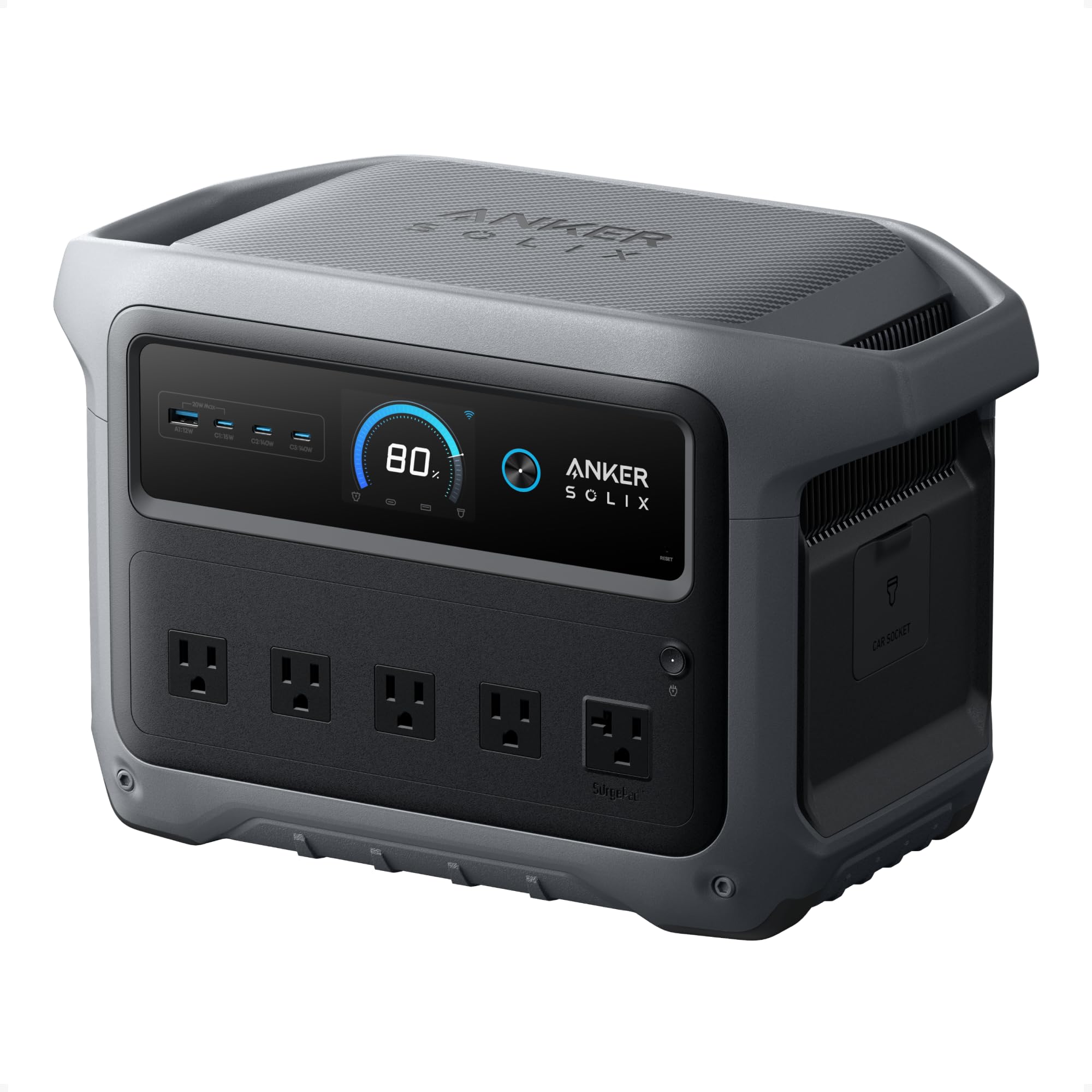
Anker SOLIX C1000 Gen 2 Portable Power Station — Fast-charging power for sun-limited sites
Best for: Quick top-ups between sunny gaps
Off-grid users with limited sun need to refill a battery quickly. The Anker SOLIX C1000 Gen 2 accepts up to 600W of solar and recharges from a wall outlet in about 49 minutes using HyperFlash mode, which pairs well with a small generator for quick top-ups. It delivers 2,000W continuous from a 1,024Wh LiFePO4 battery and weighs 24.9 pounds, light enough for one person to carry. Capacity is its limit: it will not carry a full off-grid household, and the fast-charge mode must be enabled through the app before it works.
- Up to 600W solar input
- 49-minute wall charging with HyperFlash
- 2,000W continuous, 3,000W peak
- Quiet: below 20 dB at light loads
- 1,024Wh limits appliance runtime
- Fast charging needs app setup
3.1/5
4.7/5
5.0/5
Top 3 Head-to-Head: Honda EU7000iS vs WEN 56203i vs EcoFlow DELTA Pro 3
These three are the common final choices because they cover the three main off-grid strategies: heavy-duty gas power, lightweight budget gas power, and silent battery power with solar.
| Feature | #1 Honda EU7000iS | #2 WEN 56203i | #3 EcoFlow DELTA Pro 3 |
|---|---|---|---|
| Running output | 5,500W — Best | 1,700W | 4,000W |
| Weight | 261 lb | About 39 lb — Best | 113.5 lb |
| Noise | 52 to 58 dBA | Quiet inverter design | About 30 dB under 2,000W — Best |
| Choose if… | You want permanent cabin power | You need light, budget power | You want silent, fuel-free power |
Who These Generators Are NOT For
No single product fits every off-grid situation, so check these exclusions before you buy.
If you plan to carry power on foot, only the Honda EU2200i, WEN 56203i, and the two roughly 24-pound stations are realistic, because every other pick weighs 62 pounds or more. If you want zero maintenance, skip the gas models, which need oil changes and fresh fuel, and choose a battery station.
Common Mistakes to Avoid
These four errors account for most off-grid power regrets.
Frequently Asked Questions About Off-Grid Portable Generators
What size generator do I need for off-grid living?
Add the running watts of everything you want to use at the same time, then allow extra for motor surges. A small cabin with lights, a refrigerator, and electronics often needs 2,000 to 3,500 running watts. Larger homesteads with a well pump or heating loads may need 5,500 watts or more, which points to models like the Honda EU7000iS.
Are solar generators better than gas generators for off-grid use?
Neither is better in every case. Solar power stations are silent, fume-free, and need no fuel, but their energy is limited by battery size and sun hours. Gas and propane generators deliver long runtime and high output on demand, but they are louder and need fuel and maintenance. Many off-grid users combine a battery station with a generator for backup.
Can you live off the grid with a portable generator?
Yes, but a portable generator works best as part of a system rather than the only power source. Running a generator all day is loud and fuel-intensive, so many people use it to charge batteries or cover peak loads. Larger models like the DuroMax XP13000EH can support a homestead, while smaller units suit cabins and camps.
How many watts do you need to live off the grid?
It depends on your appliances and habits. Essentials like lights, a refrigerator, a laptop, and a water pump often total 1,500 to 3,000 running watts at peak, though daily energy use in watt-hours matters more for battery systems. Heating, cooling, and cooking with electricity raise the requirement sharply, so list your loads before choosing.
How long do portable generators last?
Lifespan depends on build quality, load, and maintenance. Well-maintained inverter generators from established brands commonly serve for many years, while budget open-frame models tend to wear faster under heavy use. Regular oil changes, fresh fuel, and avoiding constant overload extend life. LiFePO4 power stations are rated for thousands of charge cycles, such as 4,000 for the EcoFlow DELTA Pro 3.
What is the quietest portable generator for off-grid use?
Battery power stations are the quietest because they have no engine. Among gas models in this guide, the Honda EU2200i is rated between 48 and 57 dBA and the Honda EU7000iS between 52 and 58 dBA. Open-frame generators such as the DuroMax XP13000EH are noticeably louder, so place them farther from sleeping areas.
Our Final Verdict
Gas inverters still win for long, high-load stays, while battery stations win for quiet, fume-free nights and lighter loads. The Honda EU7000iS is the strongest all-round choice for permanent cabins. If noise and exhaust matter more than runtime, pair the EcoFlow DELTA Pro 3 with solar panels.

Hi, I’m Michael Turner. I own a generator workshop in the United States and founded HomeGeneratorBlog to share practical, hands-on guidance about generator installation, maintenance, troubleshooting, safety, and backup power solutions. My goal is to help homeowners make smarter, more confident decisions through clear and reliable information