
Running Watts vs. Starting Watts: What Actually Matters
Quick answer: Running watts are the steady power a device needs once it’s already on. Starting watts (also called surge or peak watts) are the short, extra burst — often 2 to 3 times higher — needed to get a motor moving. Your generator’s running wattage must cover every device at once; its starting wattage only has to cover the single largest surge, since motors rarely all kick on at the exact same second.
If you’ve ever watched a portable generator’s display flash a warning and shut down the instant a fridge compressor kicked on, you’ve already met the gap between these two numbers the hard way. Here’s exactly what they mean, how to calculate both, and how to size a generator so it never happens again.
What Are Running Watts?
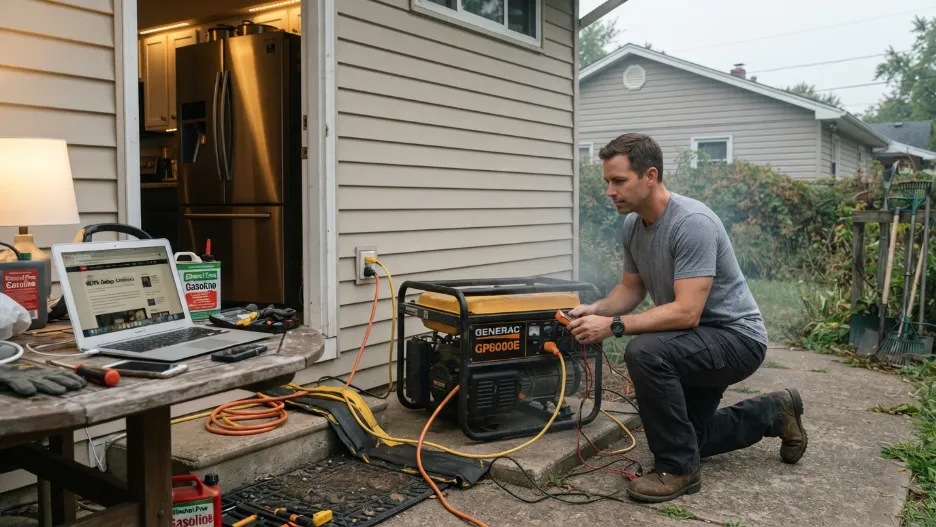
Running watts — sometimes labeled “rated watts” on a generator’s spec plate — are the continuous power draw a device needs to keep operating. A refrigerator humming along, a string of LED bulbs, a laptop charger: all of these pull a fairly flat, predictable number of watts hour after hour. This is the figure you add up across every device you plan to run at the same time, and it’s the number that determines your generator’s rated (continuous) output capacity.
What Are Starting Watts?
Starting watts are the brief power spike a motor-driven appliance needs to overcome its own inertia and get spinning. Refrigerators, sump pumps, well pumps, air conditioners, and power tools all have an electric motor inside, and that motor pulls far more current in the first fraction of a second than it does once it’s up to speed.
A window air conditioner rated at 1,000 running watts might spike to 2,200–3,000 watts for a second or two at startup. That surge is usually called starting, surge, or peak watts interchangeably — they’re the same thing.
Why This Trips Up First-Time Generator Buyers
The first time I ran a well pump off a 4,000-watt open-frame unit during an ice storm, the breaker on the generator tripped every single time the pump cycled on — even though the pump’s running load was well under the generator’s limit. It wasn’t underpowered for the job; it just couldn’t cover that half-second surge. Swapping to a generator with a higher surge rating, not a higher running rating, fixed it completely.
That’s the mistake almost every new buyer makes: they compare a generator’s running watts to the total running watts of their appliances and stop there. Ignore the surge number, and the first motor you switch on can shut the whole unit down.
Wattage Calculator: Running + Starting Watts for Common Outage Appliances
Use this as a starting worksheet, not gospel — check the nameplate or manual on your specific appliance, since wattage varies by model and size.
| Appliance | Running Watts | Starting Watts |
|---|---|---|
| Refrigerator/freezer (standard) | 150–400 | 800–1,200 |
| Chest freezer | 150–300 | 700–1,000 |
| Sump pump (1/3 HP) | 800–1,050 | 1,300–2,150 |
| Well pump (1/2 HP) | 1,000–1,500 | 2,000–3,500 |
| Window AC (8,000 BTU) | 700–1,200 | 1,800–2,200 |
| Central AC (2-ton/24,000 BTU) | 3,500–5,000 | 7,000–10,000 |
| Furnace fan blower (gas furnace) | 300–800 | 1,000–2,350 |
| Microwave | 600–1,500 | 0 |
| Coffee maker | 600–1,200 | 0 |
| Space heater (1500W) | 1,500 | 0 |
| Hair dryer | 1,200–1,800 | 0 |
| Washing machine | 350–500 | 2,000–2,300 |
| Electric clothes dryer | 4,000–6,000 | 0 |
| Garage door opener | 500–600 | 800–1,400 |
| TV, router, and laptop (combined) | 150–300 | 0 |
| LED lighting (whole house) | 100–300 | 0 |
Notice the pattern: anything with a heating element or a simple electronic circuit — microwave, toaster, hair dryer, TV — has no real surge at all. Anything with a motor or compressor does.
Worked Example: Sizing for a Real Five-Day Outage
Say you’re powering a fridge, a sump pump, a furnace blower, some LED lighting, and a microwave during a winter outage. Here’s the math:
- Running watts total: 400 (fridge) + 1,050 (sump pump) + 800 (furnace fan) + 200 (lights) + 1,000 (microwave) = 3,450 running watts
- Highest single starting watt figure: sump pump at 2,150 watts
- Total required capacity: 3,450 running watts + 2,150 starting watts = 5,600 watts (you don’t add every appliance’s starting watts — only the single largest one, since it’s rare for two motors to surge in the same instant)
That’s comfortably inside the range of a common 7,500-watt dual-fuel portable generator, which typically gives you 6,000+ running watts and 9,000+ surge watts of headroom for a scenario like this one. If you’re not sure whether your setup calls for a dual-fuel unit or a straight gasoline model, that’s worth working out before you buy, since it changes your available runtime and fuel logistics during a multi-day outage.
The 20–25% Safety Margin
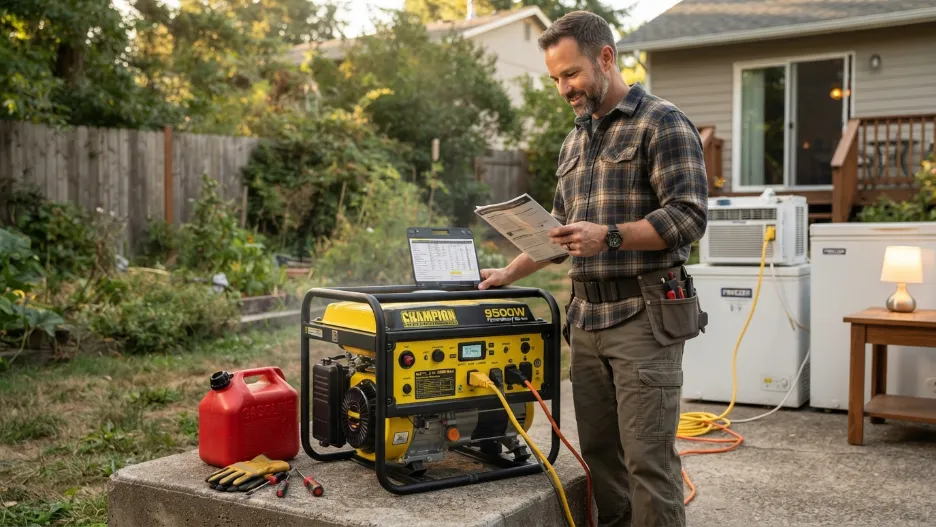
Don’t buy a generator sized exactly to your calculated total. Build in a 20–25% cushion above your combined running-plus-starting figure. In the example above, 5,600 watts becomes a real-world target closer to 6,700–7,000 watts. That margin absorbs voltage sag, an aging appliance that draws slightly more than its nameplate says, and the wear that comes from constantly running a generator at its ceiling. For a deeper walkthrough on matching total capacity to your home’s full circuit list, see our full guide on what size generator you need for your home.
How to Read the Numbers on the Generator Itself
The confusion doesn’t stop at appliances — generators carry the same two numbers, and manufacturers don’t always make it obvious which one is being advertised in bold on the box. A generator’s rated (running) watts is what it can supply continuously and safely for hours. Its surge (starting) watts is a short burst — usually a few seconds, sometimes up to 30 — that it can produce without stalling or tripping its own breaker. Every spec sheet should list both. If a listing only shows one big number, assume it’s the surge figure, since that’s the more flattering one to advertise. Our guide to portable generator wattage breaks down how to compare these figures across brands.
Does an Inverter Generator Change the Math?
Not the watts themselves, but it changes how forgiving the generator is. Inverter models produce cleaner power with lower total harmonic distortion (THD), and many pair that with electronics that manage the surge more smoothly than a conventional open-frame unit. Some newer units also support a soft-start feature — either built in or added via an external soft-start device — that spreads a motor’s surge out over a second or two instead of delivering it all at once, effectively lowering the starting-watt demand a generator has to meet. If you’re weighing the two types for a house with a well pump or central AC, our inverter generator buying guide covers where that extra cost is worth it and where it isn’t. It’s also worth a look if you’re specifically trying to size for running a central or window air conditioner, since AC compressors are one of the toughest starting-watt loads a portable generator faces.
No Wattage Listed? Use the Amps × Volts Formula
Plenty of older appliances only list amps and volts on the nameplate, not watts. The fix is simple: watts equals amps multiplied by volts. A well pump rated at 12.5 amps on a 120-volt circuit draws roughly 1,500 running watts. For three-phase equipment (rare in a home, common on job sites), multiply amps × volts × 1.73 instead.
This only gets you the running figure, though. If the nameplate doesn’t list a separate locked-rotor or starting-amp rating, fall back on the 2–3x rule for anything with a visible motor or compressor, and treat purely resistive loads — heaters, toasters, incandescent bulbs — as having no meaningful surge at all.
Can You Boost Starting Watts Without Buying a Bigger Generator?
Sometimes, yes. Two options come up often enough to be worth knowing before you shop for a second, larger unit:
- Soft-start devices: A small add-on module wired into a compressor-driven appliance — most commonly a central AC unit — that stretches the motor’s surge over a second or two instead of delivering it as one spike. This can cut the effective starting-watt demand by 60–80% on the appliance it’s installed on, which is often the difference between needing a 5,000-watt unit and a 10,000-watt one.
- Parallel capability: Many inverter generators can be linked to a matching second unit through a parallel kit, combining both machines’ running and surge output into a single connection. This is a common workaround for buyers who already own one portable inverter generator and don’t want to sell it to upgrade — instead, they add a second identical unit and run them together.
Neither option changes the physics of what a motor needs to start. They just change where that demand gets absorbed — either at the appliance, or by combining more generator capacity.
What Happens If You Ignore Starting Watts?
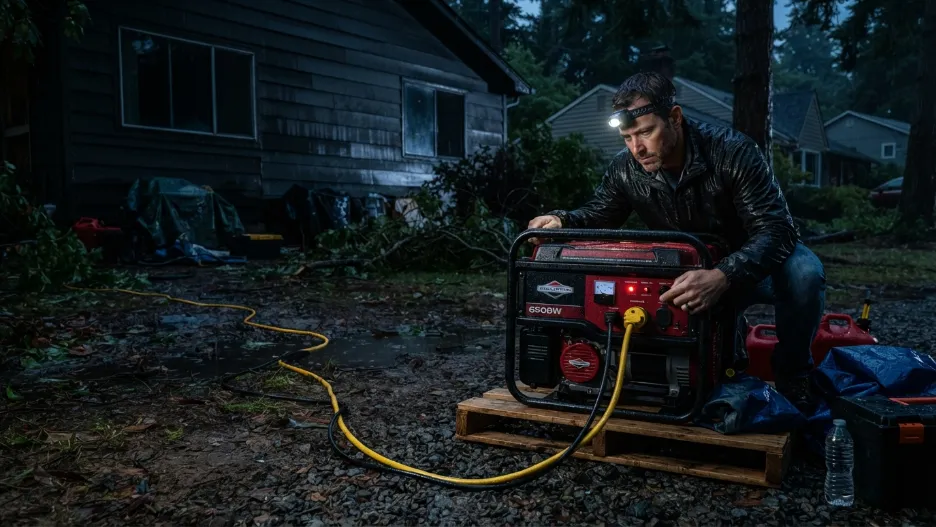
Best case, the generator’s breaker trips and you reset it. Worse case, an underrated unit strains to meet the surge, the voltage sags hard, and you damage the motor windings in the appliance itself — a real repair bill, not just an inconvenience. Repeated overload cycles also shorten the generator’s own alternator life. None of this involves carbon monoxide risk directly, but it’s worth saying plainly since it comes up in the same breath: run any gasoline or dual-fuel generator outdoors only, well away from windows and doors. The CDC’s generator safety fact sheet has the full placement guidance, and it’s a good five-minute read before your first outage, not during one.
Conclusion
Running watts tell you what a generator can sustain; starting watts tell you what it can survive for a second or two without quitting. Size for both, add your safety margin, and check the single highest surge figure among your motors rather than adding every one together. Get that right once, and you won’t be standing outside in a storm resetting a breaker. — Michael Turner
If you’re shopping with these numbers in hand, a dual-fuel portable generator in the 7,500–9,000 running-watt class gives most homes enough running and starting headroom to cover a fridge, sump pump, and furnace blower at once, with room to spare.
FAQ
Is starting watts the same as surge watts?
Yes. Starting watts, surge watts, and peak watts all describe the same brief power spike a motor needs when it first switches on. Manufacturers use the three terms interchangeably.
Do I add up starting watts for every appliance?
No. Add up running watts for everything you’ll use at once, then add only the single highest starting-watt figure among your motor-driven devices, since motors rarely surge at the exact same instant.
Can a generator run below its starting watt rating long-term?
Yes — the starting watt rating is a ceiling for a brief surge, not a number the generator runs at continuously. Once a motor is up to speed, the load drops back down to its running watts.
What size generator do I need if I don’t know my appliances’ starting watts?
Estimate motor-driven appliances at 2–3 times their running watts and non-motor appliances (heaters, electronics, lighting) at their running watts with no added surge, then apply a 20–25% safety margin on top.
Why did my generator shut off even though it wasn’t near its rated running wattage?
This is almost always a starting-watt overload — a single motor’s surge exceeded the generator’s peak capacity, even though the sustained load was well within its running rating.


10 Comments